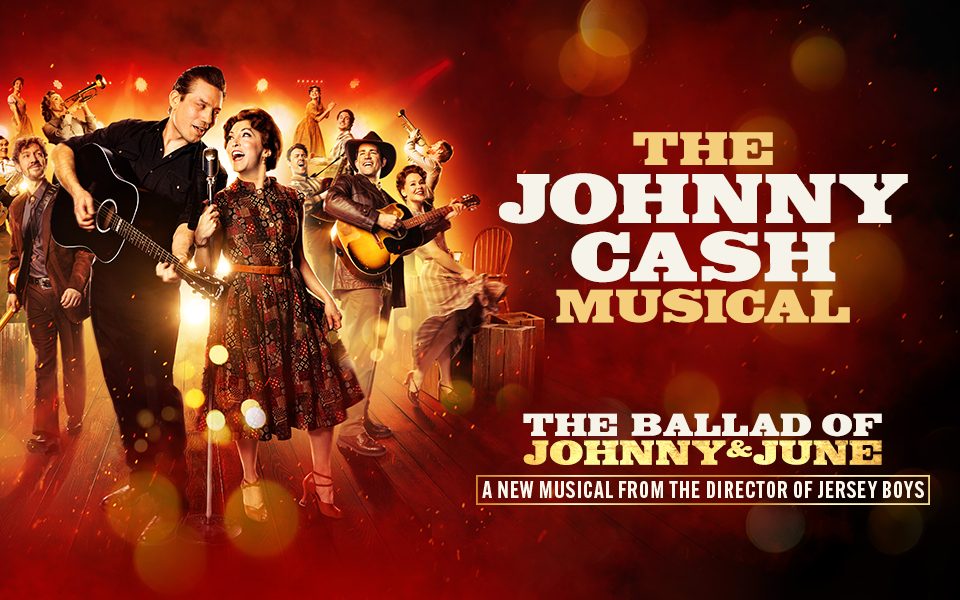
The subtitle of this piece is The Johnny Cash Musical, and, as such would have been great, covering the life and times of one of America’s most iconic and colourful – even though he always wore black – country music characters. As the main title suggests, however, the show concentrated on his relationship with his second wife, June Carter, a member of the legendary Carter Family gospel group. Legendary in the USA that is, where families would huddle round the radio each week to hear their homely gospel/folk songs, but not so well known, outside the followers of those genres, over here. The programme shows that the first performance of this work was in San Diego, California in May, 2024 where they will have been a familiar part of the musical background.
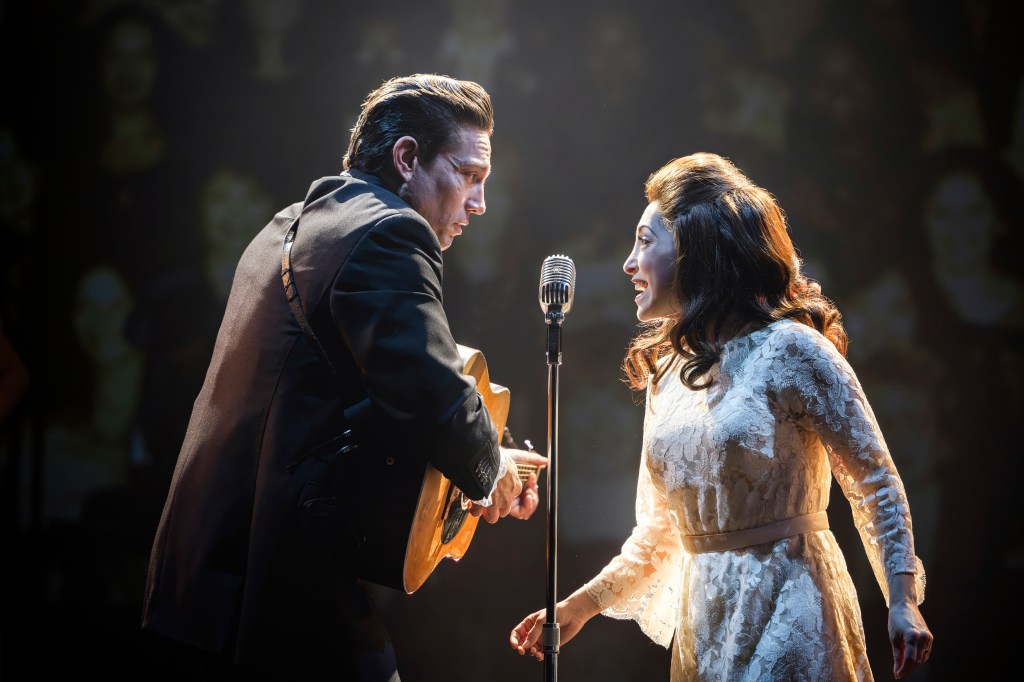
Christopher Ryan Grant as Johnny Cash and Christina Bianco, June Carter Cash
The format of the show is based on a song, The Ballad of Johnny & June – figures – which is performed intermittently throughout the piece by Ryan O’Donnell, who plays John Carter Cash, the son from the marriage of the eponymous characters. It is a bit odd to start with as he is reminiscing about events which took place decades before his birth, but, as it is told in flashback it works – sort of.
The action begins with the singing of the duet, Jackson, by Johnny Cash and June Carter, to signal the start of their relationship, which is repeated half way through when the story catches up with that moment in time.
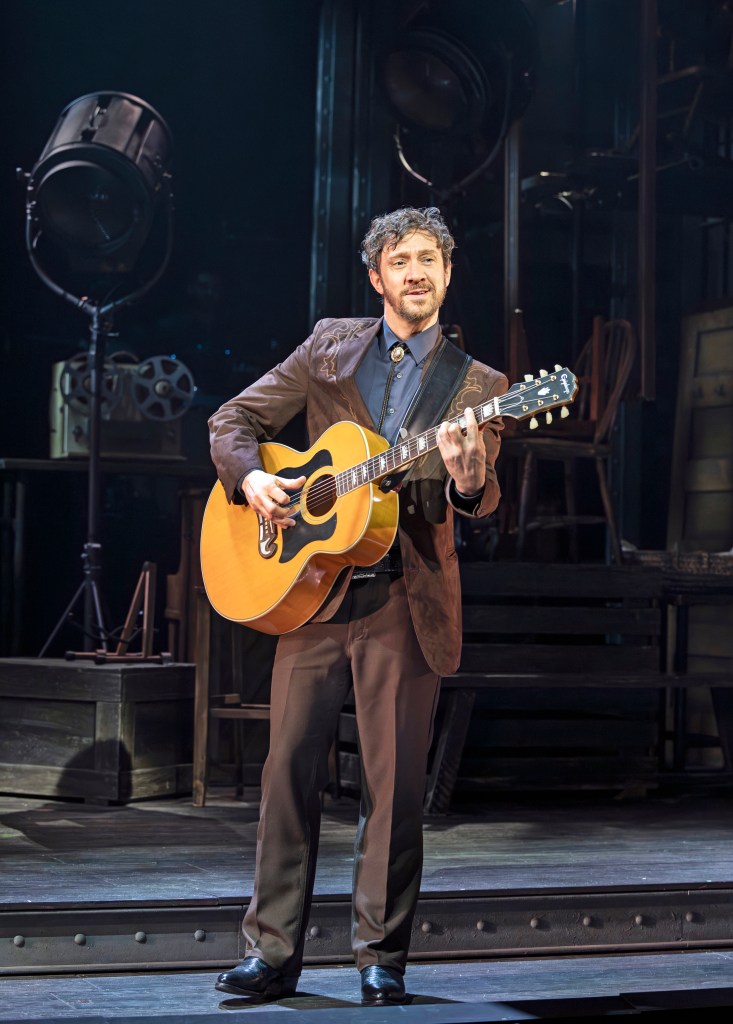
Ryan O’Donnell as John Carter Cash
As well as singing the aforementioned ballad, John Carter Cash provides the spoken narrative of the story during which he recalls one of his father’s adages, ‘Never let the truth get in the way of a good story.’ This is practised in a few instances throughout the night. There is another saying I would like to draw upon to sum up my thoughts on this show, ‘Less is more.’ Sadly, here we had the reverse and more was definitely less.
The running time of the work was 2 hours 30 minutes including a 20 minute interval which, if my maths is correct, equals 130 minutes, during which time no fewer than 36 numbers were performed, or 37 if you count the two renditions of Jackson! Granted, they were not all the full versions, but it was definitely a case of overkill. All the more so as, especially in the first half, when the songs of Carter Family were featured, along with the early efforts of Johnny Cash, some were not exactly classics.
I must say that the two stars, Christopher Ryan Grant, as Johnny Cash and Christina Bianco as June Carter, were brilliant, as were the other musicians, all of whom had their moment in the sun whilst performing on stage. Mr Grant’s voice, both speaking and singing, was, except for one point toward the end, absolutely spot on. I am not so familiar with Ms Carter’s work but I am more than happy to believe it was just as accurate.
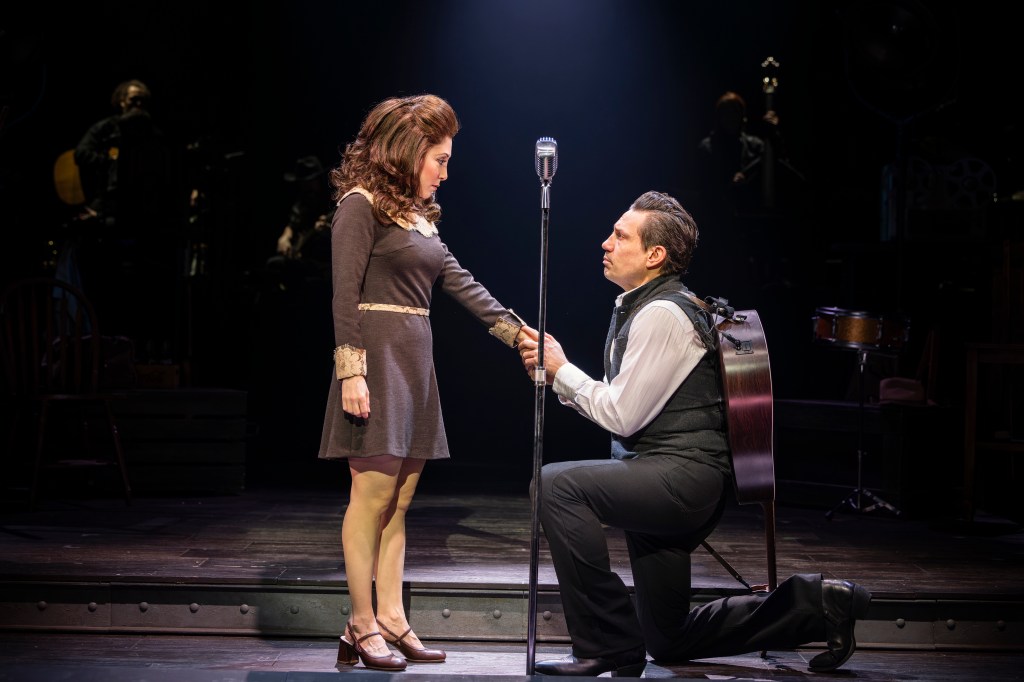
Johnny Cash proposes to June Carter live on stage in London, Ontario
The pair met early in their careers when Jonny Cash guested on the Carter Family Show and although smitten, it was their later encounter on stage which sealed the deal. The problem was that by then they were both married, Johnny Cash to Vivian (Liberto) Cash with whom he had four daughters before she divorced him due to his constant touring, excessive drinking, drug use and serial adultery and June Carter who had first been married to country singer, Carl Smith, with whom she had a daughter, and then Edwin ‘Rip’ Nixon, a police officer and ex-American football player, with whom she had another daughter. That union ended due to her affair with Cash.
Although seemingly settled, the booze and drugs continued, with the latter also becoming a problem for June. Despite several rehab attempts, they both continued their dependencies until they died in 2003 less than four months apart.
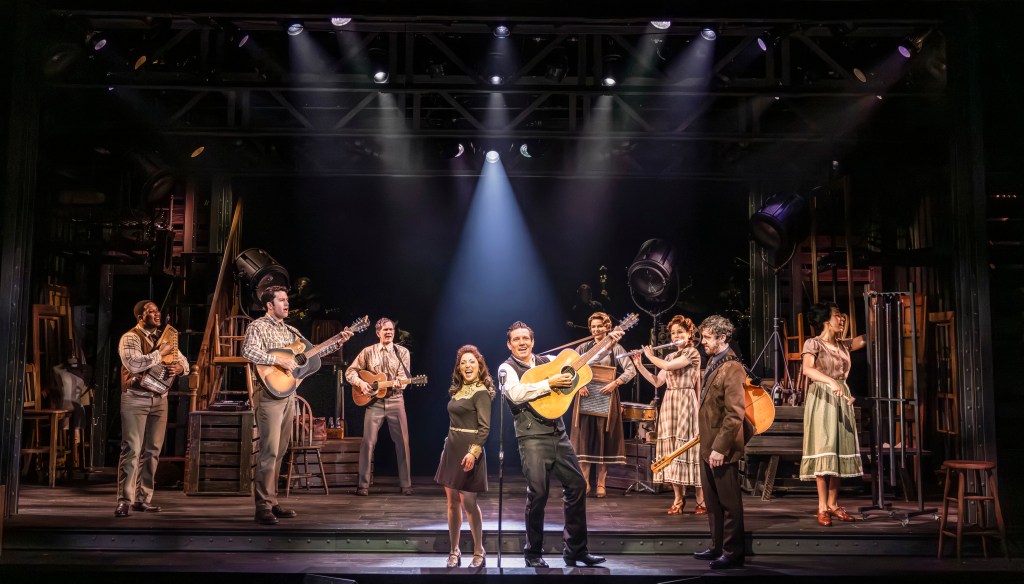
The cast
I realise that the show was about the relationship between the two main characters but found the way in which it was presented very frustrating. The emphasis on the actions of Johnny Cash during the marriage was skewed towards the negative aspects of his behaviour, making me wonder why his wife stayed with him, OK, love conquers all, but there were positives which could have better explained it had they been referenced. His campaigns on behalf of Native Americans and his support for the civil rights movement by getting black musicians on his television shows were never mentioned, whereas his couple of nights in jail for drug offences and his drunken outbursts were over hyped.
There was also seemingly no mention of the neurodegenerative disease, Shy-Drager syndrome, from which he suffered in later life. I say ‘seemingly’ because the action proceeded at such speed that lots of things were glossed over or just got a fleeting mention. I feel that the director and co-author, Des McAnuff, who was responsible for the far superior musical about The Four Seasons, Jersey Boys, overemphasised the back stories at the expense of the love story, and the negative parts of the marriage over the tender episodes, of which I am sure there were many more than were included. Perhaps a straightforward musical about the life of Johnny Cash would have been better, after all, this relationship would have been a huge part of that anyway. The audience would have also got to hear his real bangers in their entirety.
I thought it a bit disrespectful toward the other performers involved, some of whom took fairly major roles as band members, family and previous spouses, to refer to them in the programme as Man 1, Man 2, Woman 1, Woman 2 etc. The ultimate disrespect though, insofar as I am concerned, was that one of the two songs which can reduce me to tears if the mood is right, was put through the musicals machine and robbed of most of its feeling. As good as the lead actor was, he didn’t get this one right. The number in question was Hurt. Anyone who knows it and especially if they have seen the video of a man obviously very near the end of his life, now taking drugs for strictly medicinal purposes, and whose voice is accompanied only by his guitar except for the occasional piano and string crescendo, cannot help but be moved. Added killers are the cameos from June Carter, who is obviously deeply affected by the experience. This four minutes sums up the man’s life and the couple’s love for each other, far more effectively than the 2 hours of the musical. To see it, please follow the link below, but have a full box of tissues to hand. Whilst I was doing my research for this article I realised that when this was released in 2002, the year before he died, he was six years younger than I am now! https://www.youtube.com/watch?v=8AHCfZTRGiI
If you are in the least bit interested, or even if you aren’t, the other tear jerker on my playlist is Goodnight Saigon, by Billy Joel, again the link is below, but keep the Kleenex to hand. https://www.youtube.com/watch?v=Qjzjhl-QztE
The Ballad of Johnny & June is at Leeds Grand Theatre until 19th September, 2026. For further information and to book, please go to https://leedsheritagetheatres.com/whats-on/the-ballad-of-johnny-and-june-2026
For other events at Leeds Heritage Theatres please see https://leedsheritagetheatres.com/whats-on/
Photographs by Pamela Raith
Footnote.
I make no apology for including another reference here to my bête-noir – miscasting. Please bear in mind we are dealing with real people here, not fictional characters.
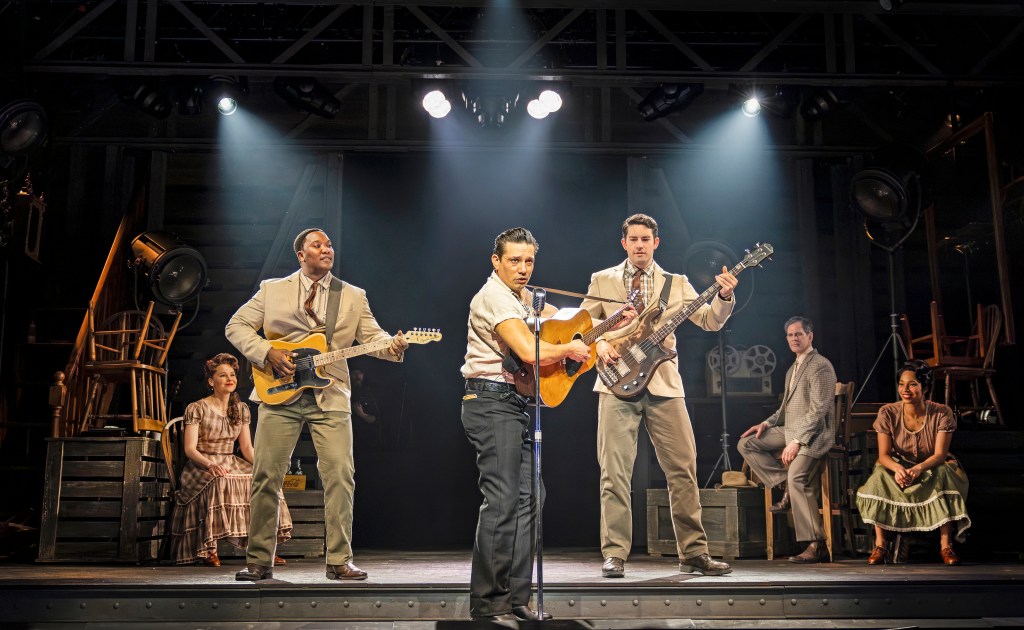
Christopher Ryan Grant as Johnny Cash with the Tennessee Two, Luther Perkins, played by Chomba S. Taulo and Marshall Grant, possibly played by Christopher Short – Man 1
As you can see from this production shot, the guirarist in Johnny Cash’s early backing band, The Tennessee Two, Luther Perkins, is played by a black actor -Man 2 as he is listed in the programme – Chomba S. Taulo, who was brilliant. The problem is that Mr Perkins was white -as an aside, he also played Edwin ‘Rip’ Nixon, June Carter’s second husband, also white. I am all for inclusivity but the lack of authenticity is bewildering to me. As an illustration, one of the songs performed in full was the novelty number I’ve Been Everywhere’ which is now used on the most ridiculously badly overdubbed travel advert ever to be on tv. The names of the places mentioned in the song were projected on the set and, as you would expect from a country act in the fifties and sixties, most of them were in the Southern States of the USA. That being the case, if Luther Perkins had been black, the tour bus would have needed to make separate stops at hotels, diners and even toilets, to accommodate the two races on board. Failing to grasp the significance of this situation by leaving it unacknowledged is, to my mind either careless or an attempt to rewrite a dark part of American history – for once, no pun intended. There are some things you can’t dismiss by saying that truth should not get in the way of a good story.
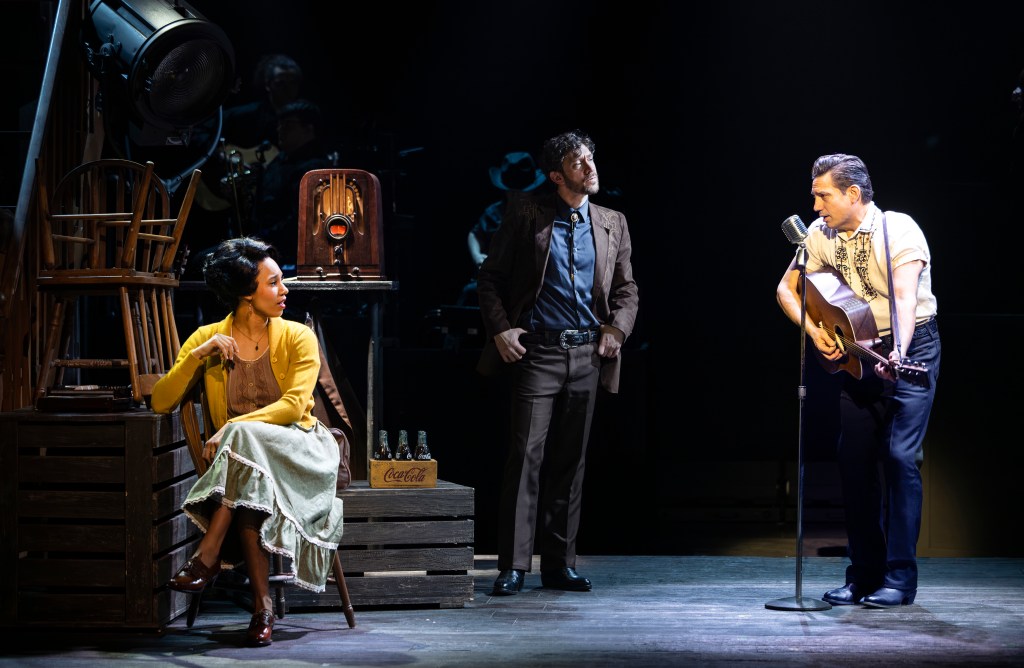
Anne-Marie Wojna, as Vivian (Liberto) Cash, with Christopher Ryan Grant as Johnny Cash and Ryan O’Donnell as John Carter Cash, who would not be born until several years after this scene.
On the other hand, Vivian (Liberto) Cash, was correctly played by a woman of colour, Anne-Marie Wojna -, billed as Woman 2 – as, although Italian, her darker than normal skin colour led to her being vilified by racists, a point which was not even touched upon in the show.
 Tyke It To The Limit