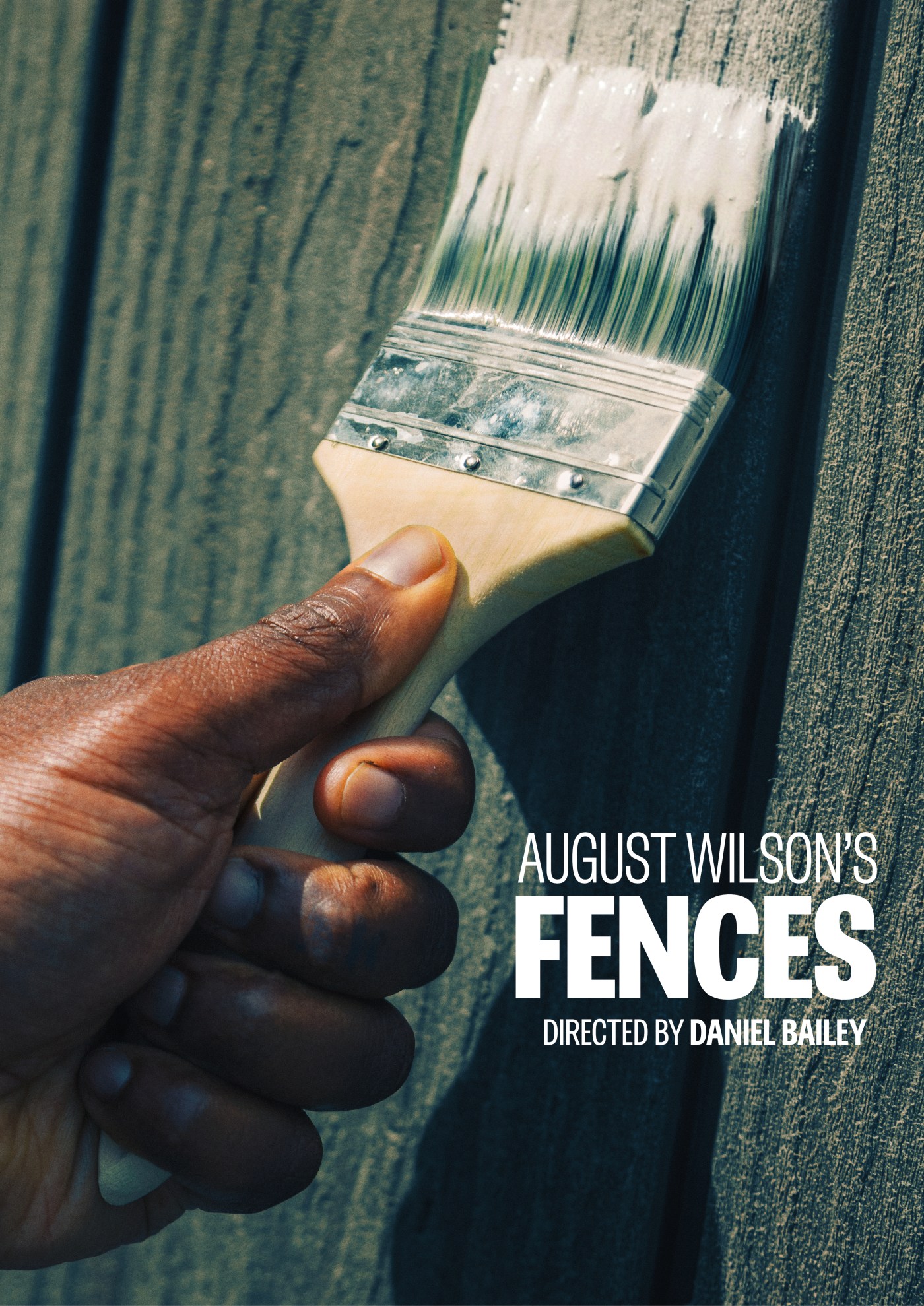
This is not a play about a handler of stolen goods, although it is set in Pittsburgh, whose NFL team is called the Steelers – stealers – never mind. No, this is a very powerful work highlighting the plight of an African American family in 1957 who are at the crossroads between old school upbringing and the less formal system taking shape post Second World War. The piece is given added heft in that the basic premise could be applied to just about everyone in the Western world, including Europe, with the inhabitants having to come to terms with the world changing to an atmosphere that improving economies and more liberal culture fostered, although we didn’t have the racial element to deal with.
The fences referred to in the title are those which insulate us from the outside world and, as the character Jim Bono says, ‘Some people build fences to keep people out, others build them to keep people in,’ which works on both the physical and psychological level. I have come across a few adages this week so here is another which could be applied; good fences make good neighbours. When boundaries are set and recognised everyone knows where they stand with each other, again both literally and figuratively.
The set, by Lily Arnold, who also designed the costumes, was superb, being the exterior of a detached house with small garden and a front porch. It would later revolve to briefly act as a performance space for musicians. Although not seeming significant at the beginning, the fence around the property was in need of repair.
The play begins with Troy, played by Ray Fearon, arriving home on Friday night after his shift at the town’s rubbish depot, with his long-standing friend and workmate, Jim Bono, Everal A Walsh. As was their wont on the last night of the working week, they were accompanied by a pint bottle of gin, which they proceeded to demolish while having a good session of ‘man talk’. I must add here that none of the older male characters used each others names whilst speaking to them, they referred to each other as Nigger. As you might imagine, this came as a bit of a surprise to we sensitive souls in 2026, but once it had been bandied about a few dozen times, the shock value all but disappeared.
The two main topics of conversation this week were an attractive woman of ample proportions who lived nearby and Troy’s appointment with the Commissioner on the following Friday. The reason for this latter summons was that Troy had complained to the depot manager that it was only white men who were given jobs as garbage truck drivers, while the black guys were charged with lifting the heavy barrels and emptying them into the back, so he had decided to take his grievance further up the line.
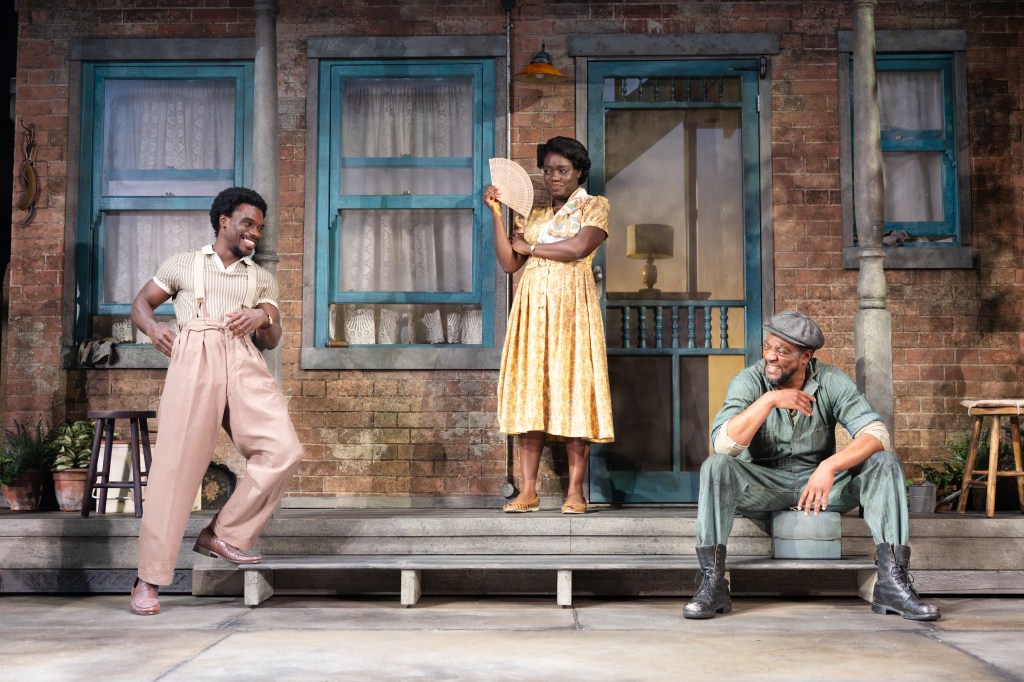
Lyons – Michael Ahomka-Lindsay – enjoying a joke with Rose – Madeline Appiah – and Bono – Everal A Walsh – while waiting to ask his father to lend him $10.
Enter Lyons, Michael Ahomka-Lindsay, Troy’s elder son from a previous marriage, who had come to borrow $10 from his father, knowing that it was payday. Troy refused saying that he should get a proper job and offering to sort him one out at the garbage company. Lyons was set on being a musician, which was not considered viable by Troy, so he refused, even though the lad told him it was just a loan as his girlfriend, Bonnie, with whom he lived, had just got a job. Despite his persistence, Lyons could not sway his father, so he went down the alternative route, and asked Rose, who acquiesced, much to the chagrin of Troy. The gin ran out and Bono went home to his wife.
While they were making short work of the gin, Troy’s wife, Rose, played by Madeline Appiah, came out and was whisked off her feet by Troy who left nothing to the imagination in telling her how their night was going to be spent. I am sure that they had some Yorkshire blood in them as Troy tipped up his wage packet and was duly given his allowance before Rose took the balance inside.
In addition to Lyons, Troy and Rose have a son together, whose name is Cory, Josh Tedeku, and who although still at high school, tells them he has been given the chance of a college football scholarship. Troy rejects this out of hand, saying that because he is black he will be exploited, and not paid properly no matter how good he is. We then learn that Troy was once a top player in Negro League baseball but was never allowed to play in the Major League and make big money, and doesn’t want Cory to suffer the same fate. Like his half brother he is commanded to get a proper job at the place where he is working weekends.
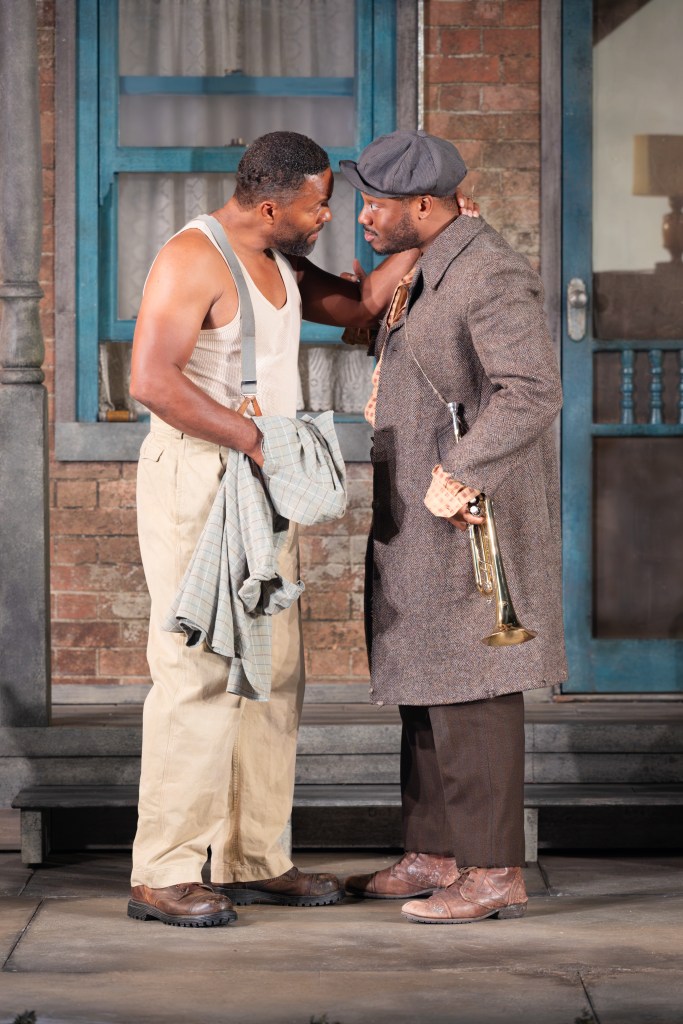
Troy, Ray Fearon, has a chat with brother Gabe, Simon-Anthony Rhoden.
It transpires that the reason Troy rules the house with a rod of iron is that he was abandoned by his father and had to provide for the family, which he did by committing robberies. After one went badly wrong, resulting in the victim’s death, he did fifteen years in jail, where he continued to play baseball and it was there he met Bono. Although putting his failure to play in Major League Baseball down to his colour, he refused to believe those who told him that by the time of his release, he was too old to begin that career. I also took it to indicate that he needed to set boundaries – surrounded by fences – so that he had a template he could rely on to keep him on the right path.
It was meeting Rose shortly after finishing his sentence which made him go straight and do whatever legitimate work he could to provide for her and his family, which included his younger brother Gabe, Simon-Anthony Rhoden, who had sustained a serious head injury during the war and was left psychologically damaged. It was the $3,000 compensation he received which was use by Troy to buy the house in which Gabe had a room. He had, however, recently decided to leave and rent a space from a lady close by. His eccentric behaviour manifested itself by his permanently carrying a trumpet, slung over his shoulder on a piece of string, which he would blow whilst walking the streets in order to ward off hellhounds. There was no mouthpiece so it didn’t make much noise but he was convinced it worked. He would be periodically arrested but released into Troy’s custody on payment of a fine. Troy also took half of Gabe’s pension to pay the mortgage.
The fateful Friday arrived with Bono calling after work to see how Troy had fared at the Commissioner’s. I was convinced that he would have been sacked and a spiral of decline begin, instead, he had been promoted to driver. Back to adages, this time it is, ‘beware of what you wish for, it might just come true.’ The change in job meant that he no longer worked with Bono throwing the rubbish into the truck, but sat in the cab alone all day. His routes were also frequently changed so they lost touch.
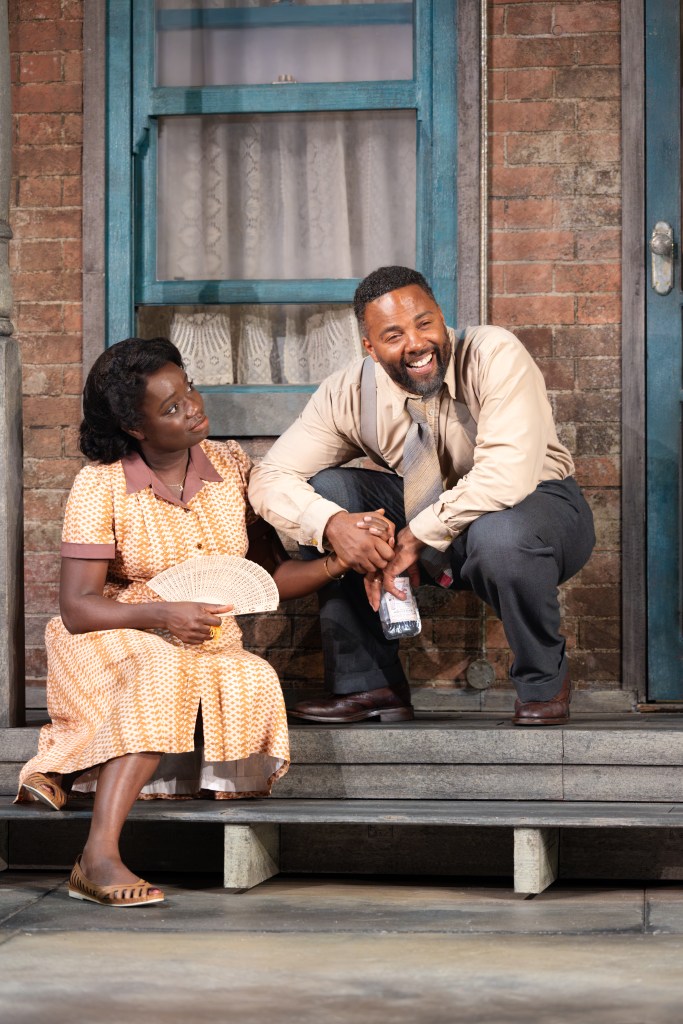
Troy, played by Ray Fearon and wife Rose, Madeline Appiah, celebrate with a bottle of gin on the porch.
His family life also disintegrated when he went to Cory’s workplace and found out that he had packed in his weekend job and was sneaking out to play football. This led to his going to the school to tell them that, not only would he not sign the papers for the scholarship, but he wouldn’t allow his son to play for the team at all. This caused a fight between the two, resulting in Cory being thrown out of the house.
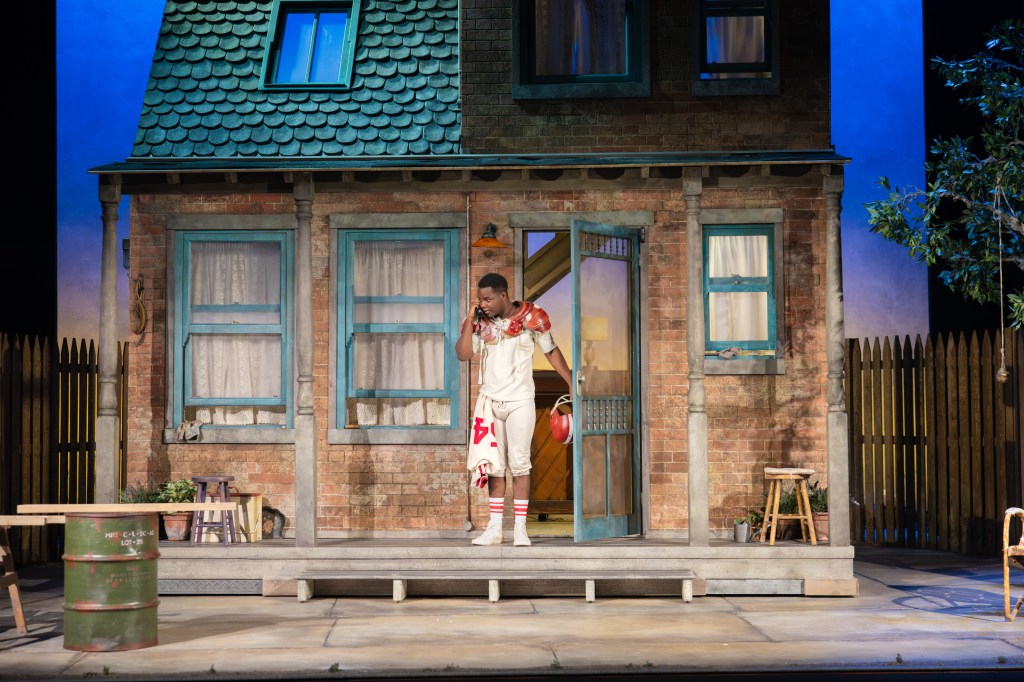
Cory, Josh Tedeku, sneaks out of the house to go to football practice. It isn’t a mobile phone in his hand, but the landline!
There was another bombshell to come when Bono called for some man talk one day and Troy told him he was having an affair with the aforementioned woman. Bono said that he should either call it off or at least tell Rose before she found out from someone else. When Bono left, Rose came out to call Troy in for dinner, at which time he said he needed to tell her something. I will go no further, as his news caused an audibly collective intake of breath from the whole audience. I have been to many thrillers and supernatural plays, but have never come across a reaction such as this.
We then skip to seven years later when the family and Bono gather for Troy’s funeral. Cory appears in US Marine dress uniform with corporal’s stripes. He tells Rose he won’t be going to the service but he is persuaded to do so when she informs him that, despite his father’s treatment of him, he really loved him.
The above is just a summary of events, the real force of the work is in the interaction between the characters and the complex relationships between them. It really is a piece not to be missed so I urge you to get a ticket if you like your theatre to give you something to hit every emotion you possess and leave you with, not just food for thought, but a banquet.
The acting was superb from all those involved, it had to be as the whole point is about both the clash and harmony of the characters, as well as changing social attitudes, so merely reciting the lines was not an option. Yes, it is very heavy and violent in parts, but it is also hilarious and touching in others, such as when Lyons called again to see Troy the week after he has borrowed the $10 in order to repay it. Referring to my first line, however, after all the heavyweight acting by this superb cast, the show was stolen by an eight-year-old.
I cannot recommend this play highly enough and repeat that if you like being both entertained and made to think, then you really should try to get to a performance. You can thank me later.
Fences is a Headlong, Leeds Playhouse, Lyric and HOME Production which runs at Leeds Playhouse until 26th September, after which it goes on tour. For full details and a lot more, see https://www.headlong.co.uk/productions/fences
For all shows at Leeds Playhouse please go to https://www.leedsplayhouse.org.uk/whats-on/
Photographs by Tyler Fayose
 Tyke It To The Limit