After my trip in the Tardis to 1943 on Tuesday, tonight I went back to the 1950s – I think. Dial M For Murder is a good old-school murder mystery – you don’t need to be Miss Marple to work that out – meaning there is nothing in the programme regarding the synopsis so as not to give the game away, so neither will I. It is based on a 1952 BBC TV play by Frederick Knott, which was transferred to the theatre before being made into a film by Alfred Hitchcock in 1954. My confusion as to the date of this version arises because the background music at the beginning of the first scene was Take Five by Dave Brubeck which wasn’t a UK hit until October, 1961. Eat your heart out, Hercule.
In most murder mysteries the piece is constructed around the search for the person who did the killing. Here, however, everyone knows who the perpetrator is, the twists lie in the peripheral actions of the characters, of which there are four, or five if you count the one who must have the shortest part in any theatrical production in history – Behave!
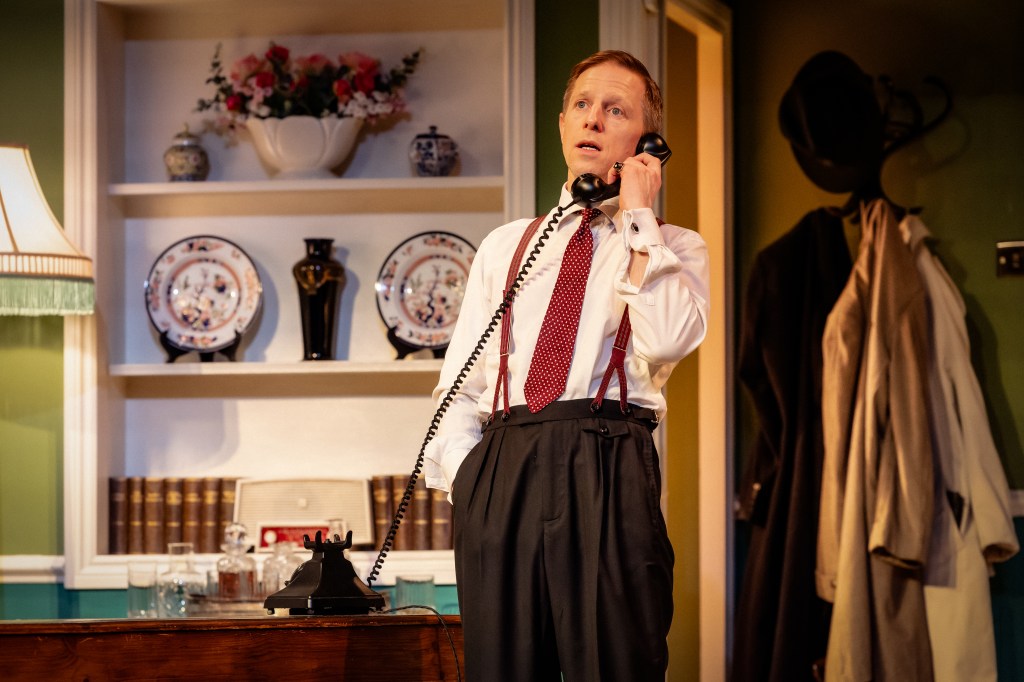
Tony Wendice played by Pete Ashmore
Tony Wendice is an ex-tennis player – an amateur as were most of them in those days as professionals couldn’t play in the major championships such as Wimbledon. He is married to Margot whom he has discovered is having an affair with Max Halliday, an American writer of thrillers, and so has hatched a plan to have her murdered by a third party, Captain Lesgate, who attended the same school as him and whom he had been observing after spotting him at Waterloo Station.
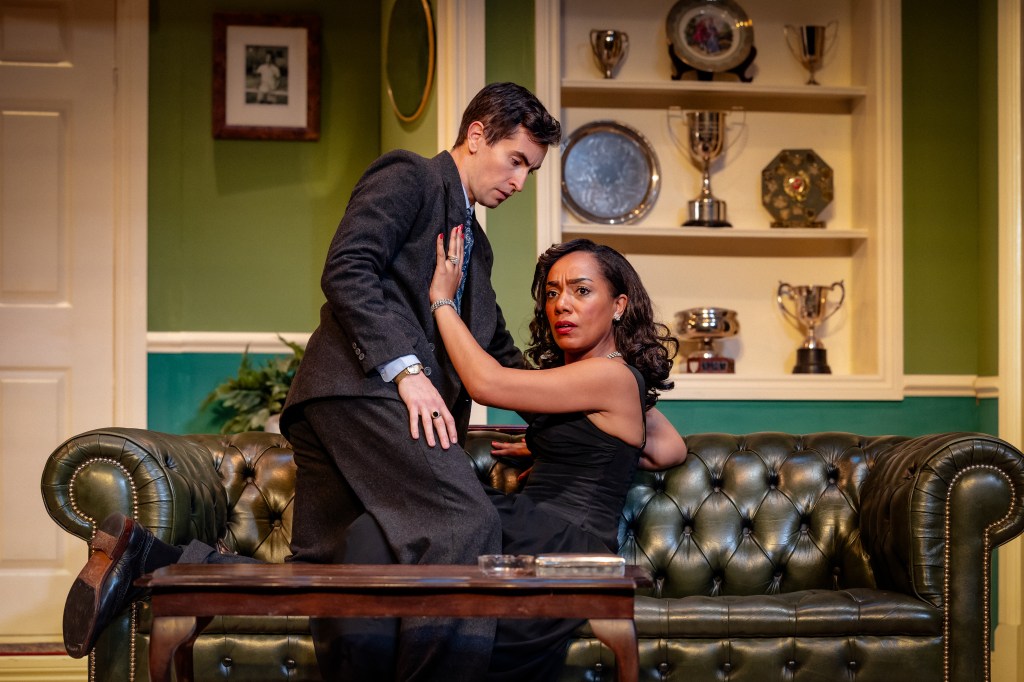
Tanya-Loretta Dee as Margot Wendice and Simon Pothecary as Max Halliday, have their tryst interrupted by the sound of her husband returning home.
The irony of the piece is that it is not the infidelity which has upset Mr Wendice, quite the opposite, he only married Margot for her money so the extramarital shenanigans have provided him with the means to blackmail the Captain into committing the deed. I realise that sounds weird, but it was so convoluted that I am not even going to go anywhere near there. The upshot is that the scheme goes wrong – obviously – and it is the Plan B’s execution which provides the twists and turns.
Plan B was not the only execution central to the play, there was also the question of the execution of the actual killer; capital punishment was still in operation until 1964, so that doesn’t help much with the date either.
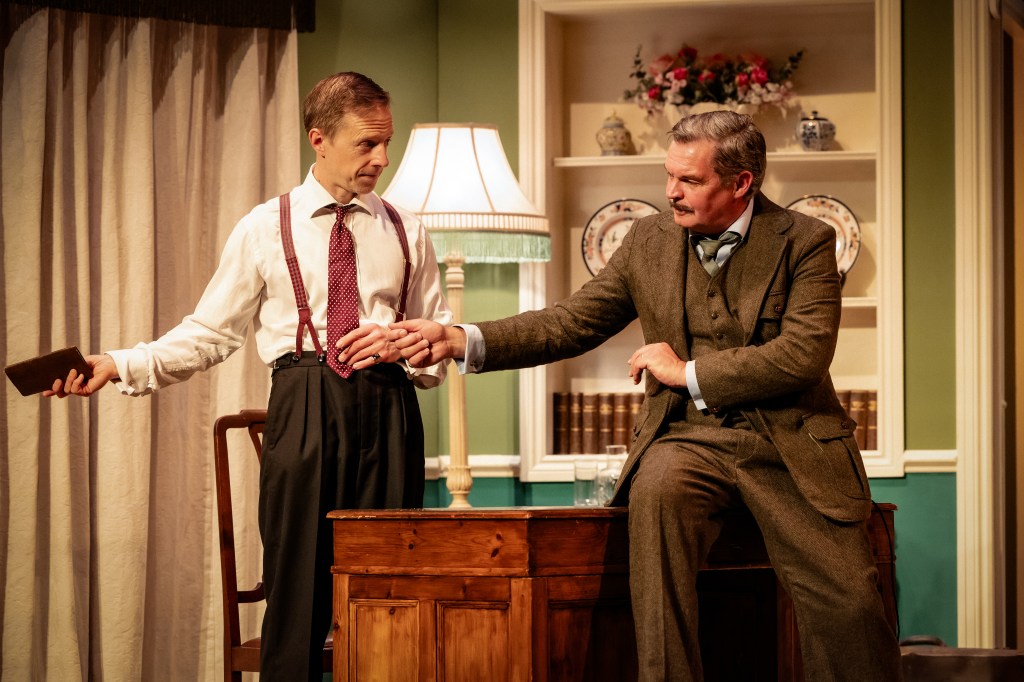
Tony Wendice, Pete Ashmore, convinces Captain Lesgate, Phil Stewart, that he should help him with his venture.
The play was set entirely in the sitting room of the Wendice’s Maida Vale flat, where the crime, its cover up and investigation all take place, the latter being conducted by Inspector Hubbard, who must have been promoted between the programme being printed and the actual performance, as she introduced herself as Chief Inspector – congratulations.
The acting was very much of the period, with cut-glass accents, except for the Inspector -and the American of course, in fact I found some of Pete Ashmore’s dialogue, especially when faced with tough questions from the police officer, a tad inaudible as they were delivered so quickly. He was very precise in his actions, as you would expect, but when under pressure, he seemed to be releasing his inner Basil Fawlty with his body language. There were other amusing moments which lightened the intensity somewhat.
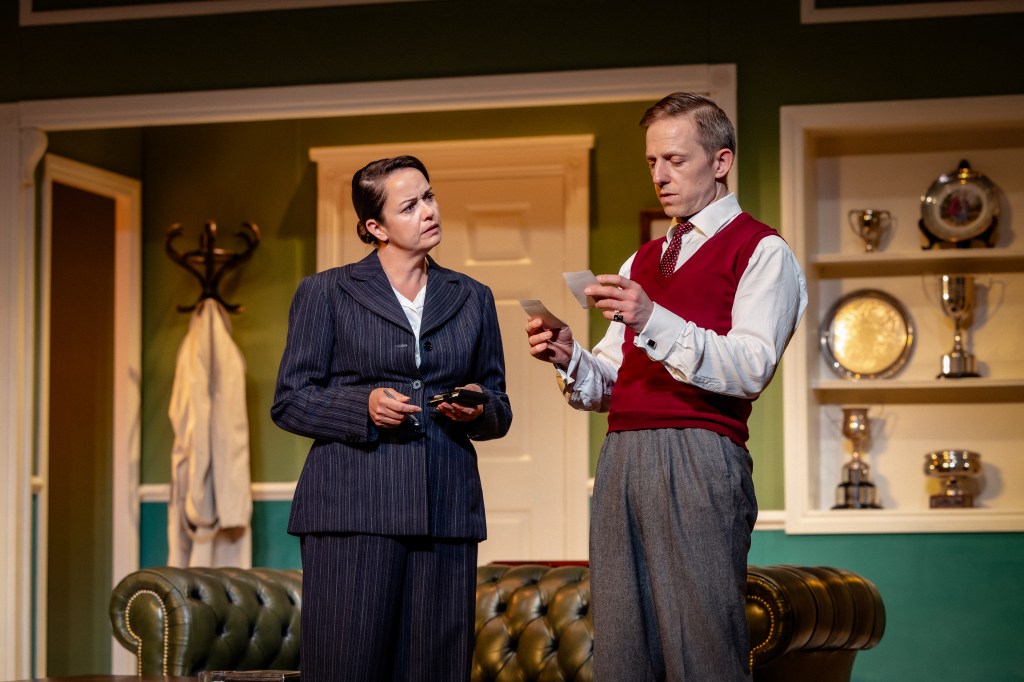
Katy Dean as Inspector Hubbard, asks Tony Wendice, Pete Ashmore, an awkward question.
Tanya-Loretta Dee as Margot Wendice and Simon Pothecary, Max Halliday convincingly portrayed illicit lovebirds who were trying to appear as just good friends in the presence of the cuckold, who they didn’t realise was aware of the true situation. Phil Stewart was the model of desperation as Captain Lesgate, who had been set-up to do the dastardly deed and Katy Hubbard gave the character of Inspector Hubbard some depth by being both incisive in her thinking, and doing her best Columbo impression by seemingly struggling to grasp a point before pausing as she was exiting the room to ask one final killer question. The nameless fifth actor was superb standing behind a door which was opened and immediately closed again staying in character for at least two seconds.
This was another piece more than worthy to be included in this year’s drama series and, although I can’t get to the next one, I am looking forward to the finale in a couple of week’s time.
Dial M For Murder, directed by Josh Mathieson, ends its run at Harrogate Theatre tonight, Saturday, 12th September. For more information on this, as well as other events at the venue, please go to https://www.harrogatetheatre.co.uk/whats-on/?instance_dates=&venue=&genre=Theatre&event_accessibilities=
The play continues on tour, so for details of the coming venues see https://philandben.co.uk/show/dial-m-for-murder-2/ where you can also see what else they have on show.
Photographs by Danny Kaan.
 Tyke It To The Limit