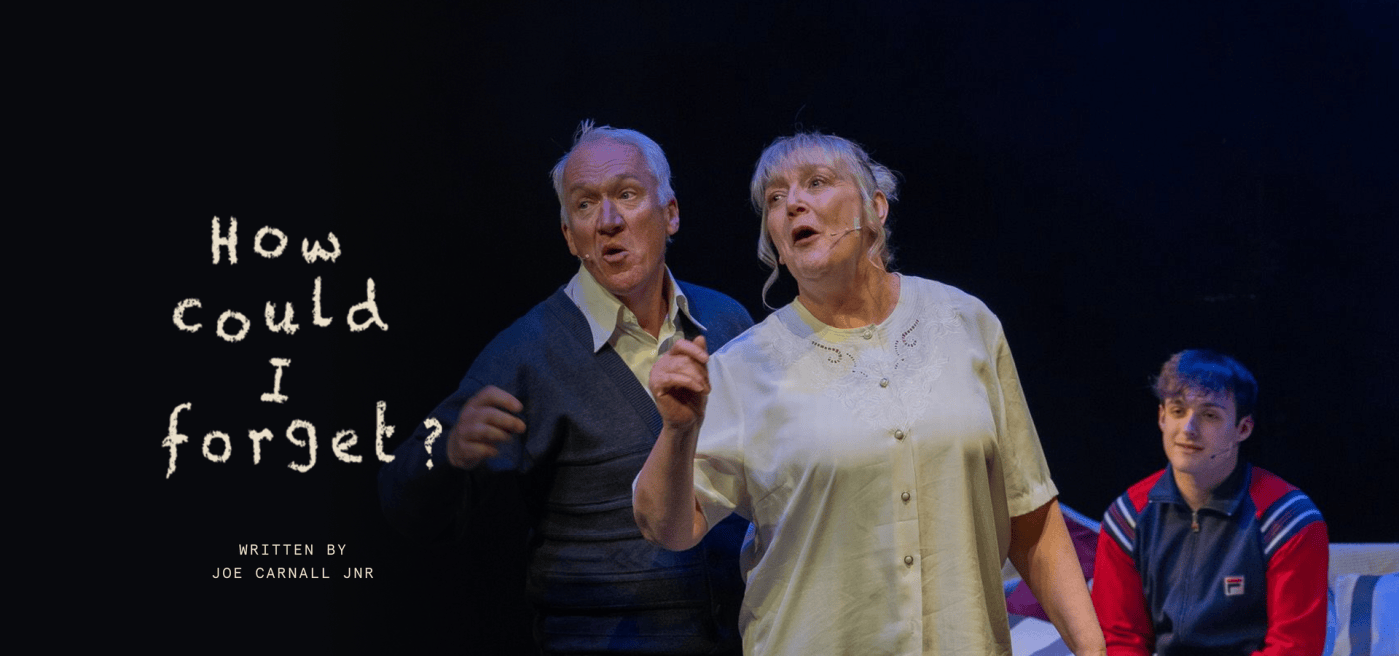
When I saw that this was a musical about someone with dementia I was a bit sceptical but, and here is a statement of transparency, as it featured a pal of mine, I just had to go see it. I won’t mention any names but they know who they are and that, if they were rubbish, I would say so – I also know that ethos is reciprocal – in fact I probably hold them to a higher standard than anyone else so as not to be accused of bias. Fortunately the conflict of interests never presented itself as all of those involved were amazing.
I won’t go into too much detail but, being a 77 year-old, I am at that time of life when the disease is always at the back of my mind, hopefully not literally, especially when I do something a bit daft, although having been daft for at least 76 of those years, I don’t notice too much deterioration. I have, however, recently lost two close friends to the condition and my only remaining school mate is in the throes of it so I, like others in the audience, could identify with the characters. Another reason I was not too trepidatious about the format was that it was written by a musician, Joe Carnall Jnr, and was autobiographical, in that his granddad died from dementia. He has said that he had been inspired by the way he saw music acting as a kind of panacea for the American singer Glen Campbell, who continued to tour for two years after announcing that he was suffering from the disease. Although we didn’t get to Phoenix or Galveston, we were treated to the conduit of the story, Billy, play an open mic night at the Fox and Duck in Sheffield. The songs in the show were used as both scene setters and a method of carrying the narrative, each doing their job very well.
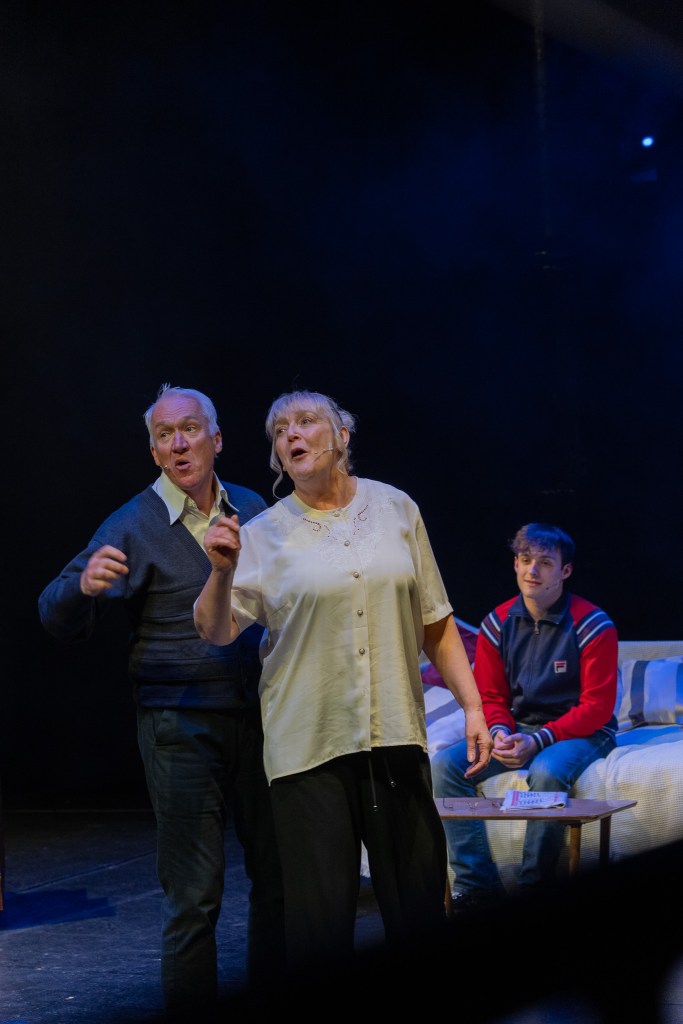
Gerard Fletcher as Jack, Cathy Breeze, Jeanie and Jamie Wray, Billy
The play opened with Jeanie, Billy’s grandmother, arriving home alone from the funeral of her husband, Jack, and having a chat with his photograph. She was in that zone where, whilst still grieving, there was a certain amount of relief that the suffering was over for the pair of them. Later in the play, during a flashback to the beginning of their marriage and well before Jack’s illness had taken hold, she sang a song wishing that for one day she could just be herself rather than having the the responsibility of bringing up two young children, doing the housework and catering for her husband between his finishing work and going out to the pub. Little did she know that that would be a situation not half as bad as those which were to come.
It transpired that Jack and Jeanie had a daughter, Billy’s mother, who, due to some unexplained reason, had acquired a new man he thought was not good enough for her, in fact he assessed the chap as being well below Mastermind material, this caused him to spend as much time as he could with his grandparents. Jack, originally from Glasgow, was a pianist and would spend time singing the Scottish songs from his youth, most of which were Billy’s favourites when he too was a youngster. He was also addicted to crosswords, which Jeanie ended up solving for him, and telling granddad jokes, one of which was a cracker.
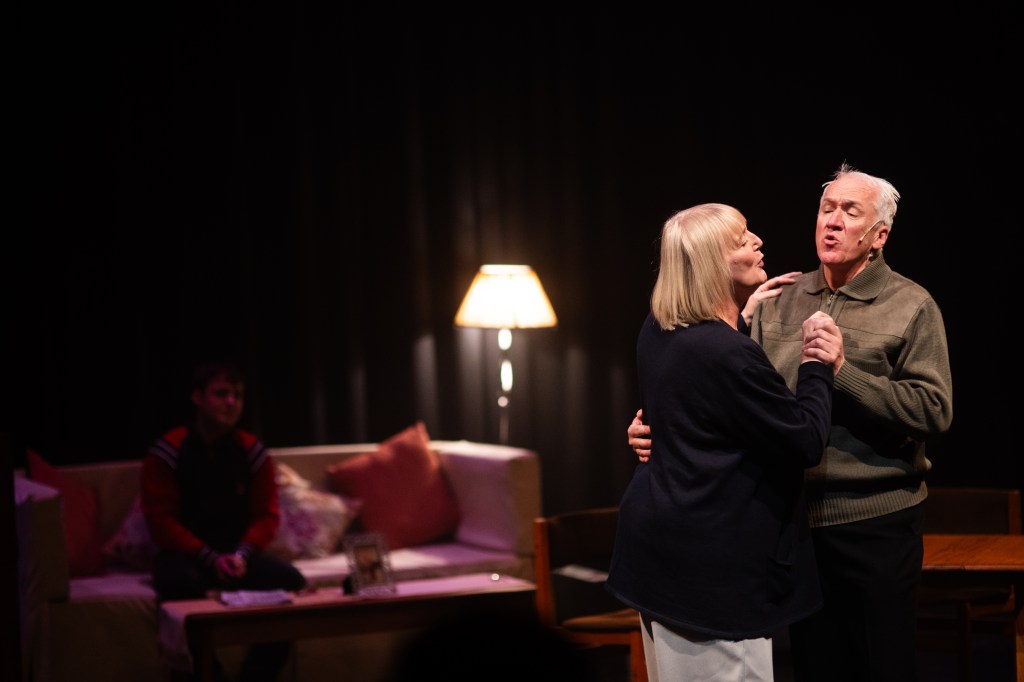
Jack, Gerard Fletcher and Jeanie, Cathy Breeze, enjoy happy times.
The first time we meet Billy he had just been accepted into university which pleased Jack no end as he had always urged him to study and get a good job rather than toil in the steelworks as he had needed to do. The music gene, however, was evident and that was his first love but one which needed to be put on the back burner whilst he undertook his studies. As the tale progressed, so did his pursuit of playing the guitar, leading to him taking it up professionally.
As you will have gathered, the format is one of timeshifting which lightened the piece no end, especially as the first half concluded with Jack’s confinement to a care home after the burden became too much for Jeannie. It left me wondering how much darker the second half would get. The gloom caused by the regression in Jack’s health was offset by the memories of some heart lifting incidents, including a holiday with the children in Bridlington to celebrate their wedding anniversary when he was given a watch by his wife, something which would play a touching part later on. There were also his reminiscences of doing National Service with Roger, Jeanie’s brother, who was later responsible for bringing him to Sheffield and introducing him to his future wife.
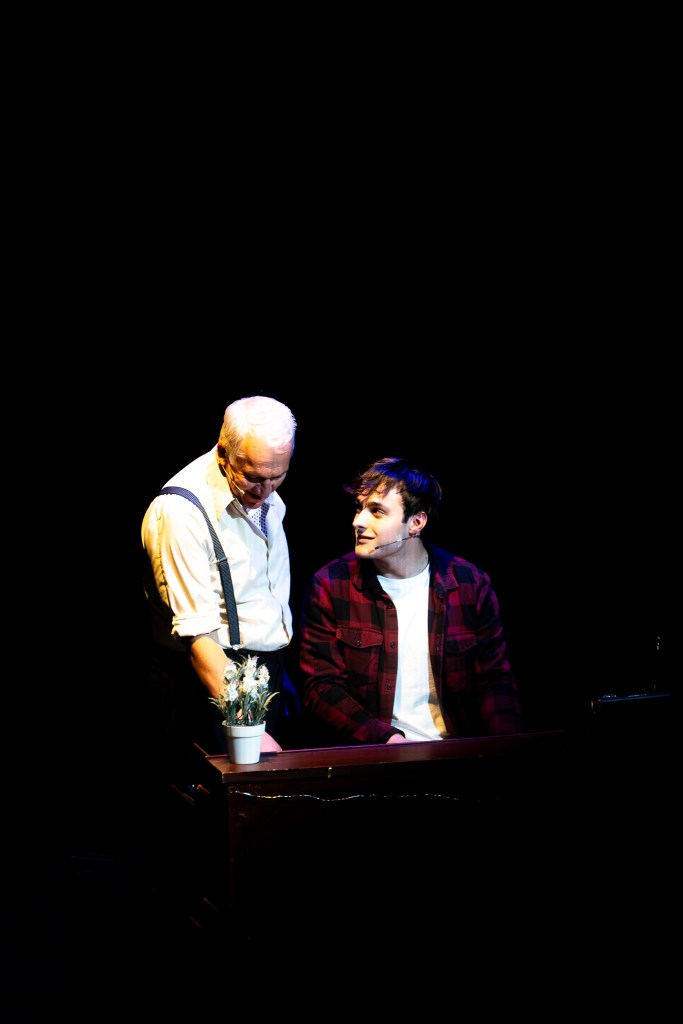
Jack, Gerard Fletcher, joins Billy, Jamie Wray in playing piano.
The deterioration in Jack’s condition was measured by the stages Billy had reached in his stint at university, his demise seemingly being at around the time of his graduation. Fortunately, just before this happened, Jeanie, who had been constantly asking Billy about his love life, or lack thereof, played matchmaker between him and Rebecca, a carer who was looking after Jack in the home. There was a very amusing incident in the Fox and Duck, when Rebecca was having a drink and composing her first text to Jack, who just happened to be setting up his guitar backstage in preparation for his performance in the open mic night, whilst reading it and responding.
I don’t think it is a spoiler to say that the story ended on a high note – pun intended – with Billy and Rebecca presenting Jeanie with a great grandson whom they named Jack, thus completing the circle of life.
There were five actors involved; Gerard Fletcher who played Jack, Cathy Breeze as Jeanie and Jamie Wray, Billy. Holly Durkin and Richard Galloway both took on multiple roles, mainly as Rebecca and Roger respectively.
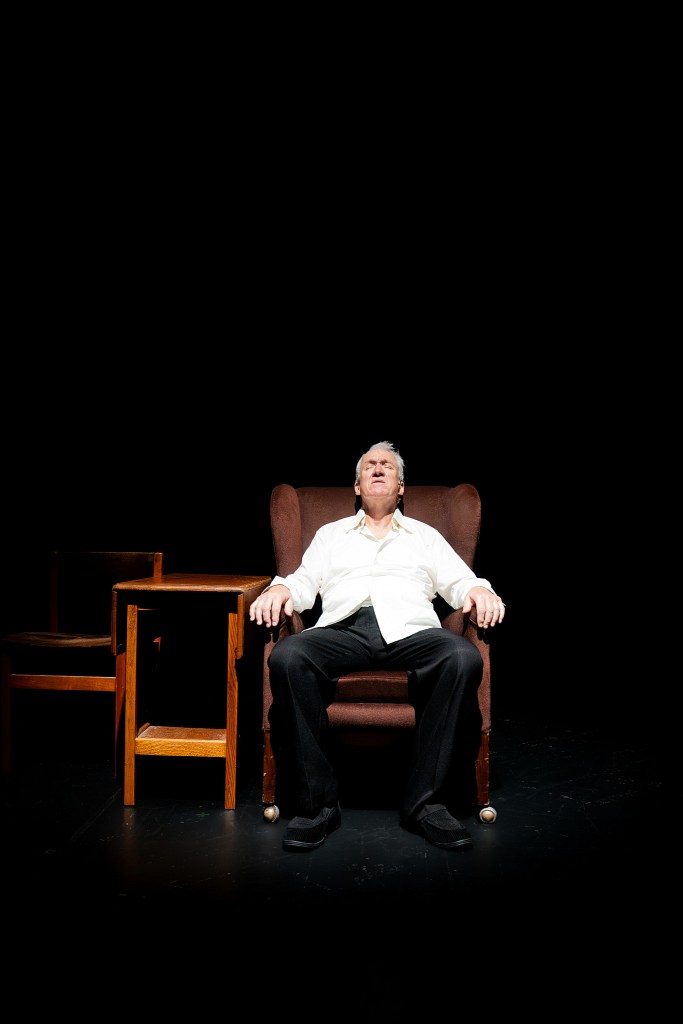
Jack, Gerard Fletcher, disintegrating in the care home.
Although all the actors acquitted themselves very well, I was extremely impressed by the way in which Ms Breeze and Mr Fletcher handled their roles. It must be difficult to gradually cover the gamut of emotions from ecstatic happiness to deep despair and frustration, but to switch back and forth between the two in an instant, as each episode occurred, takes something special. Billy, being the constant, was able to evolve at his own pace illustrating his struggles by not being able to communicate with a man who had been his role model and mentor, but had completely stopped recognising him. This whilst trying to carve out his own niche in life. He filled the role wonderfully well. Holly Durkin was shy as Rebecca, which contrasted sharply with her acting as the Sergeant Major putting Roger and Jack through various forms of discipline in their squaddie days. Richard Galloway as Roger was Jack’s best mate, prone to bouts of pig-headedness, as was Jack, resulting in them facing off at one point. He was also hilarious as the landlord of the Fox and Duck, his open mic night introductions were priceless.
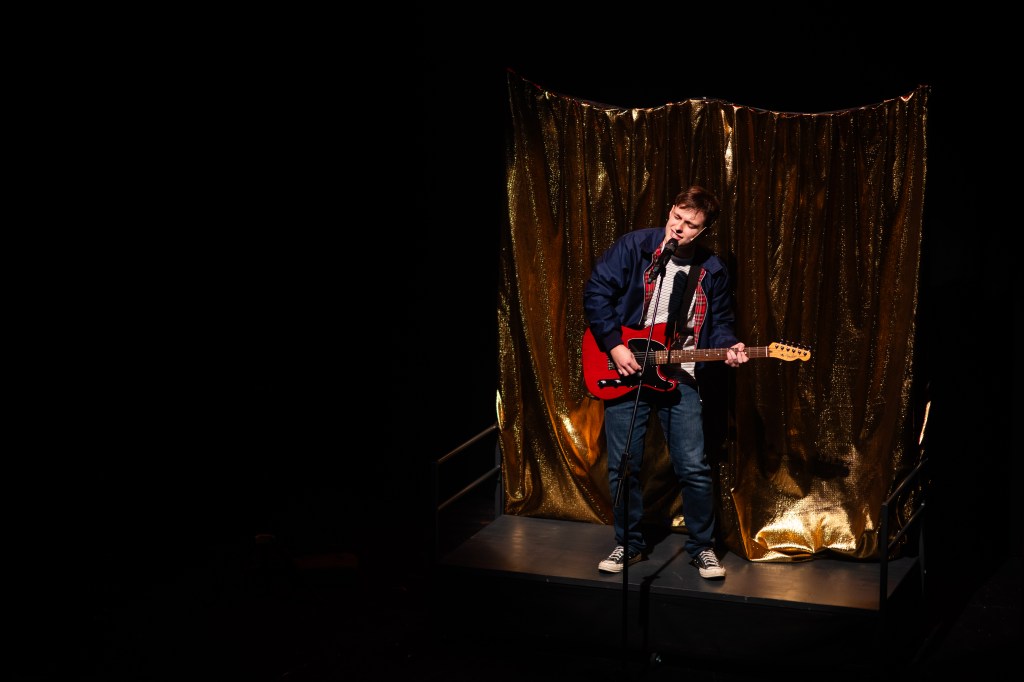
Billy, Jamie Wray, doing his stuff at open mic night.
All the participants performed the musical numbers extremely well with Gerard Fletcher playing piano, Jamie Wray and Richard Galloway, guitars – the former also doing a stint on keyboards – and Holly Durkin showing her drumming skills. Cathy Breeze was the vocalist covering a range of styles, from straight ballads as an actress relating the narrative, to more flippant ditties, deliberately interpreted as they would have been by gran at a family get together, it must be difficult for professionals to dumb down.
I refer back to my experiences with the disease and would like to praise the writer for covering the lesser known symptoms which manifest themselves during its progression, namely the self-neglect in both dress and hygiene and the removal of self-censorship leading to verbal and physical abuse of loved ones. It isn’t just dribbling down your cardigan and watching Countdown asking where Carol Vorderman and Richard Whitely have gone.
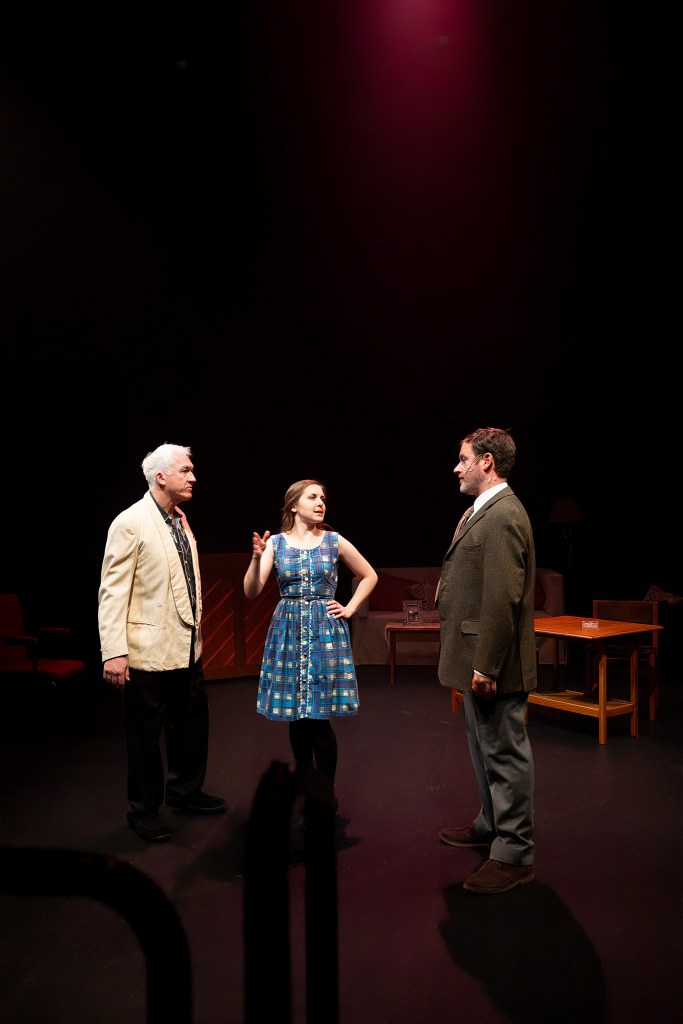
Gerard Fletcher, Holly Durkin and Richard Galloway
I only have two small criticisms, don’t I always, the first was a couple of sound glitches caused by the head mics missing the first words in two of the actors’ dialogues and the seeming lack of programmes. There were no physical versions of the playbill and I couldn’t find any notices bearing a web address or QR code. I eventually found a link by googling the name of the show.
Karen Hood was the Set Designer, whose props were versatile enough to be simply transformed to perform various functions, including one at the pub where the adaptation of the stage was part of the performance.
Haley Yiu, Lighting Designer, handled everything from subdued illumination through harsh spotlight to complete black out with aplomb. Charlotte John was Costume Supervisor catering for all occasions from smart for special family occasions to army uniforms. The Stage Manager was Georgia Batterley and Assistant Director, Alexandra Whiteley.
I can highly recommend this show as it covers a subject which is sadly becoming more commonplace as we all live to an older age than our predecessors – hopefully – and it is done with humour and sensitivity without being maudlin.
How Could I Forget? Directed by Lauren Partridge, with Musical Director, Ed Cosens, plays at Barnsley Civic Hall on Wednesday, 21st October and the songs will be performed at Festival of the Mind, University of Sheffield, on Sunday, 8th November. For more information, tickets and the link to the programme please go to https://www.hcifmusical.co.uk
To see what is coming to Carriageworks it is https://carriageworkstheatre.co.uk
Photographs by Pedalo Photography.

