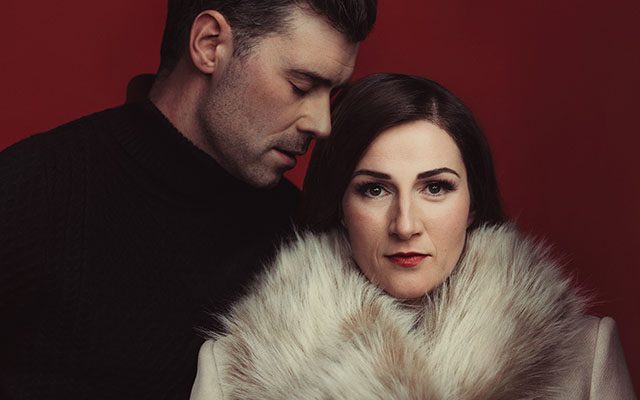
When Tchaikovsky was pitched the idea of writing an opera of the ‘novel in verse’, Eugine Onegin, he was reluctant to do so as it was based more on relationships than action. Thankfully he had second thoughts and came up with this stunner. It was so brilliant that I am not going to whinge about it being set in the last fifty or so years to cover the period during which the USSR devolved into the original nations of which it originally comprised, rather than the end of the 19th Century when it was written.
As you have probably gathered, the plot is pretty straightforward. Madame Larina has two daughters, Tatyana, a quiet, bookish girl of seventeen and the younger Olga, a bit of a raver. The latter is engaged to Vladimir Lensky, a poet, who has a friend, you guessed it, Eugine Onegin. The whole work revolves around the four younger people.
The setting is that of a communist era sports centre in early summer where people are arriving to take part in various activities relating to the 1980 Olympic Games, held in Moscow. There was a national flag with hammer and sickle, as well as others bearing the image of Lenin. A poster on the back wall read ЦCKA, which is Cyrillic for CSKA (Central Sports Club of the Army) based in the capital, where the USSR’s international sportsmen and women were trained.
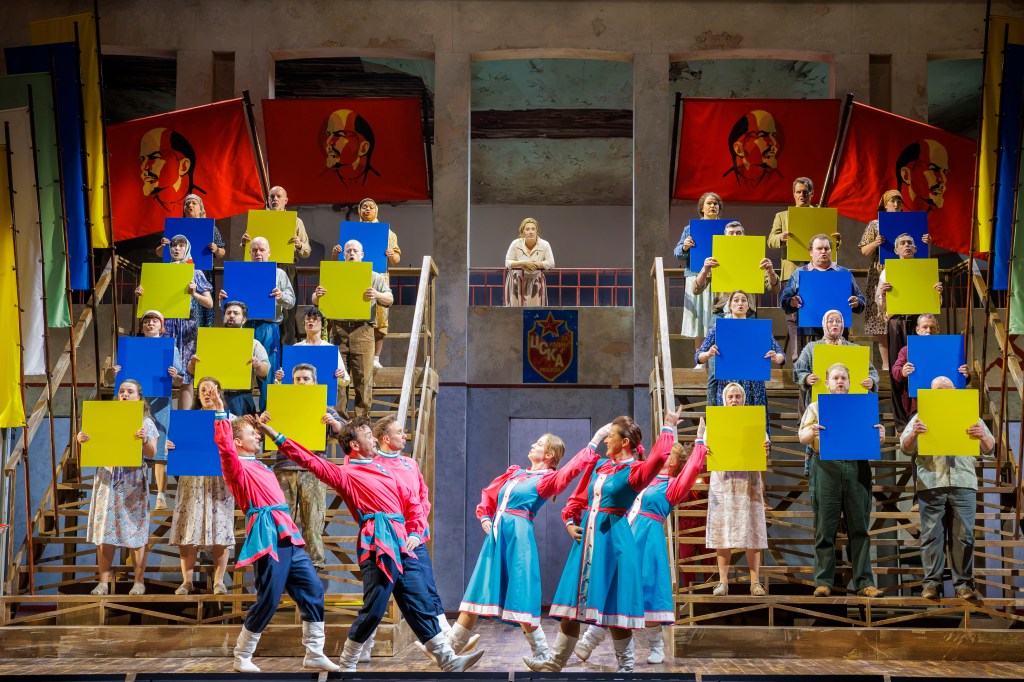
The tiered wooden seating was being used to practice the displaying of large coloured square boards, which were to be turned over in synchronisation by the ‘volunteers’ at the opening ceremony as political propaganda. I loved the way that the Director, Patrick Nolan, had chosen to use blue and yellow on one side with burgundy and white on the obverse. The first are the colours of Ukraine, then part of USSR, which is now obviously in turmoil, being dumped on by the president of one of its ‘allies’ in order to garner votes in the imminent mid-term elections, the other being the colours of another ex-Soviet state, Latvia, which appears to be next in line for Russian attention, especially now that they are getting lots of extra dollars for their diesel.
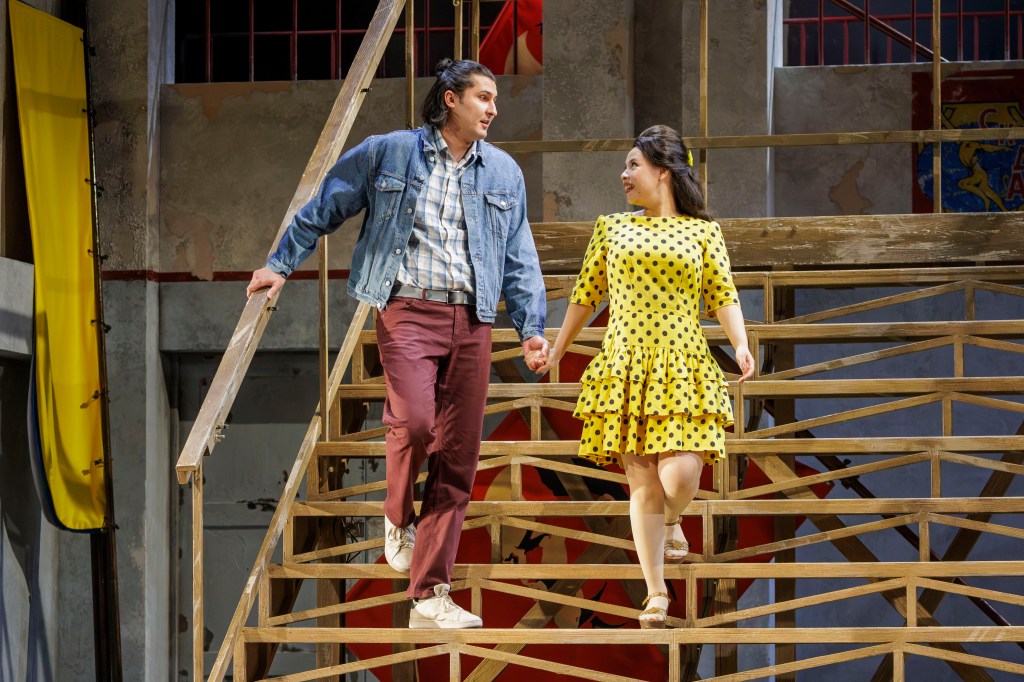
The rehearsal is interrupted by the arrival of some Soviet athletes followed by a crowd of admirers including Lensky and his mate Onegin. Lensky seeks out Olga in the throng, who has brought her older sister, Tatyana along. On being introduced to Onegin she falls madly in love with him, staying up all night to compose a letter setting out her feelings. She gives it to the family’s housekeeper, Filipyevna, who lives close to her new heartthrob, asking her to give it to her grandson to deliver. This prompts a reminiscence between the housekeeper and the girls’ mother on their first loves. It transpires that Filipyevna was the subject of an arranged marriage whilst only thirteen years old. She said that love didn’t enter into the equation in those days, you did what you were told. I found this to be relevant in the impact of the denouement.
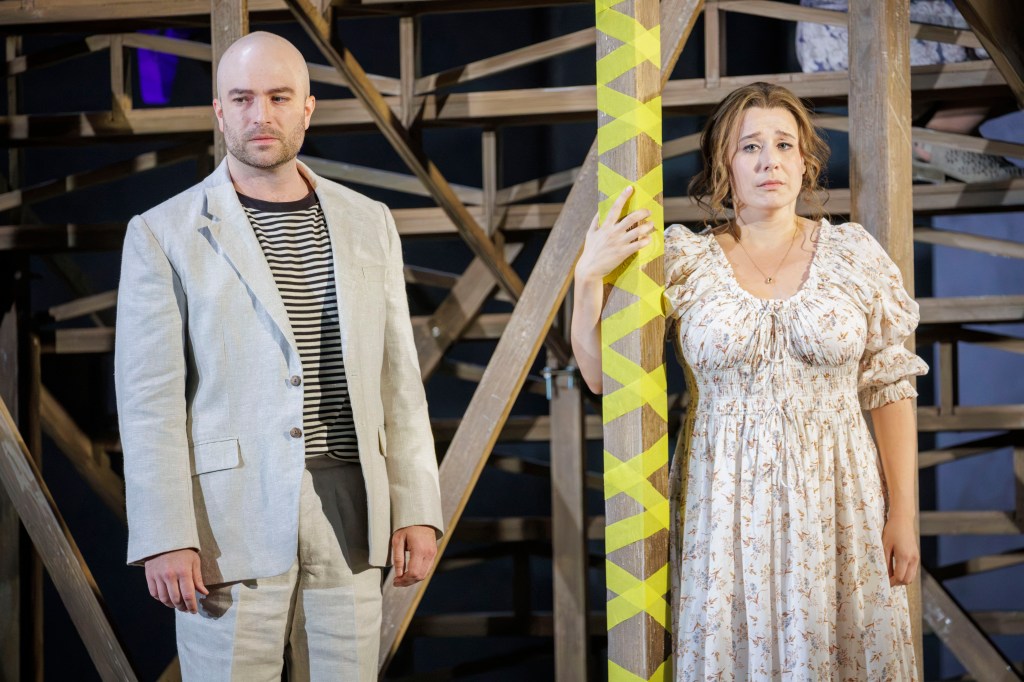
Anyway, Onegin calls to see Tatyana the following day to explain that, were he to be in search of a bride, she would fit the bill, but he was happy being young, free and single. He adds that she should beware of offering herself to any passing man. This comes as a hammer blow to the girl who retreats even further into her books.
Time marches on and winter arrives – so does Lensky, at a party organised to celebrate Tatanya’s Name Day. He has brought with him Onegin who would rather have been anywhere else and begins to flirt with Olga to cheese him off. Not being a subtle chap, Onegin goes well over the top, to such an extent that the two men come to blows and a duel is arranged for the following day. Speaking of a lack of nuance, another guest at the party is Monsieur Triquet, a Frenchman who has come to provide entertainment by singing an ode of praise to Tatyana. His style is a cross between an Elvis impersonator – that’s two in a week for me – and a male stripper, cavorting in front, and on the lap of the hapless guest of honour. I hasten to say that he didn’t go the full Monty, he just looked as though he might.
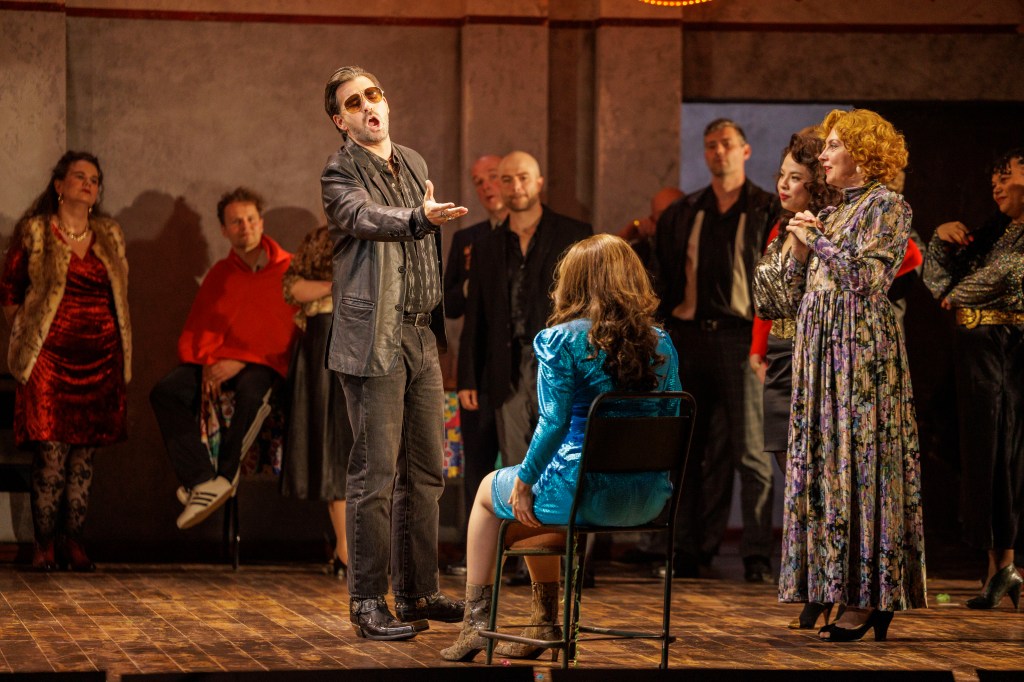
Dawn breaks on the outskirts of town with Lensky and his second, Zaretsky, waiting for Onegin and his second, Guillot to appear. When he turns up the two protagonists have obviously had second thoughts, no pun intended, but, etiquette being what it is, once two men leave to fight a duel, only one can return, or they are publicly shamed. I would like to keep the result a secret so as not to include a spoiler, but that would be impossible as, several years later, after the fall of the Communist Bloc, Onegin returns from his travels and is at a ball where he bumps into Tatanya, now married to Prince Gremin, an aristocrat who appears to have survived the old regime and is doing very nicely thank you. On seeing the now Princess, he realises that he has always been in love with her.
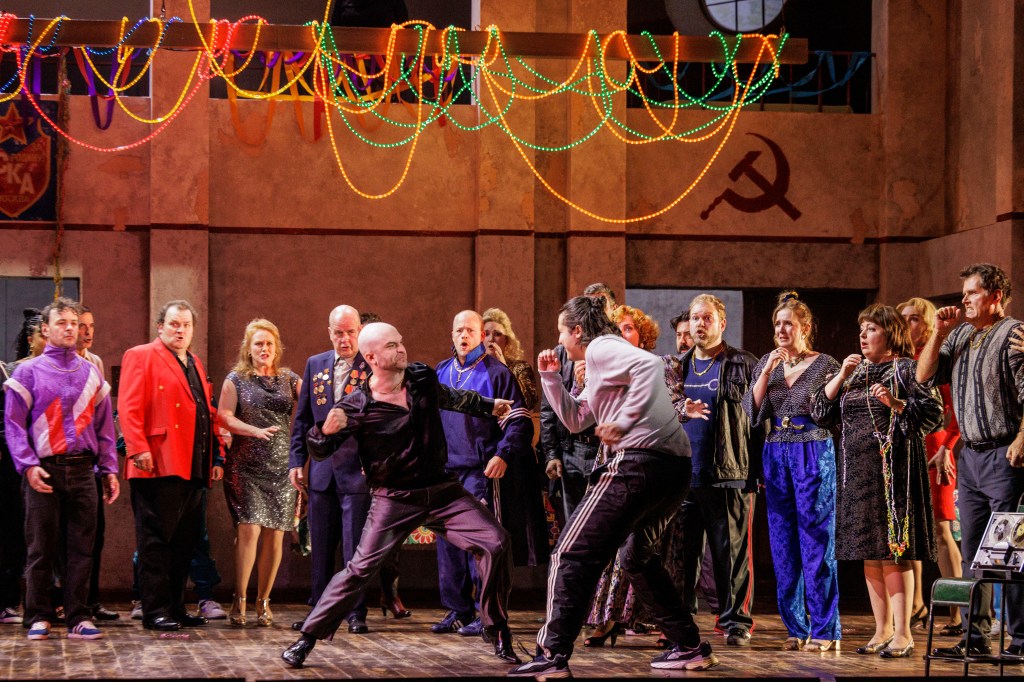
Some time later Tatanya gets a love letter from Onegin asking to meet, which they do. It is now his turn to pour out his heart and he begs her to go with him. Although she obviously still has feelings too, she gives him his marching orders saying that she will honour her marriage vows and remain with her husband.
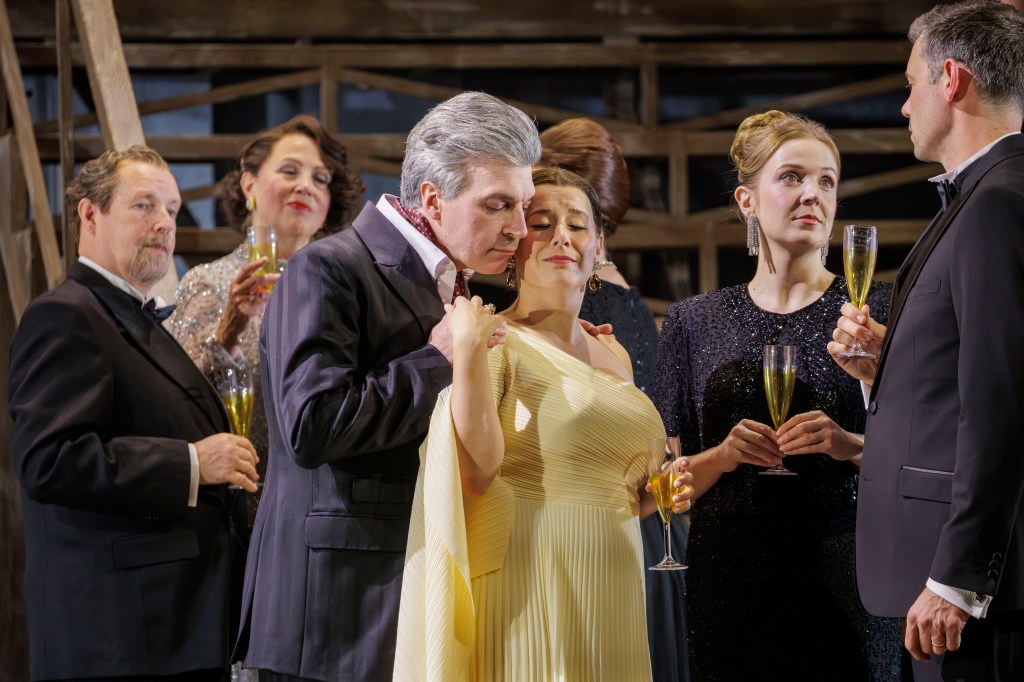
As previously stated I thought that this was a nice echo of the housekeeper’s fate. The difference being that Tatanya could have made the choice to leave but didn’t, whereas Filipyevna’s destiny was sealed by others. Another illustration of the contrasting political situation.
The remarkable thing about this production, was that all four of the main characters were making their Opera North debuts. Act One was almost a one-woman show featuring the amazing Verity Wingate as Tatyana, whose arias, some being very lengthy, were sung to perfection in her beautiful soprano voice. Jingwen Cai’s mezzo enabled her to carry off the more outgoing, worldly aspect of Olga’s personality to a tee.
Caspar Singh, tenor, as Vladimir Lensky and John Brancy, baritone, Eugine Onegin, were stupendous. Their voices covering the changing nature of their relationship superbly well. The camaraderie of the best mates period to the sorrow of its ending, via the trepidation relating to the duel, conveyed with great emotion.
The other performers, whose names are under the photographs, acquitted themselves brilliantly, as did the magnificent Chorus of Opera North, under their Director, Anthony Kraus. Garry Walker, Conductor of the Orchestra of Opera North, exceeded his already high standard to make this the best opera I have seen so far. No mean feat.
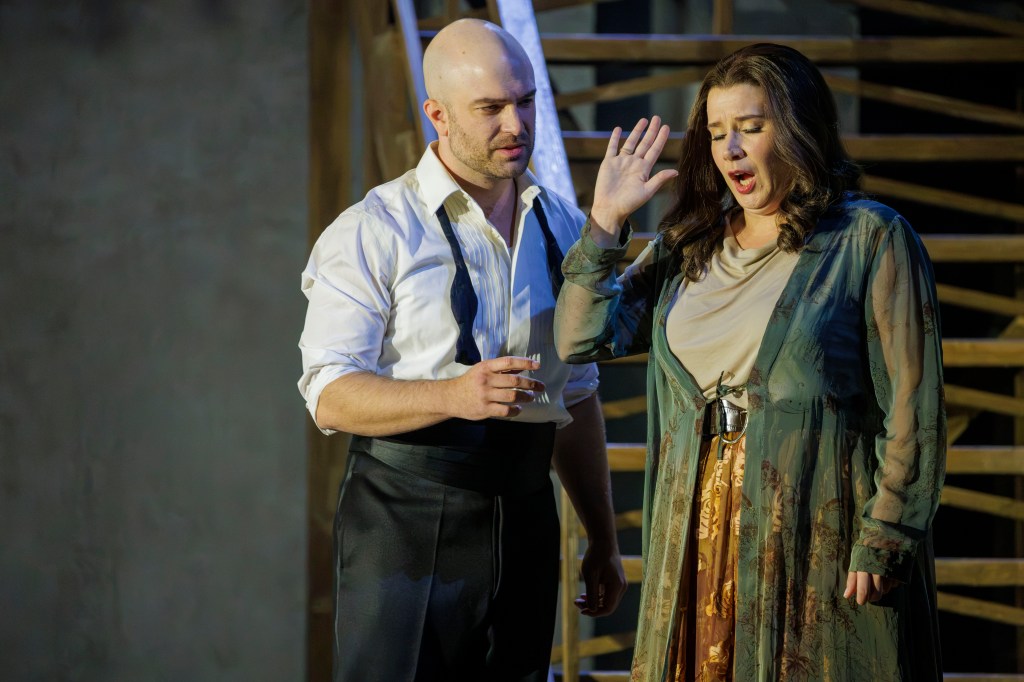
Now for a bombshell – I must admit that I was wrong and so owe the Senior Costume Supervisor, Victoria Marzetti and the Costume Supervisors Mary Gillibrand and Gemma Newsome an apology! The shock is not that I am normally right, it is that being wrong yet again merits a mention. I was thirty years old in 1980 and into fashion so I thought that the costumes were spot on, especially in the first act, when the USSR countries didn’t have access to Western markets so were forced to manufacture knock-offs to try to replicate our styles. A brilliant example was Onegin’s shell suit which was close to the real thing but a bit too flashy, making him look as though he had got it at the Russian equivalent of Peckham Market from Comerade Del Trotterovsky. The subject of my mistake, however, was that the two athletes at the very beginning were clad in red track suits with three stripes down the sleeves and legs. My immediate reaction was one of disbelief that a hardline communist state would allow their athletes to be dressed in Adidas sportswear, although not bearing the leaf logo of the time, which would have been made in decadent West Germany. On checking my facts, I discovered that the USSR did, indeed, commission the brand to supply the national team with high quality kit, so as to be able to compete in the style stakes for their own games. They apparently stipulated that the logo should not be used and the number of stripes varied, but it was indeed Adolph Dassler’s firm who got the contract.
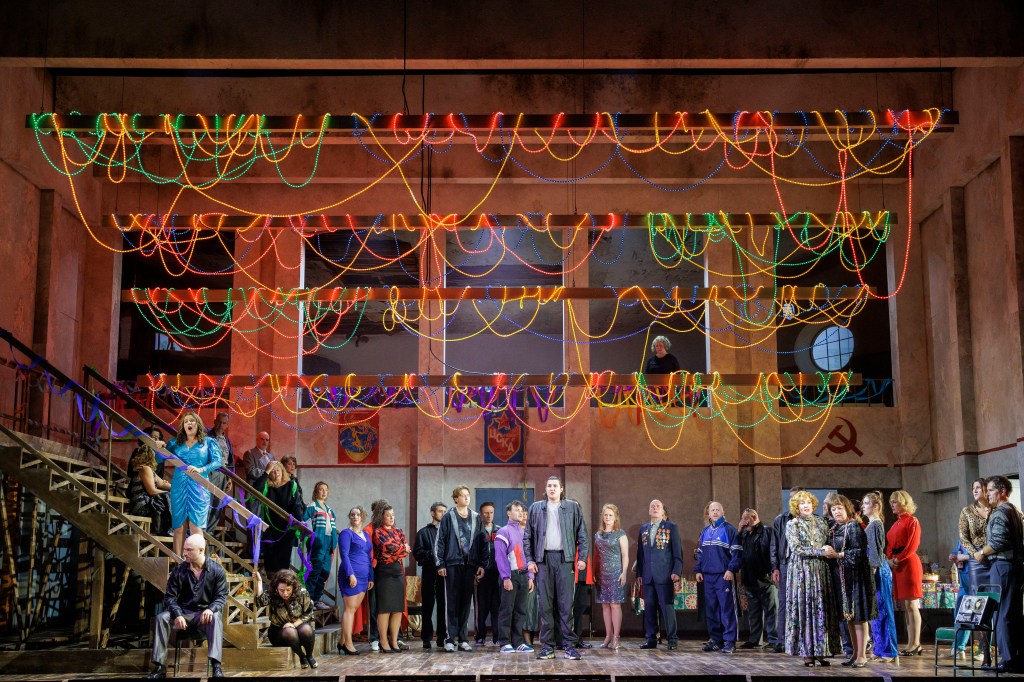
I thought that the set, designed by Leslie Travers, was very impressive, being period correct brutalist rather than flamboyant. It served very well as the sports centre at the beginning and throughout its other incarnations as a party venue and latterly an opulent ballroom, the echoes of the Soviet era being always in the background like a spectre. All were enhanced by Lighting Designer, Malcolm Rippeth.
Maxine Graham, the Choreographer, provided some great moves, covering traditional folk dance through to inventive faux disco moves, echoing the costume theme of being an imitation of Western culture, and all that before the ball.
The Fight Director and Intimacy Coordinator – now there’s a job covering the whole gamut of emotions – was Enric Ortuño.
Regular readers will know that I am not averse to telling those of you who are thinking of going to the opera for the first time, that a production might not be the best one at which to break your duck, but newby or regular, this is a treat.
Eugine Onegin, is a co-production between Opera North, Irish National Opera and Opera Queensland. It runs at Leeds Grand Theatre on various dates until 29th October, 2026, after which it tours to Newcastle Theatre Royal on 7th November; Lowry, Salford Quays on 13th November and Theatre Royal, Nottingham on 18th & 21st November.
For more details and to book for all the above venues, please go to https://www.operanorth.co.uk where you can also see what else is coming from Opera North
Photographs by James Glossop.

