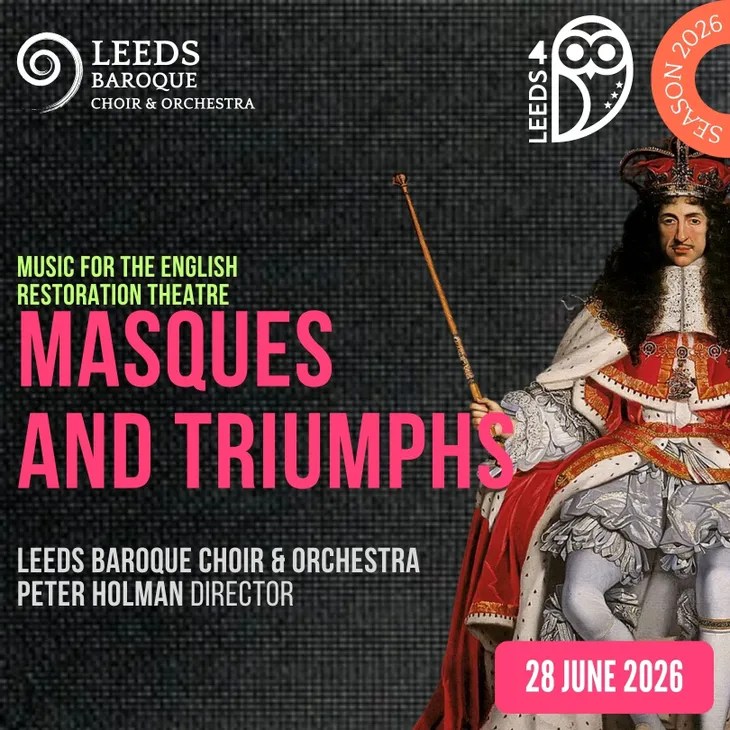
There can be fewer more incongruous places to hold a Baroque concert than The Old Woollen at Farsley, especially one dedicated to music from the Restoration Theatre. This was the period immediately following the restoration of the Monarchy – obviously – after the rule of Oliver Cromwell and The Protectorate, who later went on to form an unsuccessful indie band. Charles II was enthroned as King and, to celebrate the end of eleven years of puritanism, it was party time, with everyone who could afford it, letting rip. Opulence was the order of the day and morals put on hold. So, here we were on a Sunday afternoon in Farsley, in a converted mill with bare stone walls and industrial chic fittings, and, whilst the village, now incorporated into Leeds, has been gentrified beyond all recognition since I lived here in the late 1970s, it is hardly Gomorrah. If it had been I might not have moved to Moortown.
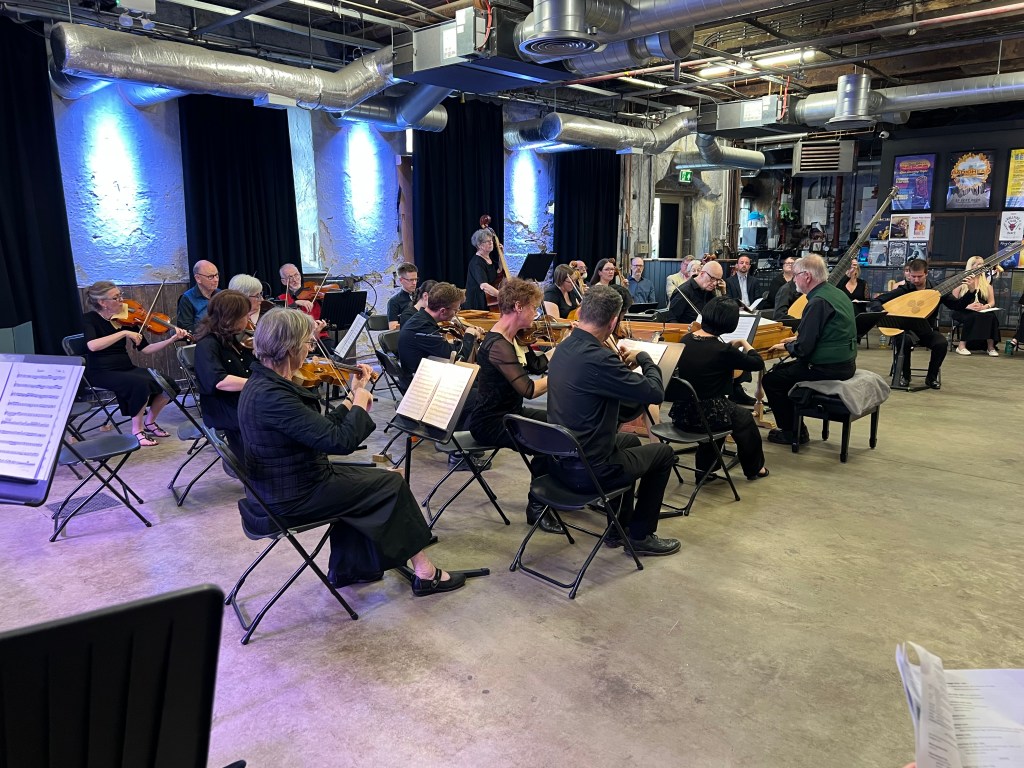
The Leeds Baroque Choir and Orchestra in the less than salubrious surroundings of The Old Woollen
What I really like about the concerts from Leeds Baroque Choir and Orchestra is the integrity and respect afforded to the pieces in the programme. They are played in a style as close as you can get to the original, thus giving a feel of the period, unlike some of the classic theatre on offer nowadays, where the action, dialogue and even the characters, are ‘reimagined’ to make them accessible to modern audiences. Will anyone ever see an original production by Shakespeare again, without going to the Globe or Stratford, and even then will it be in period costume. I don’t for one moment suggest that the aforesaid ensemble dress in Seventeenth Century garb, although an ill-fitting cod piece may be of some assistance to the odd countertenor in reaching the really high notes.
As usual, the Choir Master was Bryan White and Peter Holman, the Orchestra Director who also compèred the concert, which comprised fifteen pieces covering both choral and purely instrumental works, beginning with some from The Tempest, or The Enchanted Island (Thomas Shadwell after Shakespeare, 1674).
The first piece was, unsurprisingly, Curtain Tune, an old term for overture, by Matthew Locke (1621/22-1677) – that must have been some labour period for his mother. There then followed pieces by Pelham Humfrey (1647-1674), The Masque of the Devils; Pietro Reggio (1632-1685), Arise, ye subterranean winds; J.B. Lully (1632-1687), Dance of Winds; John Bannister (1630-1679), Go thy way (The Echo Duet) which involved two singers doing what it said on the tin; and Matthew Locke’s The Conclusion, obviously ending the section.
Mr Locke then hogged the limelight with Dialogue of Despairing Lovers from Phsyche by Thomas Shadwell, telling of the fate of four lovers who die by various methods: the first falls on his sword, the second kills herself with a dagger, a third is drowned in the sea and the fourth is saved the trouble of devising a method of suicide, as they ‘quietly expire’. A bit like the warranty on your car just before the timing chain breaks and destroys the engine.
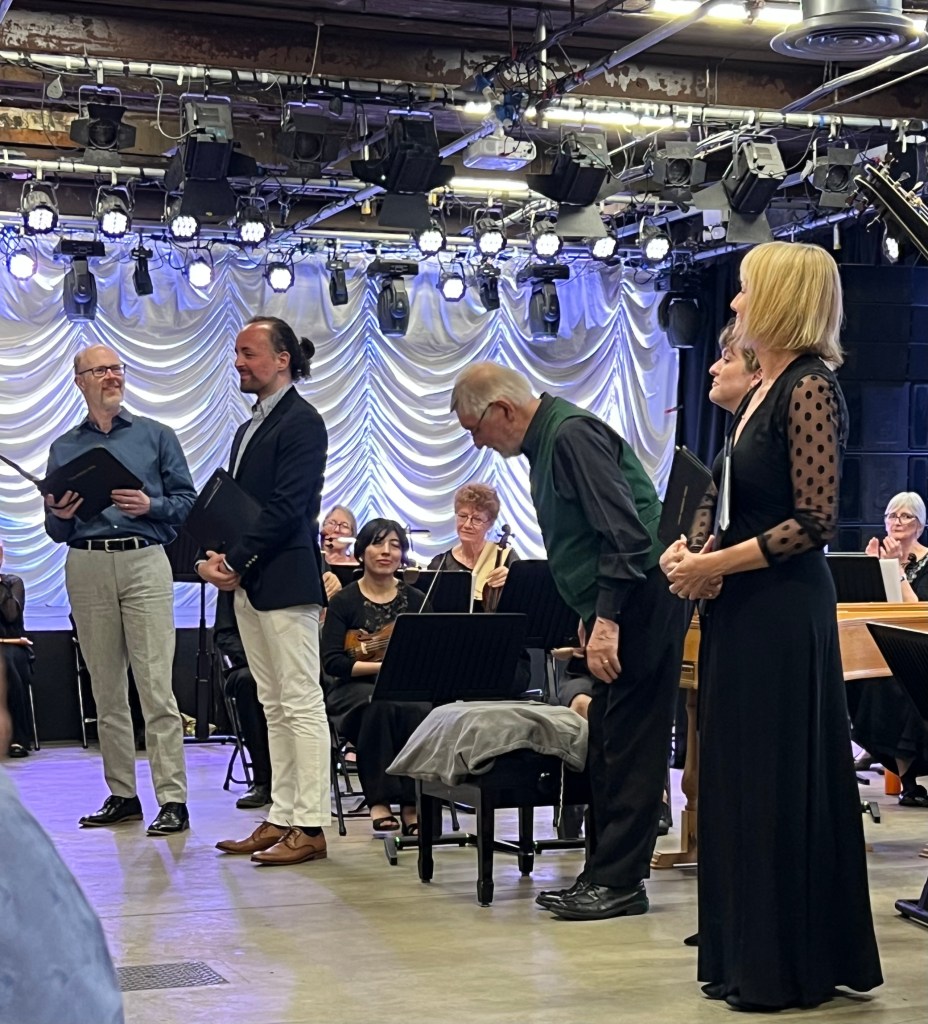
The four singers involved in Dialogue of Despairing Lovers, with Chorus Master, Bryan White, on the left and Director of the Orchestra, Peter Holman, who played harpsichord, centre. The others are Mhari Sharp, Emma Page and Zachary Kleanthous. No despairing lovers were harmed in this performance.
Logic went out of the window next, with Matthew Locke signing off for the day with another Curtain Tune, this one in C major, from an unknown play. It did, however, introduce the final piece before the interval, which was written by Louis Grabu (fl 1665-1693), Chaconne from Albion and Alanius, written in 1685 by John Dryden. To save you looking up what ‘fl’ means, it is the period in which the person concerned was known to be active, usually used when their exact dates of birth and death are not known – you’re welcome.
After the interval there came another Overture in C Minor, this one from Iphigenia (John Dennis, 1699) written by Gottfried Finger (c. 1655-1693). The only known source of this work is in a set of part books copied by an unknown musician in 1700, which are now kept in Leeds Museum.
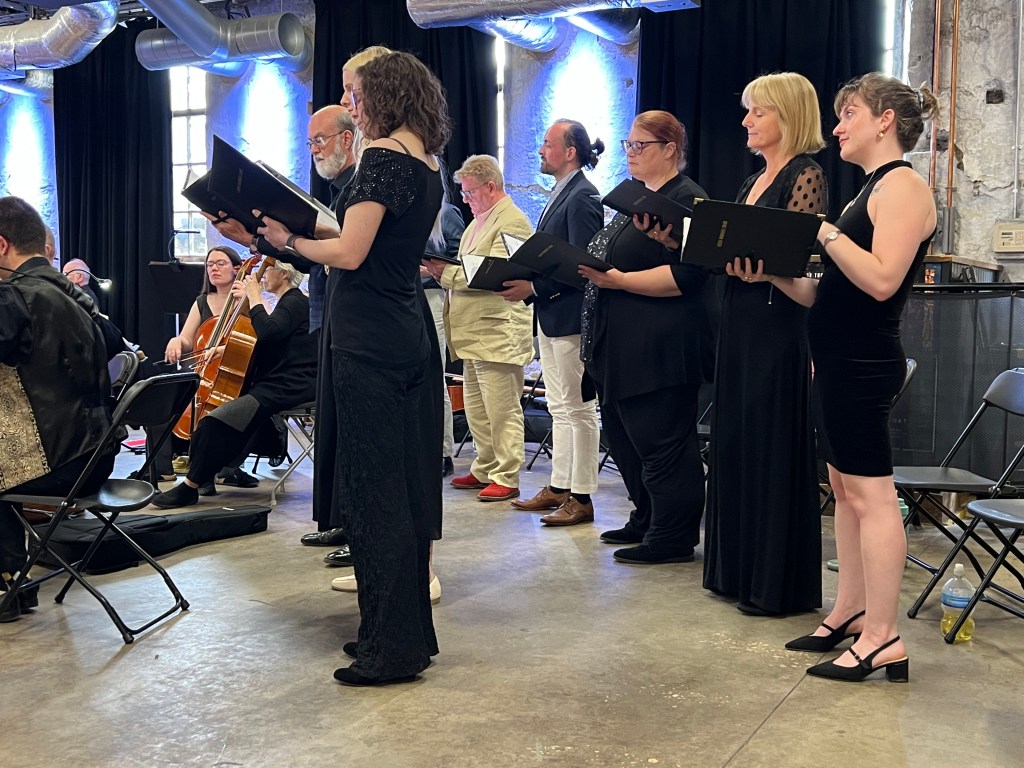
The Choir
We then moved on to The Temple Scene from Bonduca (after John Fletcher, 1695) composed by Henry Purcell (1658/59-1695) – another birth necessitating copious amounts of towels and boiling water.
Purcell also wrote the next piece, As soon as day began to peep, from Love for Money (Thomas D’Urfey, 1691), another rarity which was only discovered last year as a fragmented song-sheet which was reconstructed by Alan Howard and, as it has not yet been published, this was the first known performance in over 350 years. The play must have been a comedy as the song was performed for us by Zachary Kleanthous as Monsieur Le Prate, a French fop, as a serenade to his intended belle, Betty Jiltall. With a name like hers I don’t fancy his chances. I make no comment on his moniker.
It was back to The Tempest, this time with a selection of songs by John Weldon (1676-1736), before Chaconne from Rinaldo and Armida, (John Eccles 1670-1735), who I think are the Portuguese twin strikers in the World Cup.
Back to Henry Purcell for the big finish, Scene of the Drunken Poet, from The Fairy Queen (after Shakespeare, 1692). As its name suggests, it is about a poet, obviously having just composed an ode to Brahms and Liszt, who is being tormented by two fairies – behave! Bryan White sang the part of the wordsmith, a little too convincingly if you ask me, whilst Nicki Sapiro and Liz Moran, as the nymphs, gave him a hard time, until they got fed up of playing games with him and left the poor chap to sleep it off. He should have just about recovered from his hangover by now.
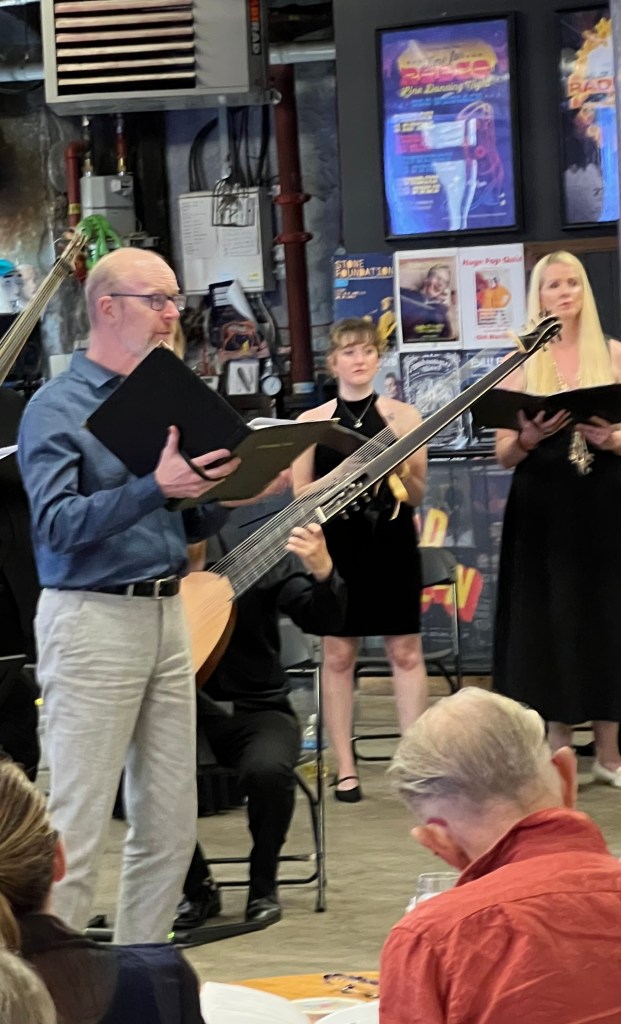
Bryan White as The Drunken Poet, with Nicki Sapiro and Liz Moran as The Fairies
Once again, this was a great performance by Leeds Baroque Choir and Orchestra, of a programme which catered for all levels of knowledge, with Mr Holman’s explanations of the works being understandable to the novices, such as myself whilst, I am sure, informative to the aficionados in the audience.
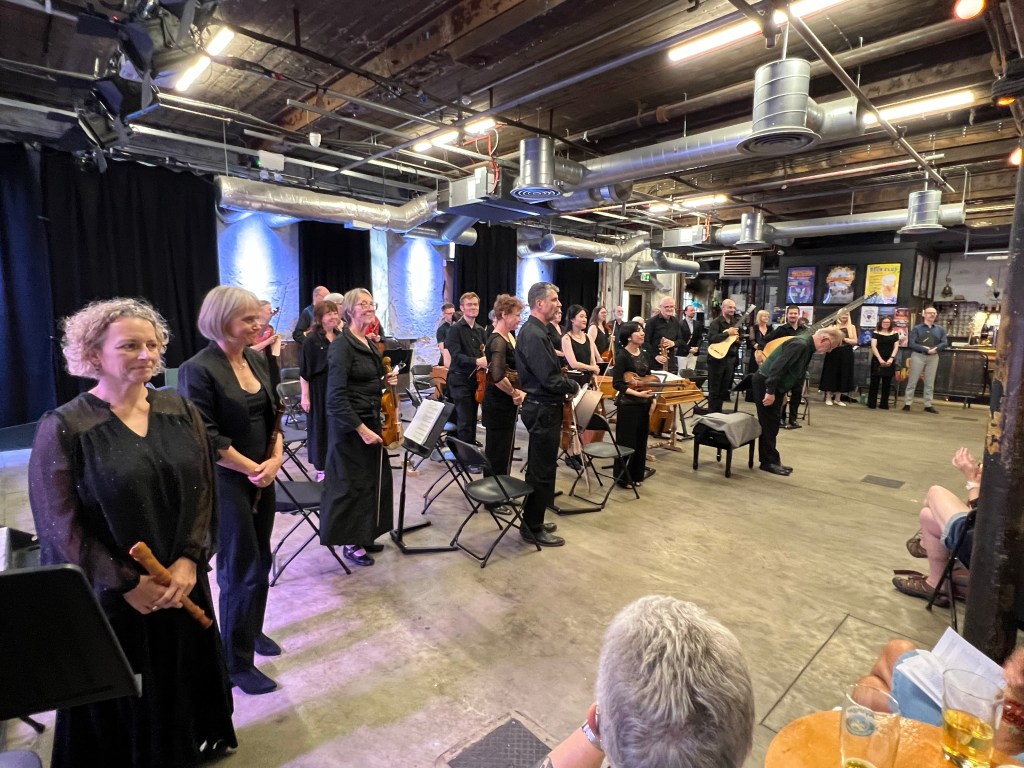
The Choir and Orchestra take a well-deserved bow
I end with great news!!!! Normally, the concerts are one-offs so you don’t have an opportunity to derive the same pleasure as I did from the performance, this one, however, will be repeated on Sunday, 27th September, 2026. Not only that, it is being done as part of the celebrations for the 400th Anniversary of Leeds being awarded City status – but wait – there’s more! (as they say on those tacky tv adverts). The September gig is not in a converted mill, but the far more appropriately opulent surroundings of Temple Newsam House. So, why not make a day of it and stroll round the house and grounds, before going inside to listen to a talk from Professor Alan Howard (Welwyn College, University of Cambridge), yes, he who found the manuscript, about the pieces you will be hearing and then witnessing the concert in all its glory. No need to thank me.
The concert starts at 3.00pm with Prof. Howard’s talk at 2.00pm. For full details and booking, please go to https://leedsbaroque.co.uk/concerts
Photographs by Stan Graham

