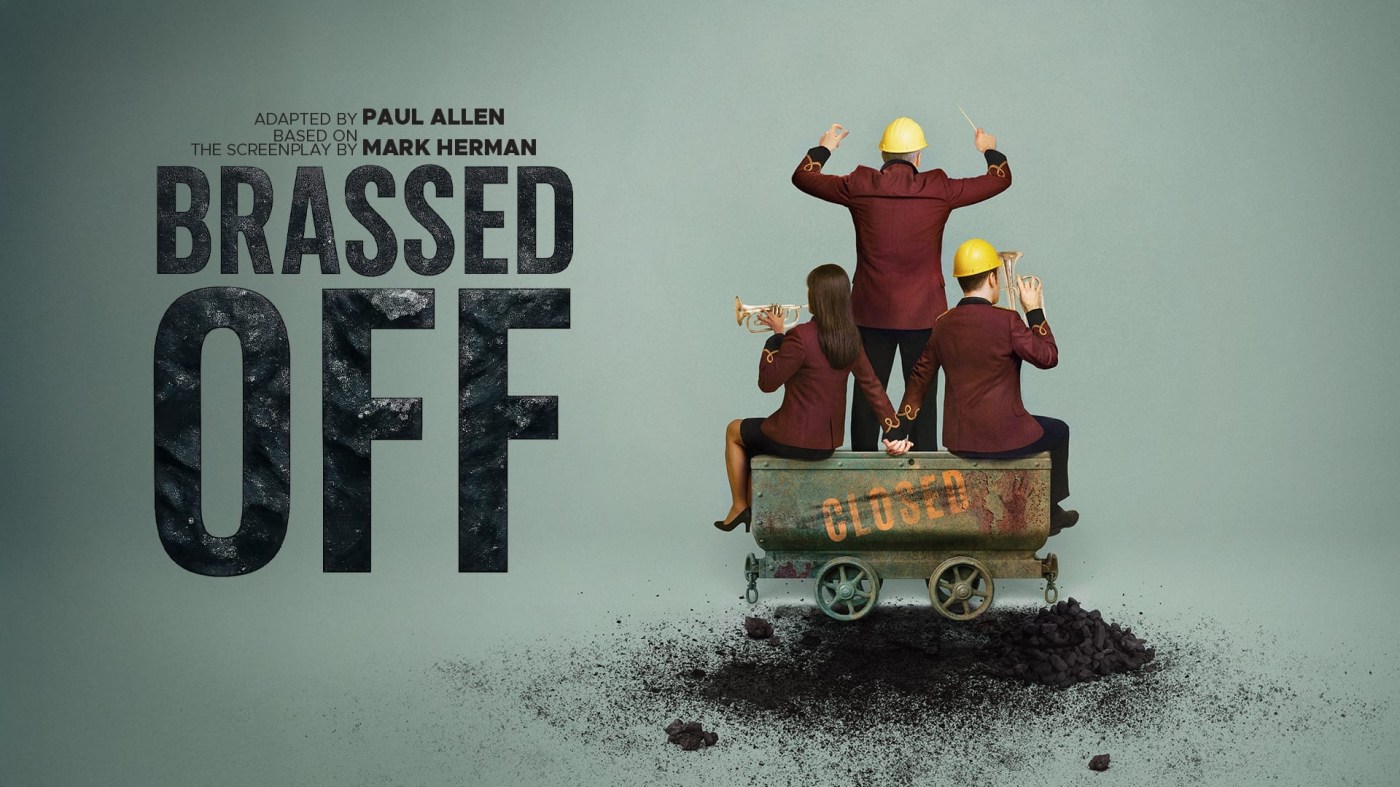
I usually try to post my reviews within a couple of days of seeing the work, but, as this play runs until 11th July, and I don’t have an editor screaming at me, I thought I would take an extra day or two to do it justice. It is always difficult reviewing a piece which is rooted firmly in a specific time when the atmosphere and attitudes were very different from what they are today, especially when the play itself is looking back at the events of twenty-five years previously. To get the most from seeing Brassed Off, and you really should see it, I thought a bit of background information might help. I won’t be offended if you decide to skip the next half dozen paragraphs – mainly because I won’t know.
Although set in the aftermath of the coal miners’ strike of 1984/85, the roots of Brassed Off were from ten years before that when the National Union of Mineworkers, under President, Joe Gormley, imposed an overtime ban in November 1973, causing energy shortages necessitating national power cuts and a three-day working week. After a 28-day strike in February 1974, the Conservative Prime Minister, Edward Heath, called a general election which was won by the Labour Party under Harold Wilson, whom Heath had defeated in 1970. Because in those days, the coal mining industry was nationalised and the ultimate employer was the state, Wilson immediately gave the miners what they were demanding – a 35% pay rise! I told you things were different in those days.
Encouraged by this, and there being few laws governing strikes, unions were calling walk outs all over the place with no notice given, so you might be waiting for a bus, only to find the drivers had gone home. It was lottery as to whether your newspapers would be published, your bins emptied, your deceased loved ones buried or your train turning up – no change there, then. Less immediately impactful disputes involved steel works, ship yards and, round Leeds, the tailoring industry. The pay rises awarded to end the strikes caused hyper inflation and the country was in financial melt down. The reputation of the unions amongst the general population was in tatters, as those workers not in a union fell behind.
In 1979, there was another general election, which was won by the Conservatives under the leadership of Margaret Thatcher, someone who was pro-privatisation and anti-union. Three years later, Joe Gormley stepped down and was replaced by Arthur Scargill, a militant Socialist, vehemently opposed to the new government’s plan to close down 20 ‘uneconomic’ pits. This created the perfect storm between Thatcher, whose cabinet was made up of like-minded members, and Scargill, who effectively ran the union single-handedly and, emboldened by the outcome of the 1974 action, called the 1984 strike without actually having held a vote to see what the members thought; an action subsequently ruled illegal as it had not followed the NUM’s own rules. It soon became obvious that this was to be a personal feud, with neither party willing to give in.
Unlike the first dispute, which, due to the overtime ban starting in November 1973, thus depleting the coal reserves over the winter months so making an immediate impact, the 1984 strike started in March with customers having plenty of stock and experiencing less demand for energy over the summer months. There had also been a switch to other means of generating electricity rather than by traditional coal fired power stations. After a year of hardship caused to the miners and their families, the NUM held a special conference on 3rd March 1985 where they narrowly voted to call off the strike. Their members returned to work two days later with nothing to show for it.
That is a basic summing up of the situation as I saw it. Being in my mid-twenties during the first strike and, obviously, my mid-thirties during the second, my memories are fairly vivid.
To illustrate the scale of the closures, the number of which had now been increased well beyond the original twenty, at the beginning of the 1984 strike, there were 174 deep coal mines in the UK but by the time the film of Brassed Off was released in 1996, there were 15. The last main deep pit, Kellingley Colliery, shut in 2015, leaving only three small niche sites, which is why I pointed out that the play is now purely an historical work rather than a call to arms to prevent further closures.
Welcome back if you skipped the previous six paragraphs, and thank you for sticking with me if you didn’t.
Obviously you can only have a coal mine where there is coal to be mined, so the small towns and villages concerned were tight-knit communities where the inhabitants, for several generations, both worked and played together – literally in the case of those which formed brass bands to fill their leisure time. Such was the situation in Grimley, where this piece is set.
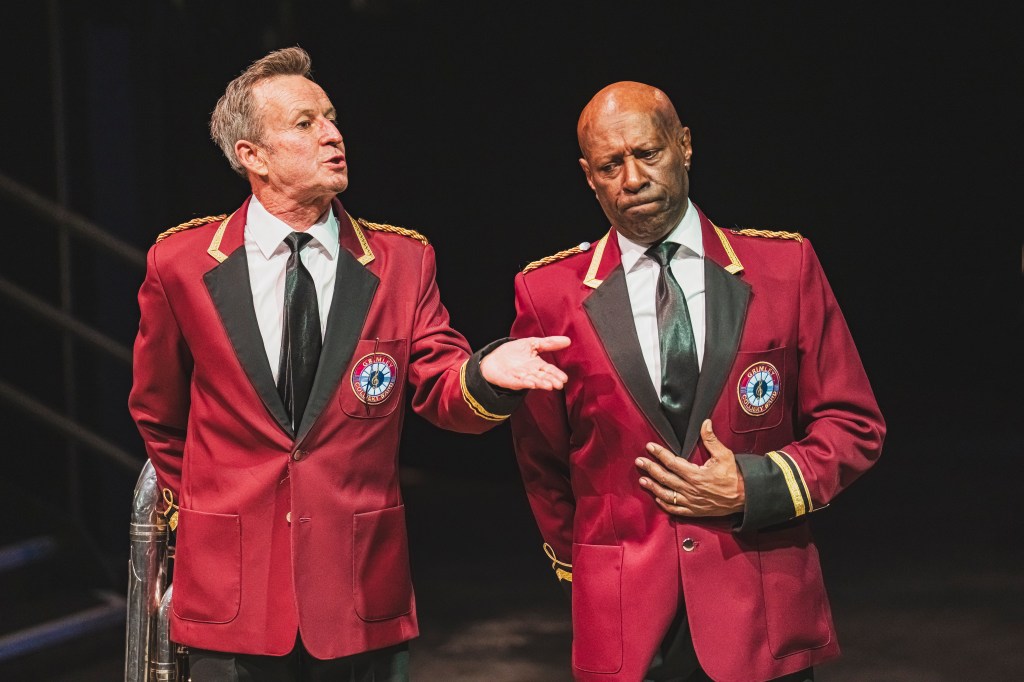
Andy Cryer as Jim discusses a strategy to stay in the band with Harry, Ewen Cummins, despite being told to resign by their wives.
The story revolves around three married couples, each of which is suffering financially from the aftermath of the 1984/85 miners’ strike; the first two, Harry and Rita and Jim and Vera, are just about getting by, although the wives are putting pressure on their husbands to drop out of the brass band to save money, whereas the third, Phil and Sandra, who have three children are destitute, mainly because Phil served a jail term for his part in a disturbance during the strike and so was not earning for a long period. His father, Danny, is the leader of the Grimley Colliery Brass Band and determined that they continue through the hard times with a view to qualifying for the National Brass Band Championships. A secondary plot involves the youngest member of the band, Andy, who becomes besotted with Gloria, a young woman who has just arrived in Grimley and asks to join the ensemble as a flugelhorn player. Outsiders are prohibited from membership but it transpires that she is the daughter of a miner from Grimley, who moved away when she was just a girl. Once this is explained, memories about her father stirred and an audition passed, she is welcomed into the fold.
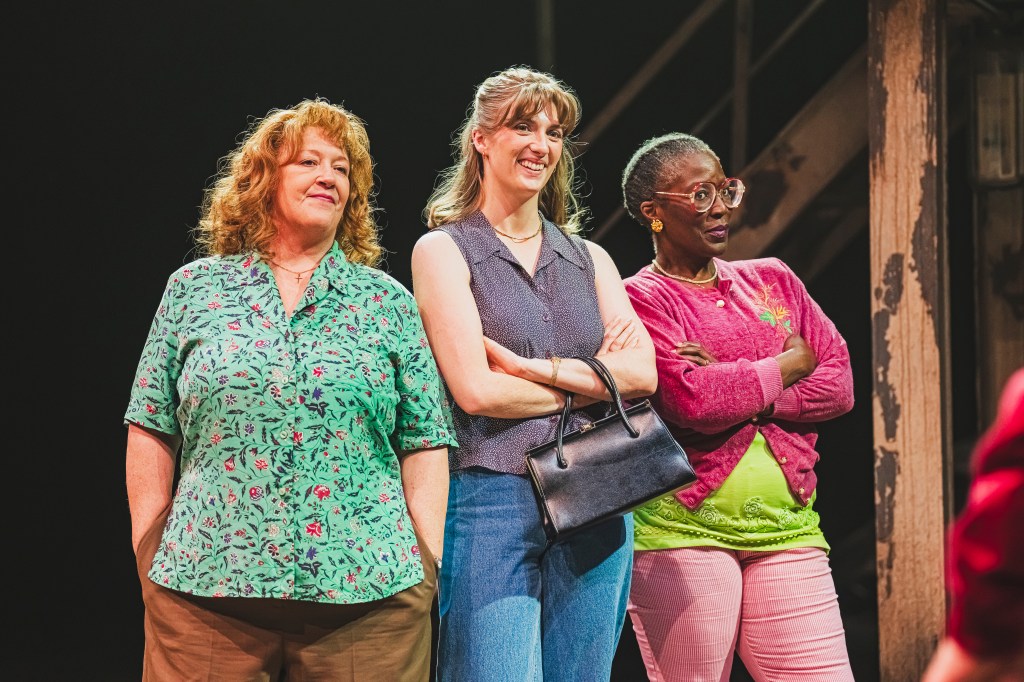
The real power brokers; Wendy Albiston as Vera, Maddie Hansen, as Gloria and Pauline Tomlin, Rita.
Meanwhile, Phil’s world is falling apart, they have very little money coming in, despite his efforts to make a living from being a children’s party clown, then, after several visits by the bailiffs to remove their belongings, the house is repossessed. Sandra takes the children and moves in with her mother, causing Phil to attempt suicide, fortunately, unsuccessfully. Danny, is in hospital having collapsed, suffering from the incurable black lung disease, or coal workers’ pneumoconiosis.
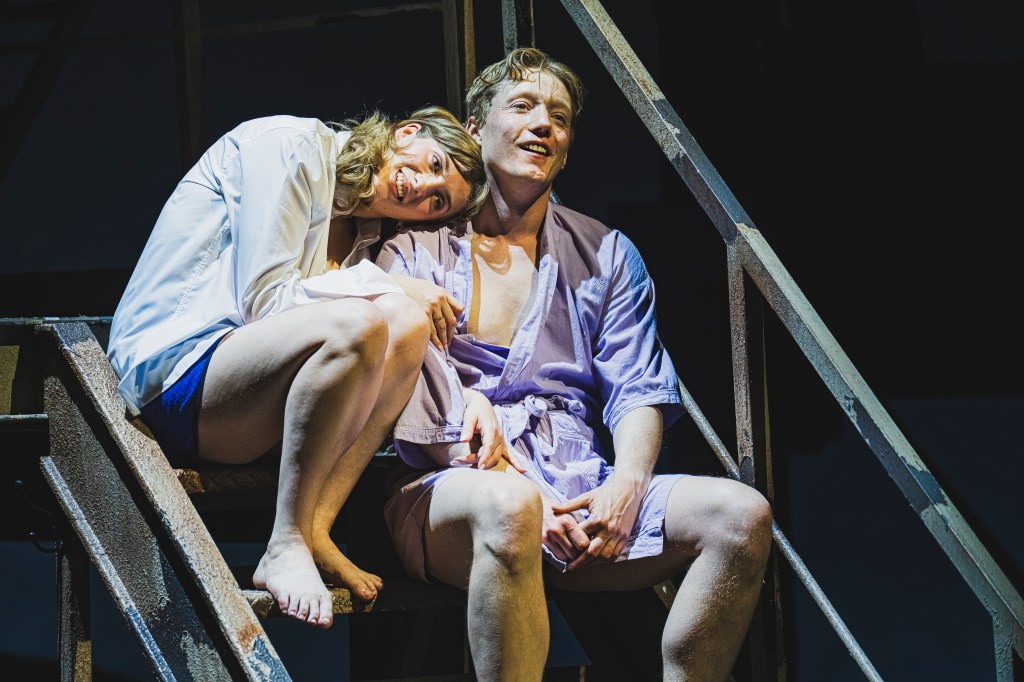
Love’s young dream – for the moment. Maddie Hansen as Gloria and Frazer Hadfield as Andy.
The young romance is thrown into turmoil when it turns out that Gloria, who has obtained a degree, is now working as a surveyor for the National Coal Board and been sent to Grimley, ostensibly to compile a report as to the pit’s viability. She is shunned by the community who accuse her of either naivety, in not realising that her mission was purely a box-ticking exercise with the decision to close already made, or complicity in the process. The situation is resolved when, after a conversation with her boss in London, she realises that the miners were correct in their analysis of the closure being earmarked despite her survey, which had not been read by the manager, showing ample reserves in the mine. After admitting her error of judgement, she is reservedly welcomed back into the fold. He musical proficiency also being a factor.
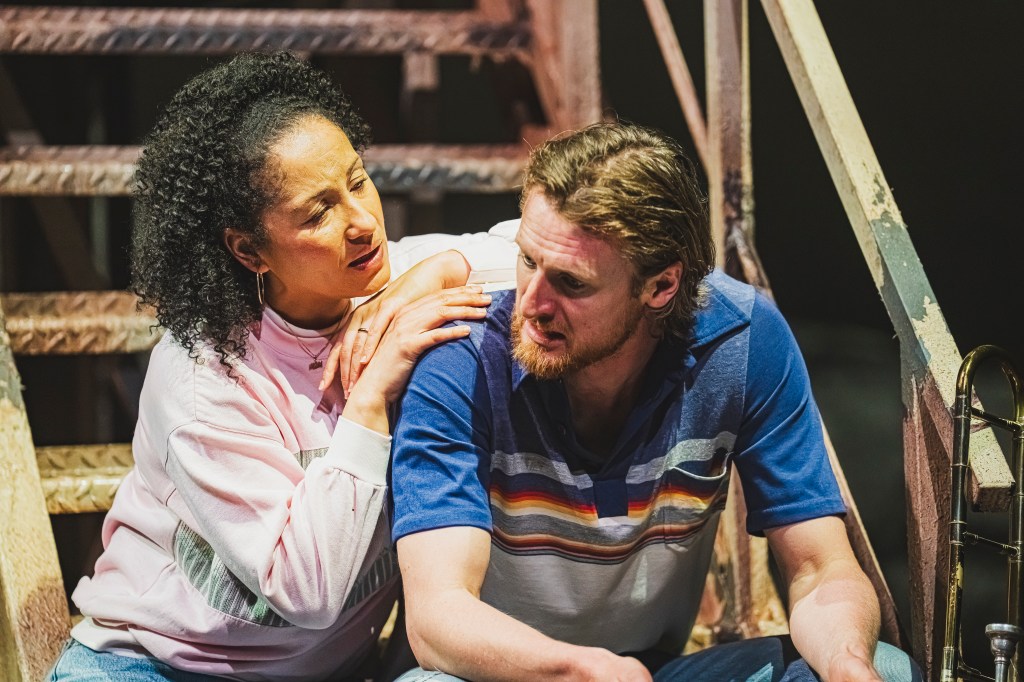
Danielle Henry, as Sandra, has a heart to heart with husband Phil, Robin Morrissey, a man on the edge.
As happened with the other pits, the workers were offered a redundancy package, comprising, £20,000 should they accept, which dropped to £15,000 if they chose to go to appeal, which was loaded against them. The vote appeared to be on a knife-edge until the voluntary sum was increased to £23,000, causing acceptance by a majority of four to one.
Despite the dark synopsis, you will be pleased to know that all ends well, with people finding redemption and re-evaluating their priorities. Oh, and winning the Brass Band Competition, something which was obvious, even to those unfamiliar with the film or stage play.
The concentration on individual stories humanised, rather than politicised, what was a general narrative at the time. Don’t get me wrong, there were the goodies and the baddies, otherwise there wouldn’t have been any point in the play at all, but this well worn practice was enhanced by the copious amounts of humour and, most importantly, brass band music.
Given the situation, the comedy was mainly blokeish banter, although the women were not found wanting in this department either, and included lots of brilliant insults and putdowns. There was also more than a hint of gallows humour, what with the physical and financial threats hanging over the characters, in Phil’s case literally.
The music was played live on stage, which served as both rehearsal room and Royal Albert Hall! The players were made up from the members of two ensembles; Horbury Victoria Brass Band – established in 1866 – and Wakefield Metropolitan Brass Band, 1977. The effect was stunning with the admission price more than covering the music on its own. There was everything from Land of Hope and Glory to The Floral Dance.
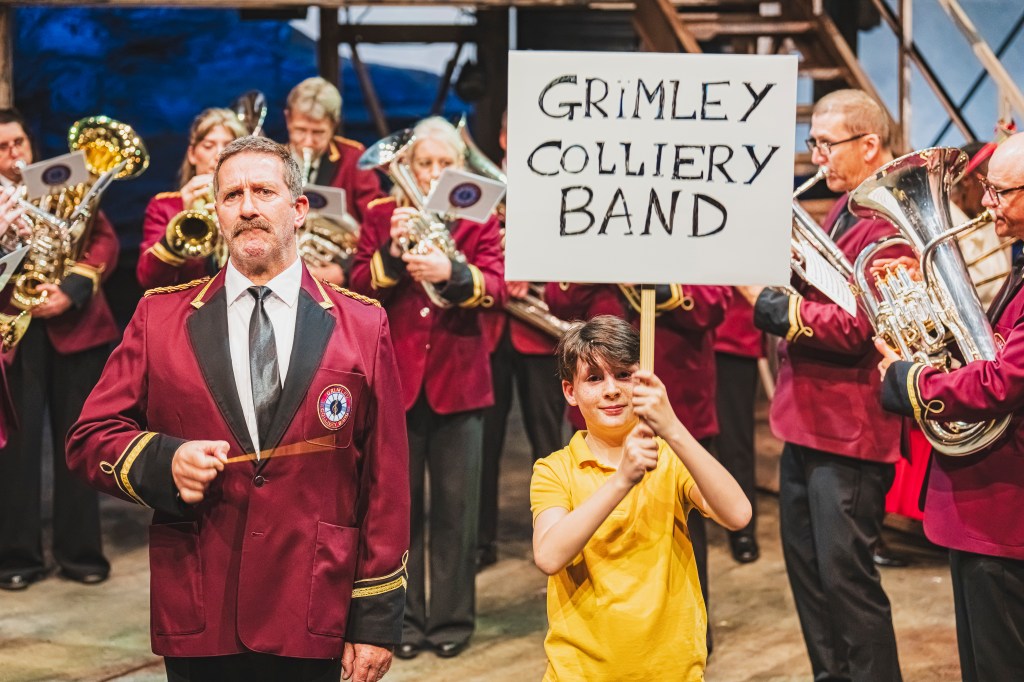
David Birrell as Andy, conducts the band in a contest at Staleybridge.
The acting was superb, reflecting the tension of the situation by switching instantly from bawdy comedy to full blown aggression when the odd ill-judged word was used. It just as quickly reverted, before transforming to pathos. Harry, played by Ewen Cummings, his wife Rita, Pauline Tomlin, along with their mates, Jim, Andy Cryer and Vera, Wendy Albiston, were especially hilarious, their chemistry palpable. Robin Morrissey, as Phil, fell apart before our eyes, disintegrating as he found it impossible to support his family, especially when faced with the choice of home life and music. Dannielle Henry played the hapless Sandra who also had a choice to make between husband and children, whose roles were filled by members of the Young Company on a rota basis. David Birrell took the part of Danny whose motivational talks to the band members, would have got him a managerial job with any Premier League team. Finally there were the young lovers, Frazer Hadfield as the gauche Andy, who still remembered his childhood fumblings with Gloria, Maddie Hansen, the, now Yuppie, woman who still couldn’t shake off her roots. Stacey Ghent played Barbara and the Nurse.
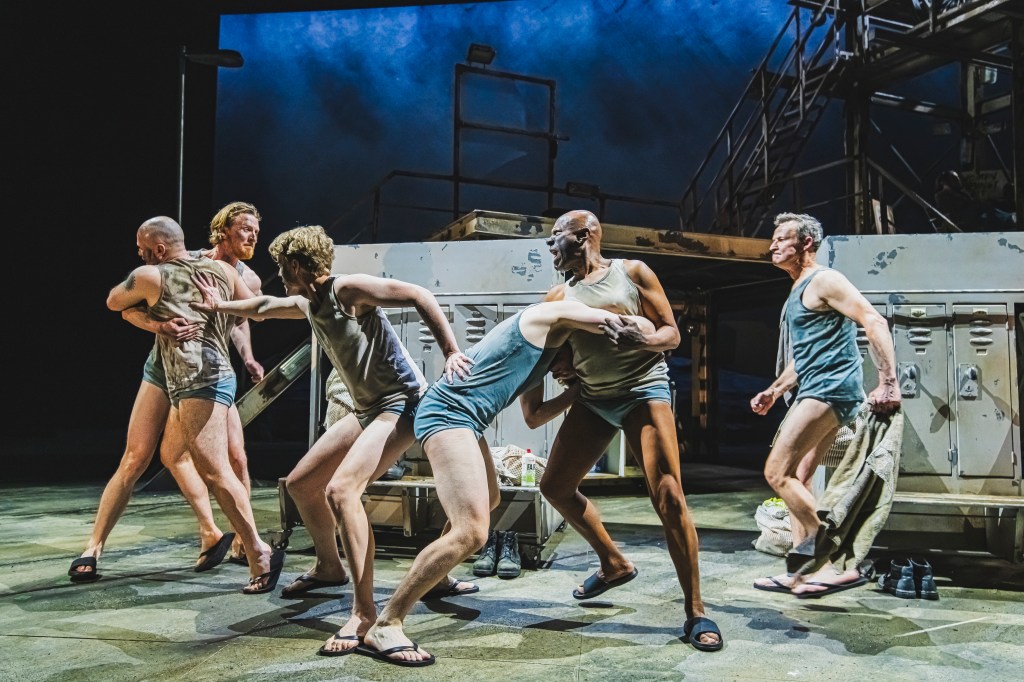
An altercation between Phil and Harry, being kept under control by their workmates.
I must also praise the creatives involved, especially Designer, Katie Scott, whose set was a masterpiece, in its versatility and scale. The winding wheel, supported by the headframe, was very realistic constantly looming over all of the action, turning to signify when the mine was working, but stopping on its closure. The cage, which lowered the miners down the shaft to the coalface was, obviously, beneath it but was rotated to serve other purposes. Lockers were smartly moved onto the stage to act as the changing room. Jai Morjaria was the Lighting Designer, John Riddle, Sound Designer, and the Musical Supervisor was Jonathan Mitra, who, as well as looking after the brass band music also threw in the obligatory Billy Bragg tune.
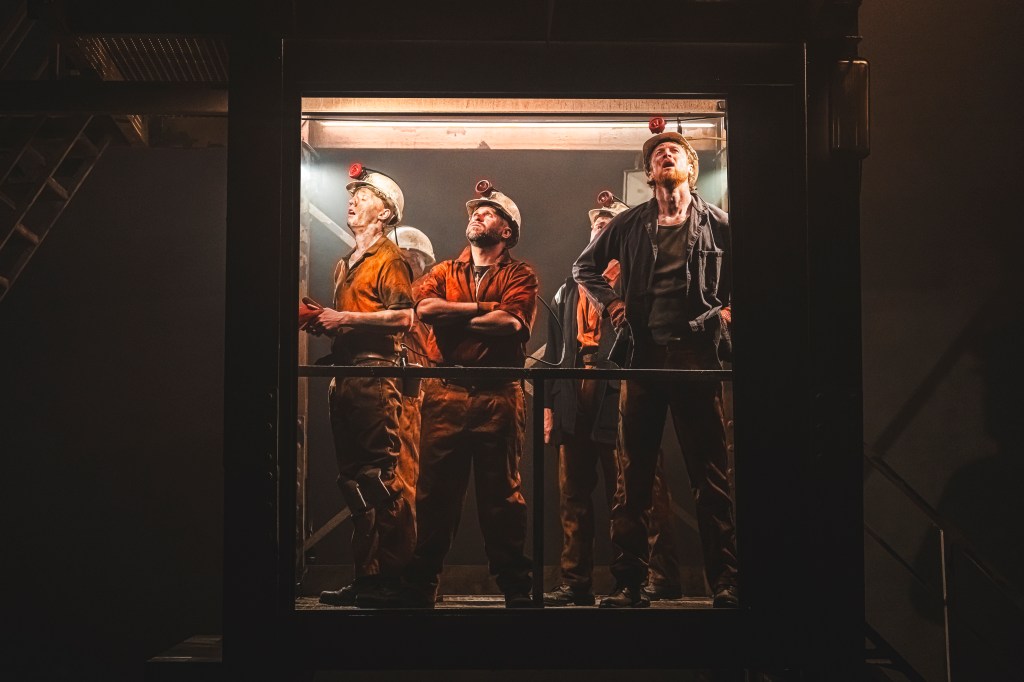
The cage bringing the miners to the surface.
Paul Allen was the Adapter of Mark Herman’s original screenplay and the director was Amy Leach, who was a little more restrained in her ‘reimagining’ than usual. She must have taken heed of the opening ear-bending given to Andy by Danny after the first run through of The Floral Dance, saying something like ‘I didn’t hear any quavers, they are there on the music, do you think you know better than the composer what he wanted. If there are quavers, play quavers!’ Tonight there was only the odd directorial crotchet and minim slipped into the piece, rather than the whole tune being altered.
I really recommend that you go see this play if you have the opportunity because it works on so many levels, at least one of which will hit the spot, especially the brilliant music. It runs until 11th July and there are matinees, although they seem to be very popular, so get booking fast. For more details of this show and to book, please go to https://www.leedsplayhouse.org.uk/event/brassed-off/
For other productions at Leeds Playhouse it is https://www.leedsplayhouse.org.uk/whats-on/
Photographs by Kirsten McTernan

