We Brits have always known how to do large scale state events. The recent Royal Funeral and Coronation show that we don’t mess about when it comes to marking momentous points in our history, so, as you would expect in a period of flamboyance such as the Baroque era, they were given the full treatment.
The pieces in question not only covered coronations, but events such as the victory over the Dutch in 1666, this was naval battle rather than the kind of defeat we inflicted on West Germany exactly 300 years later, which triggered celebrations of a more spontaneous, although equally enthusiastic kind. Speaking of which, there was an added item to the programme at the end, which you will find mention of in the same place on this review.
Sadly, the wonderful soprano, Philippa Hyde could not appear as she had been struck down with a cold, so the other choir members gallantly stepped up to the mark to make sure that the show went ahead. Get well soon Ms Hyde – I am sure that you are an avid reader of this blog!
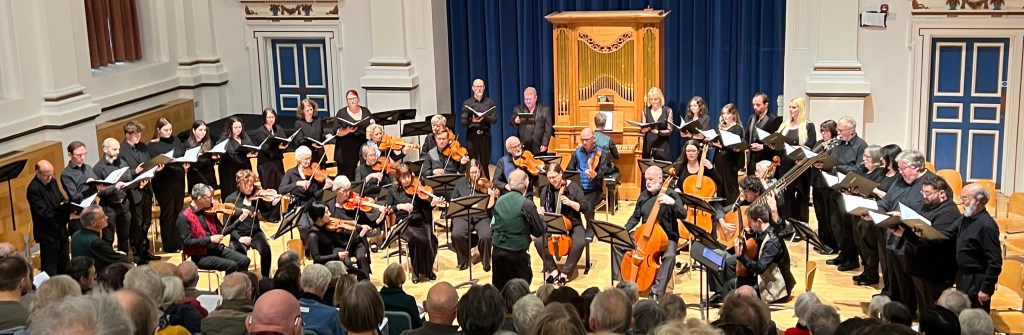
The first piece was the one written by Matthew Locke to commemorate the aforementioned sea battle, Be thou exalted, Lord. As with most of the works today it involved the whole orchestra and chorus, this one in five separate groups. In those days, before streaming, and even quaint CDs, composers were reliant on patrons to fund them, most of whom would have been the upper classes and royalty, so landmark occasions such as this were used as a showcase to attract potential investors. Hence the full monty.
The next offering was, God spake sometime in visions, by John Blow, for the Coronation of James II on 23rd April, 1685. Again this featured the whole orchestra along with solo singers. To my untrained ear it could have been a continuation of the first work in that the triumphalist air was at the forefront. Perhaps another entrant in the period’s equivalent of Britain’s Got Talent to garner favour with potential backers.
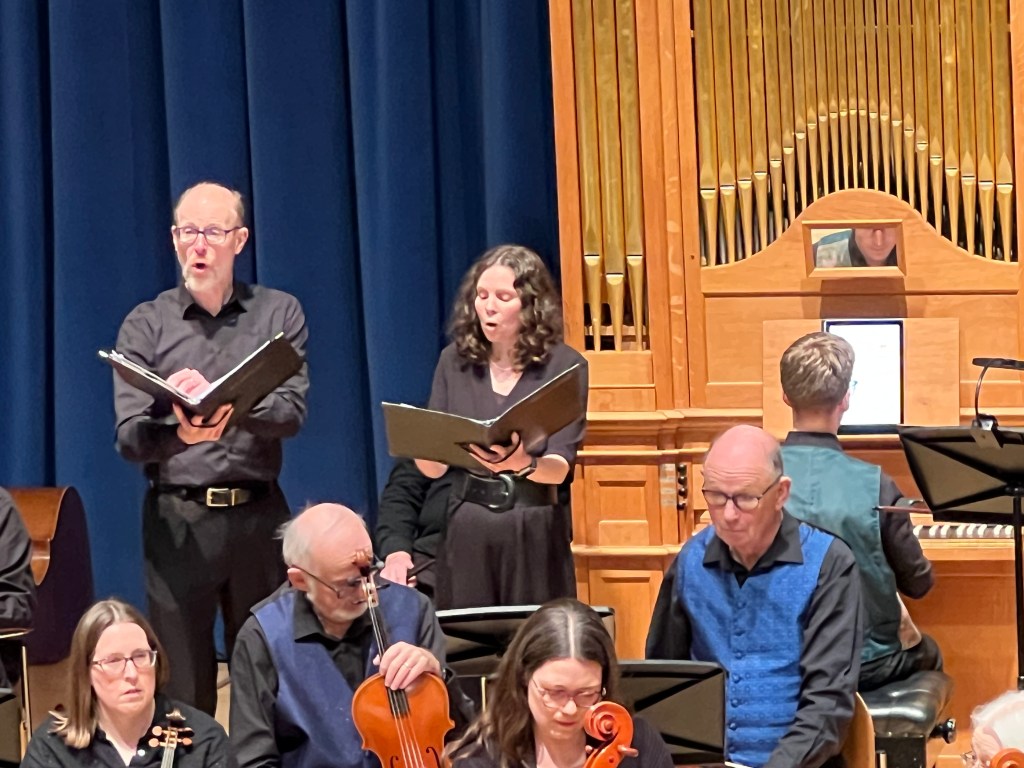
The mood did change, however, in the third piece. Thus far, Ms Hyde’s absence had been covered in her solos by other singers from the choir, but in the scheduled item on the agenda she was the only soloist and so Peter Holman, the Director, decided to substitute it for a duet by Henry Purcell, Upon a quiet conscience. See photograph above. As its name suggests, this was much less showy, in fact it was an intimate piece with minimal orchestration, mainly organ.
More Purcell to end the first half with My heart is inditing Z30, which was written for the Coronation of of James II. This piece puts the emphasis on the Queen and what she had done for the king. There was lots of praise for her in the libretto but one line I am sure I misheard, although it was repeated several times, sounded like ‘She’s gorgeous.’ I hope Babybird paid the appropriate royalties – pun intended.
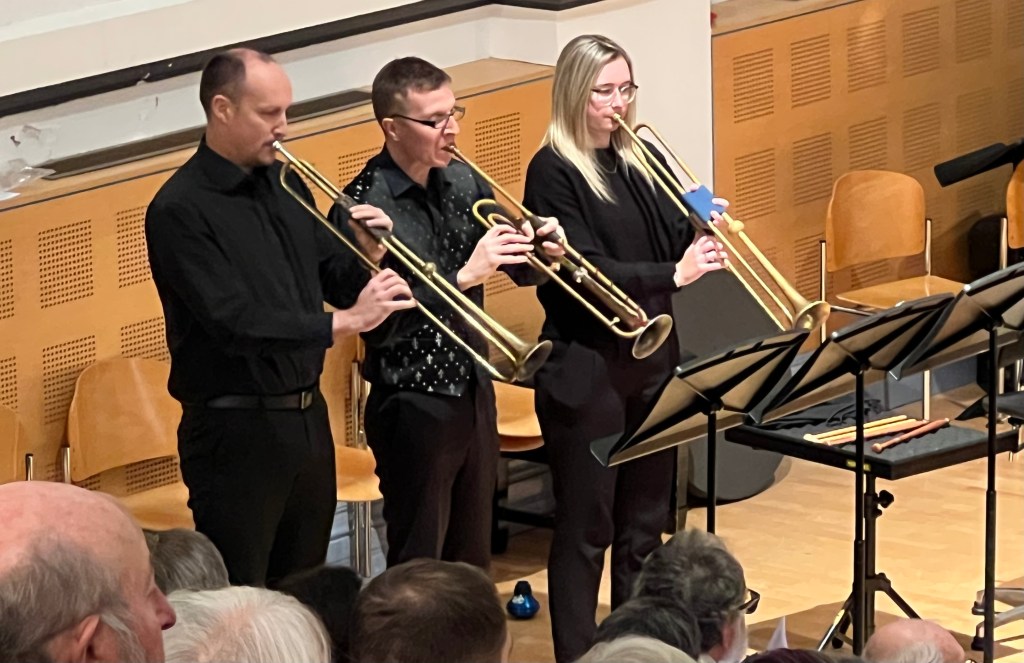
When I referred to the whole orchestra and chorus being included in the first piece, that was true at the time. The second half saw the addition of three trumpet players who performed State Trumpeters’ Flourish no.5 in D major, written by that most prolific composer, Anon, arranged by Peter Holman. This acted as a fanfare for a set of works which, although having plenty of the required pomp, were not as full-on as the earlier pieces.
George Frederic Handel was represented a couple of times with another work called My heart is inditing, used at the Coronation of George II and Overture to The Occasional Oratorio, a work written in 1746 but used in 1838 at Queen Victoria’s Coronation.
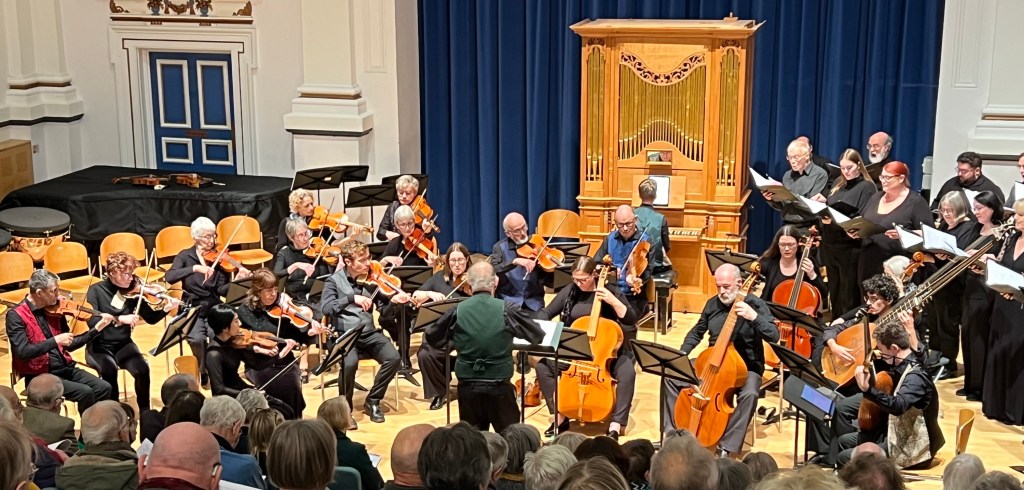
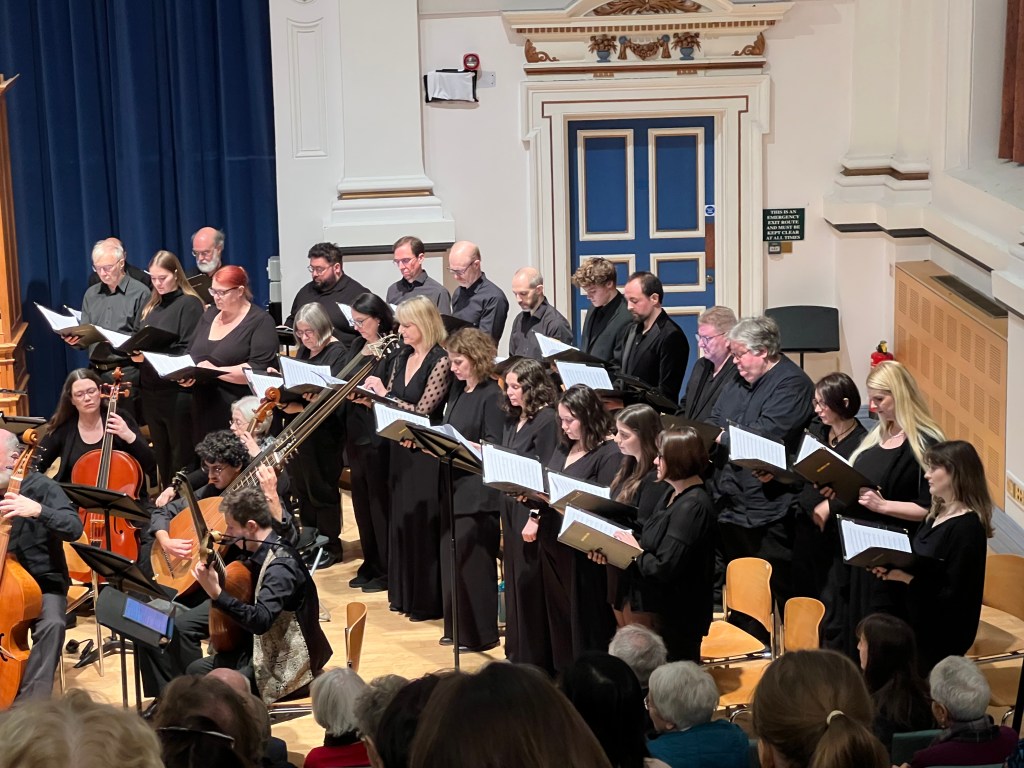
The penultimate piece on the programme was William Boyce’s Come Holy Ghost, used for the Coronation of George III in 1761. This was ostensibly a choral work with organ and very stirring. Boyce had been commissioned to rework the pieces used in various coronations and he did so, but refused to include the final, and most famous to us, opus, Handel’s Zadok the priest. He said that basically you can’t improve on perfection.
If coronation pieces were James Bond themes – I am gutted that I was overlooked for the role again – then Zadok the priest would be Live And Let Die. It begins quite innocently and then, wallop, you are given both barrels. It is so good that, nor only did Boyce refuse to amend it, it has been used for every coronation from that of George II to our present Monarch. Click on this link to see it performed for Charles III. https://www.youtube.com/watch?v=Sm_PNbQebdA&t=19s
This is what live music is all about; I must have heard this piece a hundred times or more on the radio, tv and film, but, when the live orchestra and chorus came in at 11 on the volume knob, it absolutely blew me away by making The Who sound like a string quartet. Quite superb.
This is where I should be writing that it was a great way to finish the concert, but we were treated to an extra item. Bryan White, the Chorus Master, walked up to Director Peter Holman as he was taking his well deserved ovation, and asked him to take a seat in the stalls as he would like to get the ensemble to perform a newly discovered work by the ubiquitous Handel. The opening bars of something very like the earlier offerings from the composer soon morphed into Happy Birthday To You, to mark Mr Holman’s 80th Birthday a couple of weeks earlier. It wasn’t the usual one verse job, oh no, it went on for several minutes and included the whole orchestra and chorus repeating the line to various arrangements including one of The Messiah – I never realised that Hallelujah and Happy Birthday both have four syllables, but then, having a life, it is not something which has troubled me thus far.
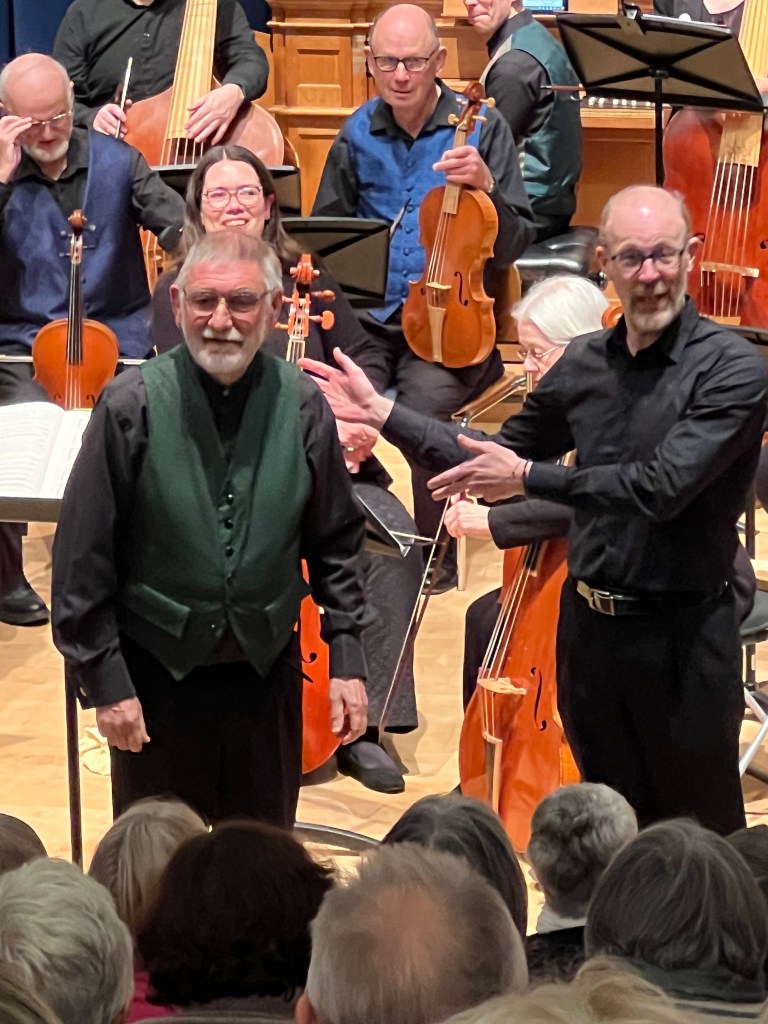
Bryan White salutes Peter Holman
When the prank was completed, Jillian Johnson, who plays the violone in the orchestra and multitasks as administrator of the organisation, was reluctantly dragged from her perch at the back of the stage and duly embarrassed by having the whole room informed that it was also her 80th Birthday. Not very chivalrous of Mr White to reveal a lady’s age, but a lovely gesture all the same, to a lovely lady who, amongst other things, makes sure I am kept up to date with the goings on at Leeds Baroque Chorus and Orchestra, and supplied with a ticket for the performances, for which I am very grateful.
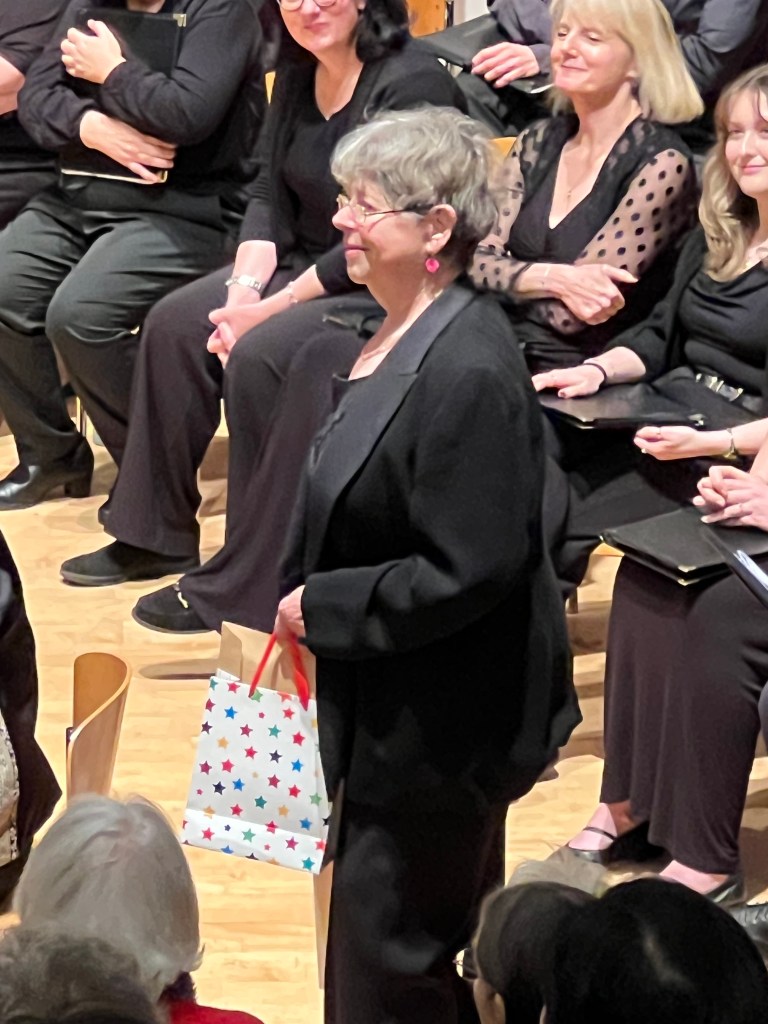
Jillian Johnson. 80 is the new 40.
After gifts were presented, we decamped into the cold November air of Leeds having had a fine afternoon of celebration of both royalty and commoners. Having said that, Peter Holman is an MBE, so one foot on the ladder, unless, of course MBE stands for Must Be Eighty.
The launch of the 2027 Programme for Leeds Baroque Orchestra and Chorus coincided with this event, so, if you are tempted to try a Sunday afternoon of superb musicianship and singing, why not give one, or more, of the dates a try. For all you need to know please go to https://leedsbaroque.co.uk
Photographs by Stan Graham

