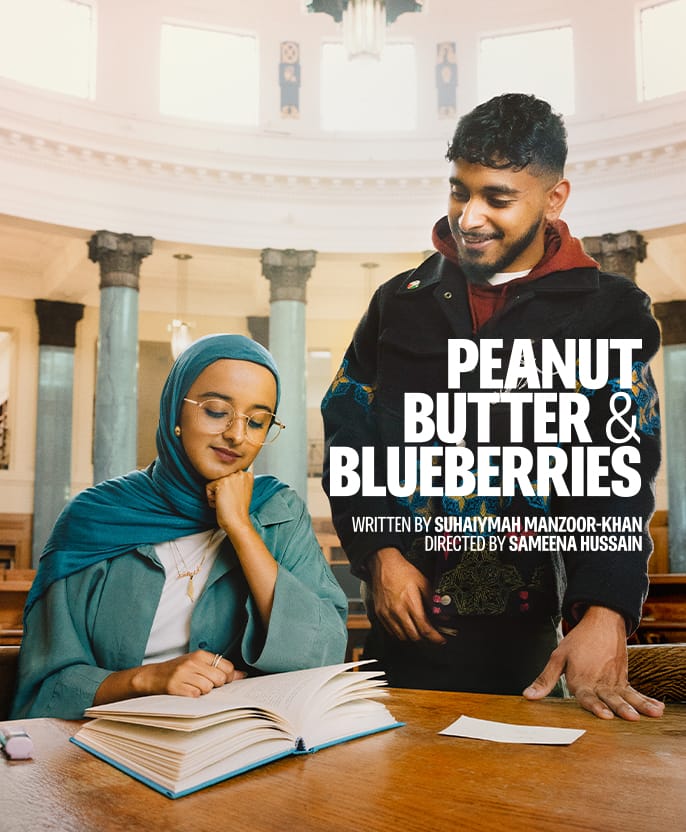
Before you start reading this I must stress that it is the review of a play and not the third in a series of food articles. Having said that, the chana masala (chickpea curry) and rice I had in the Playhouse Kitchen before the play, would have got a great write-up, had it been. The other piece of information I would like to impart is that it lasts for an hour and a half – the play, not the food, not on my plate anyway – with no interval, so a pre-show comfort break is highly recommended.
In essence the work is a romcom, and a brilliant one at that, telling of the relationship between two Muslim students who meet in London where they have just started university. Although different from each other in many ways, they share the same fundamental values, and I am not just talking about religion, some aspects of which also divide them.
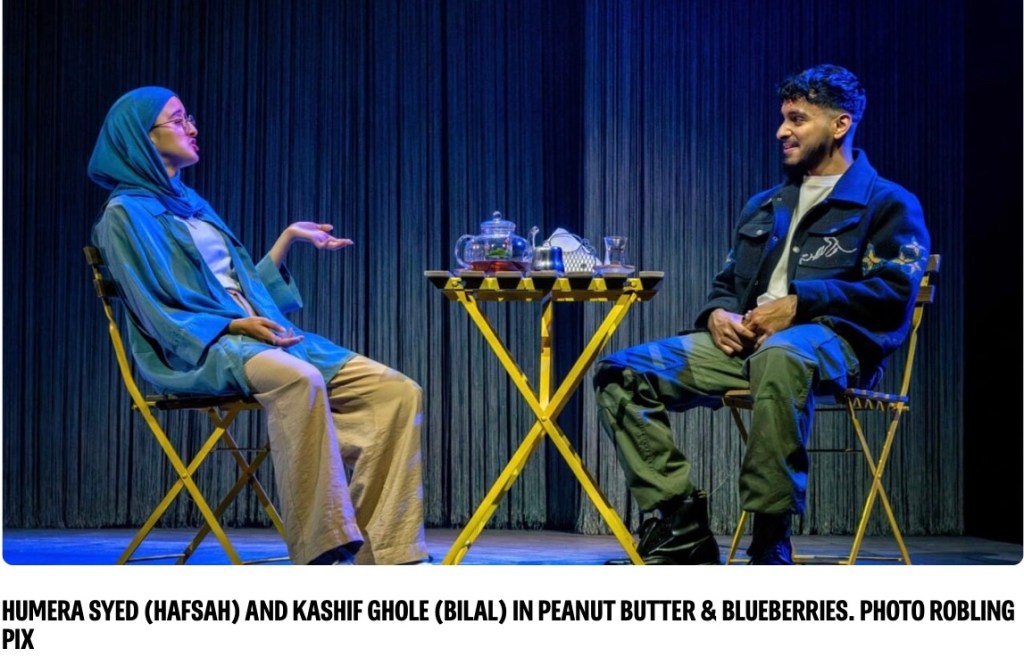
Bilal, played by Kashif Hole, is from Birmingham and his course is South Asian Studies, with particular emphasis on a small region in Punjab, which is very tranquil, unlike his home in Brum, where he has become embroiled in some nefarious activities from which he would like to escape permanently, rather than for just three years to do his degree. Hafsa, Humera Syed, is from Bradford and is doing Gender Studies. This causes her to question everything concerning the disparity in the treatment of men and women, again not specifically relating to her faith.
Where Islam does come into play, pardon the pun, is that, unlike the Hugh Grant/Andie McDowell school of romcommery, the pair never so much as touch throughout the whole story. The nearest they get is when Bilal removes Hafsah’s glasses to wipe the rain from them when the couple take shelter in a cafe. This contributes two elements, it intensifies the ‘will they, won’t they’ suspense, in that there is no physical commitment to bind them, thus siding more with the won’t they conclusion, than otherwise would be present. At the same time it makes you lean toward the, will they, conclusion by implying that the relationship is much deeper than lust.
I found this play extremely relatable due to the initial bond being created as they were both outsiders in London. Not as much through their race or religion, but their non-Londonness. Not only did I live in Birmingham for a year in 1975/6 and work in Bradford for thirty years but I studied law in the Big Smoke at the end of the Sixties and had the same feeling of isolation, except for a couple of mates who took the same path from my college to university. Because of the nature of the capital, the institution I attended had no campus as such and accommodation was so expensive that most of my fellow students commuted daily from home – one from Southampton – whereas I was back to my bedsit in Maida Vale. There was also the language barrier, it was bad enough being from Leeds but these two were Bradford and Birmingham with a Pakistani twist! Bilal said that he felt that he needed to display subtitles to be understood, which was bad as even the Italians could get by.
The relationship began on a park bench where they had both gone at lunchtime, Bilal producing a Tupperware box containing, you guessed it, a sandwich of peanut butter and blueberries. The conversation revealed their differing backgrounds which seemed to confirm the old adage that opposites attract. There obviously followed ups and downs, one with an altercation involving Bilal in a library and a conflict of attitudes between Hafsah and Bilal’s brother, which ended in a form of empathy between them. A placement in New York for Hafsah proved to be a pivotal moment, but not in the way you might think, no spoilers.
I thoroughly enjoyed this play and would recommend you see it. There is one caveat, however, in that the dialogue, of which there is a phenomenal amount, is delivered at quite a pace and some of it in three languages, one only for one short scene, but they translate as it goes along. There were screens showing the dialogue but I am not sure whether it was a captioned performance for those with hearing impairments or if it happens every time. Whatever, you will soon get into the swing of things. The humorous parts had me laughing out loud, something of a rarity, with some of it being a bit odd, as those who could speak the language chuckling before we monoglots were given the translation enabling us to join in.
I came away with my impression of life confirmed, in that no matter who we are and where we are from, we have far more in common than we have differences. These adolescents could have been a couple of besotted teenagers from anywhere in the world, or probably beyond.
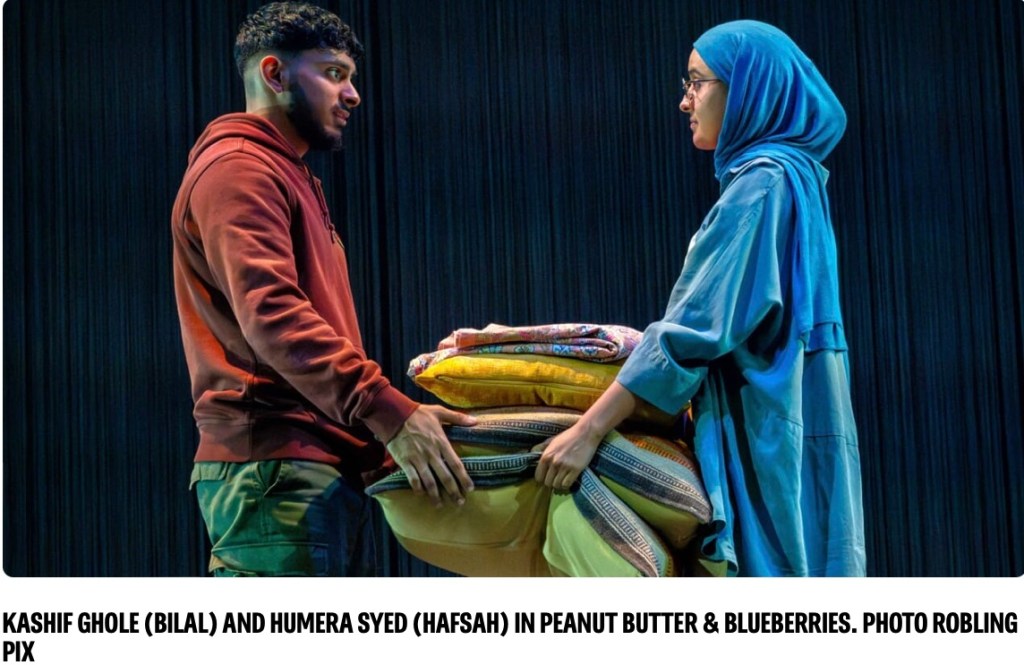
The two actors were tremendous, exuding an air of authenticity throughout, their frailty when in doubt, contrasting with the bouts of confidence when sure of their ground. Hafsah, the amazing Humera Syed, seeming more in control of her life than was Bilal, Kashif Ghole, who, although the street-wise big city boy, had a certain latent insecurity in that he wanted to break free but felt duty bound not to – superb.
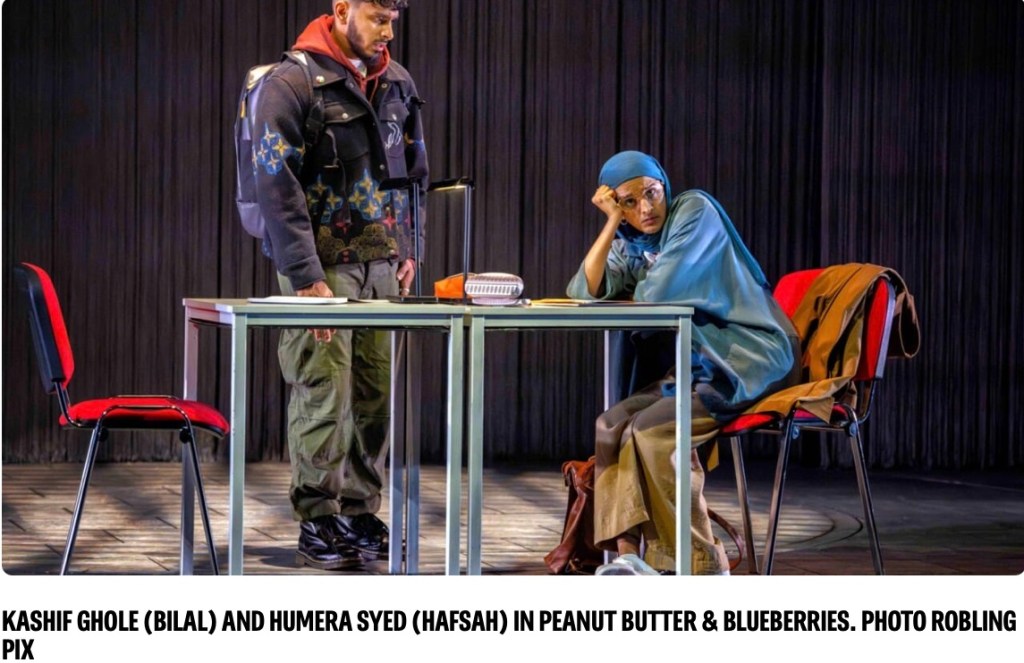
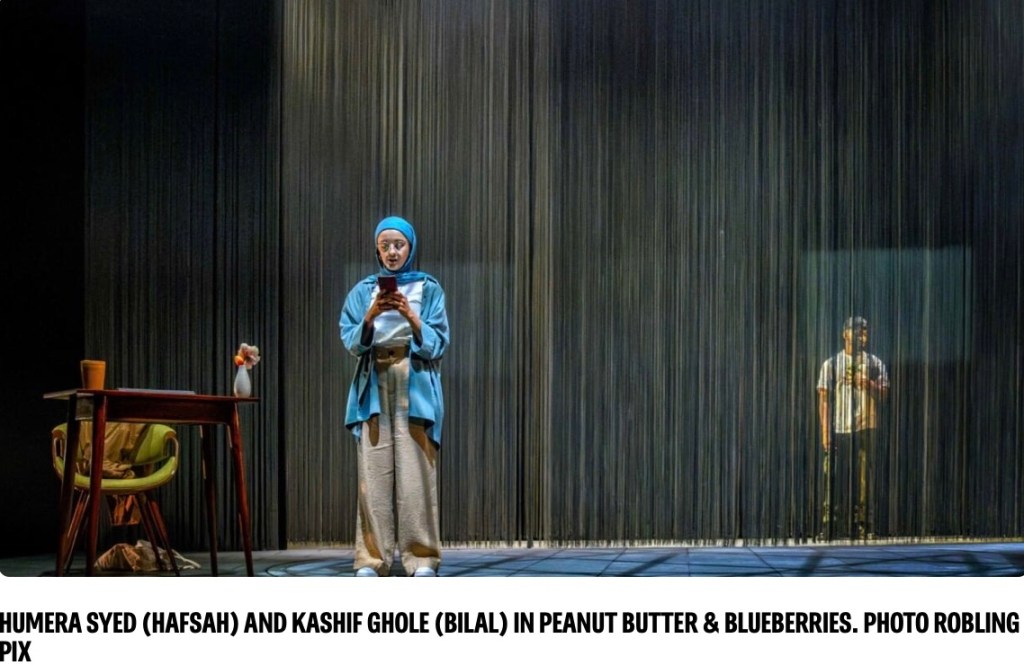
The importance of the words was emphasised by the sparse set, comprising various tables and chairs which were conveyed on stage when needed by a couple of turntables from The Revolving Stage Company, appearing from, and disappearing through, a string curtain, provided by BlackOut, like an airport luggage carousel. They rotated in opposite directions meaning that, on occasions, the actors would drift together and apart without actually moving.
The writing by Suhaiymah Manzoor-Khan was terrific, I think. There were parts I didn’t fully understand, not so much because of the formal language difference as the youth slang, but I think I eventually mogged it. The observations were sharp as a tack in their humour and sad without being maudlin in the more touching – or not – moments.
The Director, Sameena Hussain utilised the, less is more, method which usually works well in productions with a small number of actors, and you can’t get smaller than two without it becoming a monologue. The passages spoken direct to the audience effectively made us part of the action and went some way to informing us about rituals or attitudes which might have seemed outside our experience, without interrupting the flow of the piece.
Peanut Butter & Blueberries is a Leeds Playhouse Production by Zoe Bailey and runs there until Saturday, 7th November. For more details, bookings and information about other shows in the offing, please go to https://www.leedsplayhouse.org.uk/whats-on/

