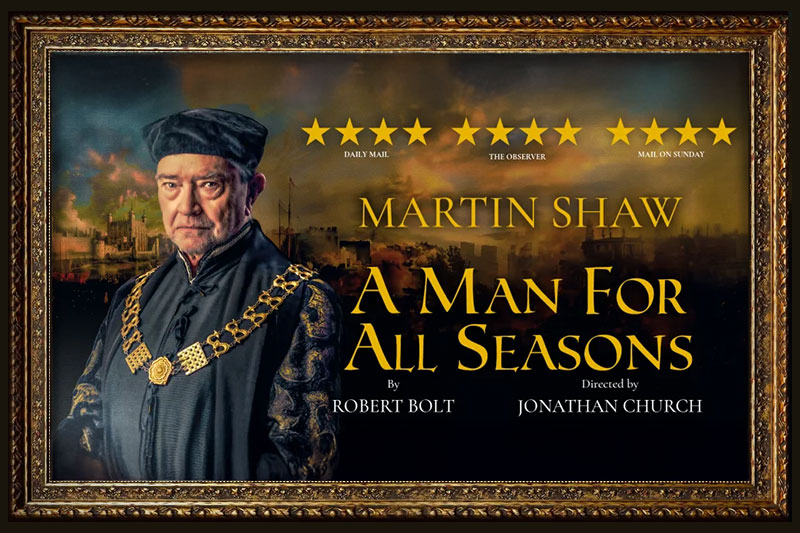
I had never really been a history buff, or even a fan of period drama, but lately I have begun to get more into it. Perhaps because I feel like a relic from a bygone age myself, so want to find out how to handle it, or that the present world order is so dire that I need comfort in the past. Whatever, my view was always that we should learn from history rather than try to recreate or relive it but after seeing A Man For All Seasons I fear we are doing both.
I was going to begin by saying that there is no real plot to this play, but then I realised that there are lots, mostly against Sir Thomas More, the Lord Chancellor to King Henry VIII, the majority of which were instigated by the monarch himself, but hatched and executed – literally – by his proxies.
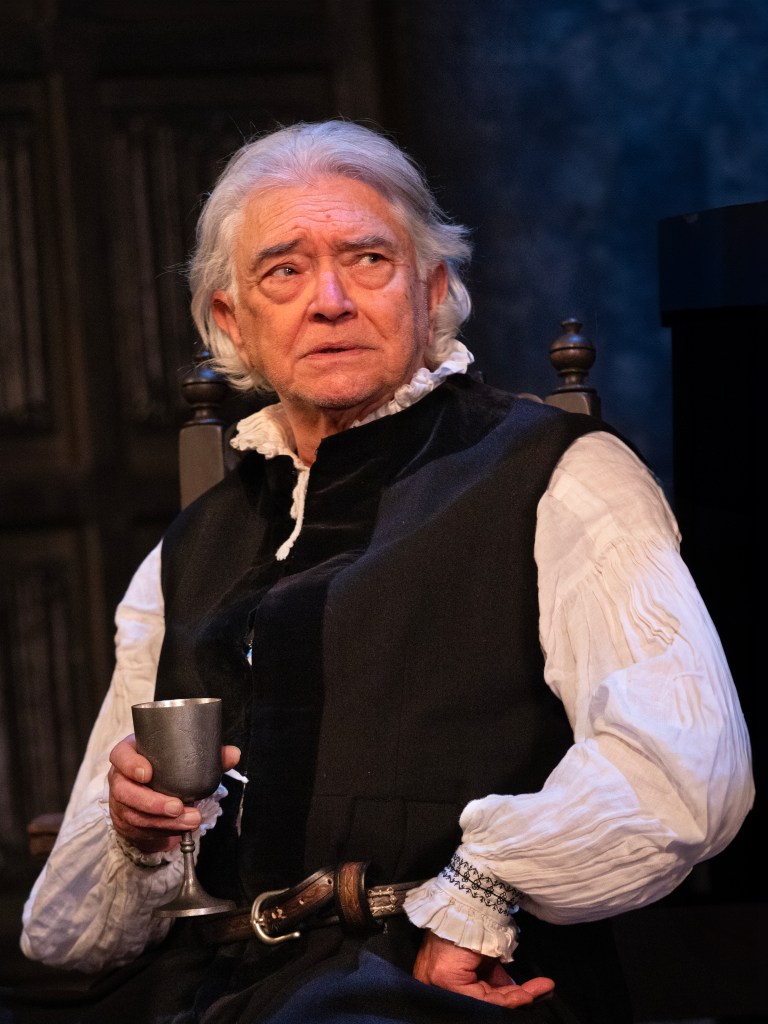
Martin Shaw as Sir Thomas More
The play covers the period from 1529 until 1535 which are the dates when Sir Thomas More was appointed Lord Chancellor and his execution. It revolves around the wish of King Henry VIII to produce a male heir to the throne which, he felt that he could not do whilst married to Catharine of Aragon who, over their almost twenty years together, had produced seven children but only one, a daughter, had survived. He had also fallen in love with Anne Boleyn. England was a Catholic country at that time and subject to the decisions of the Church of Rome, so he summoned Cardinal Wolsey to approach Pope Clement VII regarding the granting of a divorce. The grounds were that the marriage was not legal insofar as Catherine was the widow of Henry’s late brother, a union forbidden in the Book of Leviticus, but almost compulsory according to Deuteronomy. All seemed to be going well until King Charles V of Spain, Catherine’s nephew, appealed the matter and the divorce was denied.
Henry VIII decided that England should break away from Rome and formed a ‘Reformation Parliament’, which was appointed rather than elected, to set up an alternative church. He also made Thomas Cranmer the Archbishop of Canterbury, who annulled the marriage, leaving the King free to marry the pregnant Anne Boleyn. Guess what, it’s a girl, the future Queen Elizabeth I.
Sir Thomas More remained a staunch Catholic but someone still loyal to the Monarch. His appointment allowed him freedom of conscience, meaning he could act as he saw fit, but when the next phase was reached, The Act of Supremacy, which made the King Head of the Church and Clergy in England, conflict arose as it carried with it the obligation of all subjects to swear allegiance. Most clergy and landowners complied, as otherwise the first group would. have been ruined, and the second thought of the money they would make from the newly available land coming on to the market when the old churches were confiscated.
There then followed the Act of Succession, declaring Anne to be Queen of England and their children as heirs to the throne. It included an Oath of Succession which Thomas More, although supporting it in principle, refused to sign as he said it could only be validated by the Pope. The result was a sham trial for Treason and on 6th July, 1535, he was beheaded at the Tower of London.
The bulk of the play was taken up with legal and political arguments, along with the intrigue and shenanigans of the gentry, to give the King what he wanted. In those days the Monarch enjoyed absolute rule, with parliament not having influence until after the Civil War over a century later. You might think that this would make for a pretty tedious evening, but I found it fascinating and the time flashed by.
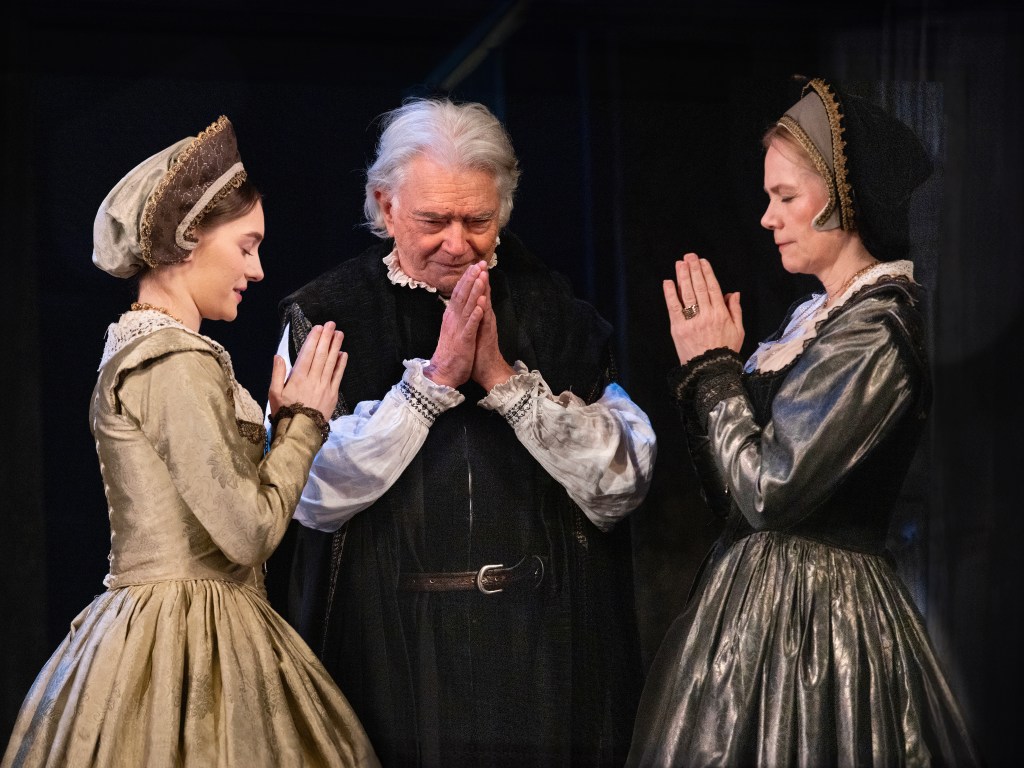
Annie Kingsnorth as Daughter, Margaret – played in this production by Grace Molony, Martin Shaw, Sir Thomas More and Abigail Cruttenden, as his wife, Alice – played in this production by Polly Kemp.
The play, by Robert Bolt, was also constructed utilising the inclusion of ‘The Common Man’. He opened the piece by appearing in an impish manner from behind a room of straight faced, Tudor clad actors and raced to the front of the stage to set the scene, introducing the participants as they joined in the action, then becoming narrator and commentator. He was played by Paul Kemp, who slipped into various comedic roles, all in a cockney accent; Sir Thomas More’s butler, a boatman, a pub landlord, the foreman of the jury and the executioner. He was a bit of a wheeler dealer, who made himself a nice living on tips from those he assisted in all his guises.
There was another object of fun in the guise of Signor Chapuys, the Spanish Ambassador, who was actually French (but I notice in the programme has the Italian spelling of Señor, the obvious template for an integrated European). Although played with a light touch by Asif Khan, as was his Assistant, Hari Kang, there was the odd sinister undertone when eliciting information. The other notable historical figures were Peter Losasso as Richard Rich, Chris Larkin as The Duke of Norfolk, Nicholas Day as Cardinal Wolsey, Huw Brentnall as William Roper, Sam Parks as Archbishop Thomas Cranmer and Sam Phillips as Thomas Cromwell, all superb in portraying the fickle nature of those in high places when it comes to bidding for power and wealth. Henry VIII, who was custodian and granter of both those assets, was played by Orlando James showing a man whose only need could not be provided by anyone no matter what gift, or misery was bestowed. It didn’t stop his self-indulgent pursuit of pleasure though.
Finally we come to the More family. Polly Kemp played hapless wife, Alice, who was made to suffer poverty and heartbreak as a consequence of her husband’s refusal to go with his peers and sign the oath. Daughter Margaret, Grace Molony, was supportive but distracted by her love of William Roper and her father’s refusal to grant his permission for them to marry as he was a Lutheran. Roper did change sides so all ended well for the young couple.
Last, but by no means least, the utterly magnificent Marin Shaw as Sir Thomas More. This really was an incredible performance with him occupying the stage for the whole time, over two hours in total. The descent from happy family man celebrating promotion to high office, down to dismissal from same, the disintegration of his home life and finally imprisonment and execution was handled supremely well. His determination to be true to his conscience despite all the consequences to his loved ones as well as himself, which proved to be the ultimate sacrifice, was portrayed with no hint of heroism, in fact it was powerful in seeming to reinforce his beliefs rather than weaken them, thus progressively providing him with peace of mind.
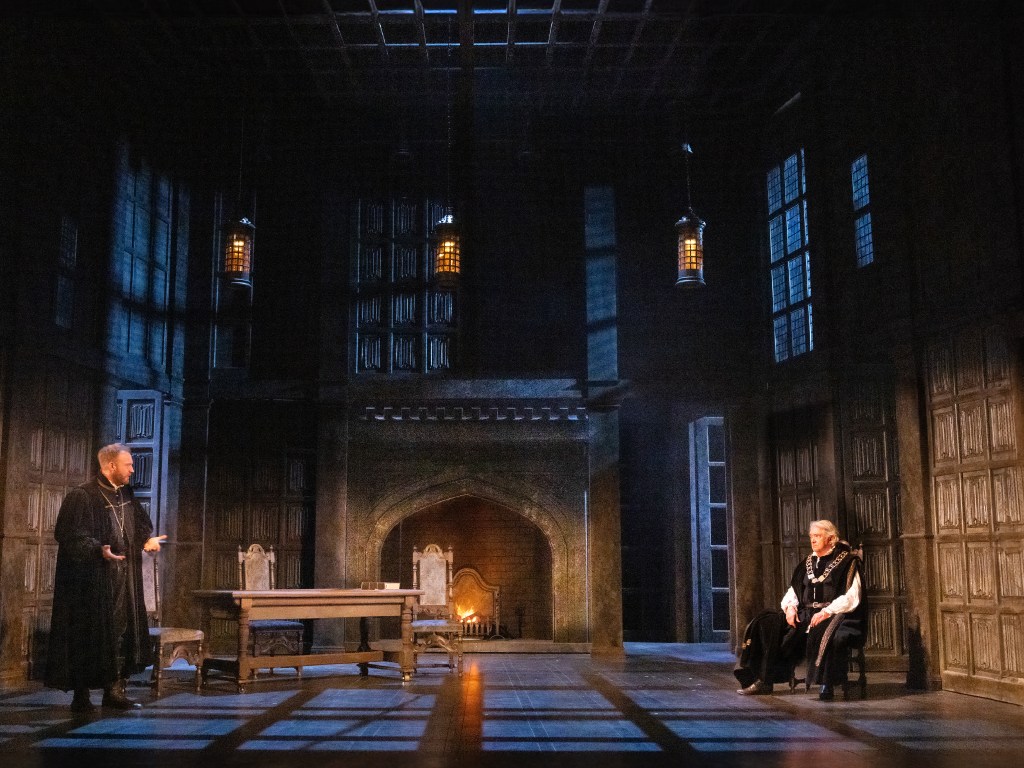
Sam Phillips as Thomas Cromwell and Martin Shaw as Sir Thomas More
I must make mention of the set, designed by Simon Higlett, who was also responsible for the costumes. It was epic with huge sliding partitions which transformed the stage into a large Tudor house, a courtroom, a pub, a garden and a Thames embankment, along with others I am sure I have overlooked. The furniture was moved by the actors, which, at one point became a part of the action in itself. The Lighting Designer, Mark Henderson and Sound Designer Paul Groothuis, both did a great job in setting the various moods as did Matthew Scott’s Music.
I can highly recommend this work to you, it was a pleasant change to see something set in its time rather than ‘reimagined’ in the present, although a powerful leader who didn’t give a monkeys about the consequences to anyone else as long as he got his way, does strike quite a modern chord, as does the carnage wreaked on innocents by those whose religious belief rules their life.
As a footnote, for those not familiar with English history, in 1537 Henry VIII and his third wife, Jane Seymore, did produce a male heir to the throne. He became Edward VI when he was nine years-old but died six years later.
A Man For All Seasons Directed by Jonathan Church runs at Leeds Playhouse until 24th October. See https://www.leedsplayhouse.org.uk/whats-on/ for details, booking and further shows.
Photographs by Simon Annand

