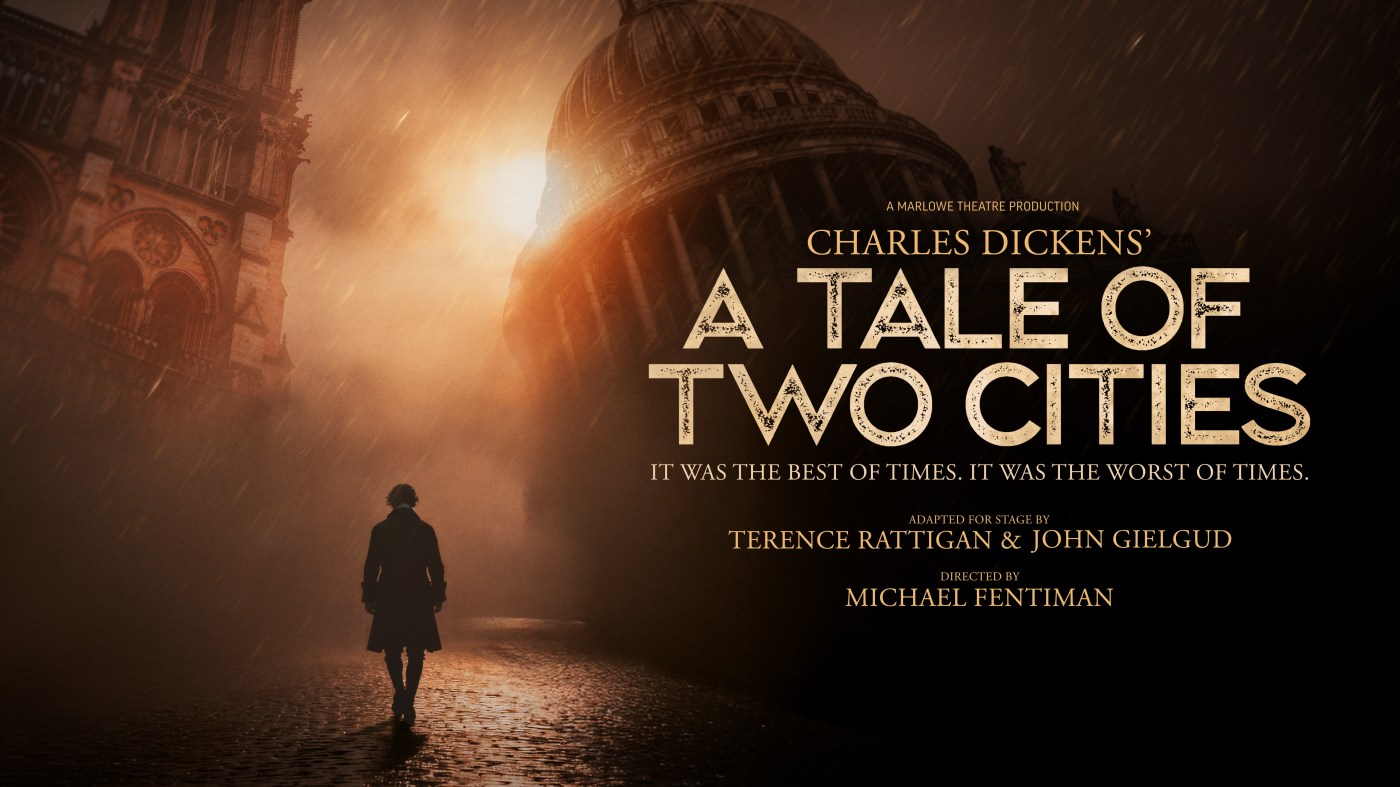
Leeds Playhouse are definitely hitting the ground running after the summer break. Following last week’s offering, Fences, I was back to see A Tale of Two Cities, the classic from Charles Dickens. It had been adapted for the stage by Terrance Rattigan and John Gielgud, so had good credentials. I have never read the book, which, after researching it, seems to be a rather complicated novel, reinforcing my impression that it had been very much truncated for the stage. The way this was done was to make it episodic rater than a flowing narrative which I thought worked well, especially as the Director, Michael Fentiman, had chosen to add state of the art tech whilst keeping the story firmly set in period. This was essential as the whole point of the novel was to illustrate how the state atrocities perpetrated in 1770s France, were still prevalent in countries in 1859, when the book was written. Sadly there has been little improvement since then, which makes the juxtaposition of the two elements of 18th and 21st Century presentation an effective way to convey this.
The play begins with Sydney Carton, a lawyer, on a bare stage, delivering the famous opening paragraphs, ‘It was the best of times, it was the worst of times….’ We then see Jarvis Lorry, a manager at Tellson’s Bank, receiving a letter telling him that Dr Alexandre Manette has been released after spending 18 years incarcerated in the Bastille, seemingly for no good reason. This causes him to visit the doctor’s daughter, Lucie, now living in England, to tell her the news, which comes as a great shock as she has always been led to believe that her father was dead. He takes both her and her governess, Miss Pross, to Paris for a reunion.
They find Dr Manette living in a garret above a wine shop owned by his former servant, Ernest Defarge and his wife Therese. He is weak and obsessed with making ladies’ shoes, a craft he learned in prison. The trio persuade him to let them take him to England and safety. When they dock in Dover, Miss Pross is suffering from seasickness and Lorry goes for the luggage, thus leaving Lucie alone with her father. She doesn’t want to wake him as he is very weak so, when she is approached by a man who offers to carry him ashore, she accepts. Before he can fulfil his obligation, Lorry and Miss Pross return along with a man called John Barsad, who accuses the stranger, Charles Darnay, of being a spy. He allows Darnay to carry Dr Manette ashore and then arrests him. As Lucie, Lorry and Miss Pross say they had seen Darnay hand a piece of paper to two other men earlier, they are told they will be summoned to give evidence at the trial.
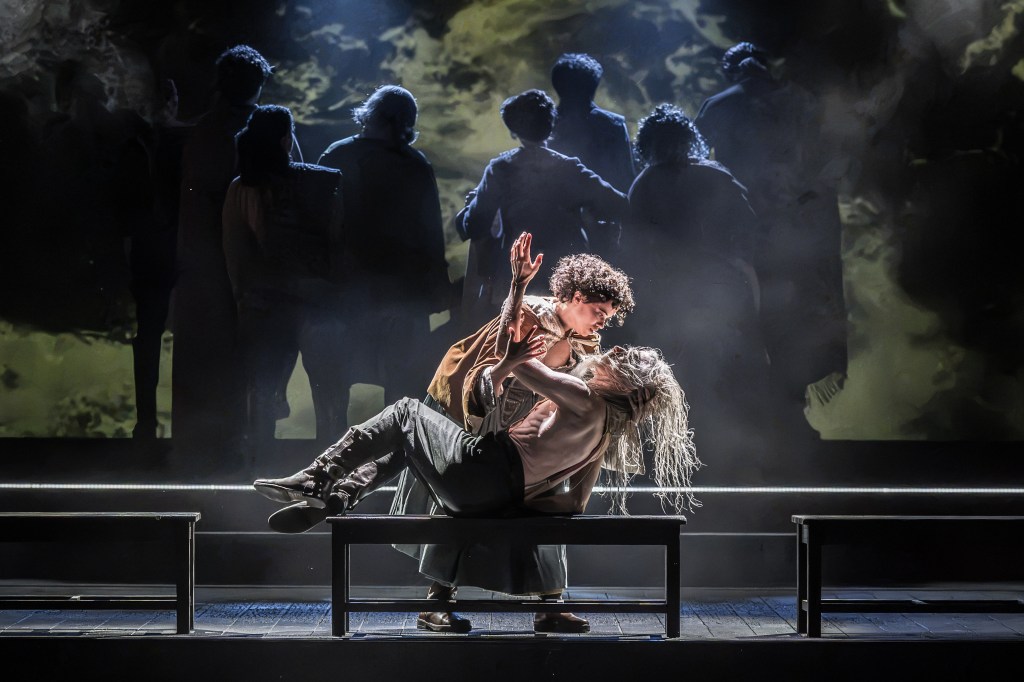
Jordan Loughran as Lucie, prepares her father Dr Manette, played by François Testory for his transfer to shore
The upshot is that Sydney Carton defends Darnay and gets him acquitted in a ploy worthy of any American courtroom drama, thus impressing Lucie, who has also been visiting the accused whilst he was in jail. Both men have fallen in love with her and she with them. Carton is obviously affected by an incident in his past which has left him constantly shunning any meaningful relationship either professional or personal, leaving the way open for Darnay to propose to Lucie and her accepting.
On the day before the wedding Darnay has a talk with Dr Manette, when he reveals his true identity as the brother of Marquis de St. Evrémonde, one of the members of the Aristocracy responsible for his serving the eighteen years in prison. Dr Manette still gives his blessing to the union. On the same day, Carton visits Lucie to give her a gift and confesses his feelings for her, wishing the couple a long and happy marriage.
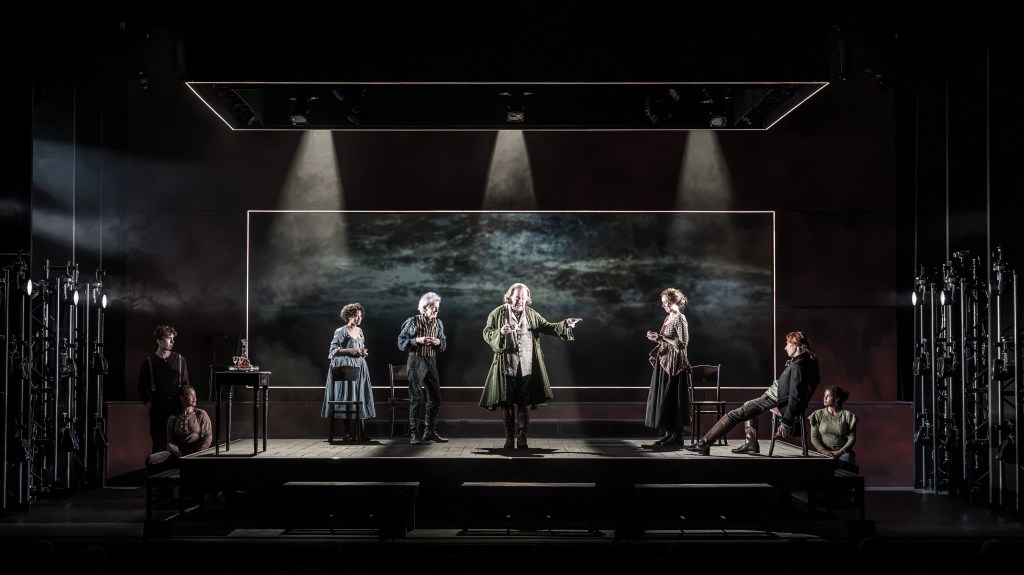
Daniel Hickey, Jasmine Kerr, Jordan Loughran, François Testory, Roger Ringrose, Scarlett Brookes, Samuel Collings, Robyn Sinclair
Time passes and in a further episode we see Darnay ready to return to France in order to tell his brother that he will refuse to inherit his title on his demise. He says that he cannot be a part of the Reign of Terror which sees hard working people being imprisoned or executed on the whim of the upper class. This causes a falling out and Darnay is shown to his room by the Marquis’s servant. I got a bit lost here, as after Darnay retires, a man sneaks into the dining room and slits the Marquis’s throat. I thought it was the servant, Gabelle, but the synopsis I read says it was a chap called Gaspard, who we had seen earlier when his young daughter had been run over and killed by the Marquis’s coach and horses whilst he was urging the driver to make haste and not worry about anyone in their way. He alighted the carriage and threw Gaspard a coin in compensation before continuing on his way. Either way, whoever killed him made his escape.
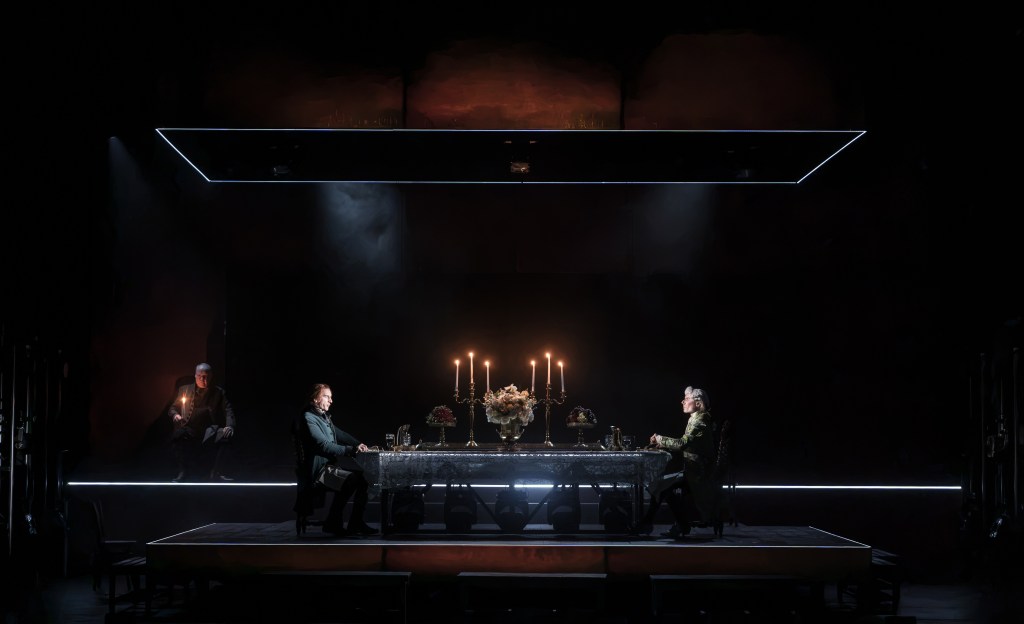
Roger Ringrose, as the servant, Gabelle sits in attendance while Ed Sayer, as Charles Darnay and Samuel Collings, as Marquis de St. Evrémonde share a cosy meal.
More years pass and Darnay accompanies Lorry back to Paris, where there are documents to be returned to England by the bank to prevent them being seized by the post revolution French government. He is reported to the authorities as being an aristocrat, even though he has denounced the title, and imprisoned in La Force. A trial is set and Lucie, Miss Pross and the Doctor all return for the proceedings. He is found guilty and ordered to be executed. Realising what could happen, Carton decides to go to help and, appreciating there could be no legal remedy, he enrols the help of Barsad, Darnay’s accuser in England and comes up with a plan.
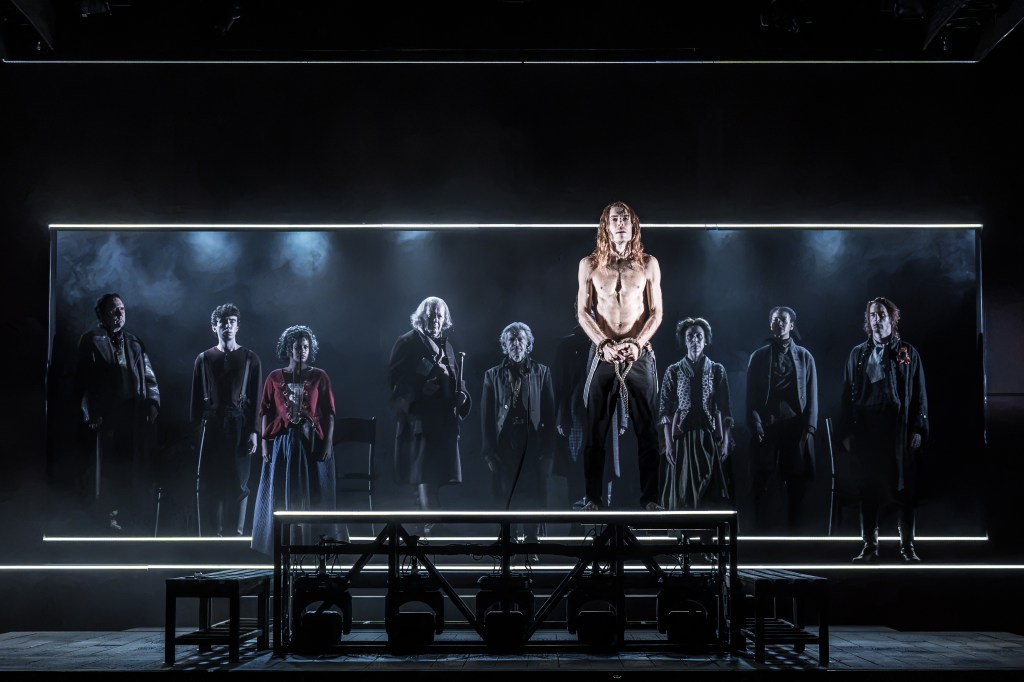
Sydney Carton, played by Samuel Collings, awaits his fate, backed by actors Simon Startin, Daniel Hickey, Robyn Sinclair, Roger Ringrose, François Testory, Scarlett Brookes, Jasmine Kerr and Ed Sayer.
He gets Barsad to supply him with passports for the whole party and gives them to Lorry, telling him to have a carriage waiting outside La Force to take them to the Calais and then England. Barsad also arranges for Carton to visit Darnay in his cell before the execution. This is done and when alone, they swap clothes and Darnay leaves now disguised as Carton, who is executed in his stead. The rest of them escape to England and safety.
Phew!
So much for the story, or at least part of it. It was the execution, no pun intended – OK, maybe a little one – which was extremely inventive. As previously mentioned, the tech was superbly manipulated to make less more. The Set Designer, Max Jones, along with Video Designer, Nina Dunn for PixelLux and Lighting and Sound Designers Ben Jacobs and Richard Hammarton respectively, did tremendous jobs. There was a back projection to give a sense of place, whilst a huge rectangular frame with strip lights round it, was raised and lowered to transform the stage into several venues; a courtroom, a ship, a chateau, a garret and lots more. I really appreciated that when the action took place in France, most of the dialogue was spoken in French, with surtitles artistically displayed on the raised frame. It added no end to the atmosphere and gave a sense of reality which would have been lost had they spoken in RP English. The same goes for the Costume Designer, Kinnetia Isidore and Fight Director, Jonathan Holby.
The acting was very powerful although there were a couple of fluffed lines and a bit of crashing into each other’s dialogue to begin with, as well as a small technical blip when a head mic failed to transmit straight away, meaning that the first couple of syllables were lost. It soon settled down and the result was another stunning piece of work, the second in a week.
I have not mentioned any of the cast by name as they played multiple roles, but you can see who they were from the production photographs. All were terrific.
A Tale of Two Cities is at Leeds Playhouse until 26th September, 2026. For more details, and to book, please go to https://www.leedsplayhouse.org.uk/event/charles-dickens-a-tale-of-two-cities/
For details of other shows at Lets Playhouse it is https://www.leedsplayhouse.org.uk/whats-on/
Photographs by Marc Brenner

