What a great way to bring the inaugural Yorkshire Fringe to a close. I have always thought of Slung Low Shorts as a sort of mini fringe in itself, being a showcase for independent playwrights, actors and other creatives, to show their work to a live audience. The format is that there are six presentations, each lasting for 15 minutes, so there is bound to be something to like. This year marks its tenth anniversary with all six being corkers.
1. The Uncivil War by Gail Renard – Directed by Keeley Lane and starring Tara Daniels as Kay, Richard Galloway as Ray, Rik Thorpe as Simon and Ellie Pawsey as Laura.
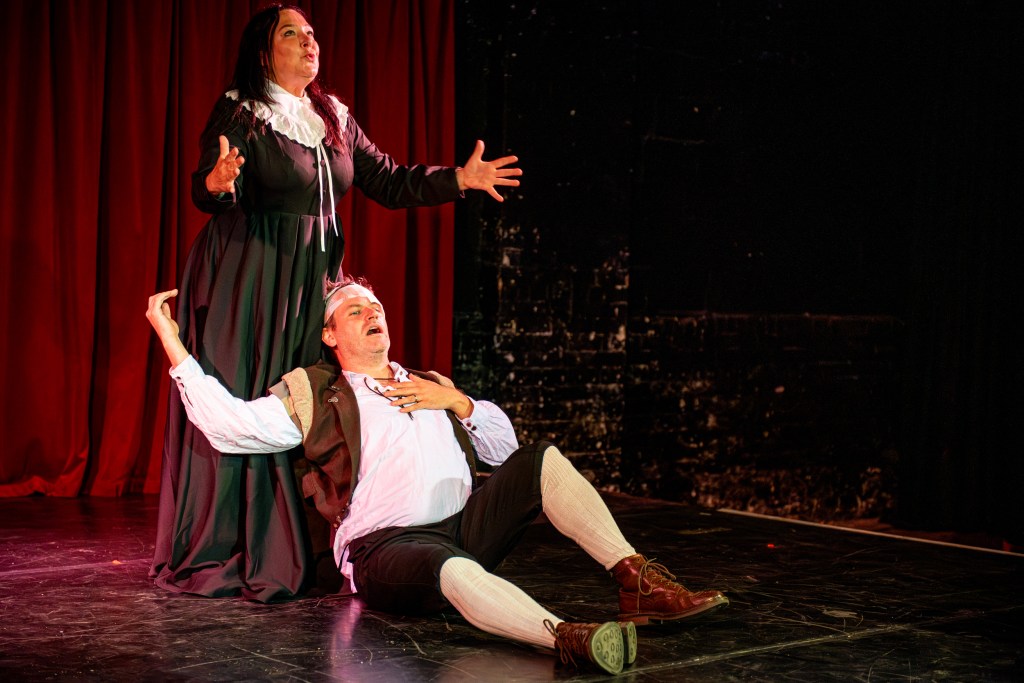
I knew I was going to have a good night only a few minutes after this play began. We saw Kay, a woman dressed in English Civil War Puritan garb of black dress with white lace collar, doing the housework, when her husband, Simon burst in and fell to the floor in agony having been struck on the head by a rifle butt wielded by a Royalist soldier. Strangely, Kay didn’t seem very surprised, in fact, she wasn’t concerned at all. It was then that the mood was shattered by the ringing of a mobile phone! All the members of the audience looked round for the culprit who had not put their device on silent, but the guilty party was on stage – Kay! It was her daughter calling to ask how she and Simon were. The response was, ‘Your dad’s been mortally wounded – again!’ It transpired that the couple were in a Civil War reenactment group and so the action was actually taking place in the present day. Brilliant.
There was some marital friction between the spouses, however, with Simon being suspected of philandering, something which he did not deny and when Kay left the scene to do some chores, in came Laura, who was a Royalist role-player, ironically named Miss Purity. She and Simon lost no time in fraternising with the enemy but were caught in the act when Kay came back unexpectedly. Enter Ray, Laura’s husband, also a Royalist who was informed of the shenanigans by Kay, and a sword fight ensued between the two men. It was hilarious as Ray, being a Cavalier, was equipped with a steel sword, whereas Roundhead Simon only had a tiny wooden one. After some deft moves honour was restored and the battle, at least the domestic one, settled, with the couples resuming monogamy.
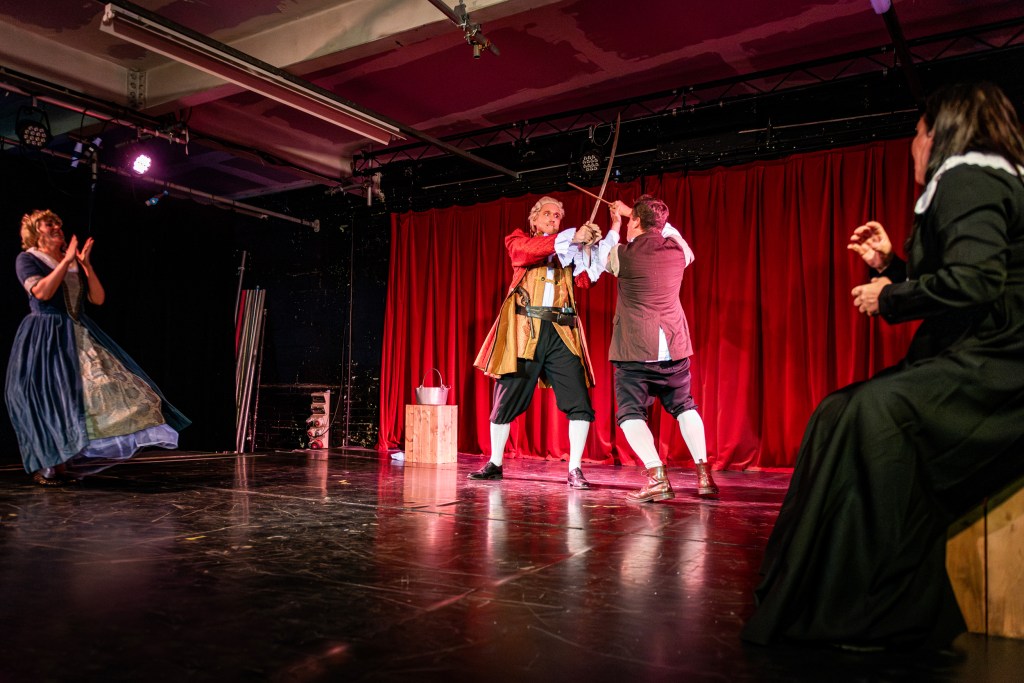
The piece was wonderfully acted and the timing was spot-on. The dialogue very funny and the direction, especially of the duel, brilliant.
2. Along Came A Spider by Carole Solazzo – Directed by Sue McGeorge. The actors were Rik Garrard as Joe and Suzan Selcuk as Evie.
This play turned out to be much darker than the first, although not in the way that it made us believe at the beginning. It concerned a couple who had hooked up via a dating app and were meeting in person for the first time. The venue was a country pub down a quiet road, which was difficult to find. Evie had arrived by taxi so she knew the driver was aware of its location should her exit strategy need to be put into action. Joe had got their drinks and they decided to is outside. Alarm bells rang when, having met Joe, Evie rang her friend whom she had asked to call her quarter of an hour after the time of the date, in case she needed an excuse to leave, to say that he seemed OK and there was no need for her to worry.
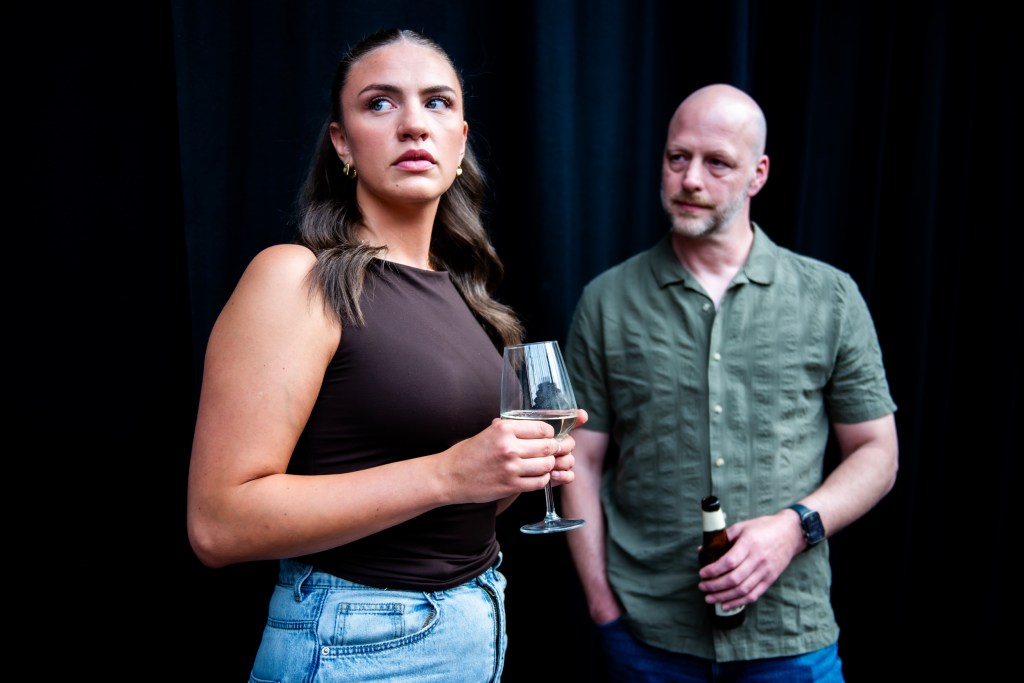
The play then became conversational with each of them revealing things about their past, leading us to think that the evening would not end well. Initially it appeared that Joe had an ulterior motive for acting increasingly strangely as time wore on, but in the end that turned out not to be the case. The way in which the dialogue was written was superb with a lot of ambiguity on the part of both characters, who delivered their lines in such a way as to convince the audience that they meant one thing, however, when we reached the denouement, we realised that it was the alternative meanings to which we should have paid heed. Agin full marks to all concerned.
3. Otters by Robert Tovey – Directed by Mark Catley, with Katie Cannon as X and Izzie Smith as Chloe.
If we thought that the last play was dark, this was positively black. It concerned two girls; X, and Chloe. We knew the context as soon as the pair walked onto the stage as X was covered in blood and had a knife in her hand, similarly stained.
X, so named after Malcolm X, was the alpha female, if you can have such a thing, and obviously the perpetrator of the unseen evil act, whereas Chloe was happy just to be there with her friend. The otters in the title stem from a fact passed on by Chloe during their conversation, that otters hold hands. it was this innocence in the dialogue between the pair which made the fact that they had just murdered someone, seem even more bizarre. As well as being the leader, X was obviously disturbed and kept having mood swings, whilst Chloe seemed naive and a bit on the slow side but anxious to impress X.
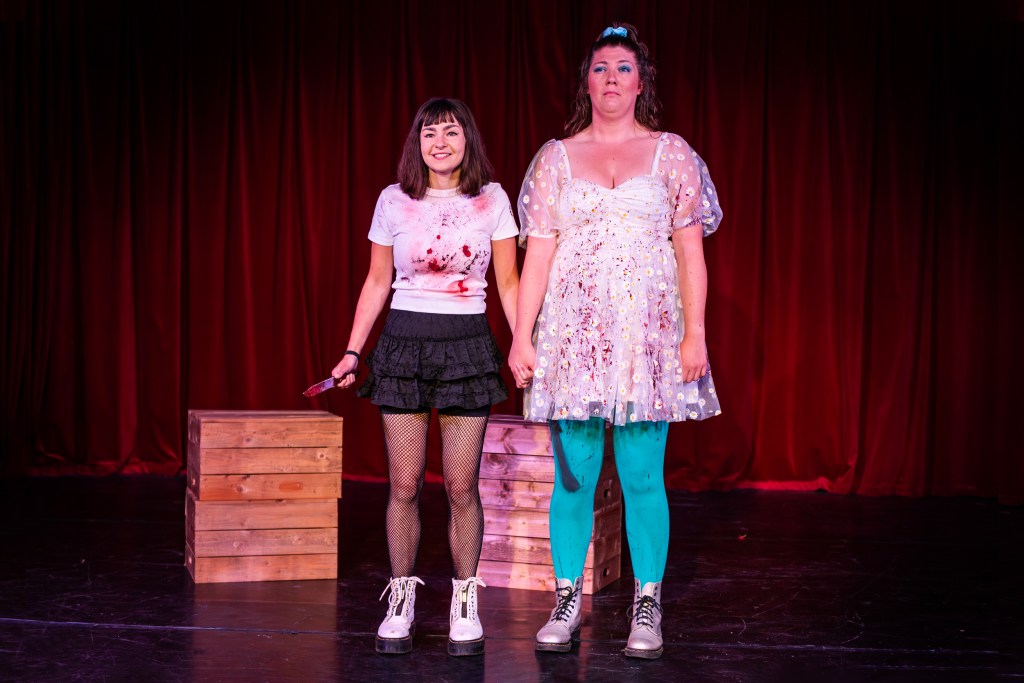
Once again we were invited into the psyches of the two characters as the layers peeled off, culminating in Chloe revealing that her feelings for X were more than just friendly, but would obviously remain unconsummated, only managing to hold hands, otter like, as the sound of a police car siren got gradually louder, finally ending the piece. Incredible.
After that we were all in need of a libation to prepare us for the second trilogy of works.
4. Decisions by Jane Steele – Directed by Leah Francis. Alf was played by Bill Blackwood; Josie by Hannah Mullen; George by Joe Osborne and Violet, Angela Wityszyn.
I think that I might have missed a reference in this piece, or I hope so – I only had one small bottle of beer at the interval, honest. The reason is that the language and attitudes seemed to reflect those which I thought had died out by the end of the 1970s. Again I hope so.
The gist is of the play is that Josie has come back to live at home with her mother and father, Violet and George. They are a working class family in a close knit community. The problem is that Josie is pregnant by her boyfriend who is in Germany and is black. This is a situation which doesn’t go down well with either George or Violet, especially the latter, who is livid that she will become a laughing stock amongst the neighbours. George initially seems fairly ambivalent to the rumpus, preferring to sit and read his paper, however, when his feelings are awakened, he is as bigoted, if not more so, than Violet. Josie is given an ultimatum, get rid of the child or leave.
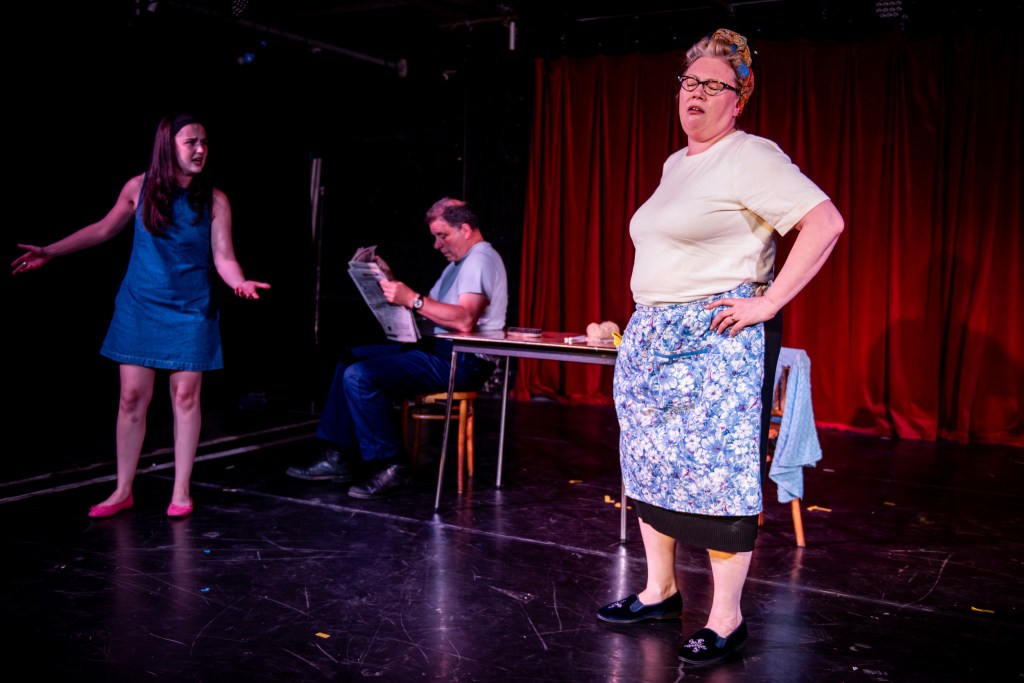
The above scenario is payed out on stage, using various racial terms which are nowadays considered taboo, and causes Josie to go visit her grandfather, Alf. He decides to intervene and calls on George and Violet to talk some sense into them. We old Yorkshiremen have all the answers. He does his best but appears to be talking to brick walls. It is not until the child is born and the family are presented with a tangible human being to deal with, rather than the abstract concept, that their deeper humanity surfaces.
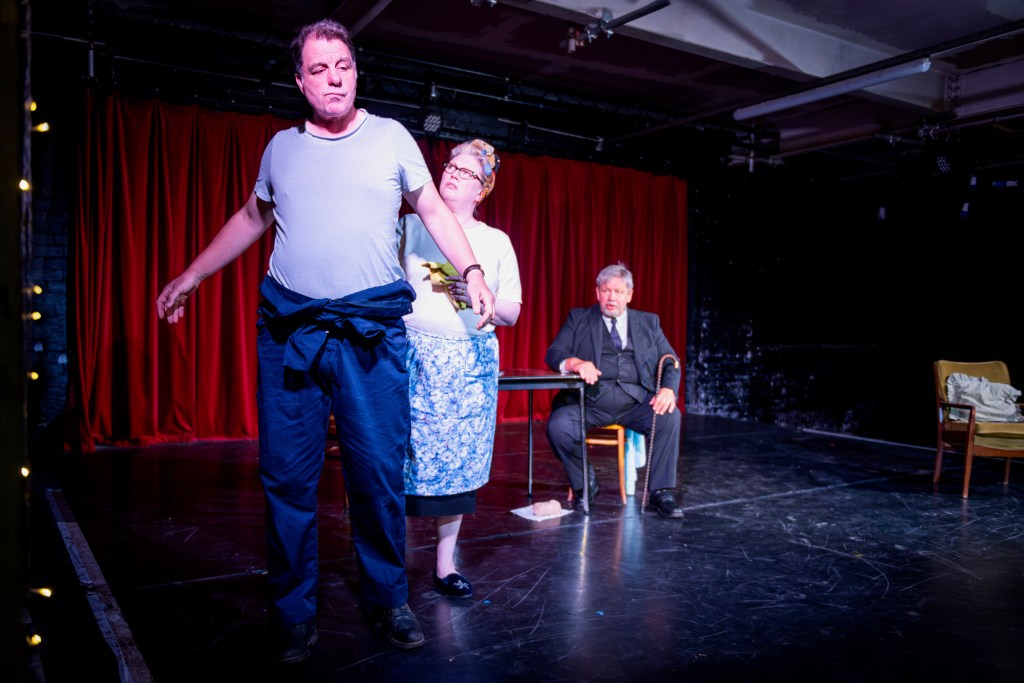
This play was brilliantly performed, directed and written. I was pleased that, what is now deemed to be offensive language, was used and not sanitised. It was all the more impactful for it and reflected a world where the terms were commonplace. A piece of history which has been lost to the younger audience, thus making them less able to see life as it was, rather than judge previous generations using today’s values. When I was a child in the 1950s and 1960s the words concerned were more descriptive than derogatory, much as we would say Geordie or Manc nowadays. I remember my mother knitting me a sweater in a shade called n****r brown. I realise that I have been a tad hypocritical in using asterisks after what I just wrote, but I can’t illustrate how language is organic and words change in their effect, by not conforming to modern day mores in this case.
5. Skyscraper to the Moon by Tyler Pickles – Directed by Katie Mae Carden, performed by Tommy Walton as Eugene and Izzie White as Rosie.
After that piece of social realism, we were treated to another two-hander with a twist. This time it wasn’t the ending providing the surprise, but a revelation in the middle which meant that we viewed the second half in a totally different light.
Eugene, a sixteen year-old boy is minding his own business, playing with his yo-yo – behave! – when he is approached by a similarly aged girl, Rosie. She instigates a conversation, despite the lad being fairly disinterested in a chat. She persists and, reluctantly, Eugene divulges a few details about himself. What is weird is that Rosie seems to be well aware of his life and experiences. They decamp to the top floor of a skyscraper, where they continue the discourse whilst looking over the edge, something which Eugene regularly enjoys doing, while pretending to be an astronaut.
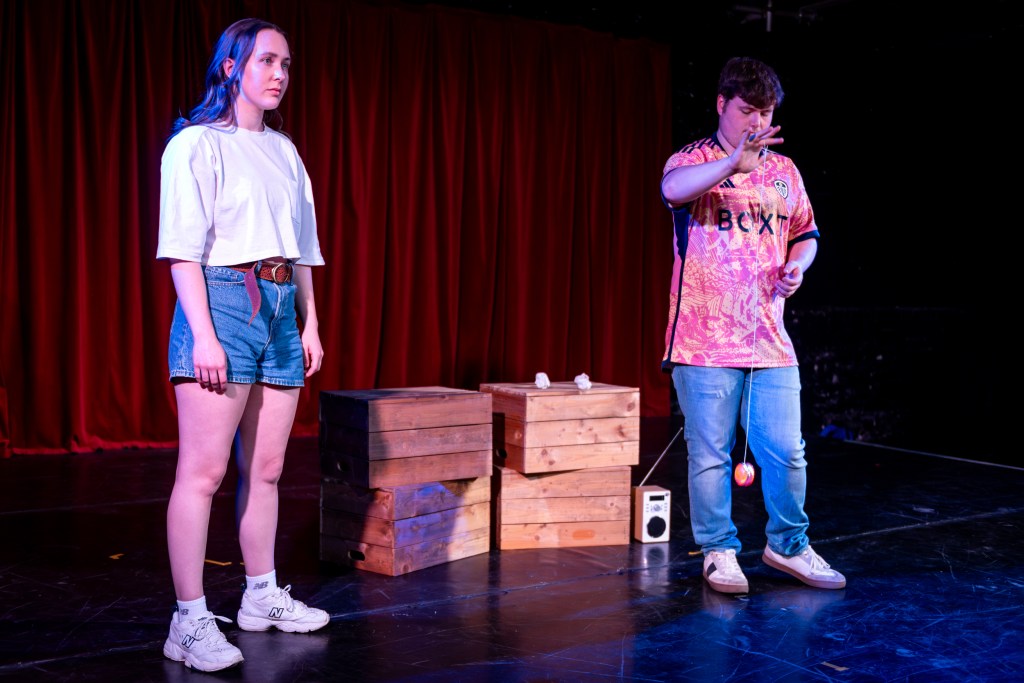
The obvious questions which presented themselves were; are they both going to jump, will one of them throw themself off, or will they step back and use the experience as a basis for a relationship. The answer is – none of the above! The reason Rosie knows so much about Eugene is that she has already taken her own life and is a spectre who has been observing him for quite some time. Her stake out ceased the last time he visited the building and hurled himself over the edge, thus joining her in the afterlife.
Their mindsets obviously changed after this reveal, in that their hopes turned into missed opportunities and their dreams remained unfulfilled.
6. Twitching by Mark Catley – Directed by Kathryn Hanke. Frankie Bounds played Nathan, Rowe Dave McClelland was Chris and Catherine Traveller appeared as Abi.
There is an old theatrical adage which says ‘always leave ’em laughing’ and this piece served the purpose admirably. It began with Chris a middle-aged bird-watcher – or twitcher – entering his hide in the woods and perching (pun intended) himself on the edge of the bench inside. He was on a mission to observe a yellowhammer which he had reason to believe was somewhere in the vicinity, so he got out his binoculars and set himself up for a day’s solitude.
His plan was soon cut short with the arrival of a young man, Nathan, who ran into the hide in a state of panic and ran out again after he had seen Chris. He stood at the hide door apologising profusely, something which seemed to puzzle Chris, who asked him in. It transpired that, as the odour prevalent in the hide, combined with Chris’s crouched seating demeanour, led Nathan to believe that the hide was, in fact, a toilet and he had interrupted his basic bodily function. Once the misunderstanding had been clarified, the two sat down and struck up a conversation.
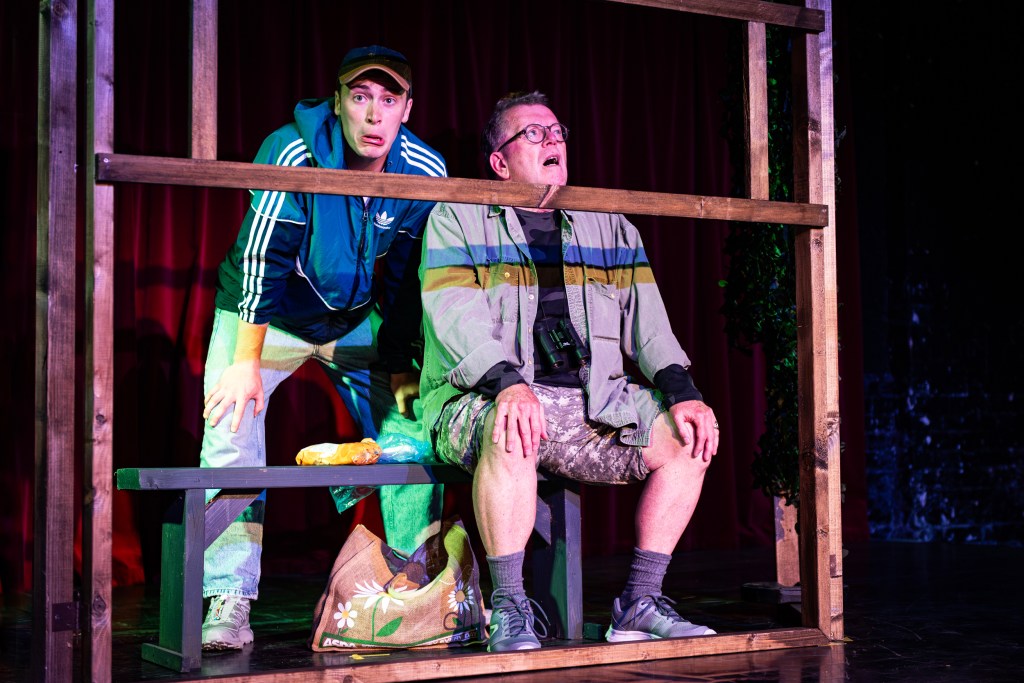
Nathan said that his sudden appearance was due to his being pursued by someone who wanted to collect a debt from him, by whatever means were necessary, so Chris helped him pass the time until it was safe to leave, by explaining the science of ornithology. This led to the obvious jokes about tits etc and more hilarity caused by Nathan’s insistence on calling the prey for the day, a yellow spanner.
Just as it seemed all was safe, Nathan emerged from the hide, only to spot his stalker, causing him to throw himself on the ground in front of the hide. Rather than being a gangster intent on collecting money or breaking several bones, the uninvited guest was a university lecturer named Abi who, after also mistaking Chris’s posture for something it wasn’t, revealed that her intention on catching Nathan, was to try to persuade him to go back to finish his dissertation and graduate. After telling Chris that Nathan was a smart lad and should easily make the grade, she left.
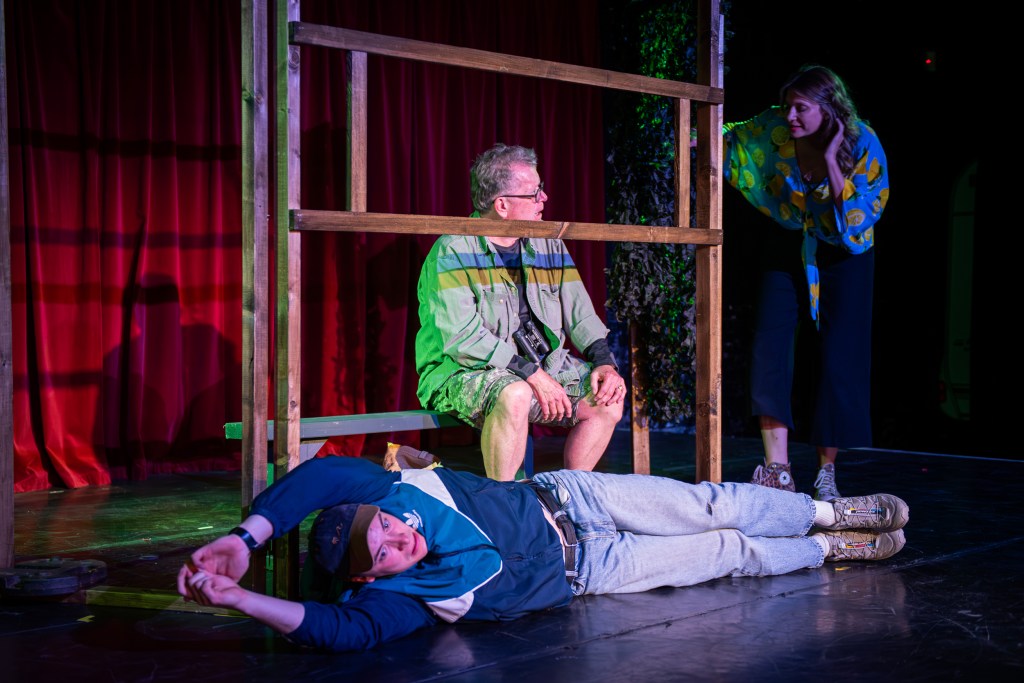
When Abi was clear, Nathan went back into the hide – no misunderstanding this time – and Chris learned that he had missed several weeks and only had a few days left to do his thesis so didn’t think he could make it in time. Chris gave him the obvious advice and Nathan resolved to do the right thing. Whether he did or not we will never know, but he will certainly have a discrete cough before entering another hide.
So, six plays in one afternoon from six writers, six directors and seventeen actors. I must also mention the others involved: Producers Mark Catley, Jonathan Hall and the legend that is Lisa Holdsworth – Technical Producer, Jonathan MacConnachie. Stage Manager, James Tully and Sound, Lesley Sharp.
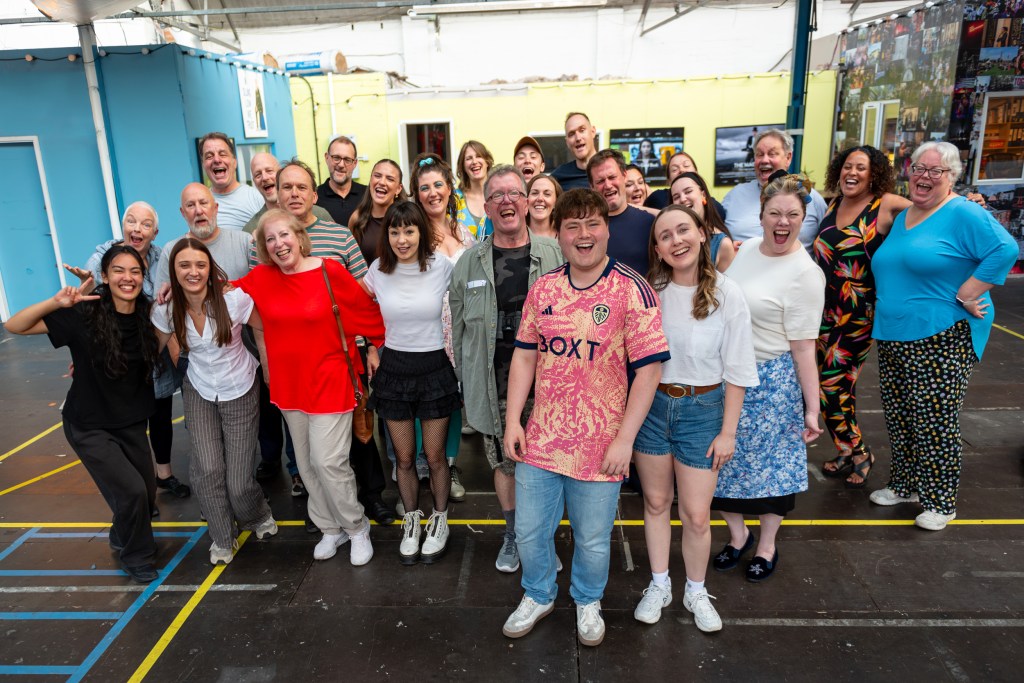
What a superb way to bring the inaugural Yorkshire Fringe to a close. I am already eagerly anticipating next year’s edition.
Photographs by James A Mumby Photography.

