
So far it looks as though 2026 will go down as the Year of the Dance. I can’t remember seeing so many productions of the genre in such a short period of time, and more are just around the corner. It’s lucky that I have come to enjoy this medium, if not downright love it. Fortunately Leeds is blessed with more than its fair share of dance companies and Phoenix is right up there with the best.
INTERPLAY is the latest in a series of presentations comprising several works in one evening. Being a glass half-full person – not an optimist, a restrained boozer – I approach these events by thinking that there will be at least one work I will like. So far, it has turned out that I haven’t seen any I didn’t. OK, I might not have totally understood them all, but that doesn’t mean I couldn’t enjoy them in my own limited way and tonight was no exception. The failure to get all the nuances is purely down to my philosophy of not reading the programme at any type of production I review, because I feel that the work, whatever it is, should be able to convey its message without the watcher having to do their homework first, after all, art is a method of communication between performer and audience, allowing each member to interpret it in their own way, which may not always be as it was intended.
As you may have gathered from the title, the four dances were concerned with various forms of relationships between people and, as is the norm with Phoenix, they were curated in such a way as to deliver the best experience possible.
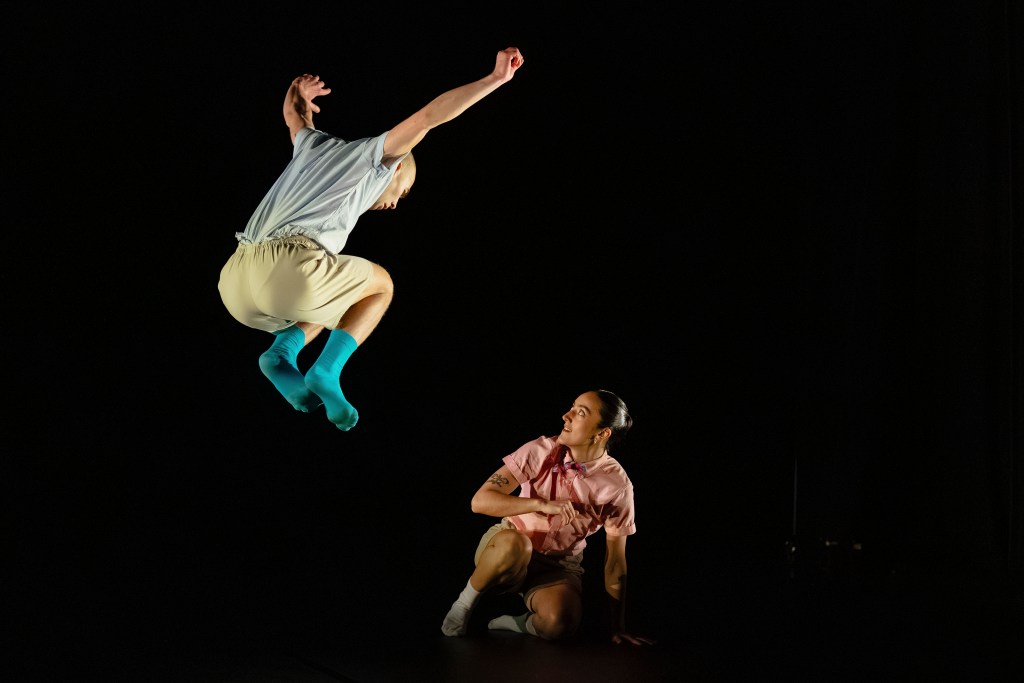
Next of Kin with Dylan Springer and Dorna Ashory.
The first piece was called Next of Kin, choreographed by Marcus Jarrell Willis, featuring two dancers, Dorna Ashory and the appropriately named, Dylan Springer, whose characters obviously knew and liked each other, spending the seven minutes of their dance getting up to all sorts of mischief. There was also a mysterious woman in red who appeared to the rear of the stage a couple of times, but stood motionless on both occasions, ghosting on and off when the lighting was dimmed in that area. I didn’t get the significance of this third performer but she seemed to add some gravitas to the shenanigans of the other two, who were having a ball. Starting the evening on such an amusing note got everyone involved. Speaking of notes, the music was Violin Sonata No.2 in A Minor, by Bach, recorded by Yehudi Menuhin. I bet neither Johann Sebastian nor Mr Menuhin would have foreseen that their musical efforts would be used to accompany such a lighthearted piece of theatre. The stark lighting was designed by Alina Longmore and the costumes realised by Melissa Parry.
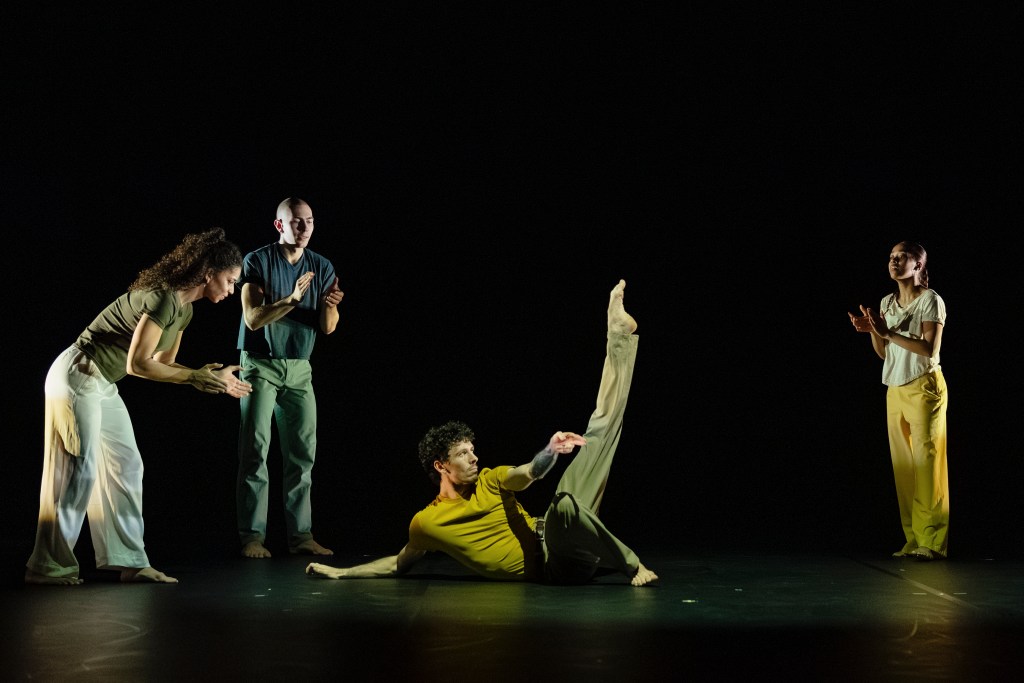
Why Are People Clapping?
The second cab on the rank was Why Are People Clapping? The obvious answer being that we had just seen a great performance, but Phoenix doesn’t do obvious. At the end of Next of Kin, the empty stage went dark and there was the sound of a fly buzzing, followed by the appearance of a dancer who chased it across the room and tried to catch it in her two hands, which she succeeded in doing at the second attempt, having made two clapping noises in the process. After the laughter from the audience died down, we were played the soundtrack of applause at Wimbledon, which provided the backing for two other dancers to perform a tennis routine, complete with John McEnroe tantrums. Once that match was over three others joined them and began to clap out a rhythm thus providing the soundtrack to the rest of the piece. Once again, this was very amusing and incorporated some head dancing as well as the conventional sort. The ensemble then each executed a solo accompanied by the others on claps. The relationship motif was illustrated by one of them disappearing and returning to the side of the stage wearing headphones, obviously playing music. She was incorporated back into the group and the dancing continued.
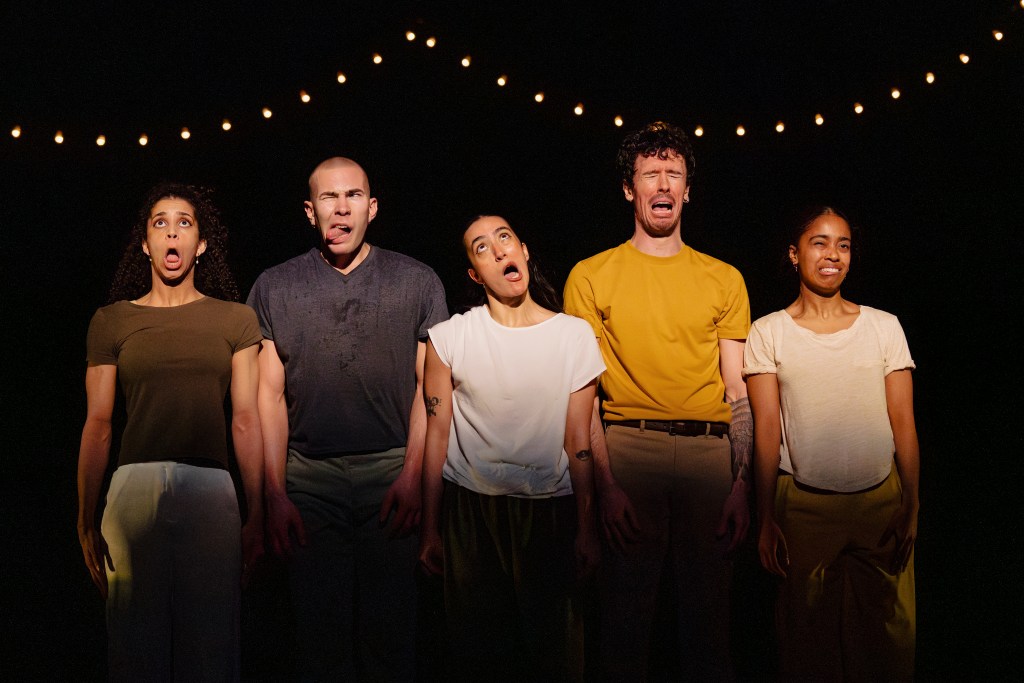
Head Dancing – not a group shot of Donald Trump’s advisors.
This was an adapted piece, originally choreographed by Ed Myhill, here restaged by Camille Giradeau. The music was by Steve Reich and imaginatively titled Clapping Music. Costumes were by Janne Beresford with the original lighting by Jose Tevar, designed for this production by Luke Haywood.
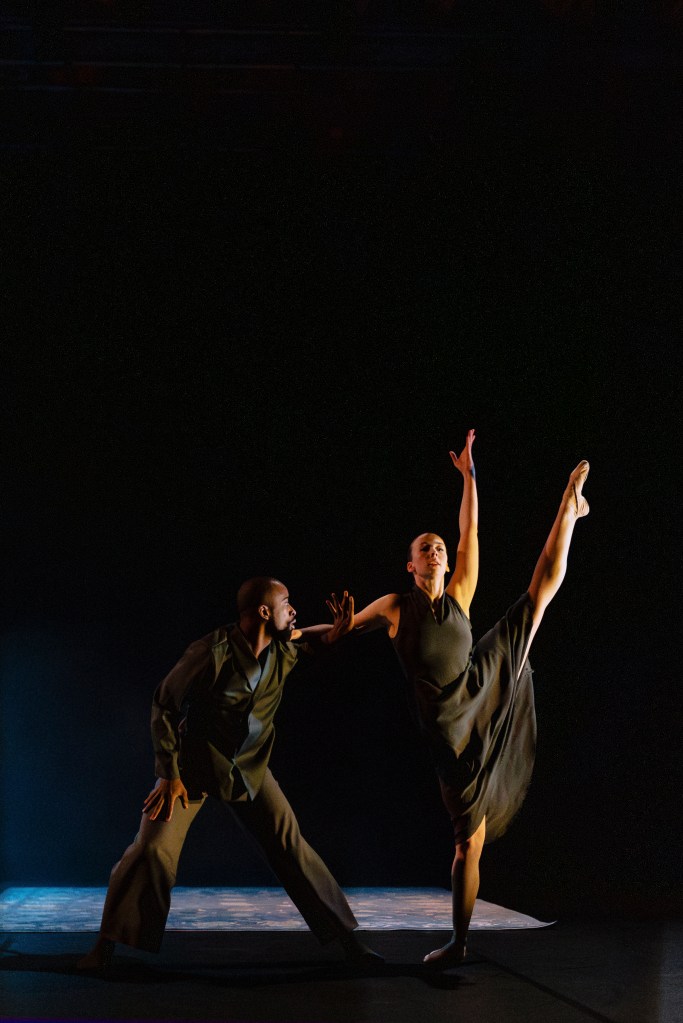
Aaron Chaplin and Hannah McGlashon in Small Talk
There then followed a longer piece, choreographed by Pete Clausen-Knight, called Small Talk, a two-hander about a couple whose relationship seemed to be disintegrating. It was performed on a stage with just a rug, a chair and a standard lamp for props, which became an integral part of the performance as the dance progressed. The items began as familiar comfort objects, before turning into focusses of disagreement and obstacles to communication. There was an amazing passage of dance where the couple were in dispute as to whether the lamp should be switched on or off. As you will gather, this was a lot more intense than the others. The music reverted to the conventional with compositions by Ezio Bosso, Franz Schubert and Angèle Dubeau & La Pietà. Costume design was by Janne Beresford and lighting design by Alina Longmore.
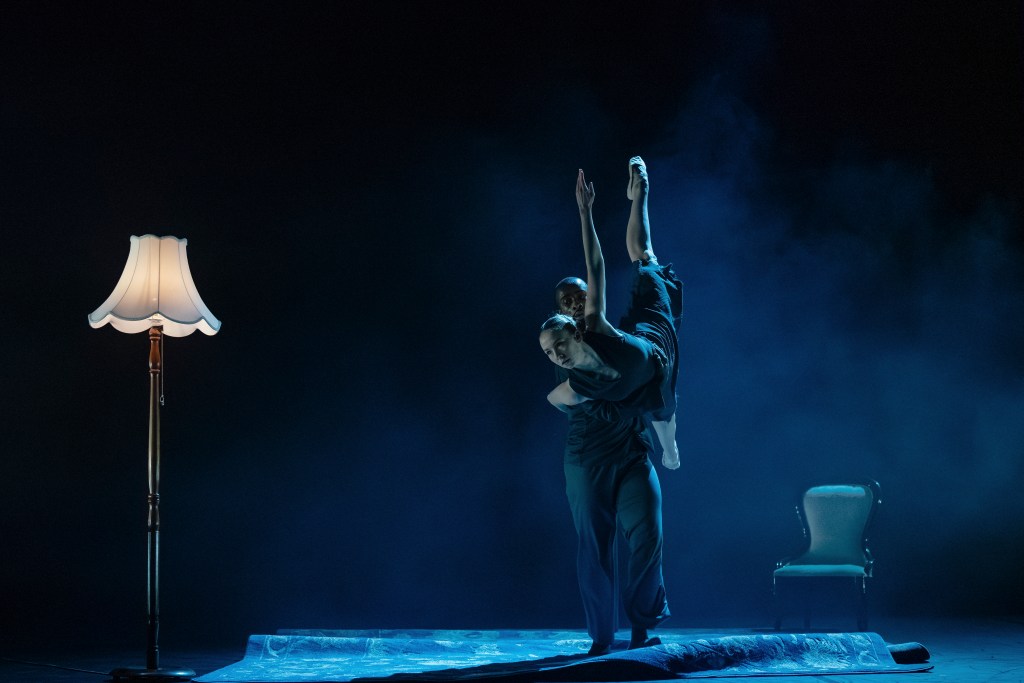
The intensity, as well as the physicality, had me in awe of the two dancers, Hannah McGlashon and Aaron Chaplin, who gave everything for a full 25 minutes. it was another example of how the programme was planned as, by the end, both the dancers and audience were in dire need of the interval to recover.
After a short break and fortified by an ice cream, I was able to devote myself to the second half which comprised a piece called Suite Release – I love a good pun – and lasted 40 minutes but it seemed more like 20, so absorbing was it. The choreographers were Marcus Jarrell Willis and Yusha Marie Sorzano. Costumes designed by Janne Beresford, lighting by Luke Haywood, with rehearsal assistant, Aaron Chaplin. You will realise just how diverse this was when I tell you that the music began with the hymn, How Great Thou Art and ended with a couple of bangers by Kendrick Lamar and Angel X. Just how hip do you want your hop?
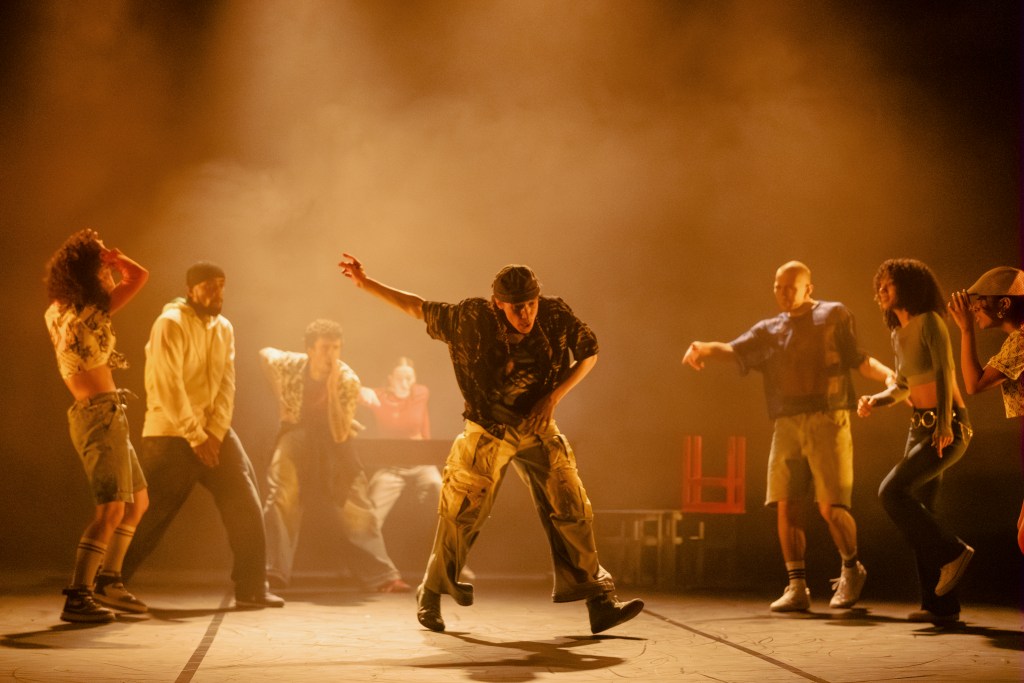
Suite Release
This had the full first eleven players on the field, engaging in all kinds of funky moves, throwing shapes the quality and extravagance of which I thought would have died out once I gave up disco. Once again, the various factions in the club created on stage, sorted themselves out and worked towards unity rather than division, a shame that these weren’t Donald Trump’s advisors!
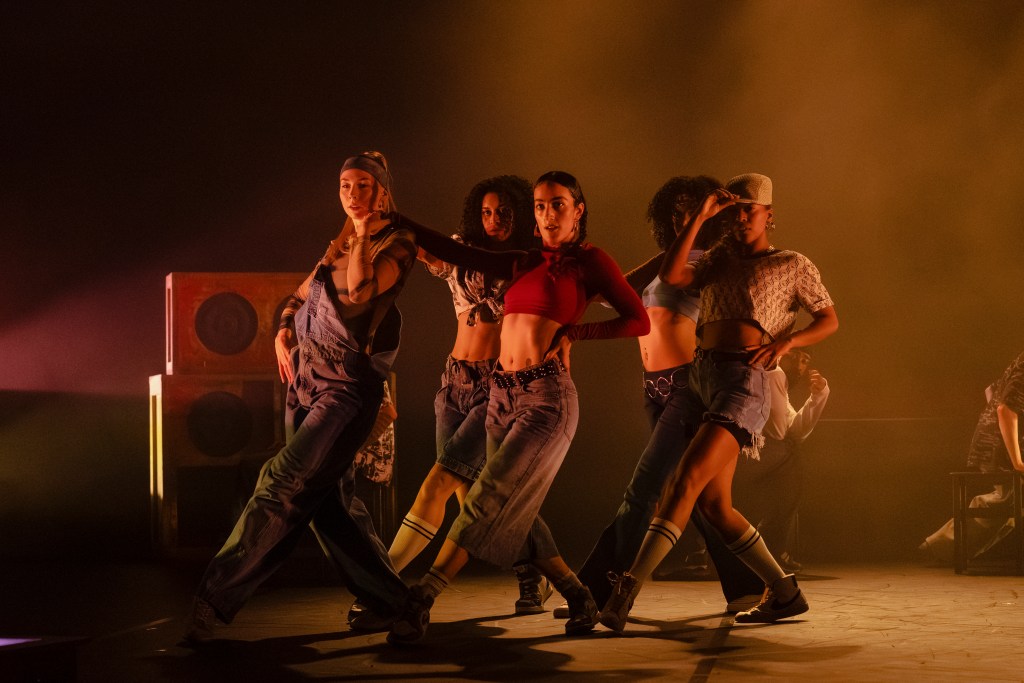
It was this last piece, however, which gave me my only source of grievance in that, there was so much energy expended – including by the two dancers who had only just finished their stint in Small Talk – and an equal amount of enthusiasm, that I really was busting to get up and join in the fun. It would have been the ultimate test for my recent knee replacement.
To watch the trailer, click on this link https://www.youtube.com/watch?v=tY73LCsxa2I&t=5s
Once again, Phoenix Dance Theatre has given us a show to remember. Unfortunately its run at Leeds Playhouse has ended but you can catch it in West Yorkshire on 28th May, when it comes to Lawrence Batley Theatre, Huddersfield. It is also visiting Liverpool Playhouse on 8th May, Malvern Theatres 12th and 13th May, Cast, Doncaster 20th May, Theatr Clwyd 2nd and 3rd June, Northern Stage, Newcastle 16th and 17th June, ending at Sadler’s Wells East from 24th to 27th June. Catch it if you can.
The full list of dancers comprised, Company Dancers: Dorma Ashory, Aaron Chaplin, Rory Clarke, Phikolwethu Luke, Hannah McGlashon, Yasmina Patel, Tony Polo and Dylan Springer with Junior and Professional Placement Dancers: Graciela Mariqueo-Smith, Camila Peralta and Roxanne Fraser.
For full details and booking please click on the link below.
Phoenix Dance Theatre’s main site can be found at https://www.phoenixdancetheatre.co.uk/
To see what is coming up at Leeds Playhouse it is https://www.leedsplayhouse.org.uk/whats-on/
Photographs by Drew Forsyth
 Tyke It To The Limit