As someone who describes himself as a lapsed atheist, it was strange to find myself listening to religious music on a Sunday. The reason for my attendance was to witness the first of the year’s events marking the 25th Anniversary Season of Leeds Baroque Choir and Orchestra.
I do like Baroque music but associate it more with the chamber works of Bach and Handel played on harpsichord and, as with today’s concert, organ. It turns out that the term is applied to most music from about 1600 to 1750. I don’t know what it’s called before four o’clock and after ten to six, but I am sure that someone will tell me. This means that it covers a huge range of compositions, from Bach’s gentle Air on the G String – Behave – the base for Procol Harum’s A Whiter Shade of Pale, to the huge production which is Handel’s Messiah, with its Hallelujah Chorus.
Fortunately, before the main event, there was a talk given by Prof. Peter Holman MBE, the Musical Director and Founder of the Choir and Orchestra, to assist with the understanding of what we were about to hear. Some of it was a bit above my pay grade, but I got the gist, and was rewarded for the experience, being able to listen out for a few things which might otherwise have escaped me.
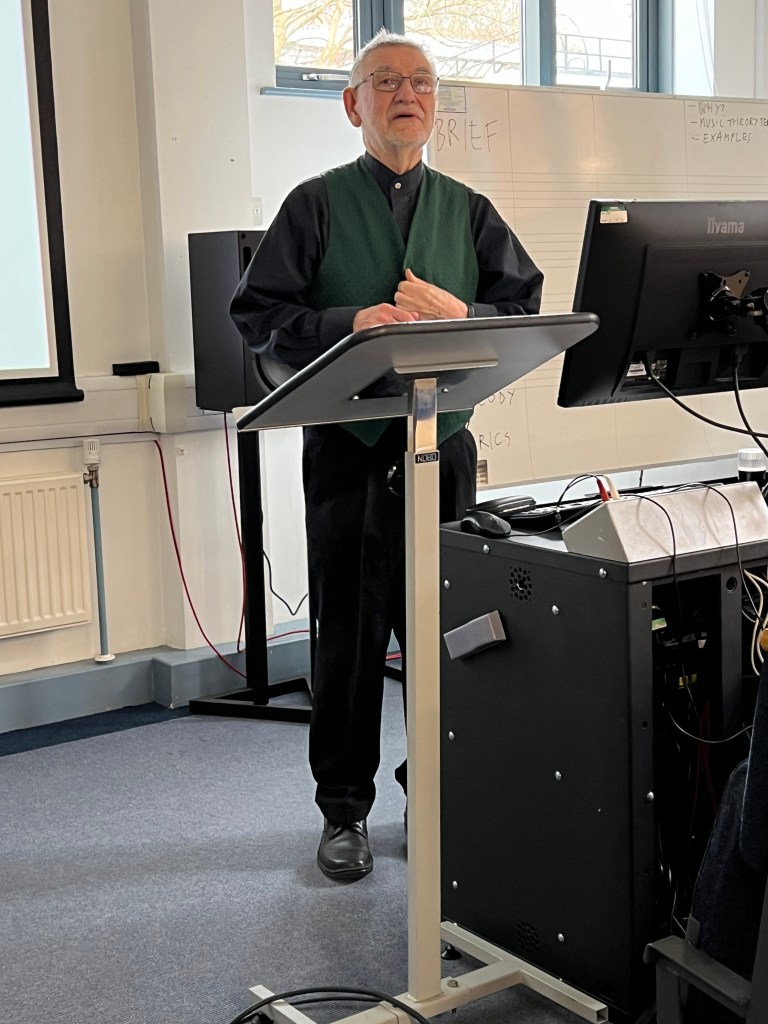
Prof. Peter Holman MBE
As the music was to be played on instruments used in this period, we were given a few minutes of explanation regarding the organ to be featured. It was constructed by Dominic Gwynn, who sadly died last year, based on a model which would have been used by Handel. The construction of the music was explained and that, in keeping with the period, three choirs would be utilised, each bouncing off the others.
It seems that the essence of Baroque music is that it is written in a particular key, rather than being improvised as was the case before. My good friend and mentor, Wikipedia, also leaves me in the dust here, so I hope that what I say is correct. Actually, unless you are going to do a degree in it, I feel that if you enjoy the music – and who wouldn’t, it is spectacular – that is all that matters. At least, that is my excuse for being ignorant! After the briefing, we adjourned to the concert hall for the main event.
I was seated in the front row, which was great to be up close and personal with the performers, but there were so many of them I could not fit the whole ensemble into one photograph. There were also three pieces in the programme; two before the interval and one after, requiring the addition of super-subs at half time, thus increasing the number of players.

Prof. Peter Holman MBE with members of the Orchestra and some of the choristers in the background.
The first work was Concerto in C minor by Antonio Vivaldi, featuring Asuka Sumi on violin and Callum Anderson on the aforementioned organ. The conductor for the whole afternoon was Prof. Peter Holman MBE.
This was followed by Missa Scala Aretina in D major by Francisco Valls which introduced solo singers; Philippa Hyde, Nicki Sapiro and Marie Lemaire – sopranos; Emma Page and Catherine Haworth altos; Steve Muir, tenor and Bryan White, Chorusmaster and baritone.
After the break came Missa in Angustiis in D minor/major (The Nelson Mass) by Franz-Joseph Haydn. This also featured Philippa Hyde, Emma Page and Bryan White, but added Zachary Kleanthous, tenor.
Both the musicians and singers were superb and the instruments very evocative of the period. In addition to the string section and organ, there were a couple of trumpets contemporary with the time, having no valves but relying solely on the players’ lips to produce the notes. My mate, who I had to consult several times, informs me that this is called a natural trumpet and is about twice as long as the valve version. You’re welcome.
The soloists all performed very well, with the principal soprano, Philippa Hyde – who got to wear the flowery frock – hitting some glass-shattering notes.
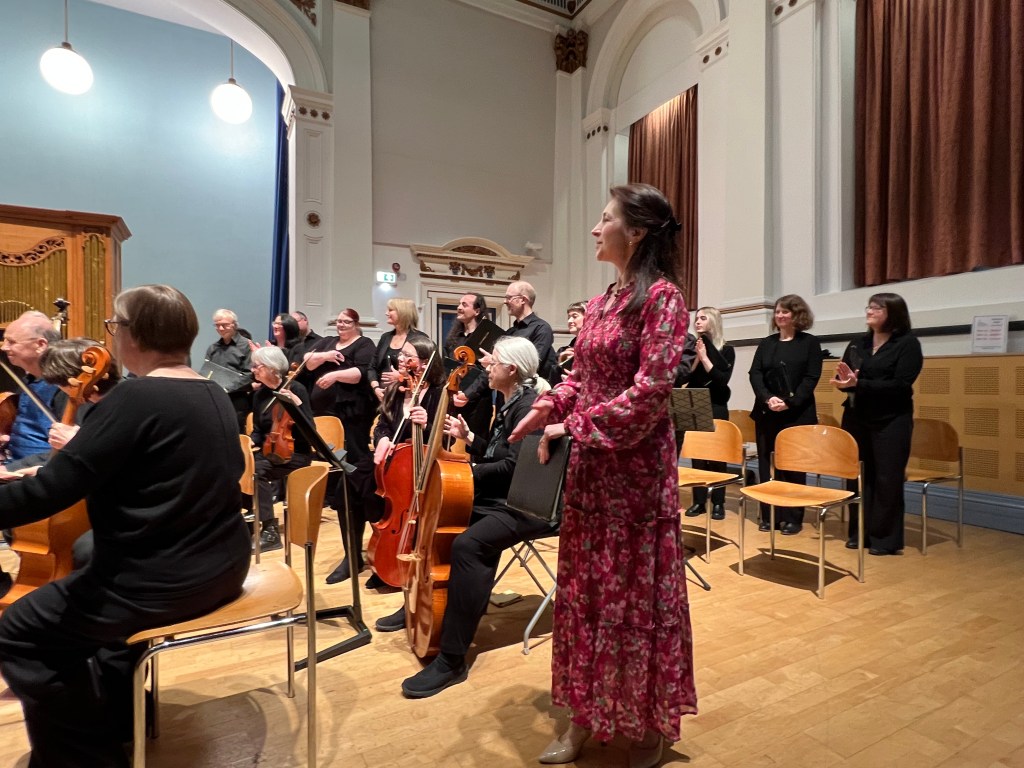
The other half of the ensemble with soloist Philippa Hyde
I am totally unqualified to even try to describe the works technically, so I will just say that they were all very stirring and inspirational. Besides, the Society itself has done a great job in explaining everything, so please click on the link below to see just how dedicated and amazingly talented the members are..
Remember when I said that the Orchestra used period instruments for authenticity, well, here is something you might not have seen before, it is called a violone and is huge. The musician in front of the player has a cello, so you can tell the scale of the thing. They say size isn’t everything, but it is if you are trying to obtain the original effect in the strings section.
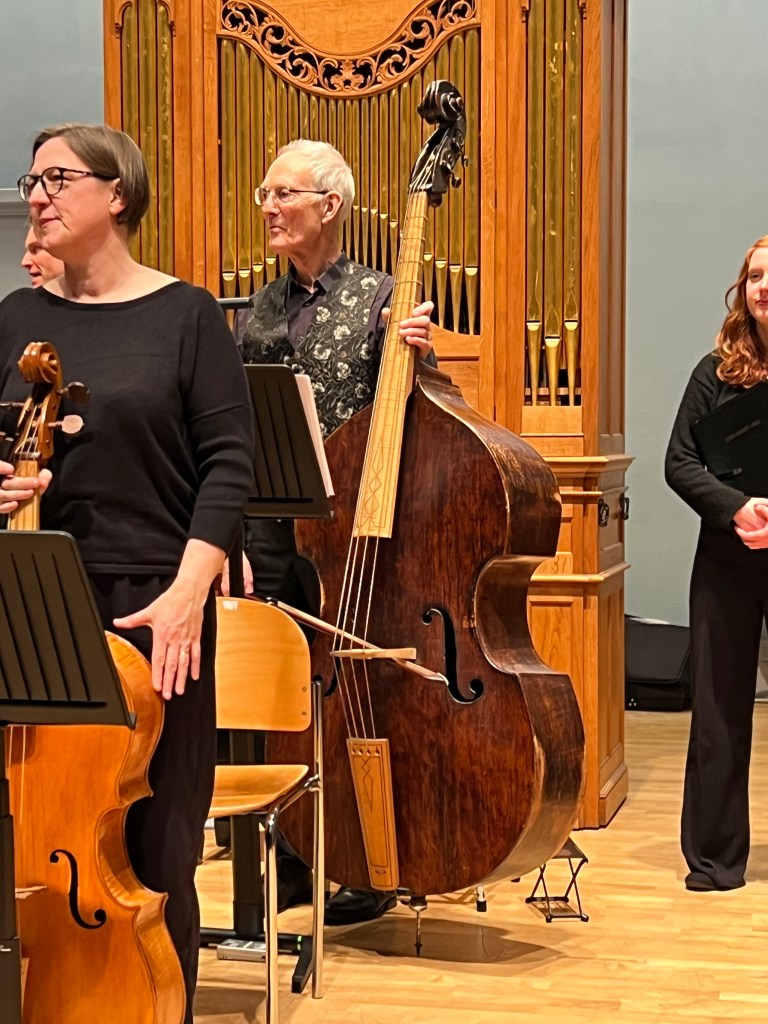
Behind the violone player is the organ, true to the period, specially constructed by Dominic Gwynn.
Although some of the instruments were of a bygone time, it was heartening to see that a few of the ensemble were very much on the young side, giving hope for the future.
Speaking of the future, the remaining concerts in the Silver Anniversary Season are:-
Sound The Trumpet at Fulneck Moravian Church, Pudsey, on Sunday, 27th April
Madrigals and ballets by Claudio Monteverdi (1567 – 1643) at St Andrew’s Church, Kildwick in Craven, on Sunday, 18th May.
Venetian Concertos at The Old Woollen, Sunny Bank Mills, Farsley, Leeds, on Sunday, 22nd June.
A Concert for St Cecilia at Clothworkers Centenary Concert Hall, Leeds University, on Sunday, 23rd November.
To see more about the Leeds Baroque Choir and Orchestra and to buy tickets for the above, please go to https://leedsbaroque.co.uk/
I have just looked at the statistics for my website and am amazed that it has been viewed in countries as far flung as Australia, USA, Canada, China, Singapore, Philippines, Jordan and many others, so let’s hope that, in the words of that legendary composer in this genre, Francisco Rossini – OK, Francis Rossi of Status Quo – we can get people Baroquein’ All Over The World. I la-la-la like it!
Photographs by Stan Graham
 Tyke It To The Limit
Lovely review, and congrats on the global reach of the website – well-deserved!
LikeLike
Thank you very much Charles. Great to know that you are still enjoying my posts.
LikeLike