
When I see the two names, Manchester Collective and Howard Assembly Room, I know that I am in for a night of music, played to an unbelievably high standard, in wonderful surroundings. It will also be a challenge – but in a good way. The great thing about Manchester Collective is that they take your hand and guide you through the programme, especially when, like this one, it is more than a little out of the ordinary. An absolute boon to those who, like myself, might not be able to grasp the nuances without a little assistance.
As its name suggests, the ensemble is a group of like-minded musicians who play music which appeals to them. They are classically trained players of various instruments but also enlist guests to enhance their performances when required. One of the most memorable concerts I have ever seen in any genre, was Oracle which combined ten members of the group with guest cellist, Abel Selaocoe. The place was rocking – to African throat music! This evening the ensemble was only half that size, comprising a string quartet and a pianist. Whilst being a conventional line-up, the programme was anything but.
Ironically, the first piece was by Cassandra Miller and called Leaving. It was played by a string quartet; violins, Eva Thorarinsdottir and Sarah Brandwood-Spencer, viola, Ruth Gibson and Nick Trygstad, cello. It sounded very much as though it was being improvised but the musicians seemed to be sticking to the scores on their iPads. I am getting worried now as this is the second time this week I have been right! On reading the programme later, which was downloadable via a QR code, and, although printed white on black, I don’t like disturbing my fellow concert-goers by consulting my phone during the performance, I found that Ms Miller’s modus operandi is what she calls, ‘transformative mimicry’, meaning that she begins with a source sound, records it, improvises on it and then scores her improv. I suppose it saves the musicians bumping into each other by giving it their own interpretations. It was a bit dark, slow and mournful, but a fair start.
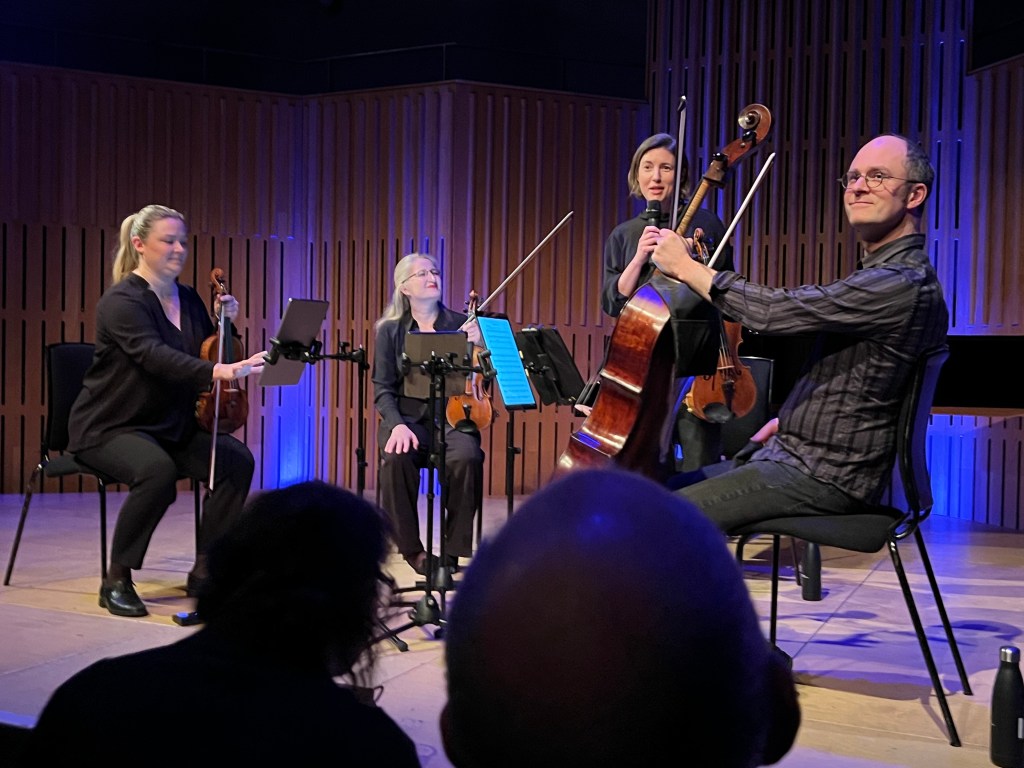
Ruth Gibson giving us an introduction to The big house, with Eva Thorarinsdottir, Sarah Brandwood Spencer and Nick Trygstad
The second work, again performed by the string quartet, was The big house, by Oliver Leith. This was a descriptive piece in seven (short) movements. Fortunately, Ruth Gibson gave us an explanation of what we were about to hear. She said that it was quite hard work playing it as a musician needs to get inside the composer’s head to interpret his intentions accurately. With movements named Blue bottles, Cornicing, Pomegranates and Fish eggs, this was no mean feat. The work is based on a book of photographs called In Ruins: The Once Great Houses of Ireland, which speaks for itself and puts the titles into some sort of context. I must say that I would never have guessed what the music was trying to depict had I not been told. It was a pleasant enough section with varying tempi and energy.
After that it was interval time and an opportunity to peruse the programme whilst partaking of a White Chocolate and Raspberry Northern Bloc ice cream – it would have been rude not to!
The second half began with the orchestra being augmented with pianist, Junyan Chen, for the eponymous piece, Hidden Mechanisms by Héloïse Werner. It was introduced by Manchester Collective’s Co-Artistic Director, Jasmin Kent Rodgman. She gave us a rundown on the organisation and said that she was going to tell us about the music we were about to hear, but rather than do it herself, she would get the composer to let us have it straight from source and welcomed Ms Werner to the stage.
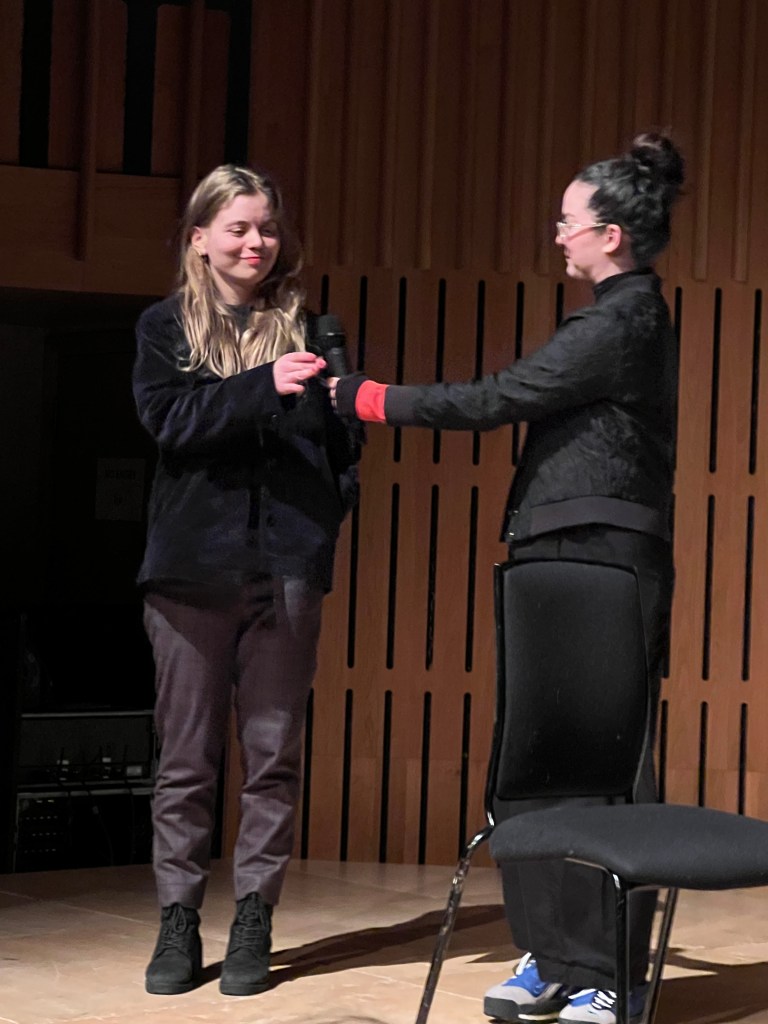
Jasmin Kent Rodgman handing the mic to composer Héloïse Werner
It was obvious that what was to follow would be anything but ordinary by the mischievous glint in her eye, and so it proved to be. Again I needed the explanation in order to better understand the work, which this time was in five, unnamed, movements. She said that it was written during a walk in the forest when her mind wandered to the way in which, although everything seemed tranquil and calm, there was lots of unseen activity going on, both above and below the ground, to facilitate the growth and continued development of the greenery.
She also said that once this idea had taken root, pardon the pun, she began observing other objects with the same intent. One of them was a music box, where, although the figurine was effortlessly dancing, there were lots of concealed elements causing the dancer to stand upright when the box was opened, their movements to be controlled and the music to play.
During the performance, there were parts when the players hissed, clicked their tongues and imitated musical marionettes by standing up at varying intervals, pulling faces to mimic the puppets. All while still playing! Fabulous.
The final part of the concert was a Piano Quintet by Olli Mustonen, which was much more conventional and melodic. It is described as being like ballet music without the dancers, which was true to a point but I shudder to think what the terpsichoreans would have done with the explosive ending!
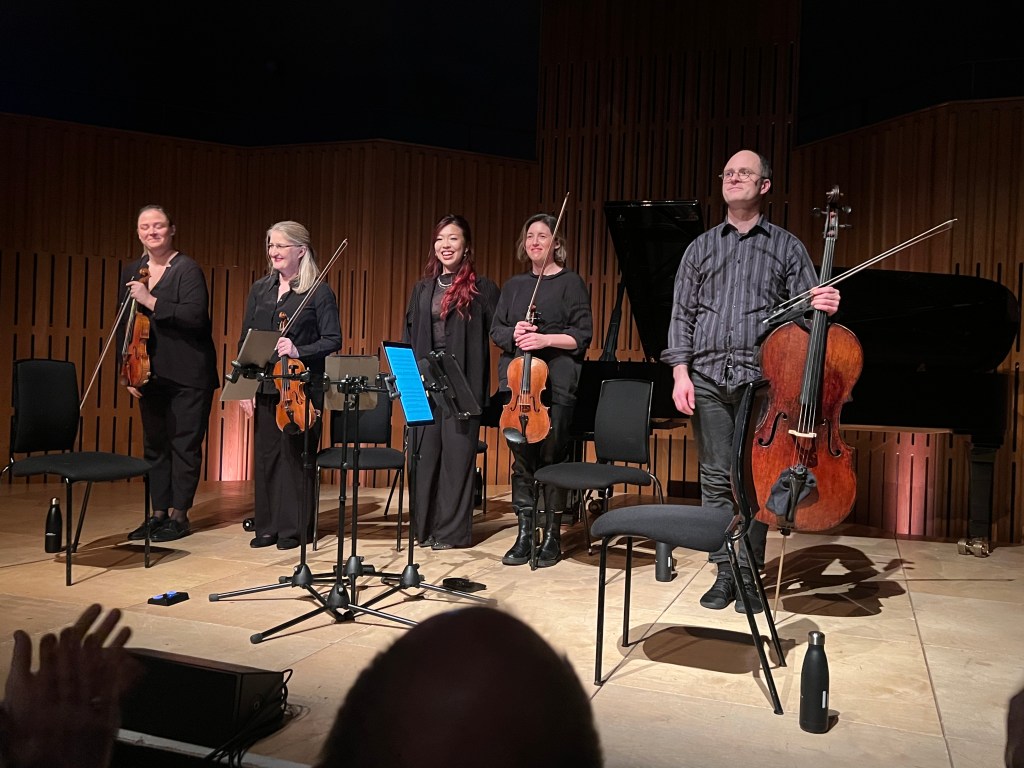
Eva Thorarinsdottir, Sarah Brandwood-Spencer, Junyan Chen, Ruth Gibson and Nick Trygstad
Once again, Manchester Collective has provided an evening differing, not only from other performers I have seen at Howard Assembly Room – or anywhere else for that matter – but also from their own previous offerings.
Manchester Collective: Hidden Mechanisms is on a short tour, with the only remaining date being at Southbank Centre in London at 4.00pm on Sunday, 9th February. For more details and to book please go to https://manchestercollective.co.uk/hidden The running time is about an hour and a half so you will be home in ample time for the Super Bowl!
For other offerings at Howard Assembly Room please see https://www.operanorth.co.uk/event-tag/har/ and have a look at the main Opera North page for their programme, which is in full swing.
Feature image provided by Opera North. Photographs by Stan Graham


Sounds weird and wonderful!
LikeLike
And so it was!
LikeLike