
When anyone mentions the violin, most people don’t immediately think of Indian music, but the instrument has become a staple in the South Asian classical world and this evening proved why.

After an introduction from Keranjeet Kaur Virdee MBE, CEO and Artistic Director of South Asian Arts, the event began. Ms Virdee said that there would be five sections to the programme: a presentation on the Journey of the Violin to India, a recital from SAA-uk Young Musicians, a piece in the South Indian style, a piece in the North Indian style and a final work with the players combined. The last of these had been specially written for the concert and comprised a raag based on Beethoven’s 9th Symphony to mark its 200th Anniversary. She also quipped that they were working on Indian Time so would be running a little late.

With that, Rakshika Bansal, a researcher from the University of Leeds, took to the stage to give us the history of the violin in South Asia. She said that there had been variations on stringed instruments played with a bow, for centuries but it was western colonisers who introduced the violin as we know it. The well-to-do families acquired instruments which gave them the cachet needed for others to copy. Before too long they were assimilated into the musical culture of the region, and today are in common use.

One of the more traditional forerunners of the violin, the Dilruba, was played by Sachpreet Kaur in a raag accompanied by Meherjot Singh Sagoo on Tabla. The main aim of South Asian Arts is to keep the musical appreciation and performance of the region alive, to which end they spend a lot of their time teaching young people to play, sing and dance. These two performers are from that programme and were superb.
They certainly taught me a lot because, being so young, they have not had chance to gain the experience needed to go off in an intricate improvisation, so the piece was kept relatively simple, meaning I could appreciate the base from which the maestros to come started. Obviously the word, simple, is relative and not meant to imply in any way that what they did was easy, in fact it has to be done from memory as the raag was not written down but learned aurally.

While the set was being arranged to accommodate the next performers, Madeleine Mitchell gave us a resume of the Red Violin Festival, of which she is Artistic Director. It was her brainchild to celebrate the violin across the arts in all its guises and was set up in 1997 with Lord (Yehudi) Menuhin as Founder Patron. The previous two, in 1997 and 2017, were both held in Cardiff so Leeds is a first for them, although Ms Mitchell said that she is no stranger to the city. Obviously a lady of refined taste.
There was one guise missing from this year’s version and that was 1970s and 80s rock, which will have upset one of my boozing buddie from that era, Mik Kaminski. He was the fiddler in Electric Light Orchestra but probably didn’t qualify as his violin was famously blue.

Sri Vijay Venkat has performed all over the world in prestigious venues as a multi-instrumentalist and vocalist, including at Leeds Grand Theatre in Opera North’s Orpheus. He is also a renowned composer who had co-written the final piece of the evening. He practises the South Indian style of violin which varies from that of the North in a way which was explained but was a bit beyond me!
One thing I did learn, was that, although billed as solos, performers never play alone, they always have a percussionist to keep time. Mr Venkat’s was Dr Abhiram Sahathevan on mridangam. He holds a Postgraduate Diploma and Master’s in Mridangam, the Doctor part of his name is because he is also a practising GP. I was going to ask him about my bad back but he triaged me.
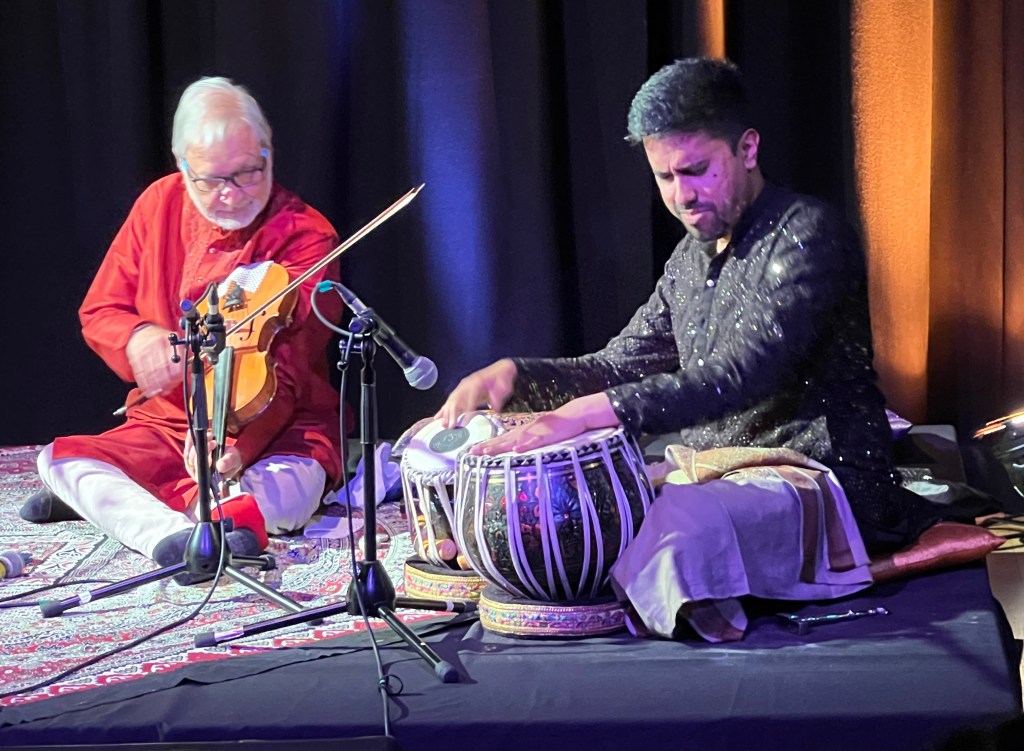
The Northern Indian style was performed by Sri Kamalbir Singh who is not only a respected violinist but also a Ghazal singer and educationalist. He has appeared at the Royal Albert Hall and with the Philharmonic Orchestra in Germany. In addition he was the first Indian musician to perform in a West End musical, The Far Pavilions.
Sri Aman Pal on tabla, was Mr Singh’s accompanist and has been playing since the age of six. He has also played all over the world and had made the journey from Sydney, Australia, where he is currently living.
The amazing thing about all of these incredible artists, is that they are all from Leeds, a tribute indeed to the efforts of all concerned to not only keep South Asian music alive in the UK, but to ensure it thrives.
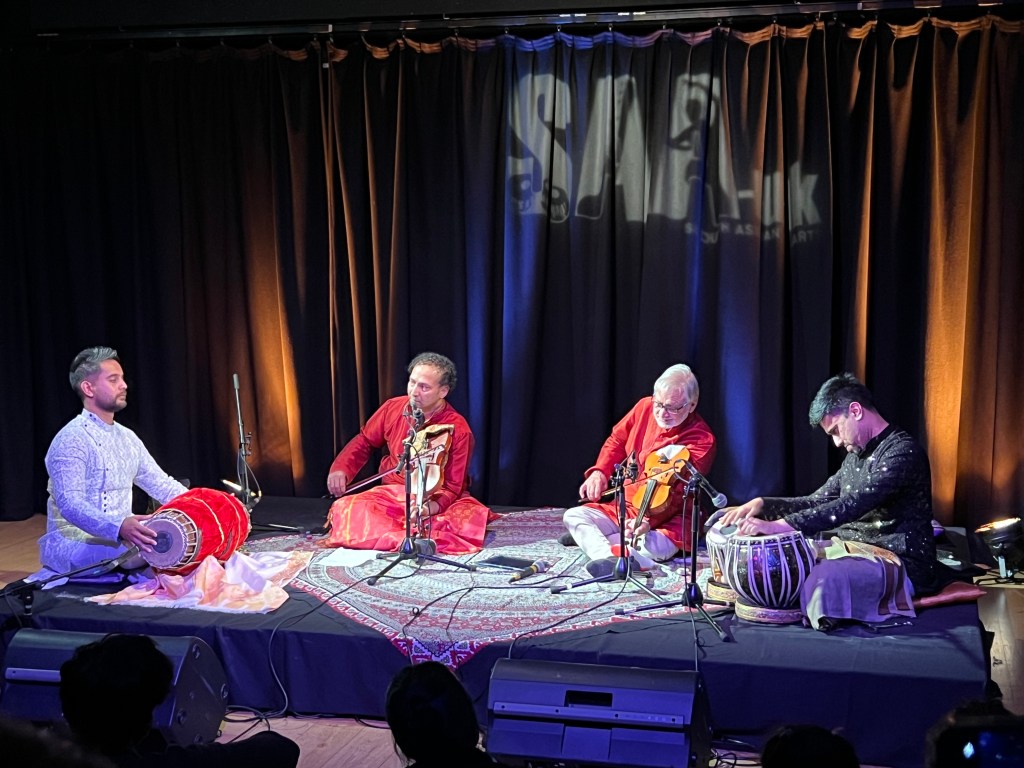
We then had the grand finale. All four legends playing together in a raag, based on Beethoven’s 9th Symphony, written by Sri Kamalbir Singh and Sri Vijay Venkat. This was the highlight of my night as it was based on a tune with which we are all familiar. All the other raags I have ever heard began with melodies from the subcontinent so were alien to my knowledge and tradition. Here, I could identify, not only with the core source, but the way in which the improvisations were embroidered. I am hoping to understand the next piece a little better now.
The violin playing was obviously brilliant, especially as it got to the lively final section, but the drumming was incredible too. The two men were in complete synchronisation, the differing sounds of their instruments played in such unity was mind-blowing. They kept exchanging glances during the piece, almost congratulating each other.
This concert was a privilege to witness with the cream of both young – and not so young – players performing to incredibly high standards. You don’t need to understand the technicalities of music, whatever the genre, to appreciate its execution and the amount of their being which the exponents infuse it with.
For more details about The Red Violin Festival please go to https://www.redviolin.co.uk/red-violin-music-festival.php
To see what else South Asian Arts has coming up it is https://www.saa-uk.org/
The Seven Arts programme of events can be found at https://www.sevenleeds.co.uk/events/
Photographs by Stan Graham
 Tyke It To The Limit