
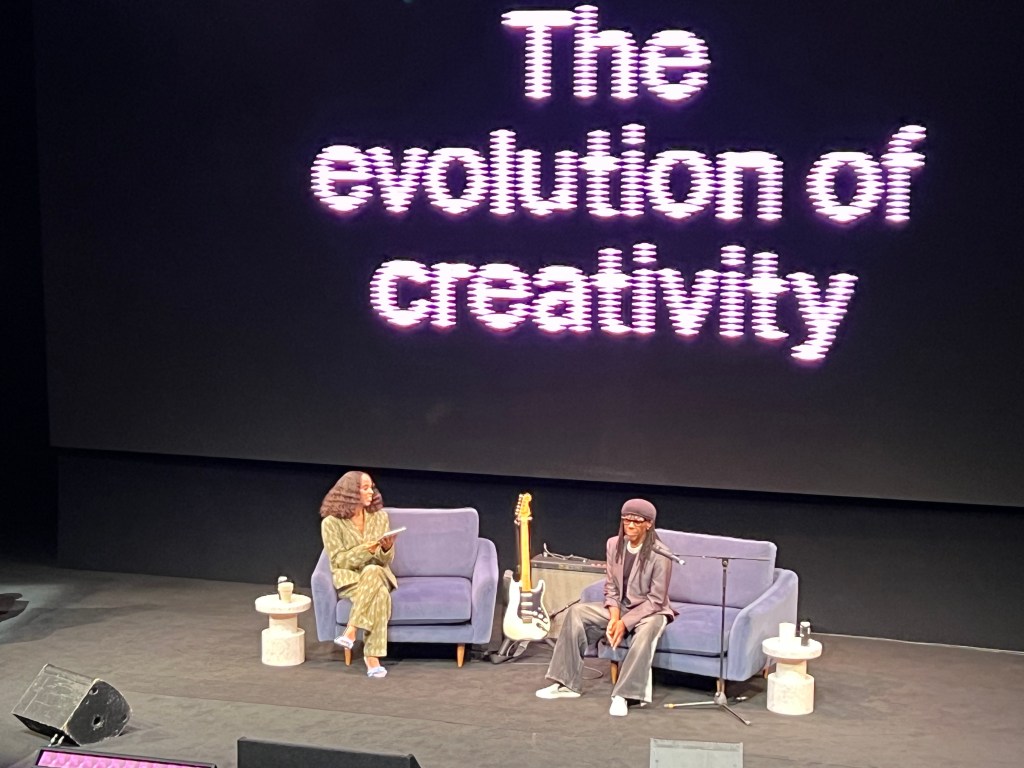
You can look at the cv of Nile Rodgers and see that he has written, produced and performed on singles that have sold over 75 million copies as well as 500 million albums worldwide. He has collaborated with artists such as Madonna, David Bowie, Dianna Ross, Sister Sledge, Duran Duran, Michael Jackson, Mick Jagger and Daft Punk, a list which only scratches the surface – pardon the pun. He is, amongst other things, a member of the Rock & Roll Hall of Fame and Chairman of the Songwriters Hall of Fame but, guess what, I really don’t care about all that stuff, last night he showed to those assembled to hear him talk about The Evolution of Creativity, that he is one of the most honest, humble and truly delightful people on the planet. Sadly there are no awards for that, as those who would put themselves forward for nomination are too modest to do so.
Since witnessing his conversation with the musician and artist, BEKA, I have been mulling the experience round in my mind wondering if it could have been an act, as Mr Rodgers is a fellow countryman of George Burns and Groucho Marx, whose brother, Harpo, was an influence on him as a child, both credited with saying ‘Sincerity is everything. Once you can fake that, you’ve got it made.’ I am three years (minus one day) older than the subject of the interview and my career depended on my being able to spot a fraud when I see one, and if he was fooling us he deserves to have a lifetime achievement Oscar to add to his six Grammys.
Not only is he a wonderful human being but he is a shining example of how to overcome adversity by taking the positive path, rather than feeling sorry for yourself and using your position in life as an excuse for giving in or, worse still, taking the perceived easy route via crime and villainy. Don’t get me wrong, he admitted to having been a user of drink and drugs for some time when he was young, but he still continued to strive to be kind and considerate to others. Kindness was a recurring theme of the evening.
He was born to a black mother, Beverly Goodman, when she was 14 years old, after becoming pregnant by her first sexual encounter with Nile Rodgers Snr, a travelling percussionist, who was seldom at home. Seven years later, in 1959 she married a white man, Bobby Glanzrock, who Niles described as, a beatnik who morphed into a hippie, as was normal in those days. As a result, the credo in the family was one of peace and love. His parents became addicted to heroin, which he began using at 13. Before all that he more or less lived on the streets of New York, sleeping in subways with his cousin – who later became a high flyer in the management structure of Delta Airways – see what I did there? His parents trusted him not to get into any trouble and so there were no ground rules insofar as curfews were concerned. When he was seven he played truant for 75 days in a row and spent his time watching films, saying that he learned more about the world from directors such and Goddard and Truffaut than he ever would have done at school. As the age gap between him and his mother was not that great, he said they were more like sister and brother so his celluloid education helped him have conversations about life in general with her.
At 16 he learned to play the guitar, and the rest is mystery as, shortly thereafter, he became a musician on the tv show Sesame Street. He told a brilliant story of how, having been inculcated into being kind to people at a very early age, this attitude was cemented by an episode on a bus carrying the cast of the show from one venue to another. The driver saw a young boy up ahead on the highway hitching a lift so he stopped a few hundred yards short of him and the actors put on their costumes. He recalled the look on the kid’s face when he was asked to get on board with Big Bird, Elmo, Cookie Monster et al and realised the effect a random act like that could have.

BEKA admitted that she was a bit overwhelmed by the thought of interviewing an icon in her field, but she need not have worried as he was only too willing to help by telling a plethora of stories. Every one was a gem but I will confine my review to just two.
The first was concerning Chic’s breakthrough hit Le Freak. He said that he wrote it with Bernard Edwards when they were just starting out and had met Grace Jones in a recording studio. She said she was performing at the legendary Studio 54 club and told them that if they went to the back door and mentioned her name they would get in. When they arrived the bouncers had other ideas and when Niles said they had been invited by Grace Jones, they were too to F**k Off! This was the stock reply to all of their protestations so they called at a liquor store, got some booze and went back to their apartment. After a few slugs, he picked up his guitar and played the opening riff which we all have come to know and love, but the only words were those as uttered by the bouncer. Because they were making progress with the tune and thought it could amount to something, they decided to change the expletive to Freak Out rather than F**K Off, and, this time, the rest is history.
The other tale happened some time later when they had been collaborating with Dianna Ross on her album Dianna. They had interviewed her for three days to get to know her story and then written songs to sum up her life. One night Niles went to a club, which turned out to be the domain of the trans community. He went to the gents to relieve himself and found that he was not alone at the trough, when he looked around he noticed that all the others seeking to eliminate the pressure on their bladders were dressed as Dianna Ross lookalikes. It is fortunate that she used to wear dresses with a long slit up the front! He realised that her popularity among the gay population was such that they were an irresistible market so he came up with the idea of writing a song for her aimed at them. Having washed his hands he rushed to the phone and rang Bernard Edwards, who was asleep, it being the early hours, and told him to write down the two words ‘coming out’. When Edwards asked him why he couldn’t wait until they saw each other later in the day, Rodgers replied that he was going to get drunk and high so would have forgotten by then, which, it transpired, was the case. The problem then was getting Dianna Ross to record it and use it in her show. He admitted lying for once in his life, and said that it would make a great opening number to her performances as, in New York, artists usually began by saying that the first song they were coming out with was ……. She believed him and still uses it to open her act.
Getting back to the title of tonight’s event, The Evolution of Creativity, he said that it was quite simple really, he uses what he calls the ‘what if’ method, always asking himself, what if I did this in order to move the composition or arrangement on. He had a guitar with him and gave us a brilliant example by playing the introduction to Let’s Dance in the way that David Bowie had envisioned it and then going through several steps of asking, what if I changed the tempo, then what if I changed the key, what if I jazzed it up etc until he arrived at the finished article. Fascinating.
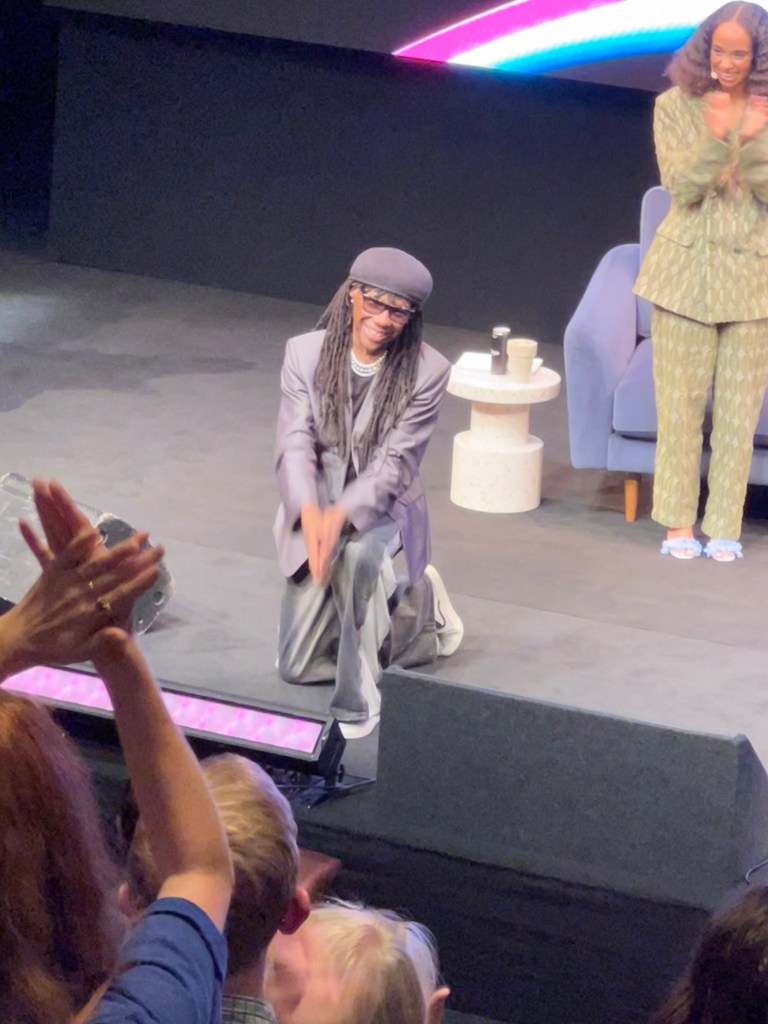
Having been to the previous incarnations of Leeds International Festival of Ideas since its inception, I resolved to leave before the Q&A session as I have found them to be more about the people asking the question than the guest, but I was a bit slow and, as the first audience member was already in full flow I thought it rude to leave, even though I was on an aisle seat near the exit. I am so glad I stayed because the enquiry was as to when Mr Rodgers first had his light bulb moment and realised that songwriting was his destiny. If I had any doubts about sincerity, this is when they were expunged. He said that he started as a classical guitarist but, there being no other black classical players, and because of the attitude to black people in those days, probably wouldn’t be for some time, he decided to turn to jazz. In order to get some money for lessons he played as a session musician doing adverts for tv. One day when he went for tuition, his teacher asked him why he was seemingly a bit down, to which he replied, in order to make a good impression, because I have been playing the introduction to Sugar Sugar by the Archies all day. The teacher asked why that was a problem, he said that it wasn’t proper music. At this point – last night, not in the story – he broke down in tears, saying that the tutor grabbed him by the back of his neck and looked into his eyes and said ‘Sugar Sugar has been number one for three weeks and has touched the soul of a million strangers, isn’t that what music is for?’
I will never never forget this event, nor will I look at Nile Rodgers in the same way again, or scoff to myself at the strains of bubble gum music. It is touching the soul of people and what is wrong with that.
Leeds International Festival of Ideas continues at Leeds Playhouse until 5th October. For more information and tickets please visit https://www.leedsplayhouse.org.uk/event/lifi24/ or https://leedsinternationalfestival.com/
For other events at Leeds Playhouse it is https://www.leedsplayhouse.org.uk/whats-on/
For more information about LeedsBID who are the organisers of LIFI24 please go to https://www.leedsbid.co.uk
Feature photography Tom Arnold. Other photographs by Stan Graham
 Tyke It To The Limit