
Another week, another show about a pioneering woman. After musicals about Jennie Lee and Shirley Chisholm, who were both politicians, here we have one written by Rosie MacPherson, based in an idea from Beth Knight, who directed the piece, about Betty Beecroft an 18th Century industrialist. As with the other two, the music style was contemporary to the time so we were treated to folk songs composed by Sean Ryan. To add to the authenticity, the setting was Leeds Industrial Museum.
Elizabeth ‘Betty’ Beecroft was the first woman industrialist in Leeds. It would have been about the first woman mill owner in the country, except that when she set up her business at Kirkstall Forge, women were not allowed to possess property and so she had to acquire the lease in her husband’s name, a bit of a switch from the present day when entrepreneurs put everything in their spouse’s name in case it fails, in order to prevent the assets being seized to pay off the debts.
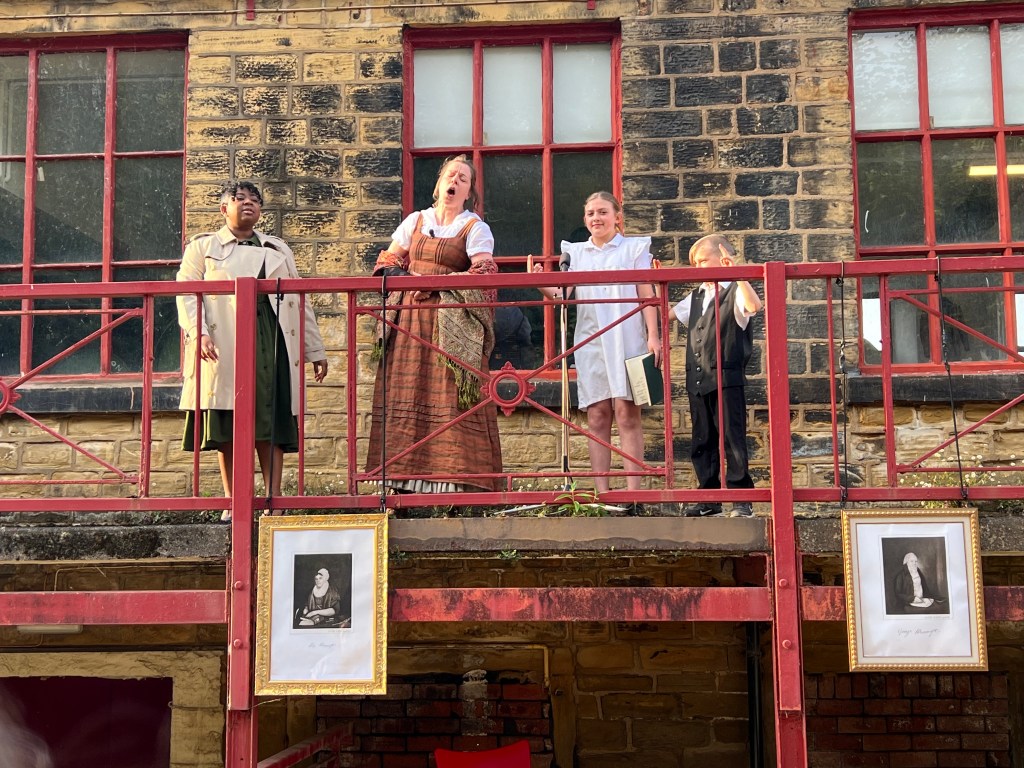
Kathryn Hanke as Betty Beecroft above the portrait of her which hangs in the museum.
Mrs Beecroft was no stranger to business having set up with her brother James in Leeds Market selling household goods and butter. She married George Beecroft, a farmer from Bramley, and moved to Kepstorn Farm, Kirkstall. In 1778, at the age of 30, she heard that the lease to Kirkstall Forge was to become available so she persuaded her husband to purchase it for her to run while he managed the farm. He was obviously a little reticent as it was a quantum leap from selling butter in the market to producing and forging iron for the world.
In order to get the business she needed to borrow money and so turned to her brother-in-law, John Butler, a businessman in Baildon, whom she disliked intensely, his being a misogynist and tyrannical in his approach to labour relations and competitors. He lent her £1,000, about £225,000 in today’s money, the balance of £800 being obtained through various other sources. Despite the animosity, the venture was called Beecroft, Butler and Co.

Adam Bassett as John Butler, his portrait being displayed below him, with Miles Kinsley as his son, Thomas Butler
Under the management of Betty, who did the accounts and bought material such as scrap metal to forge into iron, the business thrived. She did the accounts and employed and managed the workers. Although the profits for the first year were £172, by 1784 they had risen to an amazing £984 but she and her husband didn’t take a very large amount in salary. Relations between Betty and John Butler became more strained when he had a house built for himself in the grounds of the forge so that he could micromanage the business, and in 1785 he took over completely. After nine months he asked Betty to return to handle the accounts, which she did until 1805, even though they were still at loggerheads.

Betty Beecroft and John Butler having a philosophical discussion as to how the firm should be run!
Betty was also managing the family farm’s wholesale butter business so, on leaving the ironworks, she concentrated on that, as well as selling the produce in Leeds and Otley, where she was born. In 1793 she was accused of sanction busting by selling butter to the French, with whom we were at war, resulting in her taking out an advert in the Leeds Mercury, denying the rumours and offering a reward of 10 guineas (£10.50) for information regarding those involved in the slurs.
Betty Beecroft died in 1812. Her daughter, Anne, married Thomas Butler, the son of John, who had taken over the forge from his father.
The Butlers continued to run the business and, in 1851, changed the trading name to the Kirkstall Forge Company. After several ups and downs, involving a renegotiation of the rent with the landlord, Cardigan Estate, in 1892 they were the first company in the UK to produce bright steel bars, which was fortuitous in that the world demand for wrought iron had decreased substantially. During the First World War they ceased forging in order to produce axles, which they also did during the second conflict, to supply military vehicles.
In 1964 the firm expanded by buying the Regent Axle Company based in Burnley and in 1974 the whole concern was acquired by GKN. Dana Spicer Europe Ltd took over in 1995 and by degrees moved production overseas until it eventually closed in 2003. In 2005 Commercial Estates Group bought the site and planning permission was granted for redevelopment which is now well underway with the opening of an office building and bar/restaurant – called Butler’s as a nod to the past – already completed and the construction of 1,050 new homes approved. It also has a new railway station.
Although ostensibly a celebration of Betty Beecroft’s life and legacy, I found that the musical turned into a play of two halves, the biographic element taking up the first with the second going off piste and dealing with the labour and management conflicts of more recent times.
I thoroughly enjoyed the way in which the former was presented with various scenes played at locations both inside and outside of the museum, the songs and dialogue being poignant and witty. The fourth wall was constantly broken down as actors mingled with audience members, who were split into two groups, each having the odd special presentation between the scenes where we were all together.

The musicians: Sean Ryan – Composer, Lyricist and On-stage Musical Director – Millie Watson, Emily Snooks, Claire O’Connor and Miles Kinsley, seated.

The Community Choir
The play began outside with a scene-setting piece to introduce the characters and provide us with the back story of the Beecroft and Butler families. Most of the action was on the first floor walkway where the musicians gave us a rendition of Blow The Smoke Away, whilst the community choir sang below them, quite beautifully I have to say. The characters were at the opposite end of the gantry with the choir on the road outside. It was a really good set up but a problem arose as the musicians continued playing whilst the actors were delivering their lines. Sadly this drowned out some of the dialogue, mainly that of two young performers who were giving it their all. I really don’t think that a live drama needs a soundtrack to set the mood, especially when the play is staged in such an evocative venue as this. A woman in a high-vis tabard with a clipboard was standing next to me and making notes, so hopefully this might be tweaked for future performances.

Reece Carter with two actors from the archipelago young company.
We were then split into the two groups for a walk into the museum proper where an office had been set up which moved the story along to the tribulations faced by the two protagonists, The section of the audience I was in moved straight there whilst the other half took a different route. I was a bit puzzled at this point – no change there then – as we seemed to have gone through a time warp to the present day. After a few minutes the other half joined us, presumably having had a scene played out to them, and we were beamed back into the 18th Century. Betty Beecroft, played superbly by Kathryn Manke, continued her ‘meaningful negotiations’ with John Butler, performed by Adam Bassett, the deaf actor who plays his part using BSL (British Sign Language) which was brilliantly integrated and subtly translated into words by the other actors. All of the players had either multiple roles or were members of the folk troupe, including Cherie Gordon, who employed the same method of acting as Mr Bassett.
The story of Kirkstall Forge moved on, jumping from Betty Beecroft’s leaving to the 20th Century when the material seemed to consist of memories of those who had worked there.
It seemed to have been a close knit workforce employing practices handed down through time. One in particular was the source of a great deal of humour, being the celebration of staff who had completed forty years of service by being presented with a medal and having their photographs taken to be displayed for posterity. There was an example of this hanging from the wall as we passed through the museum. The laughs came as the three men due to be so honoured were waiting for the photographer to call them into his studio. They were advising each other on what poses to adopt and getting more flamboyant with each successive one.

Reece Carter, Adam Bassett and Richard Kay practising their poses for the photoshoot.
A lot of time was spent on the strike in the winter of 1981 when the management gave a turkey to each of the strikers at Christmas, which were duly returned and left outside the factory. It seemed to work as they got a 10% pay increase.
I did find this part a bit of a disappointment after the way in which the story had been handled so far, as it deteriorated into Tory bashing, with Margaret Thatcher being the principal target. I have no problem whatsoever with this, it was just that it comprised mainly of name calling and other demeaning actions such as a scene in the museum’s cinema where a film was being shown. It opened up with the Censor’s Certificate, indicating the category and bearing the name of the movie – Psycho. What followed was a mash up of clips of Mrs T being harangued by demonstrators and protesters, during which time her image morphed into that of Rishi Sunak. Throughout the showing a couple of actors on the front row of the stalls were shouting insults at the screen. At the time of the strike the current prime minister would have been one year old, so probably not to blame for the circumstances which caused it.

The Palace Picture House in Leeds Industrial Museum. Sadly no ice cream seller.
After the film we were ushered to the ground floor of the museum where we were given an insight as to the way in which the strike was organised and invited to wave the home made signs and join in with the chanting. I must stress that participation was very much on a voluntary basis and not the audience participation press-ganging that can sometimes be the case. Again I found the signs to be rather crude and not make much sense. This also applied to the chant we were asked to join in with which was just plain wrong. We were urged to repeat ‘The Workers United Will Never Be Divided!’ That is a sentence which makes no sense at all, the actual chant in this situation was ‘The Workers United Will Never Be Defeated!’

Reece Carter, Cherie Gordon, Miles Kinsley and Richard Kay preparing for action.
Before you jump to the conclusion that I am some sort of entitled, middle class pillock, you could not be further from the truth, except for the last word of course. The first twelve years of my life were spent in an East Leeds slum with no bathroom or hot water tap and a toilet, at the end of the street, which was shared with our next door neighbours. I would also like to point out that in 1981 I was on strike for five months and, as I was a civil servant, not only was Margaret Thatcher the prime minister but she was also my ultimate boss deciding the level of our settlement. I can tell you that it was nothing like 10%. I only criticise this part of the play as I believe it was given too great an emphasis for something which lasted a month in a 225 year timespan and that the legacy of Betty Beecroft deserved a little more dignity. My research into the subject revealed that the reason for her taking so little salary and looking after her workers better than Mr Butler and his ilk, was that she was a devout Methodist rather than it being a political affiliation. PS I’m not religious either!
All of the actors, in whichever role they appeared, played their parts with gusto and were very authentic in delivery. As well as the aforementioned, the cast comprised Reece Carter, Richard Kay, Miles Kinsley, Clare O’Connor and Emily Snooks.
For full information regarding the show, with biographies of the actors and creatives etc, the on-line programme can be found at https://www.canva.com/design/DAGDEY8kmyc/jUXrlhdIe8gzD7EivSkoBg/view?utm_content=DAGDEY8kmyc&utm_campaign=designshare&utm_medium=link&utm_source=editor
I would advise you to pay a visit to see The Mother of the Revolution, which plays at Leeds Industrial Museum from Thursday 9th May, which is a Relaxed Performance, to Sunday 12th May. The Saturday 11th May date is fully signed in BSL. It is an interesting story very well acted and sung and presented in a wonderful environment. Tickets are on a pay-what-you-can basis with a minimum of £5. Please go to https://www.ticketsource.co.uk/archipelago-arts-collective/mother-of-the-revolution/e-qadkqd for more details and to book.
To find out more about archipelago arts collective click on https://archipelagoarts.co.uk
For information about Leeds Industrial Museum see https://museumsandgalleries.leeds.gov.uk/leeds-industrial-museum/
Photographs by Stan Graham. Featured Image from archipelago
 Tyke It To The Limit
Shame that a historical show descended into mindless party politics – but the biographical parts do indeed sound fascinating! Was reading earlier about Luisa Spagnoli, who might be sort of like her Italian equivalent! Keep up the excellent writing. Charles
LikeLike
Thank you for the comment and the compliment. I will read up on Luisa Spagnoli although I don’t envisage being given a press ticket to a musical about her life in Milano!
LikeLike
Well… let’s see. Never say never!
LikeLike