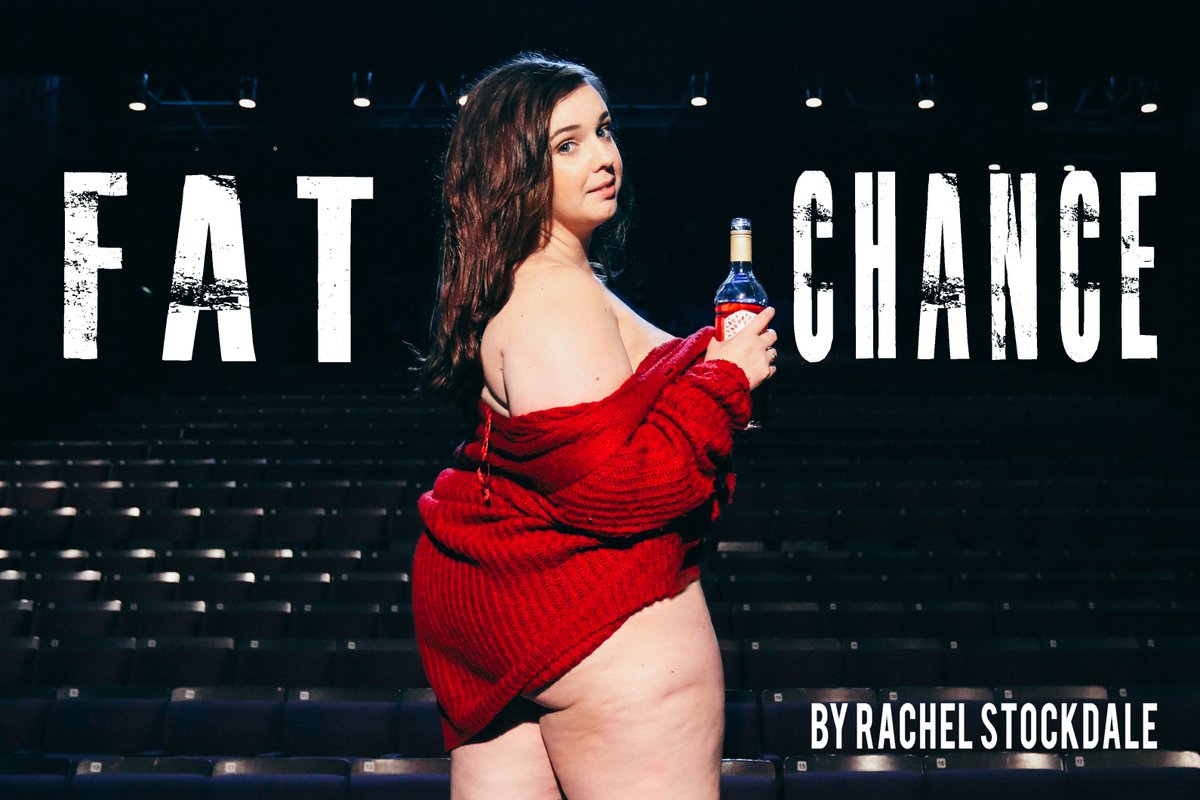
When I saw this play billed as being aimed at ‘Anyone who’s put on or lost weight.’ I thought that it would be rude not to go and see it. It is written and performed by Rachel Sockdale who hails from Middlesbrough and has gone from size 8 to 18 in the past few years.
My credentials are that I was a fat child and weighed a stone for every year of my life until I left school at 16 and went to college. I stuck at sixteen stone until my late twenties when I ballooned to tip the scales at twenty-one stone by the age of 35. I then lost six of them in as many months and hovered at around fourteen to fifteen for about ten years when I found them again, carrying them with me until 2012 when I resolved to do something about it and dropped back to fourteen. I got weighed on the morning of the show and noted I was still a manageable 14st 8lb.
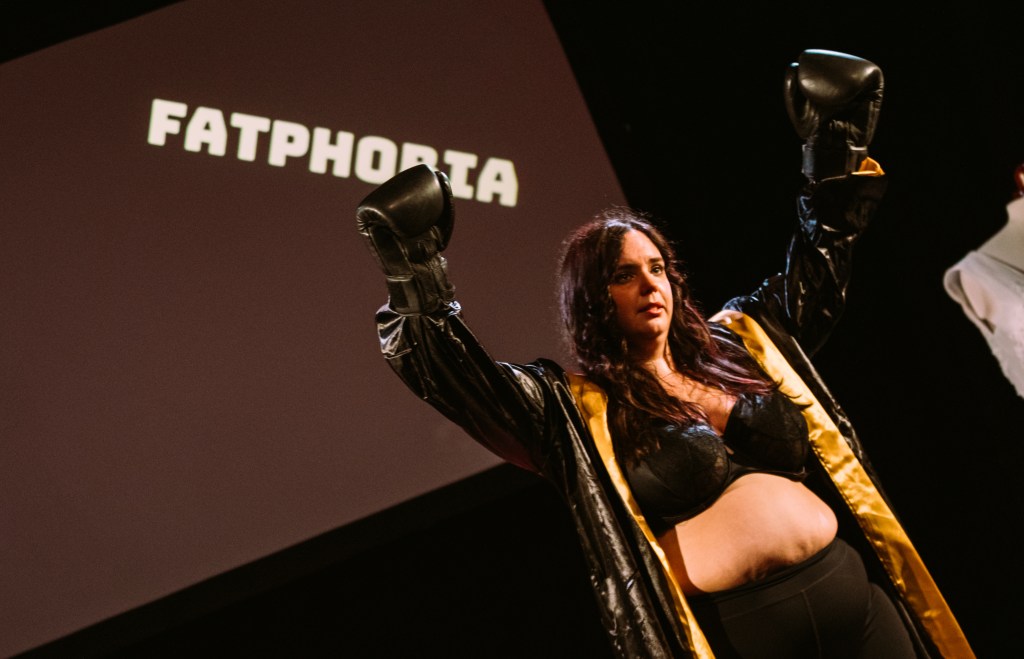
Rachel Stockdale as her alter ego, the boxer, Stocky
The play was basically the story of Rachel, obviously, and the effect that her weight gain has had on her, mainly regarding her self-perception. She used the word ‘fatphobia’ many times to refer to the way in which others regarded her, but it struck me that their intentions did not spring from a fear of fat per se, but probably were clumsy ways of expressing encouragement to assist in her weight loss. That is the way I have always interpreted comments about my size. My very first school report, which my mother kept, had me top of the class in most subjects but the overall comment was, ‘Stan is rather overweight for a child of his age’ i.e. five-years-old. I admit, however, that being mistakenly thought of as being pregnant by a waiter whilst on honeymoon, something I have been spared, or the way that a casting agent told her that she was ‘too Northern, fat and female’ could convey a certain amount of distress, although it was only the ‘fat’ part which seemed to offend.
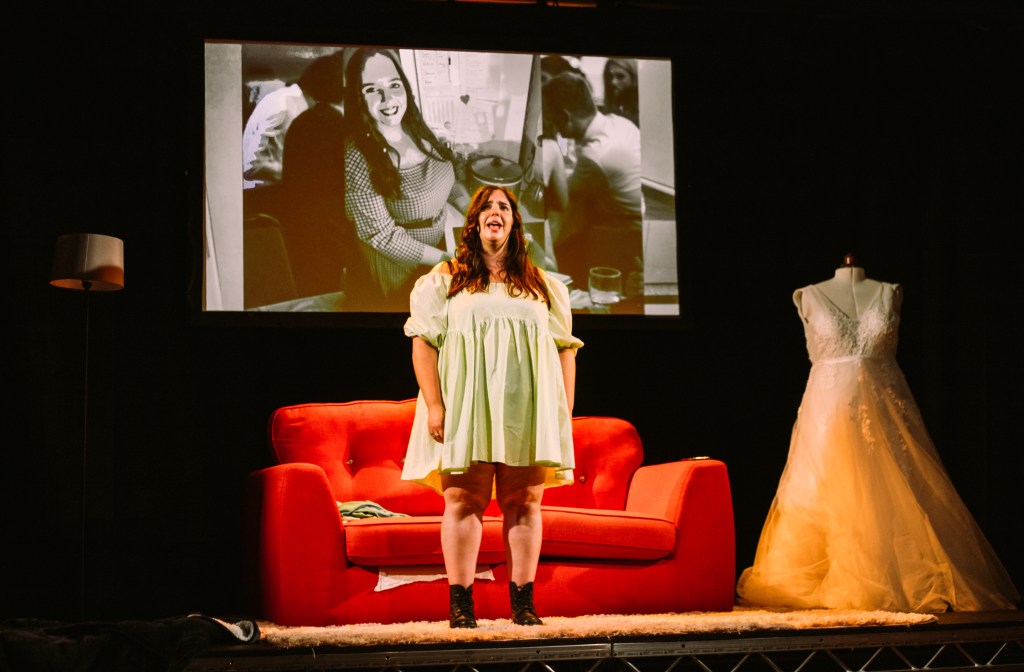
The narrative was related in a very entertaining way, the action being set in her living room and using a standard lamp to represent her boyfriend, ‘What a long pole you have!’ The aversion therapy attempt where she asked Kylie Ann Ford, the Touring Stage Manager, to throw a parmo in her face to put her off them for life was also very amusing. For my foreign readers, a parmo is a delicacy originating from the performer’s home town and is usually sold as a take away comprising a chicken breast or pork cutlet smothered in béchamel sauce and cheese. North Yorkshire Trading Standards tested a typical large parmo, chips and salad and found it to contain 2,600 calories and 150g of fat! I would give the salad a miss next time.
There were touching moments as well, when her best friend died and her unsuccessful attempts to get into the wedding dress she had bought at a discount some months before the big day, despite the assistance of the hapless Ms Ford.
I found obvious parallels in our two journeys through body change, as well as differences that the timing has highlighted. The way people look at, and judge, body fat is second nature to me, whereas it is revelation to Ms Stockdale. Wait until you get old and people treat you like a total moron! Despite the above events she didn’t have to endure constant bullying at primary school. This was an activity seemingly endorsed by the BBC who, in the 1950s, broadcast a children’s programme called Billy Bunter, about a fat schoolboy who wore glasses and was the butt (no pun intended) of pranks and jokes. Everyone watched it as there were only two channels in those days and, yes, I was also bespectacled from the age of six.
Whilst the play was entertaining and well presented, I did feel a certain apprehension about the apparent endorsement, bordering on encouragement, of obesity. Deep down we all realise that constantly carrying the weight equivalent of another human adult around with us cannot be good for our health, I certainly felt much better, both physically and mentally when slimmer in my thirties, but am now paying the bodily price for the fat years. I felt it akin to a twenty-something Keith Richards doing a play about drugs. He got away with it unlike so many of his peers. I truly hope that Ms Stockdale does as well.
The similarities in our stories lay in the emotional vicious circle which begins with a desire to lose weight and then, when we fail, consoling ourselves that we are who we are and it is up to others to accept it. It is my body and I will do what I want with it. There is also the need to justify our size by noting all the research and statistics which reinforce this stand, even though other scientists contradict them. One of those quoted in the show was that there is the same proportion of healthy to unhealthy people in both the fat and thin population. In my twenties I would have pounced on that as reassurance too. Now, in my more ‘mature’ years, I would want to know the source of the figures, what was meant by healthy and unhealthy, what was meant by fat and were the data obtained from the UK or world-wide. All have a bearing, especially the latter as the thin, unhealthy people could be the millions who are malnourished in the Third World. Even if UK based, the unhealthy thin people may be those living longer and suffering from non-life threatening conditions, whereas the illnesses affecting fat people, such as heart failure, certain cancers, strokes and the fatty build-up round vital organs, could prove fatal more quickly, or more risky to operate on under general anaesthetic, both cutting down on the number of ill fat people in the most extreme manner possible.
I don’t want to turn this into a competition as to who has been affected more, or sound like the bore who has given up smoking and lectures others to follow suit – yes I smoked as well up until I was in my thirties – but I strongly believe that in my case, and in many others, food is an addiction, and addicts are always the last people to recognise their condition, I am also convinced that it is the hardest one to kick. With drugs, smoking, drinking, gambling etc, it is possible to give up completely, but with food the reverse is true. We need to eat in order to live and cutting down on something is far harder than giving up altogether. I despair when I read about the various medications to suppress hunger pangs. Ask anyone who has a weight problem, we don’t eat because we are hungry, and, just as importantly, we don’t stop when we are full. We consume calories to celebrate, reward or comfort.
For what it’s worth, I looked at myself as a whole, and decided that obesity was just the most visible manifestation of my addictive personality so I resolved to take up an alternative lifestyle. I now am capable of walking past the (empty) biscuit barrel and having a tea or coffee without a sweet accompaniment. I still enjoy a nightly scotch before dinner with a few redskin peanuts, so my life is not all deprivation, which is the one thing guaranteed to have you cracking in double quick time. Weekends are also a ‘sod it’ period when I cook a good (fairly sensible) meal which I have with wine. I do this because it gives me something to look forward to and it gives my week some structure but prevents me from becoming totally obsessed by losing as much weight as possible, something equally self-destructive. Once you get the balance right it becomes second nature.
I am sorry if I have strayed too far from reviewing the play but I really feel that the message needed tempering, and that my experience and thoughts might help those who want to lose a few pounds. For those of you who don’t, then it is your body and I wouldn’t dream of telling you how to treat it, or judge you on your life choices as, like the playwright, I have been the victim of that far too often.
Fat Chance is Directed by Jonluke McKie
For details of the remaining tour dates please go to https://fatchanceplay.co.uk/
For forthcoming events at Leeds Playhouse it is https://www.leedsplayhouse.org.uk/whats-on/
Images provided by Leeds Playhouse
 Tyke It To The Limit
I understand!
Sent from my iPad
<
div dir=”ltr”>
<
blockquote type=”cite”>
LikeLiked by 1 person