
No, the small case ‘r’ in the title is not a mistake, Italian operas, I have recently found out, do not use upper case in titles except for the first letter in the sentence. You’re welcome. Regardless of the grammar, this is the third and final work in Opera North’s Green Season devoted to making the productions as environmentally friendly as possible. It is also the most spectacular, and the least bonkers, of the three being a fairly straightforward love story. By the way, it means The Swallow.
As already mentioned, the sets, props and costumes have, wherever possible, been recycled from previous productions or obtained second-hand and repurposed. The effect was so lavish that I can only surmise that there has been a Noel Coward show in the past from which the scenery and costumes have been up-cycled. I love good tailoring and, even if second-hand, I only wish I could afford a suit which fit so perfectly as the ones worn by the leading men. Immaculate. The ladies were not neglected either, with opulent dresses and accessories. Congratulations to the Costume Designer, Gabrielle Dalton. Leslie Travers, the Set Designer, managed to quickly convert the interior of a really posh gaff into a nightclub at the end of Act One without the action being held up for any length of time, and then almost strip the stage bare after the interval to depict a rented room with just a bed and a few items of furniture.
The opera, by Puccini, was first performed on 27th March, 1917 at Salle Garnier, Monte Carlo. It was written in 1912 and supposed to have been premiered in Vienna, but the First World War put paid to that, so it was moved to the neutral principality. The date also reflects the moral values of the time. Had it been written today, the ending would have been totally different, in fact, the story probably would not have been thought worthy of being told at all.
The gist of the plot is that Magda de Civry is the mistress of a wealthy Parisian banker, Rambaldo Fernandez, who keeps her in a luxurious house in that city. He has also provided her with a maid, Lisette, so no expense spared.
The action begins at a party at Magda’s place, where she and a group of friends are hitting the drinks trolley with a vengeance. The guests are being entertained by a poet, Prunier, who also writes songs and plays his newest composition to the assembled crowd. It tells of the trend towards the return to romantic love, concerning a woman called Doretta, but he doesn’t know how to finish it. Magda comes to his assistance by suggesting a rapturous dream of love.
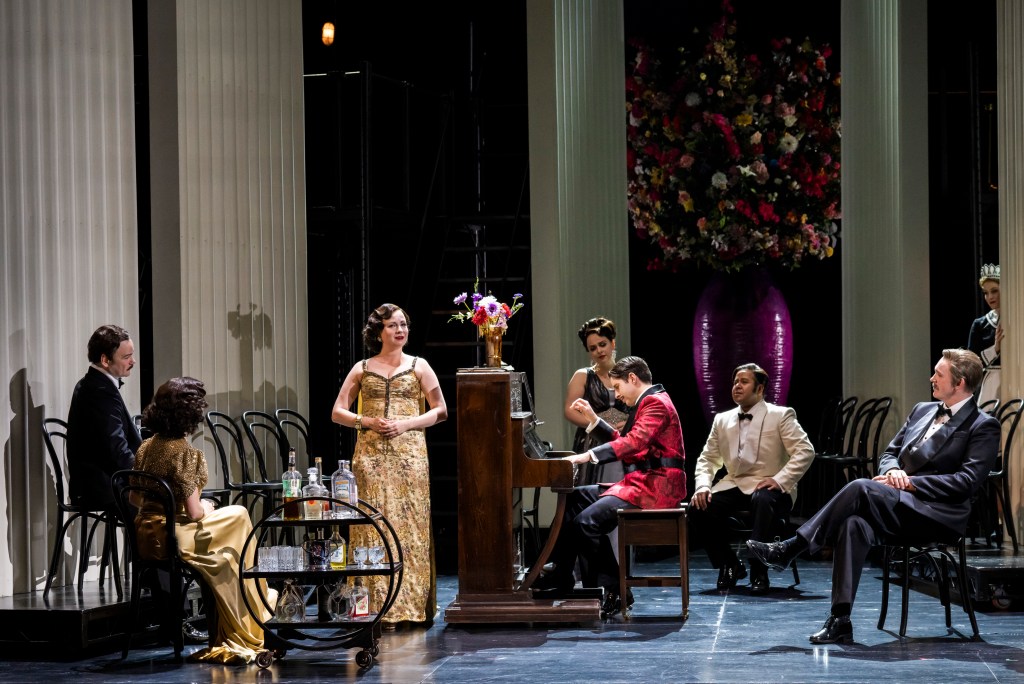
After the song, Magda is telling her girlfriends about her first love, many years ago, before she came to Paris. It was with a young boy who, on their first date, ordered two beers, gave the waiter a twenty franc note and told him to keep the change. Prunier, on hearing this, offers to read her palm, which he does, and says that she will find love again and fly away to a distant land of dreams.
While this is going on Rambaldo is receiving a visitor who has turned up at the house. He is Ruggero, the son of a childhood friend from the provinces, who has a letter of introduction from his father. When Magda sees him she is struck by his resemblance to the chap she has just been talking about.
Rambaldo offers to take him under his wing and he is welcomed into the party. The guests fawn over him and offer suggestions as to the best place to end his first night in Paris, but Lisette insists that the only way is with a visit to Bullier’s Club.
The guests leave and Lisette reminds Magda that it is her night off and she is dismissed for the evening. Magda decides to dress in the clothes she wore when she arrived in Paris, rather than the chic creations she currently sports, so as not to be recognised, and pay a visit to Bullier’s herself, obviously hoping to run into Ruggero, which she does, and the two fall in love. She even gives him a twenty franc note to order the last round of the night, specifying it be two beers and instructing him to tell the waiter to keep the change.
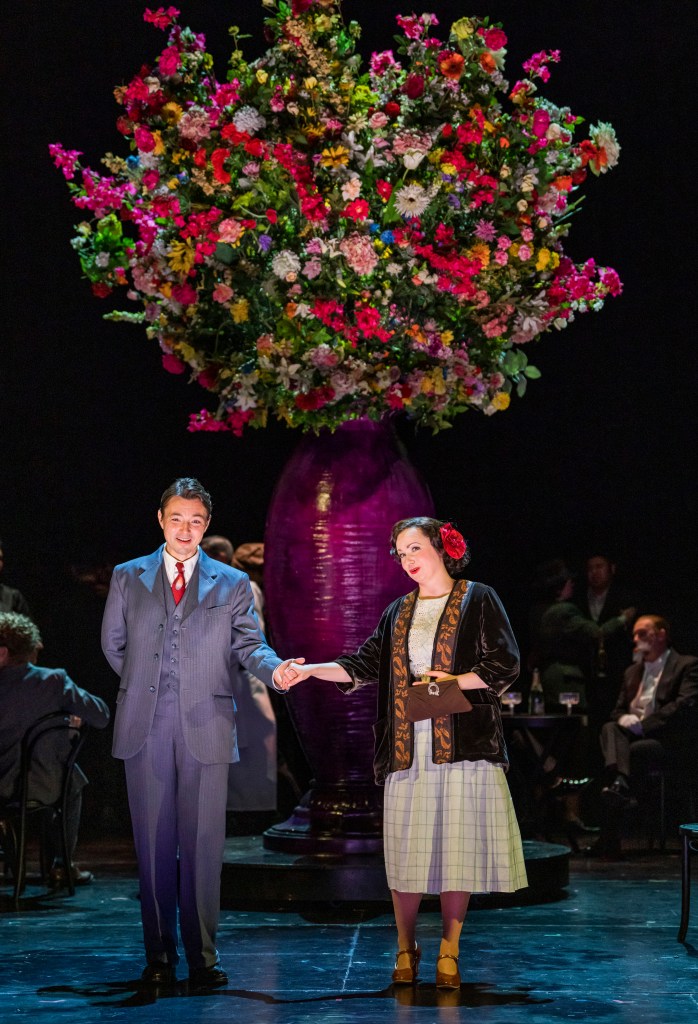
Lisette has also arranged to go to Bullier’s with Prunier, who turns out to be her secret lover. She has ‘borrowed’ an outfit from Magda’s wardrobe for the occasion. The pair meet Ruggero whom they recognise from the party. Although noticing that the woman he is with bears a striking resemblance to her employer, but, as she has told Ruggero that her name is Paulette and that is how he introduces her, they think they must have been mistaken.
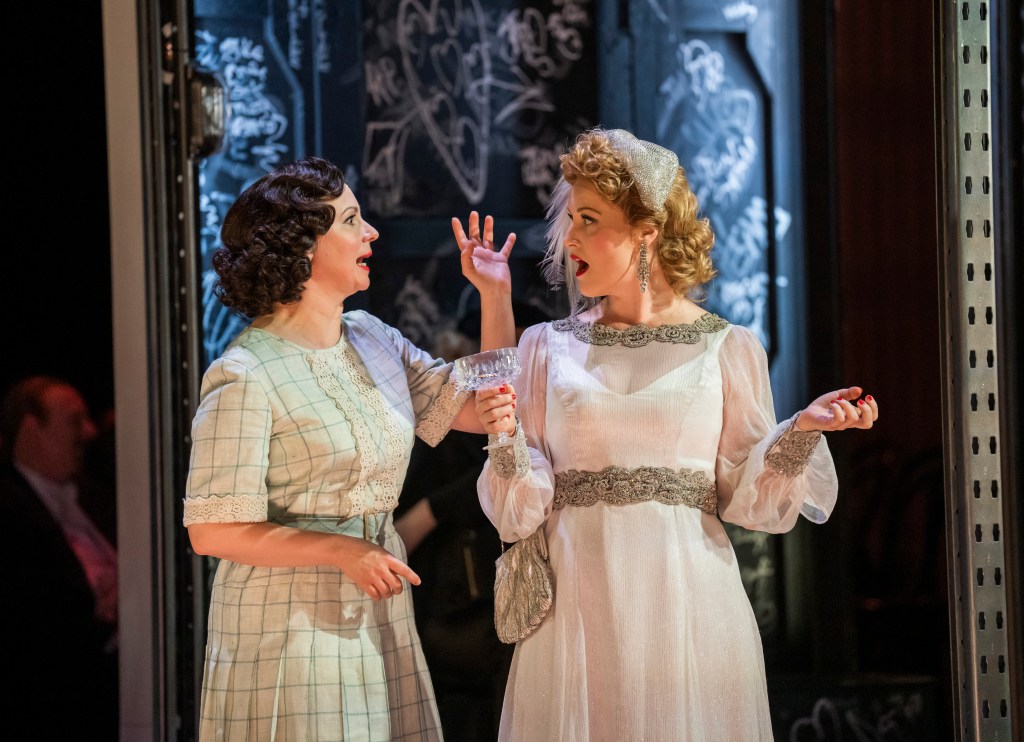
It is then that Rambaldo arrives and, having seen through Magda’s disguise, he demands that she go home with him, she refuses and says the she has finally found the love of her life. He leaves saying that he hopes she has not made a terrible mistake. Ruggero and Magda, depart together.

The action moves to the Riviera, some months later, and finds Ruggero and Magda living together in total bliss, except for the poverty now that her source of income has dried up and his prospective career has come to naught. He tells her he has written to his parents for funds to keep the landlord at bay, and his mother has not only sent money, but also her blessings for their marriage.
Out of the blue Prunier and Lisette arrive after having been to Nice where he has persuaded her to take up a career as a singer. It did not go well, as she was jeered and whistled off the stage on the first night. He suggests that Rambaldo would welcome Magda back should she need to return. He has also brought money from him to show his sincerity.
Magda decides to come clean to Ruggero about her tawdry past and say that she can only ever be his lover, not a wife nor mother to his children. She says that it is for the best that she leaves, knowing the devastating effect it will have on him. See what I mean about attitudes, no one would care less nowadays. She packs he suitcase and departs, telling Ruggero it will be for the best but he will always be in her heart. Oh, and she takes Rambaldo’s money with her.
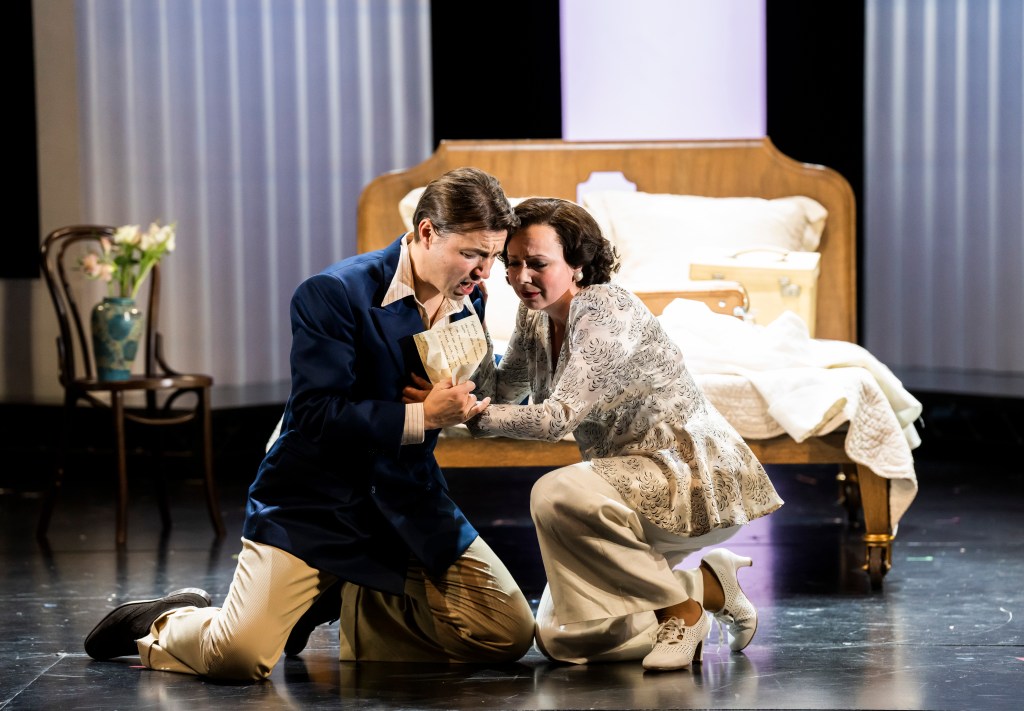
I liked the open ended conclusion, it is far better than some heavily contrived wrapping up. In fact, I liked everything about the production. It comprised a cast of thousands, not just on stage but in the orchestra pit as well, where the full ensemble seemed to have been utilised. There was also a dance troupe who, amongst other vignettes, performed an apache routine. This has nothing to do with Native Americans, but is the French for trouble-maker, and involves male dancers dominating the women, who normally wear seductive outfits, by throwing them around the floor. This was superbly done and took me back to the variety shows of the fifties and sixties when this was considered the height of eroticism. Another change in attitude. The Choreographer was Lauren Poulton.

Being by Puccini, the music and arias were superb, even though this is is one of his lesser known operas. There was one set piece in Bullier’s Club a few minutes before the interval which involved the whole cast and was breathtaking in its scale, staging and energy. During its execution I had put my notebook in my pocket thinking that this must be the big finish before the half-time break, but there followed a quieter piece to end the section, a ploy which worked very well, with two cleaners signifying closing time by sweeping the flowers, which had been thrown around during the previous song, from the floor.
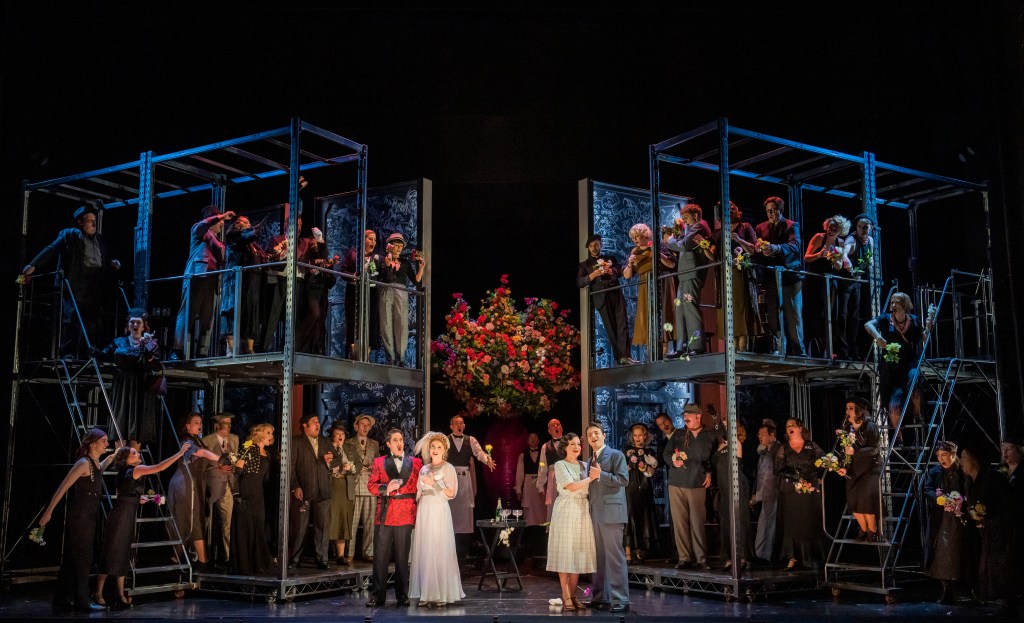
Something else which worked brilliantly was the humour. It was not farcical, as can be the case in this genre, but quite subtle. When the ladies are emptying the drinks trolley and all that is left is a pale blue liquid, one of them pours out a round and, holding the bottle to sniff the contents, grimaces at the odour, but then shrugs her shoulders and downs it regardless. I also couldn’t help but smile when Lisette, sung by Clair Lees, dressed in archetypal French maid’s costume, was pushing the trolley, as she looked like a cross between a Lyons’ Corner House ‘Nippy’ (google it you young ‘uns) and Julie Walters in the famous Victoria Wood sketch in a cafe. You had probably better google that as well!
The one comedic example which I believe was unplanned, but if so was superbly covered up by Galina Averina, as Magda, was when she was leaving Ruggero, Sébastien Guèze. She had packed and put her suitcase on the bed before leaving him at the end, but when she picked it up the lid opened and her clothes fell out. She rapidly replaced them and strode out without missing a beat. If it was accidental, it fit perfectly into the plot. How many times have we wanted to maintain an air of dignity in a crucial moment only to be embarrassed by an inanimate object, such as a spilled tea cup, a pen which wouldn’t work or pushed a door which should have been pulled or slid.
The remaining two performers of the five main characters were Elgin Llŷr Thomas as Prunier and Philip Smith, Rambaldo. The quintet was in magnificent form displaying, not only their singing prowess but also the ability to be physically expressive without going over the top. Ms Averina’s vocal range was truly remarkable.
The Chorus of Opera North was under Chorus Master Anthony Kraus, the Lighting Designers were Ben Pickersgill and Paule Constable and the Opera was Directed by James Hurley.
The Orchestra of Opera North was conducted by Kerem Hasan although Oliver Rundell will be taking the baton for the performance on 3rd November.
La rondine continues its run at Leeds Grand Theatre on various dates until 28th October, when it tours the usual venues; Theatre Royal, Newcastle, Theatre Royal, Nottingham and The Lowry, Salford Quays. For full details and to book please go to https://www.operanorth.co.uk/whats-on/la-rondine/#book
To see a trailer it is https://www.youtube.com/watch?v=4j12nb4Wd7U&t=12s
For details of all Opera North productions click on https://www.operanorth.co.uk/
I always mention the Try It ON scheme from Opera North giving first-time buyers a special deal with great seats and other goodies for £20. I cannot recommend La rondine highly enough as your initial foray into the world of opera.
Feature image provided by Opera North. Photographs by Tristram Kenton
 Tyke It To The Limit
Sounds like an excellent production, I’m sorry to have missed it! Compliments on your Italian, by the way!
LikeLike
Grazie
LikeLike