
I admit to not knowing a great deal about sculpture, in fact you could write my entire canon of expertise on the back of a Christo work. In the spirit of my writing, I am open to experiencing and learning about unfamiliar aspects of all forms of art, I jumped at the chance to witness the unveiling of a major statue by Sir Eduardo Luigi Paolozzi CBE RA, at Leeds University as an addition to their Public Art Collection.
As you have probably gathered from his name, Paolozzi was a Scot, born in Edinburgh in 1924. He studied at Slade School of Fine Art, Edinburgh College of Art, The University of Edinburgh and Central St Martins. he died in London in 2005, ages 81. My, albeit superficial, research into the artist revealed some fascinating facts. As well as being a sculptor he probably invented ‘pop art’ with his collage, named I Was A Rich Man’s Plaything in 1947; he taught Stuart Sutcliffe, one of the original Beatles who left the group in 1961 and died two years later, and was also responsible for designing the cover for Paul McCartney’s Red Rose Speedway album.
It was the sculpture ‘Master of the Universe’ with which we were concerned at the ribbon cutting. It happened to coincide with my birthday – a good thing, and also with a stinking cold – not such a good thing. Fortunately most of the proceedings happened outdoors so my coughing didn’t cause too much disruption. The title of the piece suggested an homage to a superhero, which, in its own way it was. Not the Marvel comic book type, but Sir Isaac Newton, who altered the way in which we view physics. Just as important as He-Man but with more gravity, see what I did there?
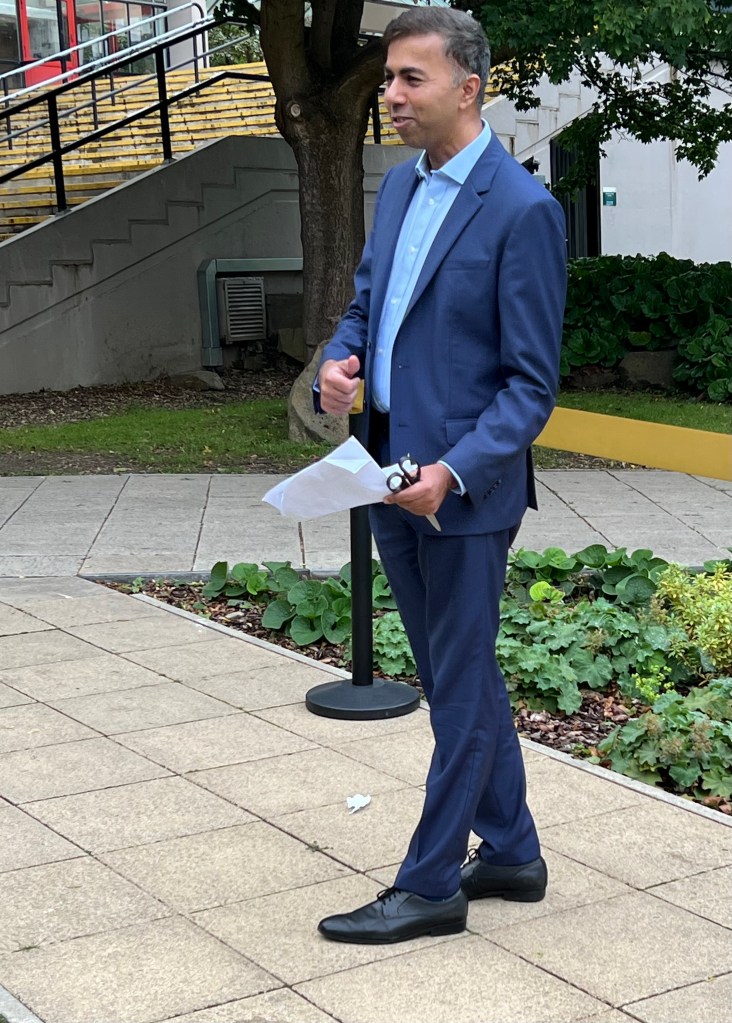
Masud Khokhar
The ceremony was conducted by Masud Khokhar, University Librarian and Keeper of the Brotherton Collection at the University of Leeds. The work is situated outside the Edward Boyle Library so that ties up nicely. He introduced the man responsible for the piece being at Leeds University at all, Douglas Caster, who completed his degree in Electronic Engineering there in 1975. He went on to head two FTSE100 companies.
He explained that there had been three bronzes made of the statue in 1989, one stands in the courtyard of the British Library in London, another is housed in the Jockey Club of Hong Kong and the third was ordered by a private individual who had to pull out of the deal, thus endangering the future of the foundry commissioned to produce the pieces. As it happens, the foundry in question is run by Brian Caster, Douglas’s younger brother, and so he agreed to take over the purchase and put the bronze in his garden. I don’t think we are talking council semi here! Brian Caster had studied under Paolozzi in London and they had become good friends, hence his decision to use Brian’s services. Mr Caster Snr later told the story of one of his gardeners asking him why he had a statue of a bloke on the bog in his garden.
Douglas Caster might be a huge success as an electronics engineer and businessman, but he could do with a crash course in ribbon-cutting. Rather than delivering his words of wisdom and building up to the grand event, he walked straight over to the tape and cut it before anyone had realised. Hence no photograph of the ceremony. Sadly, there is no photograph of Mr Caster at all, as I had to withdraw from his address in order to have a good cough and splutter in relative privacy. When I returned I was under the misapprehension that I had already had images captured of this very generous benefactor but, what with the extra year now added to my tally of them, the short-term memory is even less reliable than it was yesterday, I think! I can only apologise profusely to this gentleman who has enriched the lives of students at his alma mater and well as rescuing his brother’s business.

The statue itself has a mechanical look about it, and strikes me as a piece deliberately constructed of parts, like a Lego or Meccano set, possibly to indicate the many elements of Newton’s work, and perhaps his personality but I am getting a bit pretentious here, darling. The pose is based on a painting of Sir Isaac by William Blake which, far from being a collection of pieces, is a classical pose in the Renaissance style. I am beginning to annoy myself now so you must be well cheesed off.
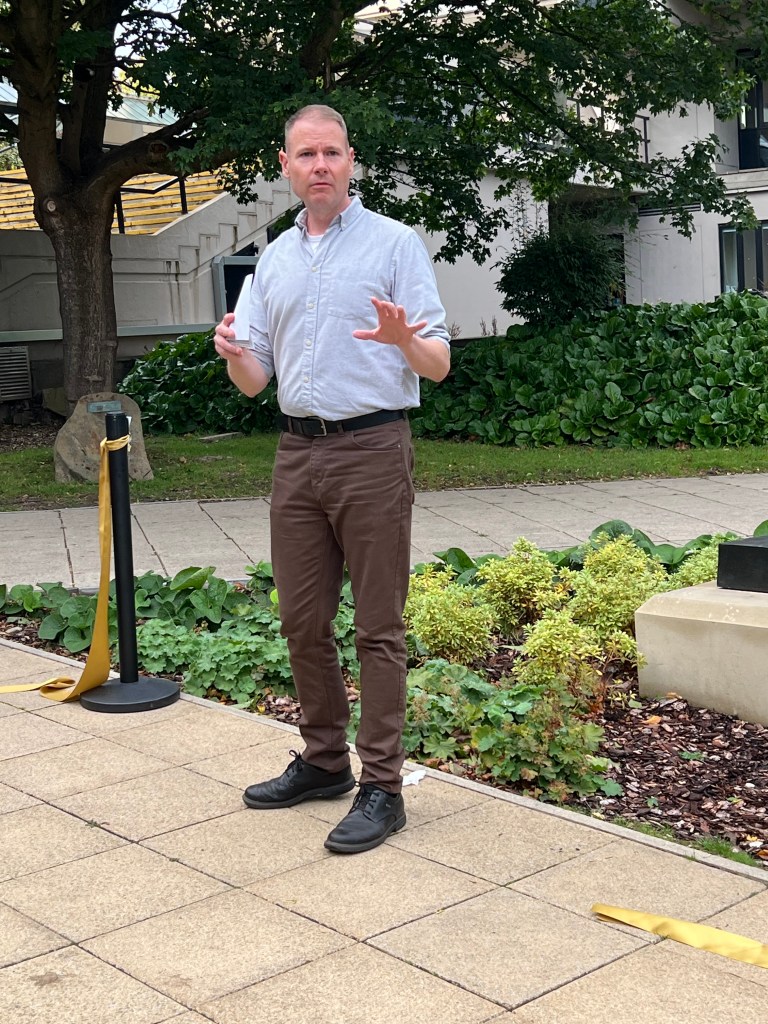
Matt Howard
There were two breaks from the narrative relating to the sculpture; one for the reading of a new poem by Matt Howard who was just coming to the end of a two-year Douglas Caster Cultural Fellowship, is there no end to this man’s generosity, about the intricate nest building of the wren, and a second due to a different airborne presence, this time in the form of a low-flying helicopter. Another metaphor for the work, the natural bird being Blake’s painting, and the mechanical one, Paolozzi’s statue. Pack it in now, Stanley!
After the outdoor formalities we were ushered into the School of Music where Brian Caster was interviewed by Layla Bloom, Curator of the Stanley & Audrey Burton Gallery at the University. He recollected working with Paolozzi as both a pupil at the Royal College of Art in London and a colleague, before talking us through the process of casting bronzes and the different techniques involved. Most of them are so large that they need to be made in sections before being welded together, usually the joint being rendered invisible by filing the seam.
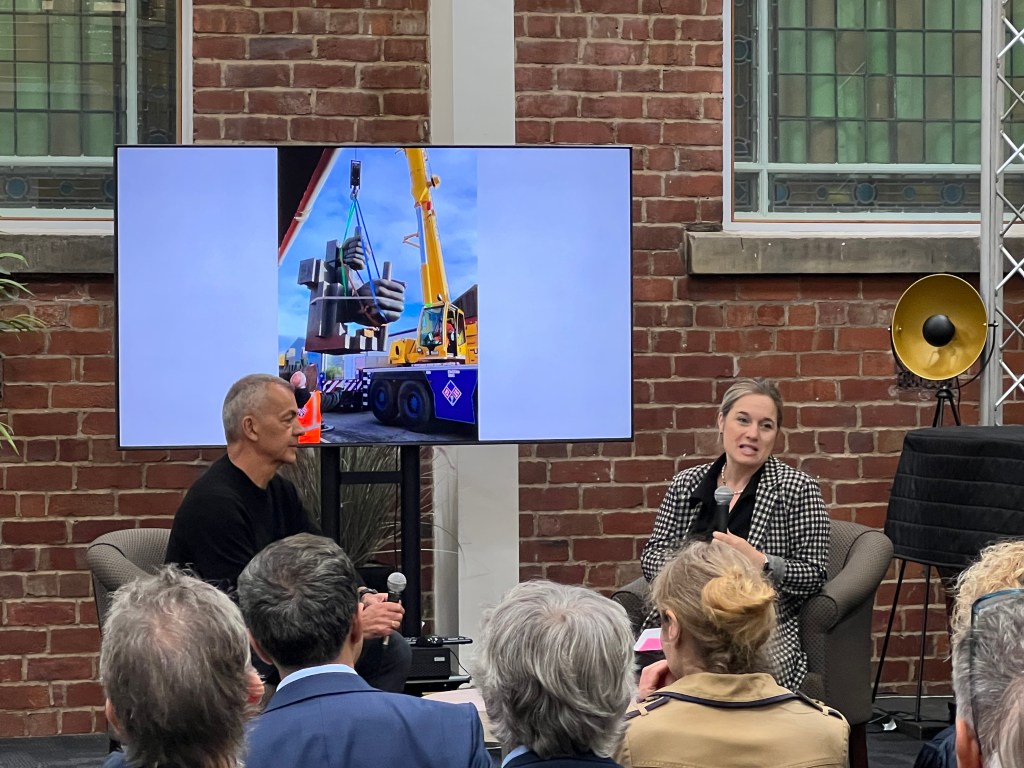
Brian Caster interviewed by Layla Bloom. You can see the scale of some jobs on the photograph.
Brian said that the thing which earned him his Brownie points with Paolozzi was in the early days when the master was fabricating a small piece. His hands were huge and he was having trouble inserting one of them into the aperture of a work in order to smooth the inner part of the seam, so the young Mr Caster offered to do it for him. He said that it could have gone either way with the artist blowing his top at the thought of needing assistance from a student, but it worked out fine and the offer was graciously accepted. I can’t help thinking what a great name Caster is for someone running a foundry.
Anyway, my knowledge of sculpture, and the manufacture thereof, took a huge leap forward and so from now on I will look at statues of blokes sitting on the bog in a whole new light.

If you fancy having a look at Master of the Universe, just take a stroll round Leeds University Campus in the vicinity of the Edward Boyle Library. Should you wish to see the whole of the Leeds University Public Arts Trail, which includes works by Henry Moore and Barbara Hepworth, then download the leaflet at https://library.leeds.ac.uk/downloads/download/165/public_art_trail
 Tyke It To The Limit
Very interesting! We were struck by this when we visited the university on Saturday. Good to learn more about it!
LikeLike