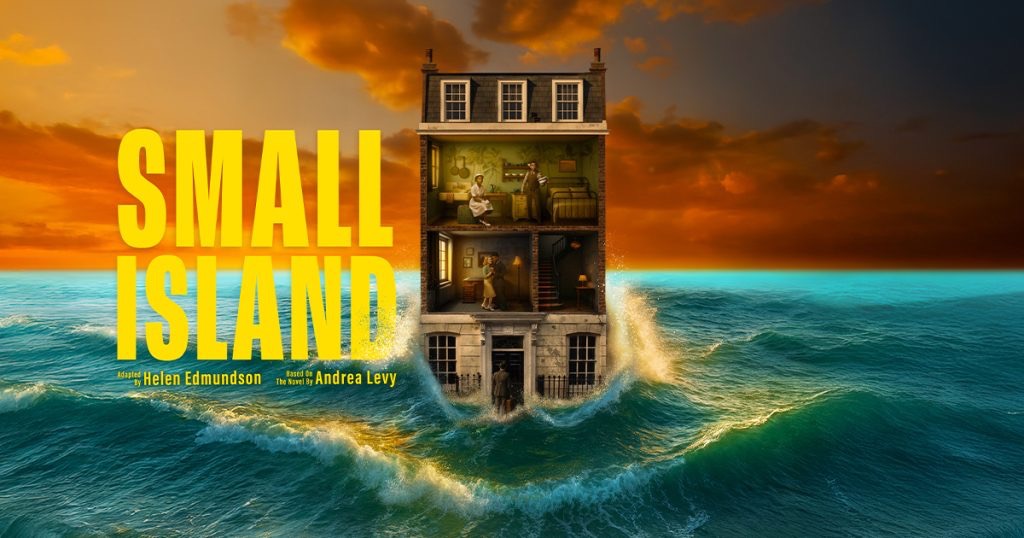
When trying to tell a story based on a complex set of circumstances, there is no better way than to extract the essence by personalising it. To say that there were 1,027 passengers on HMT Empire Windrush, with over 800 from the Caribbean, on its first sailing from Jamaica to to UK in June 1948, is just another statistic, but by narrowing the experience triggered by that journey to one passenger, Gilbert, it is much more relatable. When the background to the event is also put into context by highlighting the backstories of a Jamaican family, the Roberts, and an English one, the Blighs, it takes the presentation to a new level.
The story begins in 1939 with a cinema newsreel of a hurricane in Jamaica, showing how the inhabitants were preparing for it by protecting their crops and buildings. The live action on stage began with Hortense, a newly appointed teacher, and the school’s white American owner, Mrs Ryder, trapped in the premises, Hortense saying she would await being rescued by her hero.
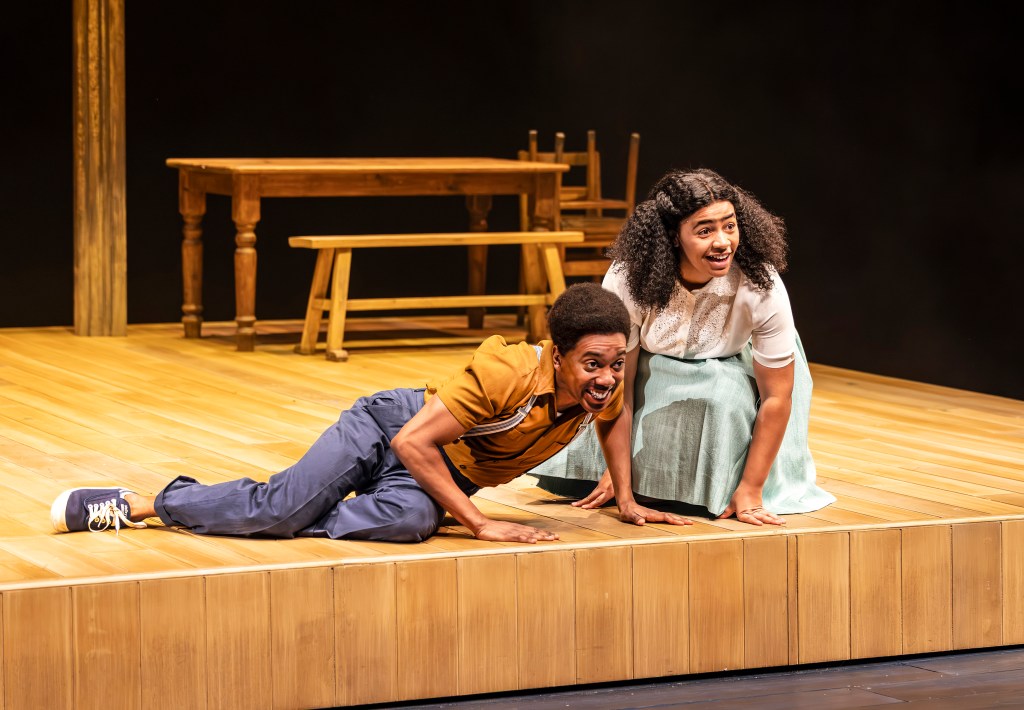
Jordan Laviniere as Little Michael and Anna Crichlow as Hortense up to a spot of mischief.
Using another presentational technique employed throughout the piece, there was then a flashback to her being dropped off at the home of her uncle, Mr Philip Roberts and his wife, Miss Ma, as they were well off and, as Hortense had fair skin, her father thought she would stand more chance of having a good life with them. Her uncle was a devout Christian and extremely strict, so, when his son, Hortense’s cousin, Michael, encouraged her to talk at the dinner table, she was chastised and banished to her room. Punishment also took a physical turn against the boy, who was the hero for whom Hortense was waiting at school.
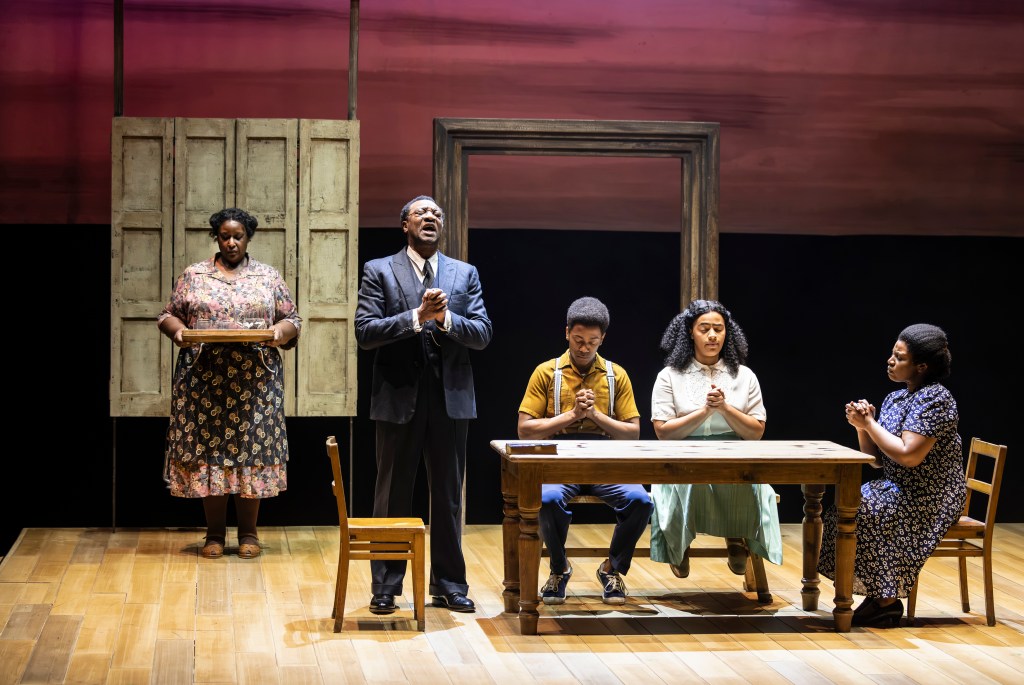
Marcia Mantack, Miss Jewel; Everal A Walsh, Mr Philip; Jordan Laviniere, Little Michael; Anna Crichlow, Hortense; and Mara Allen, Miss Ma say grace.
Michael was sent away to boarding school and returned a handsome young man but a free-thinker who questioned his father’s views on religion and life in general, causing a great deal of friction. It was at this point that we returned to the hurricane and Michael indeed battling his way to the school, but it was to continue his illicit affair with Mrs Ryder, rather than drag Hortense onto his steed and ride off with her. He ultimately joined the RAF as an officer and went to England to fight in the war. This left Hortense feeling distraught and abandoned.
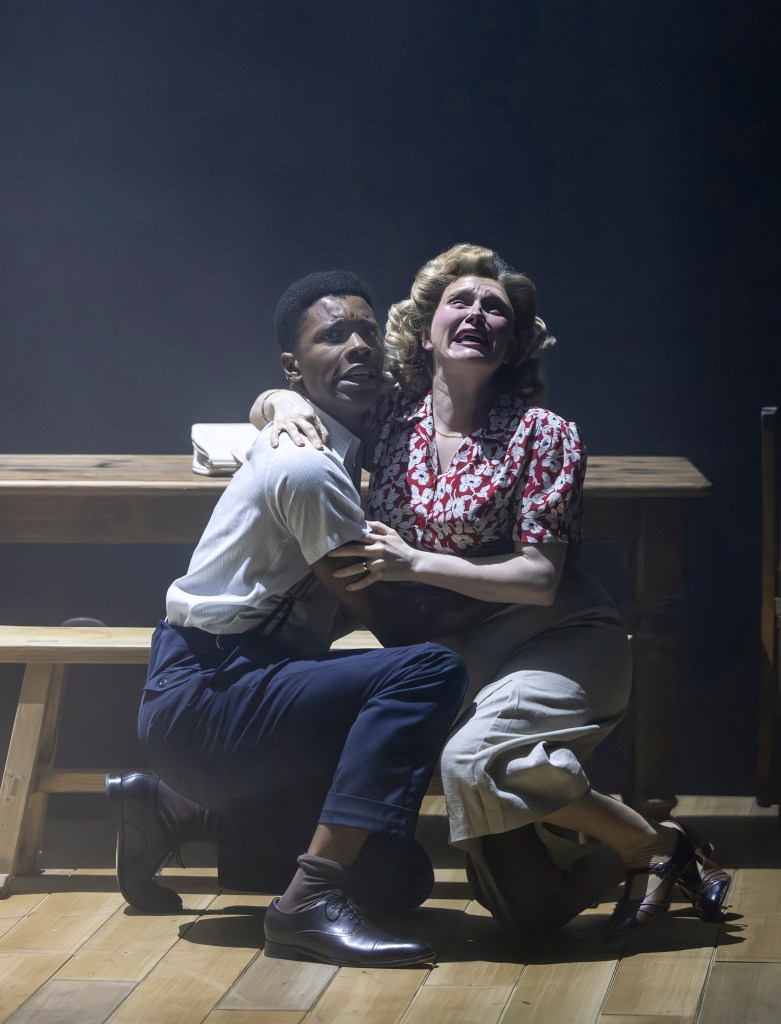
Rhys Stephenson as Michael, comforts Rosemary Boyle, Mrs Ryder, during the hurricane.
Meanwhile, in London, Queenie, a butcher’s daughter from Lincolnshire, had got a job in the sweet shop owned by her Aunt Dorothy. She worked behind the counter, fending off the advances made by local boys until, one day, Bernard, an awkward young bank clerk, made an impression on her and they began to date. He lived with his father who was suffering from shell shock after an experience in the First World War, so needed to be looked after. The two ended up marrying and living in Earl’s Court. Their physical relationship left a lot to be desired, mainly by Queenie, but, as was the norm in those days, she put up with it for a stable relationship.
To give her a sense of purpose, Queenie helped with the war effort, looking after and taking in, those who had been made homeless. Bernard became angry that she was living a new life and neglecting him, so he joined the Army and was posted abroad.
To make ends meet Queenie accepted paying lodgers, including three RAF officers, one of whom was none other than Michael Roberts. They were leaving for Canada the following day, but, captivated by him, Queenie also became one of his conquests.
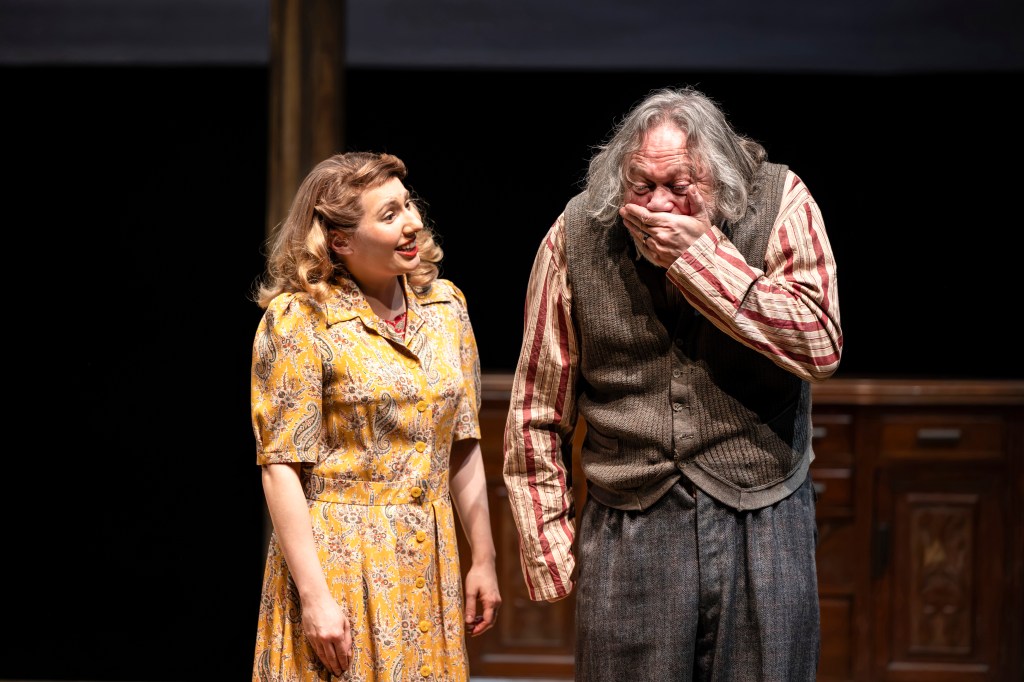
Queenie, plated by Bronté Barbé, caring for Arthur, Paul Hawkyard
Queenie found it difficult looking after Arthur in London as the air raids would trigger his condition so she decided to take him home to Lincolnshire where she worked in her father’s butchers. One day Arthur went for a walk and got lost, but was found and taken home by Gilbert, a Jamaican RAF member stationed in the county. They got on well and arranged to take Arthur to the cinema where the usherette said that Gilbert must sit at the back as they didn’t want to upset the white GIs also stationed there. Queenie objected and the soldiers came to blows, causing the US MPs to be summoned. One of them drew his weapon and accidentally shot Arthur dead.
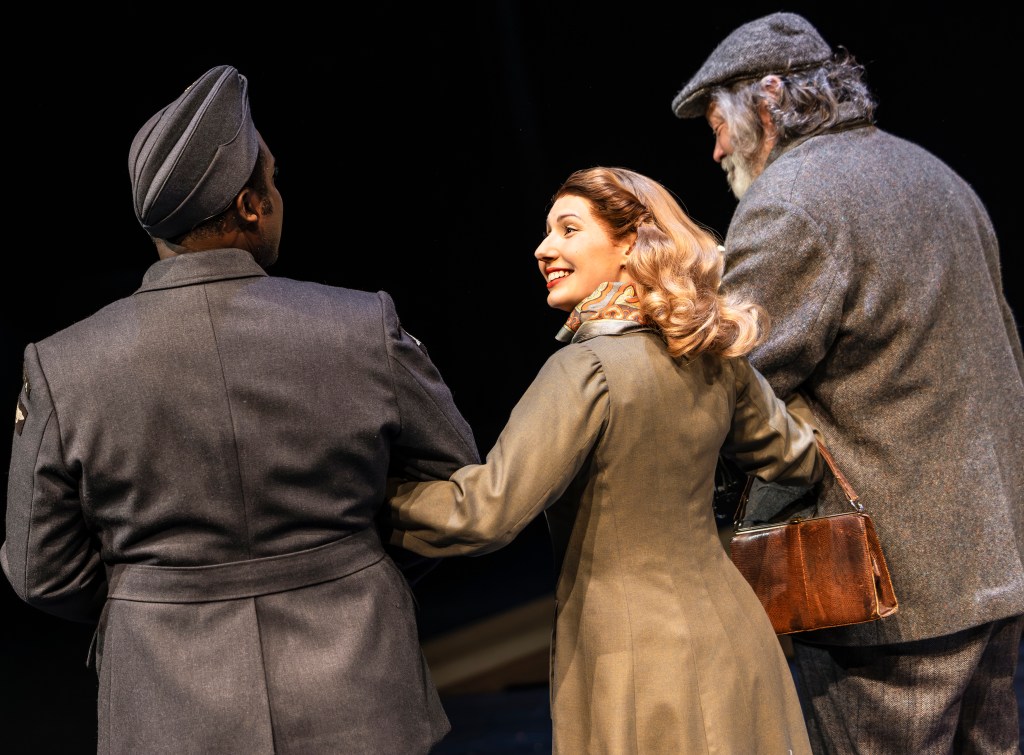
Gilbert, Daniel Ward; Queenie, Bronté Barbé and Arthur, Paul Hawkyard on their way to the fateful night at the cinema.
The war ended and life returned to normal with the servicemen being demobbed and Queenie going back to London.
Back in Jamaica, Hortense would go out with her older friend, Celia, who attracted the attention of Gilbert, now back home, and the pair became an item. Gilbert, said that he wanted to go back to England on HMT Empire Windrush and would like Celia to go with him. They didn’t have enough money, and it turned out that her mother had mental health problems so could not be left alone. Hortense offered to lend him the money and he suggested that they get married and he would send for her when he got settled in.
On arriving in London Gilbert found a room which happened to be in Queenie’s house. Bernard had not returned from India being presumed dead. He explained the situation to Queenie and they prepared for the arrival of Hortense.
Gilbert worked long hours at the post office and was subjected to a lot of racist abuse from his colleagues. The day he was supposed to meet his wife at the docks he was so tired he slept in and was woken by her arriving under her own steam. She was devastated when she saw that their home comprised one attic room with a shared toilet on the ground floor. Her dream was a house with a door bell and bone china tea set. She did her best to clean it up which upset Gilbert as he felt slighted and didn’t want to see his wife on her knees scrubbing.
Things got worse when, out of the blue, Bernard returned from the war, where he had been in prison for being in a fight and losing his weapon. He had also spent some time in Brighton on his return to England rather than come straight home, this obviously annoyed Queenie. Being an out and out racist, Bernard said that the lodgers would have to go. To complicate matters even further, Michael had found himself in London for a couple of days and he and Queenie had got together for a night, after which she became pregnant.
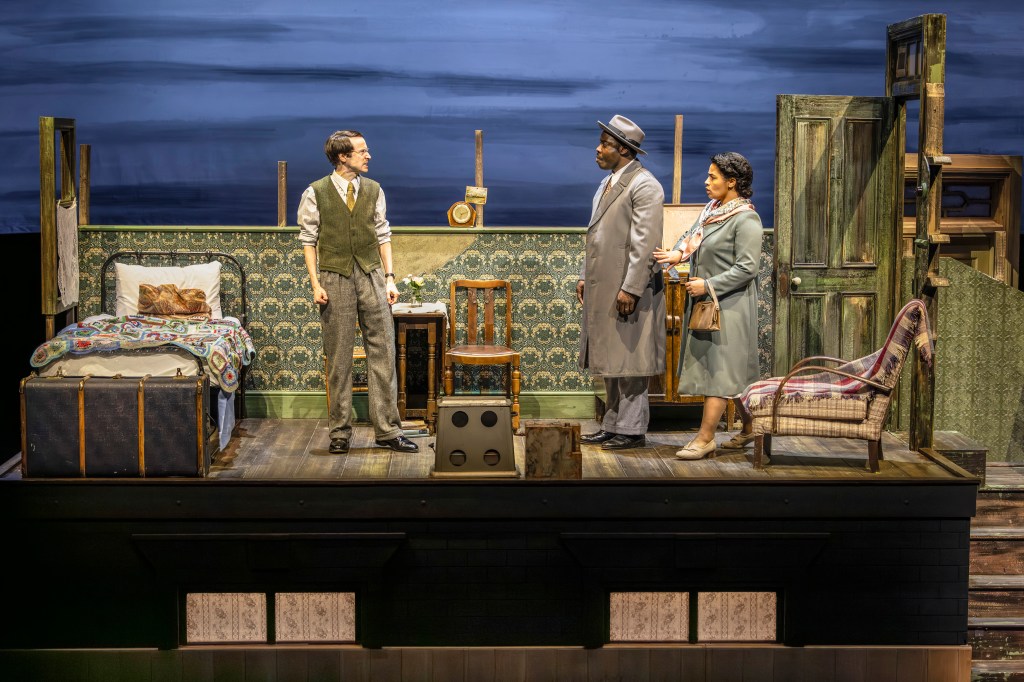
Mark Arends as Bernard telling Gilbert, Daniel Ward and Hortense, Anna Crichlow, they will have to go.
Surprisingly enough Bernard took rather well to the baby, named Michael, and wanted to keep him, suggesting that, when questioned about his colour, they could say he was adopted, but Gilbert and Hortense said that they would raise him as their own in the new house they had found space in, after it was bought by another of Queenie’s tenants, on condition that they help him restore it.
I thought that the plot was little far fetched with the random meeting of the inter-connected characters, but it served the purpose of showing what life was like in the late 1940s and early 50s for both immigrants and English alike. When I say English I refer to those born here, because in 1948 The British Nationality Act was passed creating the status Citizen of the United Kingdom and Colonies, granting all Commonwealth subjects the right to live, work and settle in the UK making them de jure British.
It is ironic that the purpose of that act was to encourage immigration from the Commonwealth to fill the jobs here, and there was a vigorous advertising campaign to that end in most of the countries concerned. The problem was the resentment caused amongst some of the native English which shattered the promise of a secure job and warm welcome portrayed in the adverts.
There were several scenes depicting racial incidents, like the one in the cinema, and Gilbert’s colleagues refusing to talk to him. There were others which are frowned upon now but were perfectly innocent then, such as Hortense being asked by Queenie, whether there were dress shops in Jamaica; a kind of reverse image of the doorbell and bone china picture that Hortense had of England.
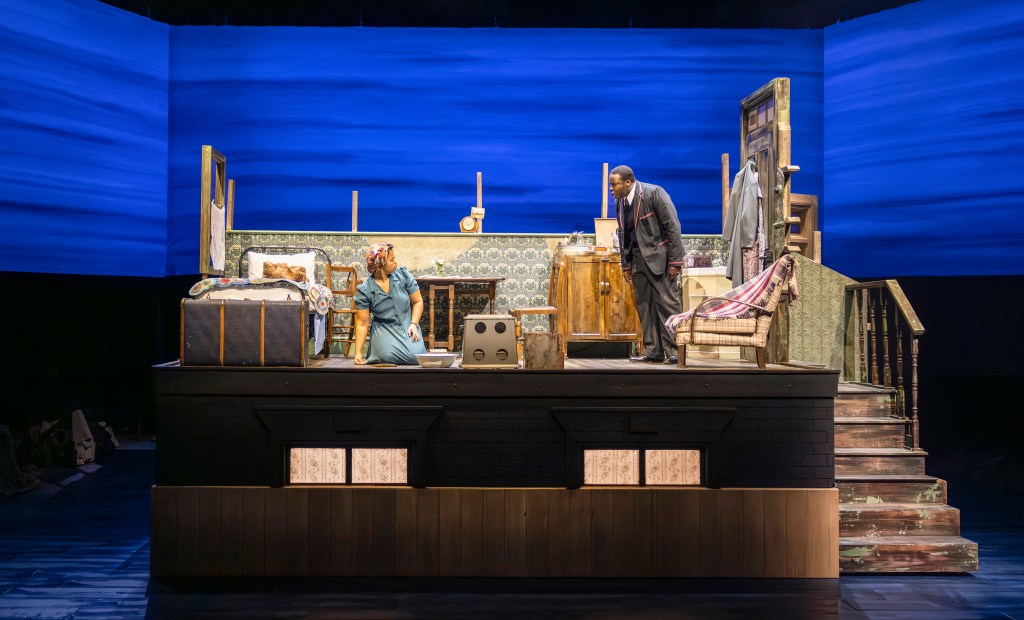
Anna Crichlow as Hortense and Daniel Ward, Gilbert in their attic room.
The set, by Simon Kenny who also designed the costumes, was superb with a revolving centre displaying Gilbert and Hortense’s small room on one side and the Bligh’s sitting room on the other. Although the latter was obviously furnished in the style of the time, I thought that what it was lacking was more important than what it contained. There was a radio but no TV, the significance of which I wonder whether registered with the younger audience members, i.e. those under fifty. In 1948 there were only 45,564 TV/Radio Licences issued, all in the London area, the Birmingham transmitter didn’t open until 1949. Even those who had a set could not use it between 1st September, 1939 and 7th June, 1946 as the BBC shut down as it was thought the powerful transmitter at Alexandra Palace would help with enemy navigation.
I say all this to illustrate that before Windrush there were very few black people in the UK and so a novelty. The only ways in which they had been seen were in newspapers, books or on the cinema, either in films or the aforementioned newsreels. This did cause the curious to ask whether the black washed off or whereabouts in Africa Jamaica was. It was not racism as we know it, in fact, just the opposite, an attempt to learn about these new citizens from a position of innocence.
The acting from all concerned was brilliant, especially as it was a bit of an epic, the first half was an hour and three-quarters, the total running time being 3 hours 25 minutes. Daniel Ward as Gilbert, who had started a law degree in Jamaica before joining the RAF, was the epitome of a dignified man trying to stay focussed on making a life for himself and Hortense despite the setbacks encountered. Anna Critchlow matured from a young Hortense, naive enough to think that England was just as she had read about it, through to someone having to come to terms with the stark reality of the population of an alien country as uninformed about her background as she was about theirs. Another metamorphosis was undergone by Queenie, superbly played by Bronté Barbé who handled the stages of unfulfilled wife, committed volunteer, sexual awakening and back again without missing a beat. Mark Arends as Bernard was spot on as innocent nerd – a term not used in those days but is the best I could come up with – who had had a rude awakening in his war experiences. The role of Michael was split between two actors, Jordan Laviniere, the mischievous young lad, forever in trouble with his father, Everal A Walsh, and Rhys Stephenson the handsome stud making the most of his charisma. Although not a speaking part, Paul Hawkyard portrayed the hapless Arthur, veering from the absent minded, child-like victim of his condition to the more horrific side of it in the blink of an eye. Actions definitely speaking louder than words.
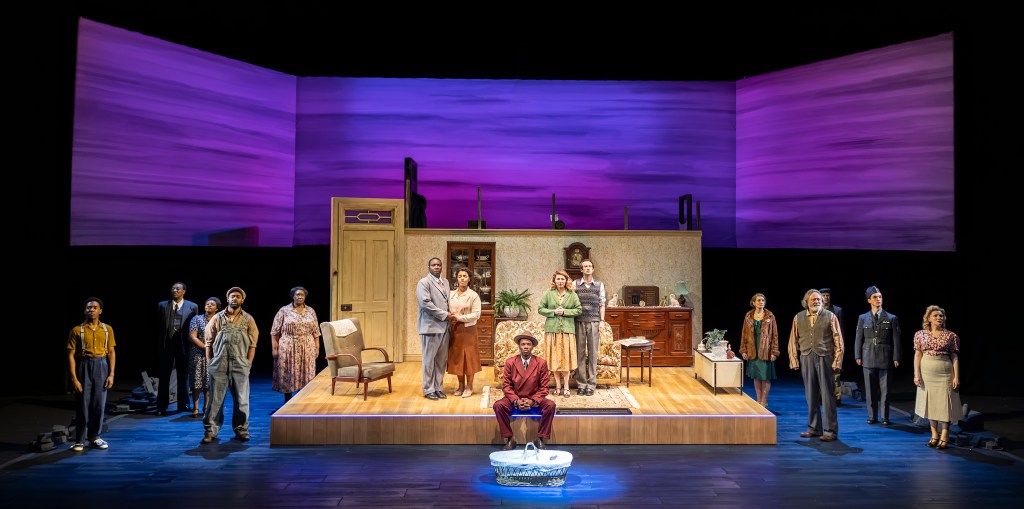
The full cast showing the Bligh’s side of the set
Small Island was originally a 2004 book by Andrea Levy, turned into a play in 2019 by Helen Edmundson and staged at the National Theatre. This, however, is the first time it has been performed outside of London, and a great job Leeds Playhouse, Nottingham Playhouse and Birmingham Rep, along with Actors Touring Company made of it, as has Director, Matthew Xia. The run at Leeds Playhouse continues until 28th March and I heartily recommend you see it.
For further details and bookings, please go to https://www.leedsplayhouse.org.uk/event/small-island/ and to see what else Leeds Playhouse has in store it is https://www.leedsplayhouse.org.uk/whats-on/
Photography by Pamela Raith
 Tyke It To The Limit