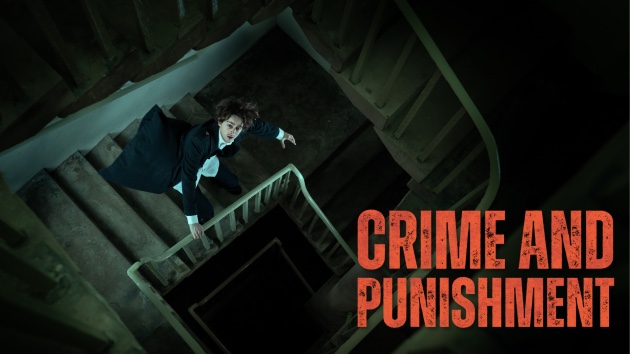
Yet another first for me, not just in the play itself, but also the venue, which I had never even heard of before the visit, let alone been to. It is in the Leeds City College School of Creative Arts, Quarry Hill Campus next door to Leeds Playhouse and is a very intimate room which suited this production a treat.
Crime and Punishment is based on the classic novel of the same name by Russian author Fyodor Dostoyevsky, and tells the tale of Rodian Romanovich Raskolnikov, a drop-out from university, who spends his life in a small room doing not much at all. He is in arrears with his rent but is secretly fed by the landlady’s servant, Nastasya, who smuggles him scraps from the kitchen.
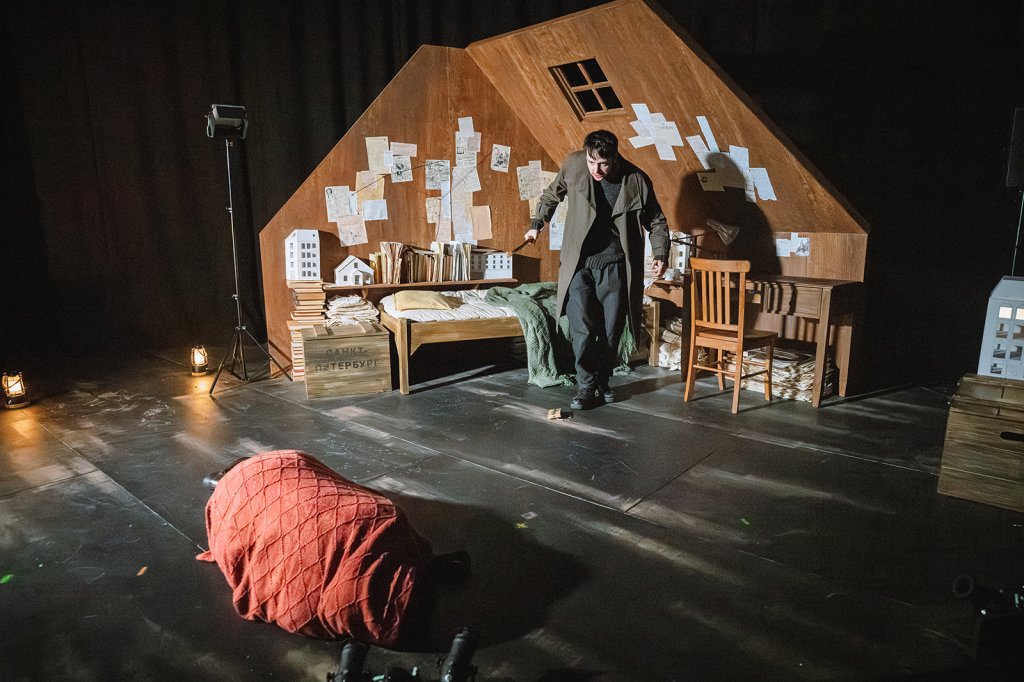
Connor Curren as Raskonikov
The title sums up the piece nicely, as he turns to crime and then faces the punishment. The twist, however, is that it is not so much the penal system he has to deal with, as his conscience and guilt complex.
The novel runs to about 750 pages so there has been a lot of editing to get it down to two hours plus interval. The cast number has also been reduced from an even dozen to just three actors, one of whom is the title character and the other two portray the remaining eleven, all three multitasking by scene shifting and acting as lighting technicians. Having said all that, it works surprisingly well, although, being a Northern Broadsides production, there is no real surprise there.
The plot of the first half, which deals with the crime element of the title, begins with Raskolnikov planning to rob and murder a back-street pawnbroker, Alyona, an old woman who takes advantage of the most vulnerable people in their hour of need. He ‘borrows’ an axe from the caretaker’s cupboard in the house where he lives, and carefully goes through a meticulous rehearsal of the proposed atrocity. When he gets to the pawnbroker’s flat, he gives her a watch to see where she stores it, and, after she has ripped him off by giving I’m a few roubles fewer than she promised, he sets off back home.
On the way, he stops for a drink and meets a chap called Marmeladov, who has lost his job and taken to drink. He is married to Katerina, who was from a fairly wealthy family but they are now in such dire straits that their daughter, Sonya, is working as a prostitute to get them money.
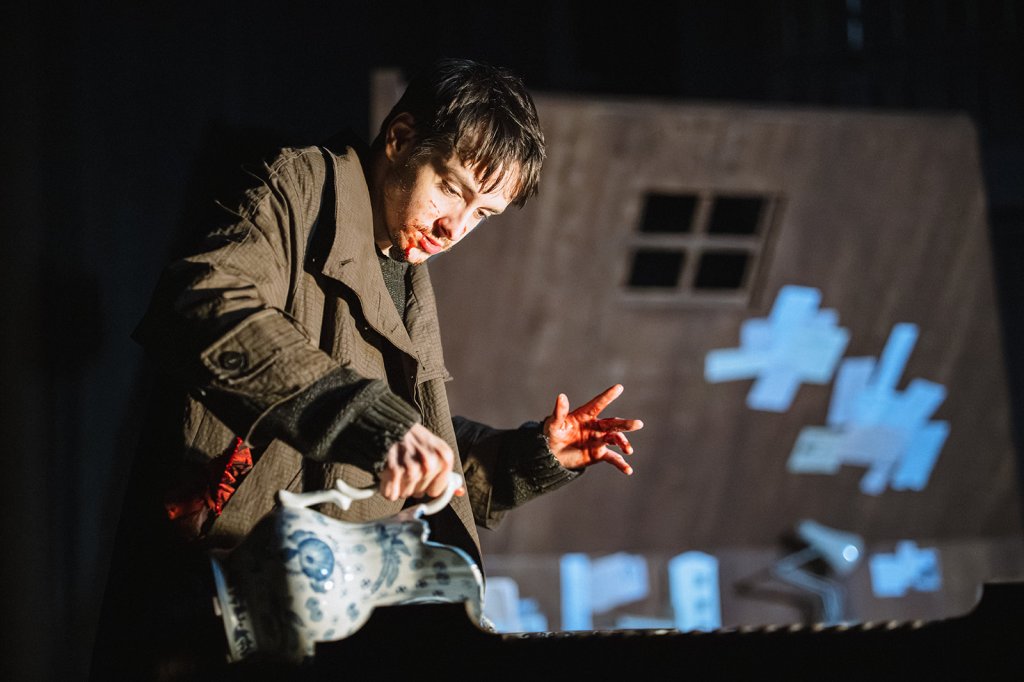
Connor Curren as Raskolnikov washing the blood from himself and the axe.
The day of the crime arrives and Raskolnikov retraces his movements from the dummy run, offers the pawnbroker a silver cigarette case and, when she turns her back to put it with the other trinkets, he strikes her with the axe, killing her. He is in the process of using the keys she keeps on a chain around her neck to access her cache, when her sister unexpectedly arrives and so she meets the same fate. After grabbing what he can, the villain returns home.
Shortly thereafter he is asked to go to the police station for an interview. Rather than it be for the murder, however, it is to confront him about a summons his landlady has taken out against him for rent owed. They discuss the matter and he is released.
On his way back he sees a commotion in the street and discovers it is centred around Marmeladov, who has been trampled on by a bolting horse and carriage. He tends to the victim, who dies in his arms. Katerina and Sonya arrive and he gives the wife 20 kopeks, which is the cash element of his robbery, to help with the funeral costs.
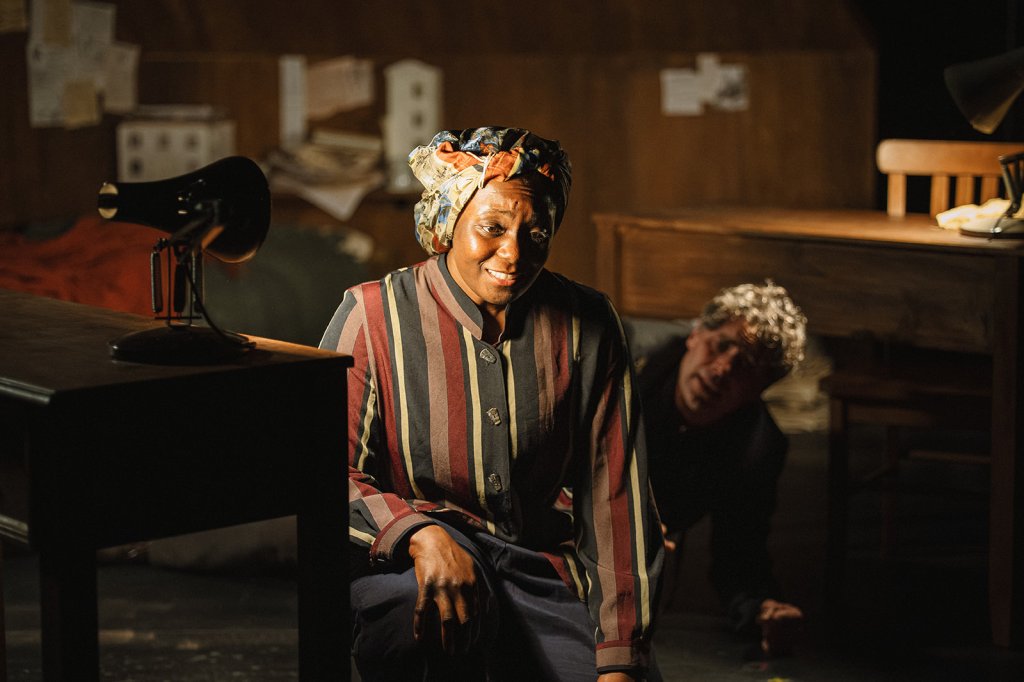
Trudy Akobeng.
When he eventually arrives home, Nastasya reminds him that his mother and sister are arriving the following day. She had given him a letter to that effect a few days before but he had not read it. It has been years since they had seen each other but parted on not the best of terms. They too, were experiencing hard times and Dunya, Raskolnikov’s sister, has planned to marry Luzhin, a middle-aged professional man, for financial security. Coming to the conclusion that this is tantamount to a more respectable parallel narrative to that of Sonya, he tries to talk her out of it, but she is set on the plan.
The second half switches to a more profound scenario where Raskolnikov tries to justify his actions, propounding to himself that there are ‘exceptional people’ for whom murder is almost an obligation in order to rid the world of parasites preying on the those who cannot defend themselves. The more he mulls this over, the less he comes to believe it.
Enter Svidrigailov, a wealthy country gentleman with a disreputable past, who knew Dunya and would like Raskolnikov to facilitate a meeting between them. In return he offers him a passport, a ticket to America, and enough money to live on.
There then follows a game of cat and mouse between Petrovich, the Chief Investigating Officer and Raskolnikov, whom he is convinced is guilty but doesn’t have enough proof. There are several interviews and meetings but he always gets released.
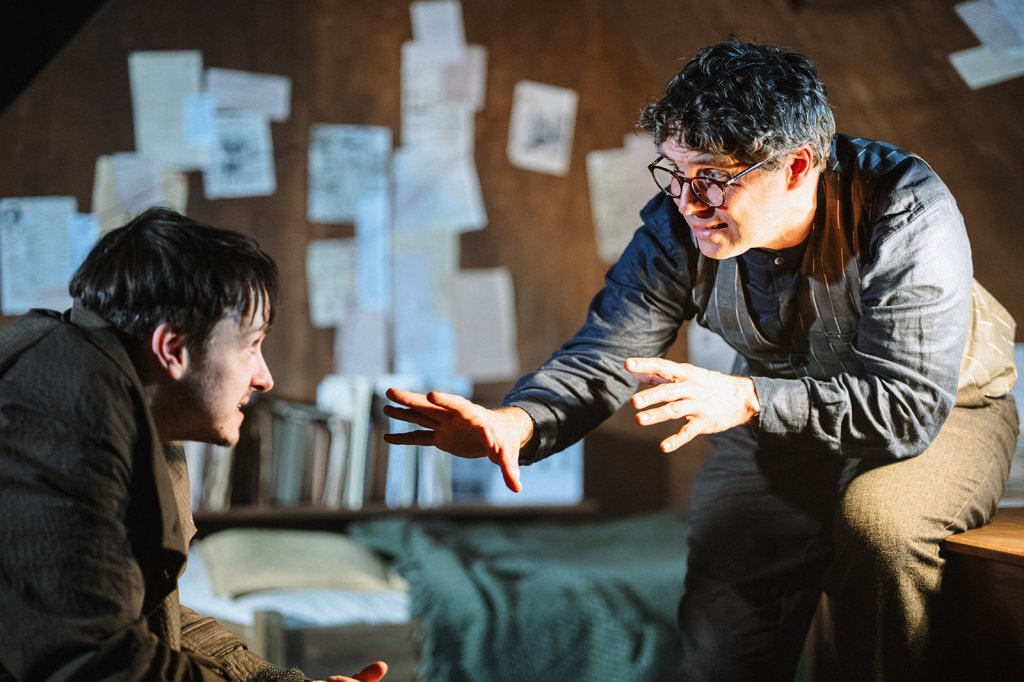
Connor Curren, Raskalnikov with Niaill Costigan as Petrovich, Chief Investigator.
Finally, with his conscience outweighing the offer of safe passage abroad, he goes to the police and confesses. Obviously it is a lot more involved than that, but most of the rest is philosophical idealism and, difficult to convey here.
Although hardly a barrel of laughs, I enjoyed it immensely, so much so, that the time seemed to flash past. The acting from all three performers was superb, especially as, there just being the three of them, they were all on stage almost constantly throughout and, in the cases of Trudy Akobeng and Niall Costigan, also playing multiple roles. The disintegration of Raskolnikov, played by Connor Curren, was remarkable, even eliciting a certain amount of sympathy, despite the heinous crime committed.
I mentioned the scenery, which, although sparse, was very atmospheric in its drab and threatening air. This was aided by the lighting, consisting of a free-standing spotlight, two lanterns and a couple of angle-poise desk lamps. There was also a very effective touch in that there were several hand-held devices emitting light, which were either aimed at other actors to pick them out in the gloom of the dark stage, or shone upwards towards their own face to convey menace.
The tour of Crime and Punishment, adapted and directed by Laurie Sansom, continues with dates at HOME, Manchester on 19th and 20th March, Victoria Theatre, Halifax on 25th to 27th March and Studio Theatre, Edinburgh, 1st to 4th April. To find out more about it, watch a trailer and book tickets, please go to
Photographs provided by Northern Broadsides.
 Tyke It To The Limit