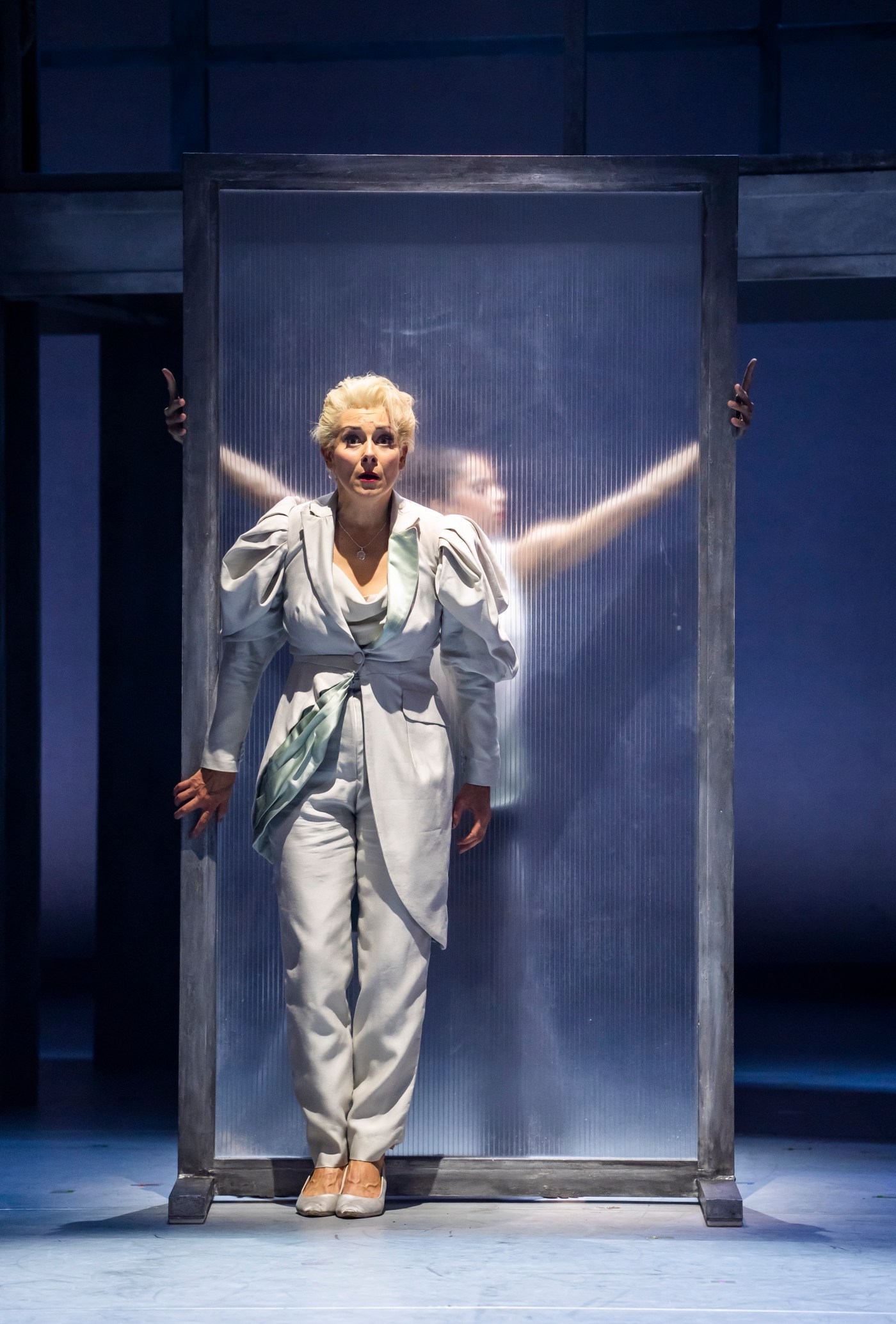
I say, I say, I say. What’s the difference between an opera and an oratorio? I don’t know; what is the difference between an opera and an oratorio? A boat load of money! Back in the early 1700s when Handel was nobbut a lad, operas were the telling of stories through music with extravagant settings and singers in the Taylor Swift wage bracket. He realised that he was on a hiding to nothing by writing these works in Italy, to where he had moved from his native Germany, so he came to England, where we were a little more frugal, and developed our form of musical drama, the oratorio. The story was still set to music, but was performed in a concert setting, like his Messiah. Opera North have teamed up with Phoenix Dance Theatre to hit the sweet spot in the middle of the two. The story was both sung and acted by the former, on a stage with minimal scenery, but it was also danced by the latter. For good measure, a third element was introduced, a British Sign Language actor who translated the work for those with hearing problems. The words are always displayed on screens at the side of the stage so the introduction of the BSL participant seemed, at least to my untrained eye, to be more of a mood and tempo interpretation than a verbatim one. I discovered later that her presence throughout was to act as reassurance that nothing was going unnoticed, her observations being transmitted to the character Daniel so that justice could be done.
When I saw that there were dancers involved I assumed that they would be there to help with the atmospherics of the piece and enhance its pleasure. It certainly did that but it also told the story in parallel with the actors and singers. This proved to be a little weird at times and it took me a while – well into the second half – before I had sussed it out.
Normally, when I say that the plot is very simple, I end up writing hundreds of words laying it out. No such problem here. The work, which I will call an opera, is about a woman, Susanna – even I got that part – who is married to Joacim. In the original bible story they have been hitched for quite a while, but here the action seems to take place on the wedding day when the groom is called away on business, leaving the bride to be comforted by her father, Chelsias, sung by Matthew Brook, and her Attendant, Amy Freston.

No sooner has he gone, than two Elders try hitting on her, but she rebuffs their advances. They say that if she doesn’t put out, they will tell the others in the village that she has been playing away with a young man. This will obviously disgrace her and test her husband’s faith in her. Regardless of this, she stands her ground and is tried for adultery. At the hearing a young man, Daniel, comes forward to defend her by cross examining the two Elders individually. When they come up with two different accounts of where the alleged infidelity took place, it is they who are disgraced and Susanna is exonerated.
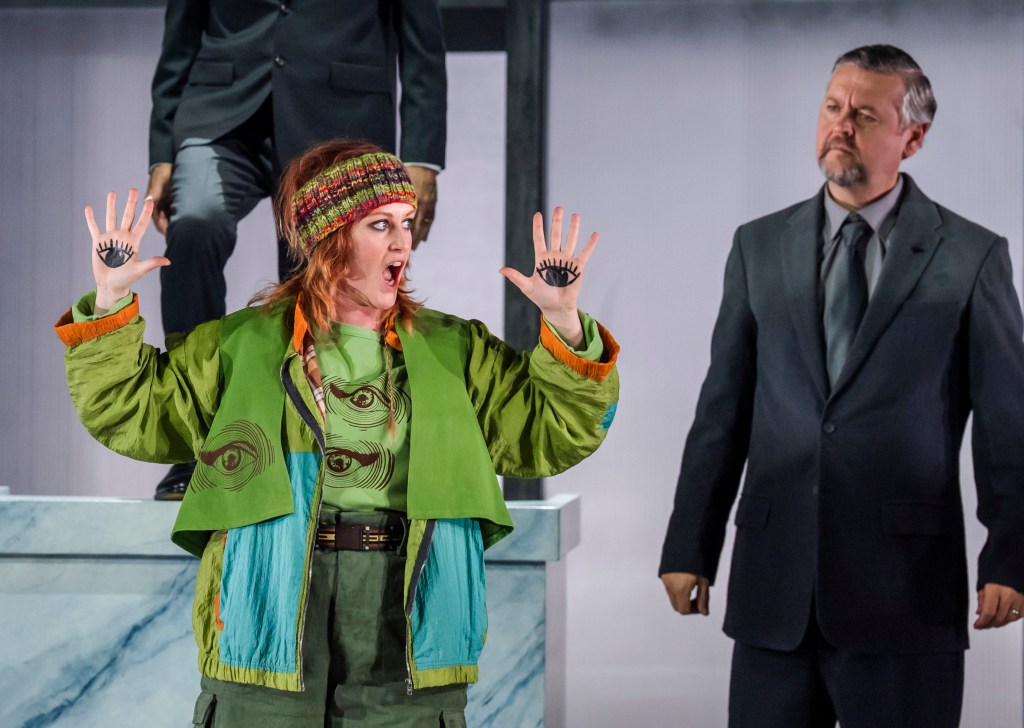
Joacim returns and they all live happily ever after. Except the Elders of course, especially one who has taken a well aimed kick in the underpants area from Susanna to ward him off! He will probably be singing counter tenor in the next performance.
Speaking of counter tenors, that was the register of James Hall, who sang the part of Joacim. To someone who is still coming to terms with the medium, I found it odd that the leading man’s voice was almost indistinguishable from that of the soprano prima donna, Anna Dennis. Unless I could actually see their lips move, I honestly couldn’t tell them apart. Perhaps Mr Hall began his career as a baritone, but got in the way of Ms Dennis’s practice swing at the Elder in rehearsals. I believe a more credible explanation is that, when the oratorio was first performed in the Baroque era, counter tenors were all the rage. They seem to have gone out of fashion in music nowadays – except for the BeeGees of course.
Every element of the production was superb in its own right, but I must say that at some points in the execution, I found the stage was so full that I didn’t quite know what I was supposed to be looking at. Should I follow the dancers, concentrate on the singers, the actors or switch back and forth. That was even before I cut away to read the title screen.
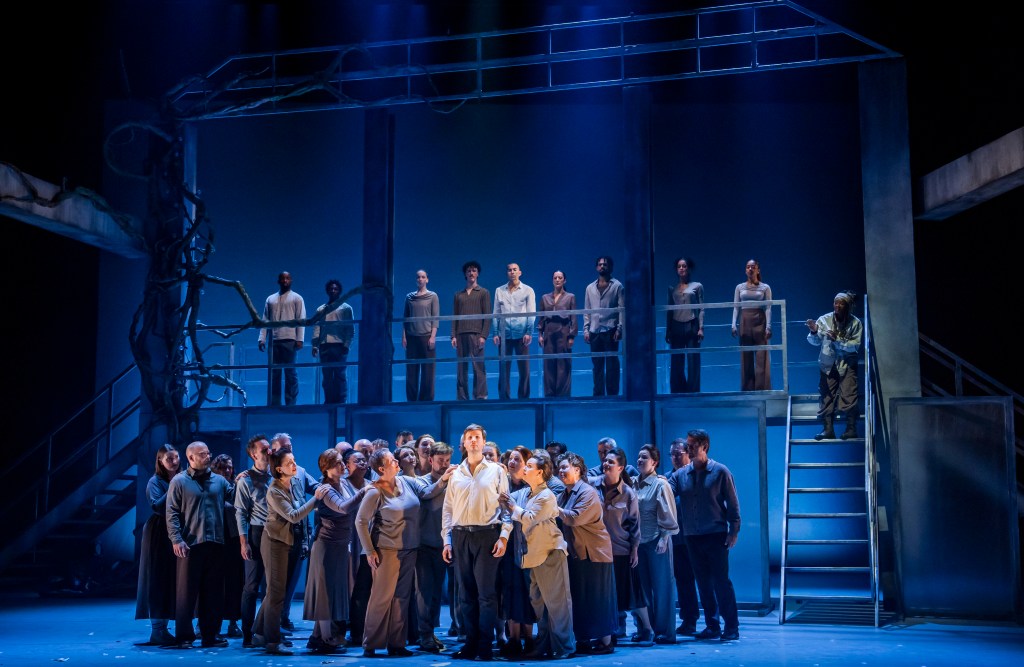
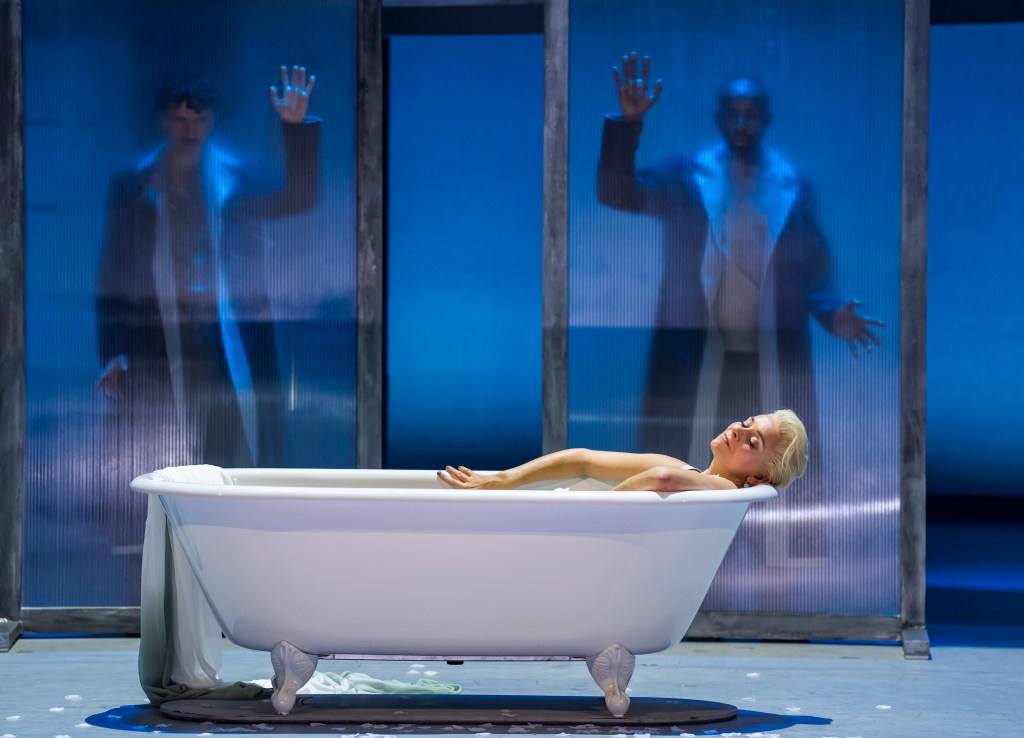
As I already suggested, the set was sparse, being a double decker with a staircase to the side, both levels utilised by each discipline, either separately or in unison. Any other prop was pushed on and off by the artists. One example which freaked me, and the rest of the audience, out, was when a roll-top bath tub was pushed on. Once in place, a pair of women’s arms dangled over the edge, shortly followed by her head and the rest of her torso. This seemed weird, as Susanna was standing on the stage waiting for it so that she could begin he ablutions. It took me back to being a kid in the slums of East Leeds when my mum and dad would have to fill the tin bath with water from a kettle, or several, on Sunday night. I would take mine first and then be sent to bed whilst they took their turn. It was not until later that I realised the woman in the bath had been the dancing version of Susanna.
My imagination had already been tested when Joachim was taking his leave of Susanna and the pair shared a going away embrace. Their Phoenix counterparts joined in, giving the impression of a swingers’ party.
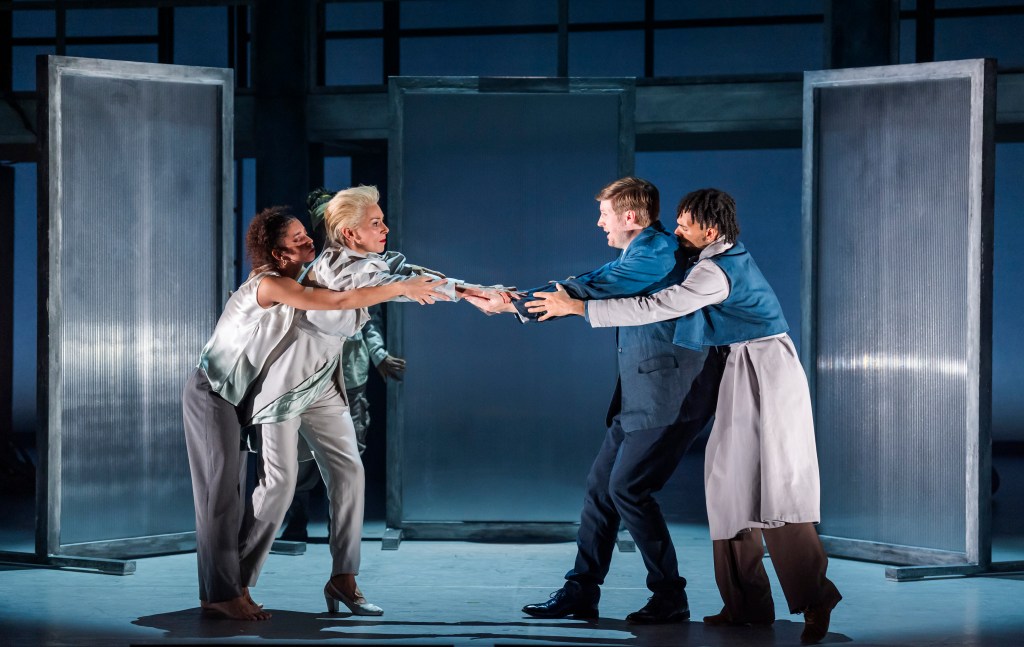
Normally I would baulk at the production being done in modern dress, but the content is possibly even more relevant now than it was at its first performance in 1749. The coercion of women for sexual gratification by men in power seems to reveal perpetrators with alarming regularity, whilst blind eyes continue to be turned.
I do like Baroque music and Handel was one of the greats, along with Mozart and Bach, so I would still have had a great night even if the dancing and acting had not been of the high standard we enjoyed. The members of Phoenix Dance Theatre continue to amaze me with their agility and the synchronisation of their moves. The singers were on top form, both in the Chorus and the solo performers. Colin Judson, tenor and First Elder, Karl Huml, bass, as Second Elder with fellow bass, Matthew Brook, as Chelsias added the depth needed to give variety, as did Dean Robinson, another bass, as the Judge. Claire Lees, as Daniel, and Amy Feston, Susanna’s Attendant, completed the list of superb singers. Ms Feston, as well as being a member of the cast, multi-tasked by filling the function of Chorus Movement Coordinator. That’s just showing off!
The Orchestra of Opera North, conducted for this production by Johanna Soller, were their usual sparkling selves. Chorus Master Anthony Kraus had his work cut out as the choristers were an integrated part of the action, as John Denver used to say – they can sing, they can dance but can they juggle? Probably!

The Phoenix Dance Theatre contingent were Choreographed by Marcus Jarrell Willis.
Olivia Fuchs was the Director, Zahra Mansouri the Set and Costume Designer. The Lighting Design was by Jake Wiltshire and the BSL Consultant was Adam Bassett.

A couple of things outside of the opera proper, which are worth a mention were the introduction by Garry Walker, Opera North’s Musical Director, who gave us a quick speech before the curtain opened, in which he said that there were over 300 people involved in staging Susanna, and I was moaning about the number on the stage. He went through a comprehensive list of creatives at the end of which the stage blacked out. He gave a hasty apology for omitting mention of the lighting crew at which time the illuminations were restored.
The other was the cacophony of pantomime boos at the curtain call when the two Elders appeared. They had obviously succeeded in their task.
Susanna is at Leeds Grand Theatre on Saturday, 11th October, Monday, 20th October and Wednesday 22nd October, after which it plays at Newcastle Theatre Royal on Friday, 7th November, Lowry, Salford on Friday, 14th November and Theatre Royal, Nottingham on Friday, 21st November. For full details and booking please go to https://www.operanorth.co.uk/whats-on/susanna/
To see what else is coming up in the Opera North Season it is https://www.operanorth.co.uk/ or you could always look at my Launch Article.
Everything about Phoenix Dance Theatre can be found at https://www.phoenixdancetheatre.co.uk/
Feature Image; Anna Dennis as Susanna with Yasmina Patel as her Phoenix Dance alter ego.
Photographs by Tristram Kenton
 Tyke It To The Limit