
It’s funny how theatre productions seem to arrive in types, a few months ago there was a procession of films turned into plays, there were television shows given the live treatment, and now this is the third book adaptation out of the last four theatre visits I have made. Don’t get me wrong, I am not complaining, far from it, they have prompted me to explore works of literature which would otherwise have passed me by. This one certainly would as the story of four sisters, their mother and aunt, was not really the book to be seen with at a boys’ grammar school with an inner city catchment area in the early Sixties.
I have just read the synopsis of the novel, which was originally written in two parts spanning about 750 pages, and find that the stage version, adapted by Anne-Marie Casey, is somewhat different from the source material. It doesn’t matter that much though, as the main theme is the relationships between the sisters, their mother, father, aunt and the men they encounter during their adolescence, spent at the time of the American Civil War. It also illustrates the forward thinking of the author, Louisa May Alcott.

It must be said that the characters of the four sisters: Meg (16), Jo (15), Beth (13) and Amy (12), could hardly be more different, although the aims of them are the same, i.e. to get married. Well, it was written in 1868. That was never going to be much of a problem for Meg, as she was the pretty one who was the most stable and a traditionalist. She also had a job tutoring the four children of a local family. Beth, the shy, timid one, was happy to stay at home, help her mother around the house and play the piano. Amy, who was still at school at the start of the play, was ostensibly an artist, but materialistic and more interested in the trappings of high society. Jo was the tomboy, and free spirit, who looked after her aged great-aunt, a wealthy widow and strait-laced so her antics did not go down very well with her.
The more immediate problem for the girls and their mother, Marmee (Mammy, geddit?) was to make enough to survive. Their father had lost all of his money and was serving as a chaplain for the Union Army in the War.
The play opens on the first Christmas Day spent without their father and, although living in ‘genteel poverty’, they decide to distribute whatever food they have amongst the poor children of the town. When they get home, they find that Mr Laurence, their wealthy old neighbour, has provided a Christmas dinner for them. The two families become better acquainted through their mutual kindness.
As well as looking after Aunt March, Jo is a keen writer, so much so, that she has her writing outfit, a black coat and a matching floppy cap, which she wears when working, as a sign that she is not to be disturbed.
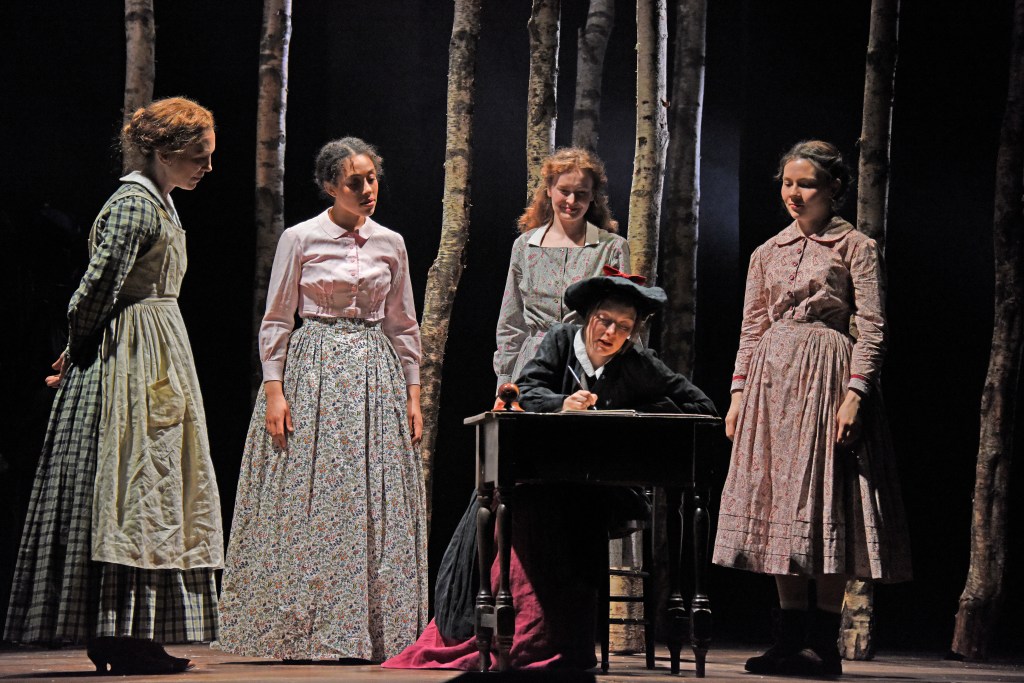
Time goes on and the little women grow up, despite there being some conflicts, notably when Amy burns the, almost complete, manuscript of Jo’s book. They have also become friends with two young men; Theodore ‘Laurie’ Laurence, the grandson of the Christmas benefactor, and John Brooke his young tutor. Laurie and Jo form a bond, as do Brooke and Meg, whom he wants to marry, but is told that she is too young so he agrees to wait.
Word reaches the house that Mr March has been taken ill and is in Washington suffering from pneumonia so Marmee leaves to nurse him. Further disaster strikes and, while Marmee is away, Beth contracts scarlet fever after spending time with a poor family, whose three children die from the condition. Amy is sent to live with Aunt March while Jo, who has already had scarlet fever, tends to Beth. She doesn’t get much better so the doctor sends for Marmee to come home. Beth recovers somewhat but never gets back to full health.
Brooke joins the army but is wounded and returns to find work so as to be able to buy a house for when he can marry Meg. Laurie goes to college and, on Christmas Day, a year after the book begins, father (who we never see in the play) comes home.
A further three years pass and Meg and Brooke marry and have twins, upon whom Meg dotes at the expense of caring for her husband, who begins to feel neglected. After advice from Marmee, Meg involves Brooke more in the child rearing and makes more time for ‘wifely duties’. Nudge, nudge, wink, wink, say no more.
Laurie graduates from college, with a little help from Jo, and realises that he has fallen in love with her. Again, Marmee knows best, so Jo tells her that she loves Laurie like a brother but there is no romantic spark. In addition to this bombshell, Jo is mortified that Aunt March has decided to take a trip around Europe, but chosen Amy, rather than her, as a companion. She decides to do some travelling of her own and moves to New York City where she takes a job as governess to the two children of a friend of her mother’s who runs a boarding house. This suits her tomboy – now feminist – side a treat, as the house has boarders of both sexes and is very liberal in its outlook. She begins to take German lessons from a fellow tenant, Professor Friedrich Bhaer, who has come from Berlin to help care for his sister’s orphaned sons.

For extra money, Jo writes racy stories for the more populist newspapers of the day, which sell very well. Friedrich suspects this and castigates Jo as he finds this kind of writing beneath her dignity, and pleads with her to go back to writing more intellectual prose. At the end of her tenure Jo returns home, where Laurie proposes marriage but she declines, so he sets off to Europe with his grandfather to find solace. Beth’s scarlet fever has left her extremely weak and Jo becomes devoted to caring for her until her eventual death shortly thereafter.
Laurie, instead of finding solace, finds Amy, who is still there with Aunt March, and he falls in love with her – Amy that is, not Aunt March – who will not allow her to go back home with Laurie and his grandfather unchaperoned, so the pair get married before they leave.
Friedrich, who happens to be on business in Massachusetts, visits the March family several times and proposes to Jo, who accepts and, unlike the novel, which goes on some time into the future, the story ends.
I enjoyed the play very much, there being lots of humour, and even the sadder moments not being too maudlin. The only problems I had were that the ‘little women’ were played by full grown women and it took a huge leap of faith to imagine them as 12 to 16 year-olds. Their body language and expressions were utilised as well as they could be, but didn’t quite do it for me. I realise that the actors had to be much older for legal reasons and, given the more adult ways in which 19th century genteel children behaved, the situation was somewhat mitigated, but it wasn’t until the second half that I found them to be credible.
The other thing was the accents. The house where the action took place was in Concord, Massachusetts, and, as the father and Brooke were fighting for the Unionist Army, that would confirm that they were Northerners. The accents, however, seemed to have a Southern twang, especially Belinda Lang, as the formidable Aunt March, who conjured up an image of Bette Davis if she were to play Blanche DuBois. I have looked through the programme and there is no mention of a voice coach so I will stick to my theory. It was Belinda Lang, however, so all is forgiven anyway.

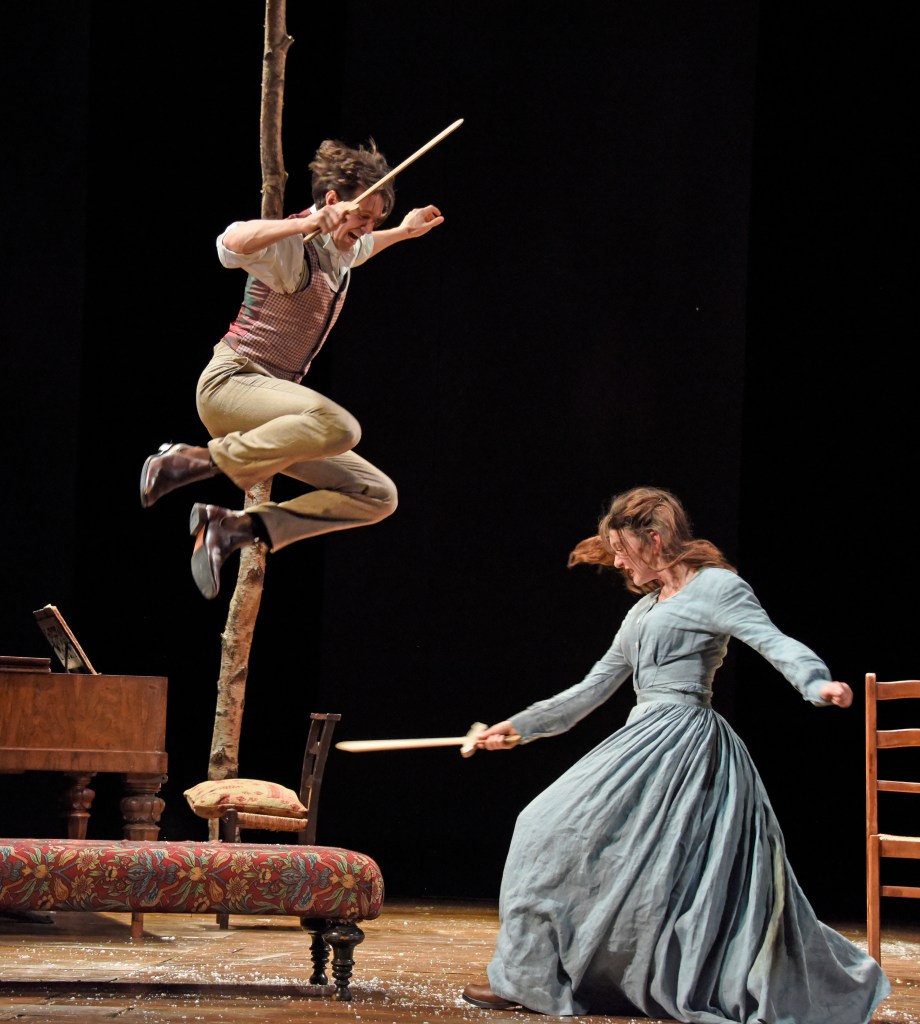
There had been a cast change on the night and Marmee was played by Ellie Pawsey, rather than Honeysuckle Weeks, but I doubt that Ms Weeks could have done it any better, she was superb. The main sister, around whom the story was built, Jo, was played by Grace Molony, again a top-notch performance, improving as her character aged to become more credible. Her comedy timing was also excellent, as was that of Cillian Lenaghan, who, as Laurie, provided hilarity in a sword fight, the two of them had as children.
Jack Ashton played the parts of Brooke and Friedrich, who said men can’t multitask, with aplomb. The former character was a young, confident man, whereas the latter was much older, bookish and, being penniless, feeling unworthy of Jo’s affection, therefore relying on his intellect to feel her equal.
The final three sisters: Jade Kennedy as Meg, the senior peacekeeper, and later, mother to twins, Catherine Chalk, the ill-fated Meg and Imogen Elliott, Amy, all did more than justice to their respective roles.
I found the set to be a little overstated insofar as depicting the March’s house to be in the woods was concerned, as there were trees all over the place, including, seemingly, indoors, a couple at the back would have conveyed the message. They were even more incongruous when stacks of lighted windows were illuminated at the back of the stage to depict New York Skyscrapers.
One clever effect, was the partial drawing of a large red curtain just behind actors occupying the front of the stage, when the scenery was irrelevant, or being shifted. It didn’t totally obscure what was at the back of the set, that would have been a real Morecambe and Wise moment, but covered about three-quarters to let you know that something else was going on while your attention was diverted to the actors involved.

There were effective interjections of songs, either Christmas carols or, on a couple of occasions, The Battle Hymn of the Republic, which set the mood. All perfectly sung by the cast.
Once again, I really enjoyed the play, despite my Virgo side preventing me from abandoning all vestiges of reality. So, if you are up for another classic novel performed by a superb cast, then this is for you.
Little Women runs at Leeds Grand Theatre until Saturday, 14th June. More information and tickets can be obtained by clicking on https://leedsheritagetheatres.com/whats-on/little-women-2025/
For details of other presentations at Leeds Heritage Theatres, please see https://leedsheritagetheatres.com/whats-on/
Photographs by Nobby Clark.
 Tyke It To The Limit