
Yet another production adapted from a novel – this is becoming a trend. Once again it was presented in a totally different format than the two I referred to in my last review; the twist here, is that it is staged in a conventional manner, no karaoke machines or circus performers, we were back to actors delivering their lines to each other. This was very much in keeping with the serious nature of the subject.
The book on which this play is based was written by Khaled Hosseini as a spiritual sequel to Kite Runner and adapted for the stage by Ursula Rani Sarma, as an illustration of life in Kabul, Afghanistan at the end of the last century.
Looking at the history of Afghanistan, the country seems to have been constantly at war since 1709, either against outside forces, or, more commonly, amongst its own various indigenous factions. From 1928 to the present day, there have been four civil wars, invasions by USSR, United States and the Northern Alliance (UK, France,Canada, Italy, Germany, Australia and New Zealand) and a number of uprisings, rebellions and revolutions; all are too complicated to even try to expand on here.
According to Roxana Gilbert, the Director, the time span of the work is from 1974 to 2001, the former year seeing the downfall of the Republic of Afghanistan and the latter, the end of the Fourth Afghan Civil War. In order to bring home, literally, the effect of these turbulent times, the common ploy of using one family as an illustration, rather than try to broaden the scope, has been utilised. This makes the plight of the population as a whole, especially the women, much more relatable.
During the Second Afghan Civil War (1992 – 1996) which had immediately followed the First (1989 – 1992) there were up to six Afghan mujahideen (Islamic militant groups) involved in the overthrow of the Republic of Afghanistan, as well as with each other. In 1994, a new faction was formed with support from Pakistan, named the Taliban, which became the dominant force for change and in 1996 took over the main towns and cities in the country.
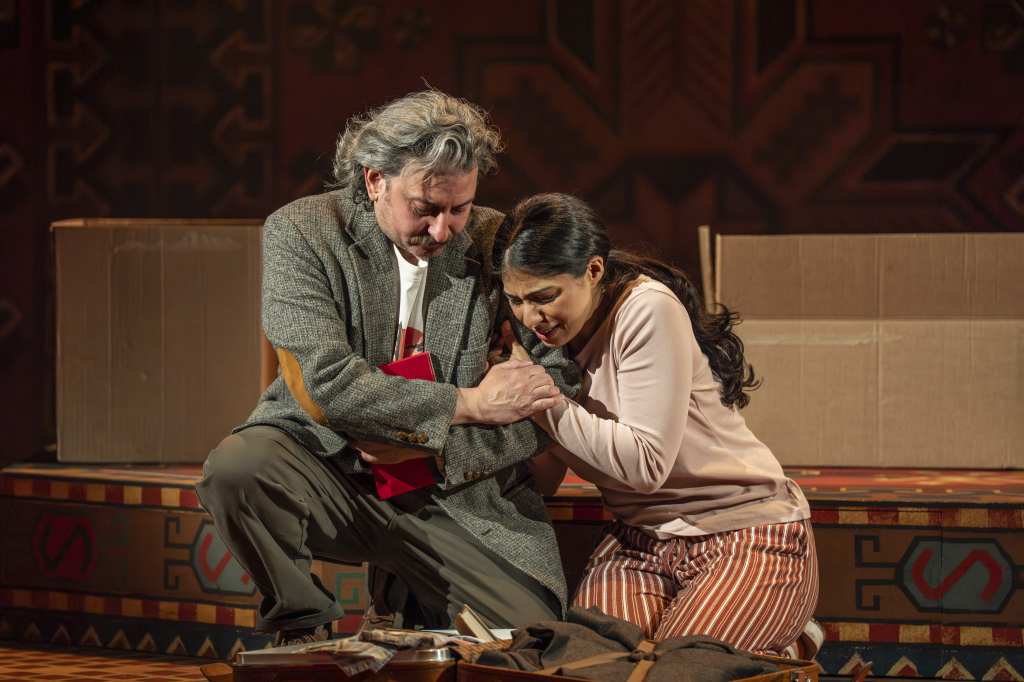
David Ahmad as Laila’s father with Serena Jagpal as Laila.
The fictional family in question was a product of the political and religious unrest, in that the main character, Laila, a teenage girl from a more liberal Muslim family, whose father was a teacher, lived a fairly carefree life, except that her mother suffered from depression after her two sons died in the war against the USSR. She is friends with a young neighbour, Tariq, but, when she is fourteen his family decides to leave the city for refuge in the country. On their farewell meeting he pleads with her to go with him, but she says she can’t as she doesn’t want to leave her mother. They do, however, have sex and he goes back to his family.
Shortly after this, as Laila’s family are packing in order to flee the city, their house is hit by a bomb and Laila is the only survivor. She is dragged from the rubble of her house by a neighbour, Rasheed, who, although having one wife already, says that if she marries him, he will take care of her. Realising that she is pregnant by Tariq, whom she has been told was killed by a bomb along with his family, en route to Pakistan, she agrees and moves in with Rasheed and his existing wife, Mariam. Polygamy being an accepted state.
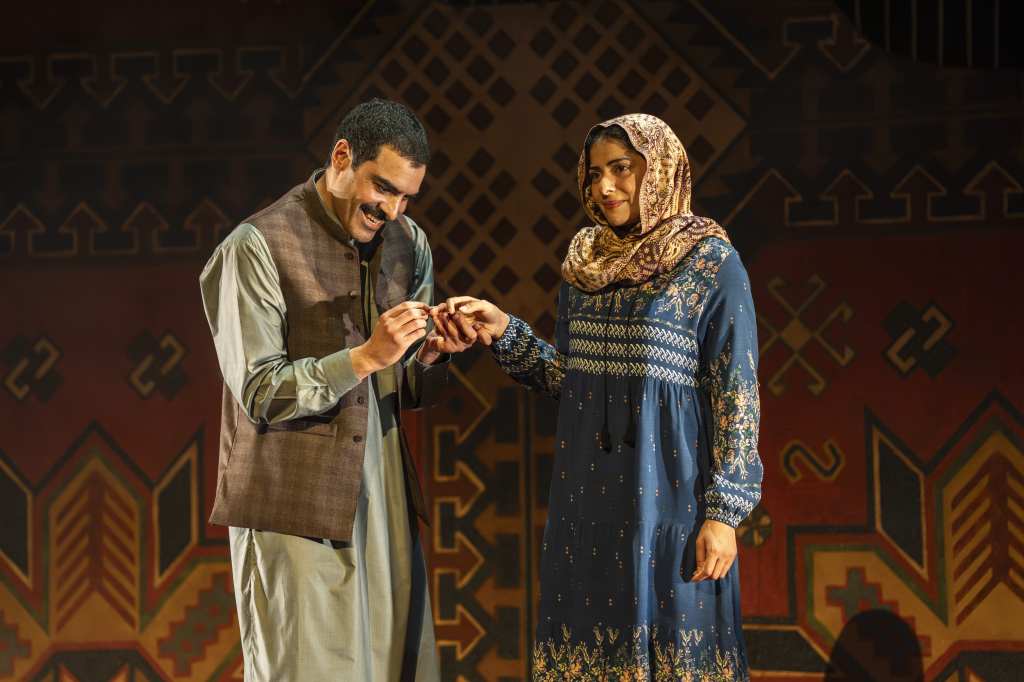
Jonas Khan as Rasheed tying the knot with Laila, Karens Jagpal
Mariam is from Herat where she lived with her mother, Nana, in a secluded hut, and was born after an affair between her and Jalil, a rich businessman. They lived in isolation so as not to encounter Jalil’s real family. Nana resents Jalil for excluding them from his life, although he does visit Mariam every Thursday. On Mariam’s fifteenth birthday, Jalil had promised to take her to the cinema to see Pinocchio, but he didn’t show up. Against Nana’s wishes, she travelled into Herat where she slept outside Jalil’s house when she was told he wasn’t in. She later discovered that he was at home the whole time. On getting home she found her mother had hanged herself. After living for a short time with Jalil, Mariam married Rasheed, who at that time was a widowed shoemaker, and moved with him to Kabul.

Rina Fatania as Mariam, right, with Humera Syed as the young Mariam in happier times.
At first Mariam is resentful of Laila as she is much younger and prettier than herself and, whilst Laila has no problem with helping around the house, Rasheed insists she look after the baby and so Mariam has even more chores to do. It is not long before Rasheed’s attitude begins to change and regular beatings are handed out, especially when the infant is disturbing his peace and quiet, an irritation compounded by the fact that it is a girl, and he wanted a boy. A further complication is that Mariam has miscarried seven times, so he has no heir. This brings the two women closer together, both sharing a hatred of their abusive husband, especially when he produces a hand gun which he fires in the direction of the child.
It is at this point that the Taliban take over and introduce strict laws, especially on women, barring them from education by closing all the schools, and insisting that they stay indoors at all times except when accompanied by a man, when they must keep their heads and face covered.
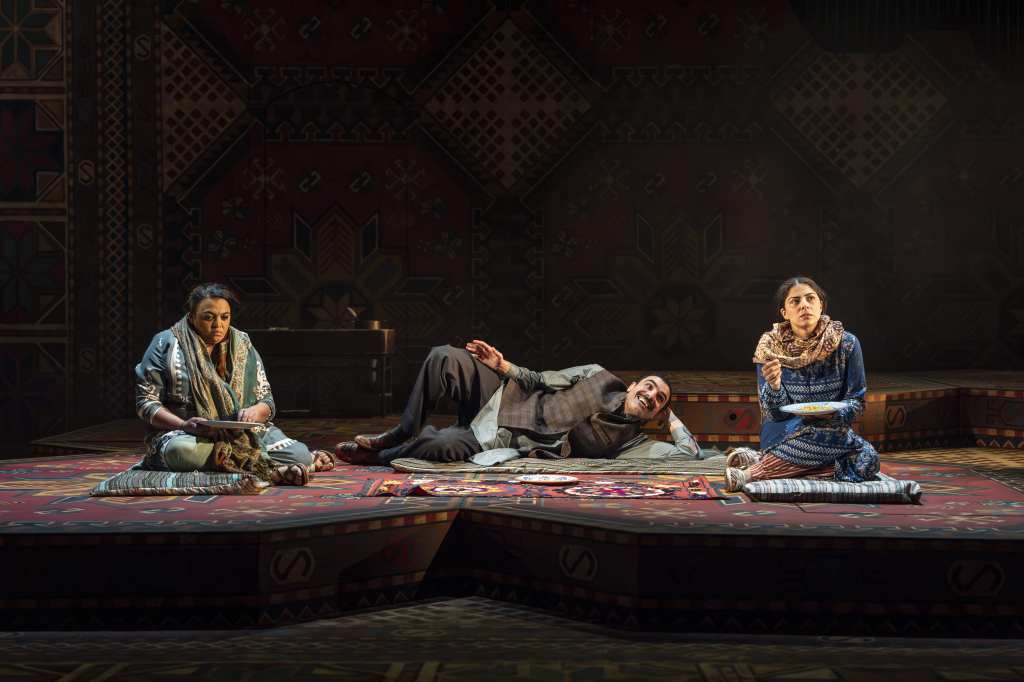
Mariam and Laila catering for Rasheed.
The two women attempt to flee but are captured by the local police and beaten and starved by Rasheed as punishment. Laila becomes pregnant again, this time with a son, to whom she has to give birth by Cesarean section with no anaesthetic as the women’s hospital has none due to the Taliban laws. The son is named Zalmai, and is doted on by Rasheed who, having lost his workshop, is struggling to find work, thus worsening his mood, so ships Aziza off to an orphanage.
Being unable to persuade Rasheed to take her to see Aziza, Laila makes the trip herself, knowing that she will be beaten by the Taliban for travelling alone. This comes to pass.
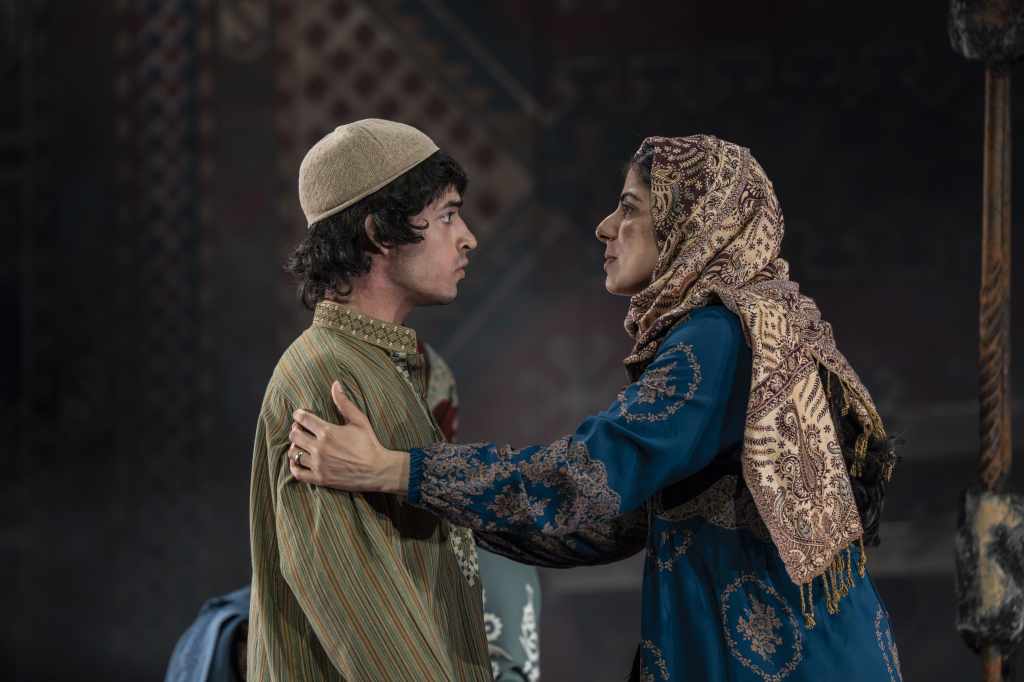
Noah Manzoor as Zalmai with his mother, Laila, Serena Jagpal
Time passes with nothing getting better, until one day, Tariq appears on Laila’s doorstep. She realises that the man who told her he was dead had been paid to lie by Rasheed so that she would stay and marry him. The two women, who have now formed a tight mother/daughter like bond, decide to run away again, this time with Tariq’s help. Their plans are thwarted when Rasheed returns home from work and is told by Zalmai, who is now growing up, that Laila has had a male visitor that day. Rasheed puts two and two together and begins to savagely beat both wives. He says he suspected that he was not Aziza’s father and begins to strangle Laila. Mariam picks herself up and hits Rasheed with a shovel, killing him.
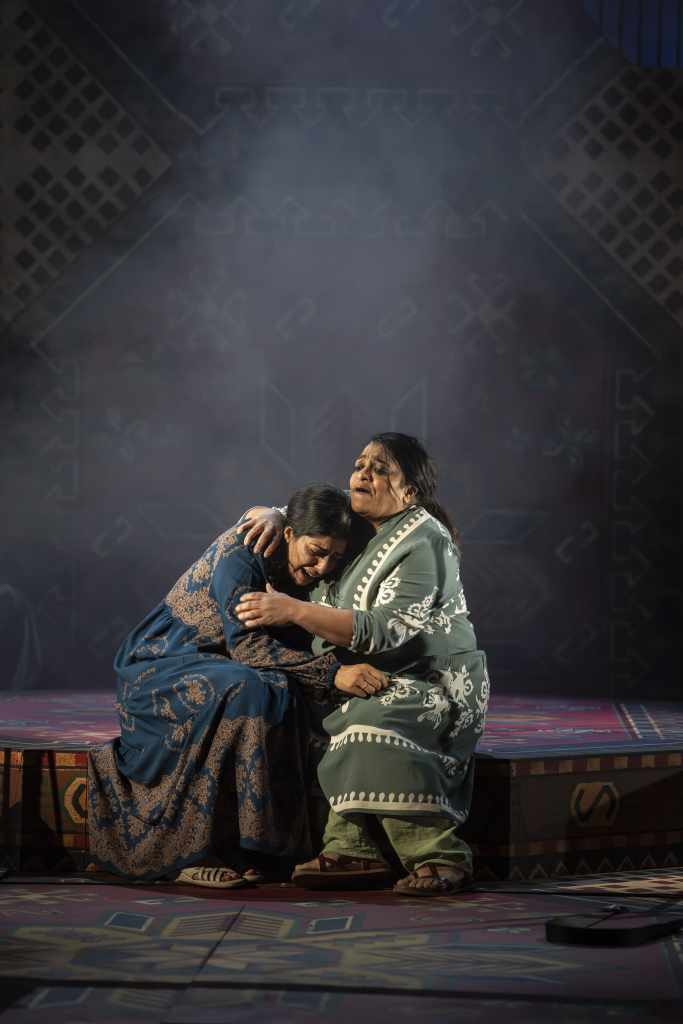
Laila and Mariam say their final farewells.
Realising that there would be a police hunt for them, Mariam tells Laila to go on her own, and she will confess to the murder to stop them from seeking another suspect. She is sentenced to public execution which she accepts knowing that her new family will be safe.
Laila and Tariq escape to Pakistan where they get married and, once the Taliban has been overthrown they return to Kabul. On the way, they stop at Herat, the village where Mariam was raised and meet with the son of a mullah who had taught Mariam. She is given a box containing a videotape of Pinocchio, a sack of money and a letter from Jalil expressing his regret and love for her, wishing he had fought harder to be a good father.
The narrative is told in sequential action with a few flashbacks to fill in the back stories of the characters. A technique which works really well. The set by Simon Kenny, who doubled as Costume Designer, was basic with the floors and walls covered in ornately pattered carpets, with a section at the back of the set, seemingly semi destroyed by the conflict. It was easily converted to house the torture chamber for the Taliban beatings.
The Lighting Designer, Matt Haskins, and Sound Designer, Clive Meldrum did a great job in setting the atmosphere, as well as frightening the life out of the audience in the bombing scenes. The Composer was Elaha Soroor and the Movement Director, Kuldip Singh-Barmi.
This was a great example of less being more. The sparse stage enabling the audience to concentrate solely on the intricacies of the intertwined relationships and the time shifts.
I found some of the acting to be a little stilted with not much nuance, but on the whole everything worked very well. David Ahmad, who played several roles, was superb and the two female leads, Rina Fatania as Mariam and Serena Jagpal, Laila stupendous. The former’s transtiion from drudge to rebel and from foe to friend was handled brilliantly, as was the latter’s development from callow young girl to hardened woman, determined to do the best for her children no matter what the cost.
A Thousand Splendid Suns is at Leeds Playhouse until 14th June and, if you want to see something which will keep you thinking long after the play is over, I would urge you to get a ticket. To do so please go to https://www.leedsplayhouse.org.uk/event/a-thousand-splendid-suns/
For details of other Leeds Playhouse events it is https://www.leedsplayhouse.org.uk/whats-on/
Photographs by Ellie Kurttz
 Tyke It To The Limit
One thought on “A Thousand Splendid Suns at Leeds Playhouse”