
Leeds Playhouse is on a roll at the moment, the last four or five productions I have seen, whether their own or touring, have been as interesting, varied and spectacularly well performed as you could hope for. Tess was no exception, being a take on Thomas Hardy’s novel, Tess of the d’Urbavilles. This is the second adaptation of a classic I have seen this week, both were interpretations but as different from each other as they could possibly be. The last one was a comedy and this is performed by a group of circus artistes. There were no lions, tigers or elephants, made to perform tricks, as in my day, thank goodness, not even clowns who drove a car which fell apart. Having said that, the wheels certainly came off for Tess at the denouement.
Once again the full novel had to be comprehensively abridged, as the original was serialised in the Graphic between July and December 1891 and when first published in book form it ran to three volumes! This didn’t detract from the piece one bit as the plot seems to be quite straightforward It is the setting and the philosophy which will have taken up most of the prose. These elements were conveyed in the physical performances involved. The story itself used a narrator, who was the older version of Tess Durbeyfield, played by Anna Crichlow, recalling her younger self, performed by Lila Naruse. Although I have recently come to appreciate modern dance, I found that this was great help in understanding the finer points of the tale.
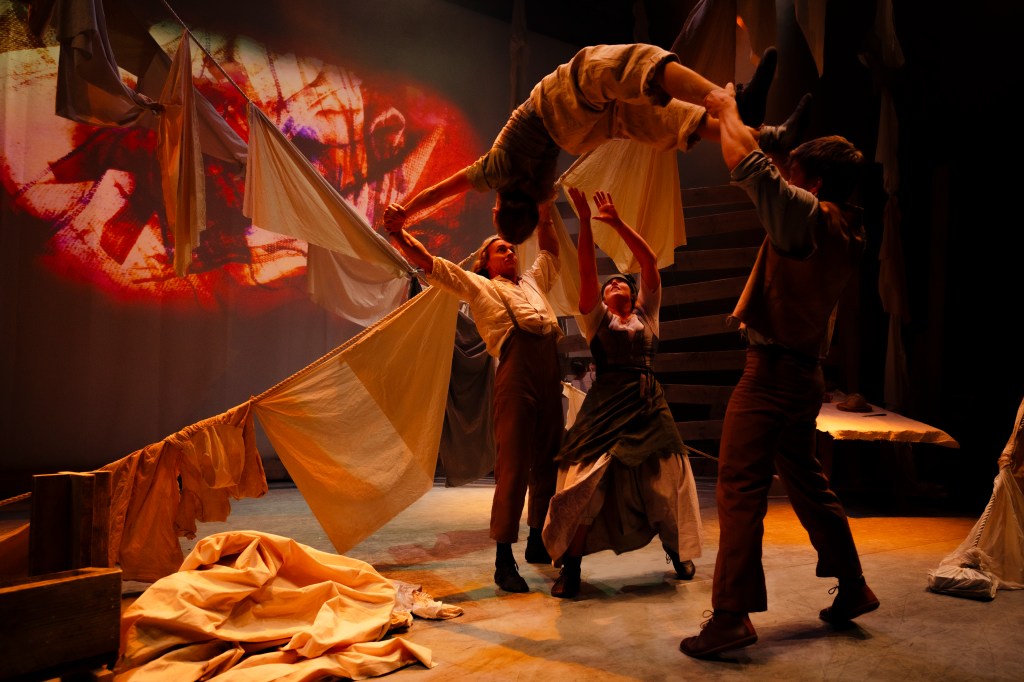
Washing day.
Here is the synopsis.
As you will have noticed, Tess’s surname is not d’Urberville, but is close enough to suggest there is a connection between the two monikers, leading to a link being found. Her father is a drunk and her mother does what she can to get by. The d’Urbervilles are an aristocratic family apparently dating back to the Norman Conquest, who agree to take Tess in. Tess, who is both attractive and innocent, suffers the fate which has befallen many young women over the years, and is seduced by the libertine heir, Alec d’Urberville (Joshua Frazer) and bears him a child, appropriately named Sorrow, who dies in infancy before she can be christened. This is where the first of many examples of the double standards of the time are highlighted. Tess performs the baptism herself on the dying baby, as there is no cleric to do it. When she approaches the local clergyman he assures her that it makes no difference that she has dispensed the rites, the child will still go to heaven, however, she is still condemned to be interred in a part of the church grounds reserved for paupers and criminals.

Some time later, and working in a dairy, she meets Angel Clare (Nat Whittingham) a man of apparently sympathetic temperament, who eventually persuades her to marry him, despite her reticence to do so because of her guilty secret. Shortly after their nuptials, Angel confesses to Tess, that he is harbouring a secret in that he had had an affair with an older woman when he was younger, but it was now firmly in the past. At this point, Tess feels that she can reveal her own skeleton. Enter, double standard number two. Angel is overcome with shock, and, it seems, abhorrence, toward Tess and casts her out. He says that he would have reconsidered if her lover had died, but cannot stand the thought of him still being a threat to their relationship, even though Tess has assured him that that is not the case.
Once more in poverty, she does return to Alec and is taken back into the d’Urberville family home, where, again, he abuses her on a regular basis in between his other trysts.
Time passes and Angel, not being able to live without Tess, seeks her out and asks her to come back, but she says it is too late and reveals her situation. They are both overcome and, remembering Angel’s words, Tess picks up a knife and murders Alec, only to be arrested and hanged for the offence.

OK, so it isn’t a barrel of laughs, although there are some highly amusing interludes which counter the dark ones. These are provided by the contortions of the performers, each of whom is a mixture of dancer, gymnast, weightlifter and flat-pack assembler. I don’t think I have ever seen anyone get into positions which these amazing people did, and not only that, walk in the process, as they did when four high on one man’s shoulders.
A couple of particularly amusing episodes were centred around Angel Clare, who was a particularly good looking chap, actually, Alec d’Urberville wasn’t bad either, especially when in his frock coat. The first was when the other girls in the village were on their way to church one Sunday, dressed in their finery. They came across a flooded field and tried to cross it using rocks as stepping stones, but were getting their dresses splashed. Angel came to the rescue and carried them across the quagmire, at first one by one, but they were contorting as he carried them, so as to flirt outrageously with him. They then asked to be taken back to do it again, but he was having none of it and conveyed three of them at once!

Angel, the human ferry.
The second was when, again, the girls were flirting with him. He was relaxing on the ground reading his book, while they were trying to catch his eye by performing amazing gymnastic moves on a wooden structure. It was not just the moves which were amusing, but the expressions on the girls’ faces. I suppose you had to be there for that one. Nat Whittingham provided another moment of comedy gold whilst trying to milk a cow. Hilarious.
There was also an awful lot of trust involved, with performers falling backwards from the top of the set into the arms of their fellow artistes. and running at full speed across the stage three abreast only just dodging those coming the other way.
Despite the above antics, the overall atmosphere of the work was pretty sombre, as it should be when dealing with such a subject. This was enhanced by projections on a screen at the back, displaying the relevant chapter in the action as well as appropriate images.
The set was sparse with a wooden framework to the right, filled by slats at various angles, providing spaces through which to crawl, climb, or dangle. At one point there was a second structure on the left which was built in real time in an Ikea-like fashion, and then dismantled when done with. Unlike the Swedish version, there were no bits left over and the finished item could support the weight of several people. No more meatballs for me!

Ride a cloth horse.
There some amazing effects provided by the use of cloth. The baby and a horse were both constructed from the material, as were some enormous cow udders, created by inflating double pieces, similar to a large pillow case, and waving them until they filled with air.
The performers not mentioned above were: Lauren Jameson, Victoria Skillen, and Leah Wallings.
The Directors were Alex Harvey and Charlotte Mooney.
It is difficult to translate such a physical show into static typeface so may I ask you to click on https://ockhamsrazor.co.uk/tess where you can see the trailer.
I think it would also be a good idea to go to see the show for yourself. It runs at Leeds Playhouse until Saturday, 31st May, after which it ends its tour at Home, Manchester from 5th to 7th June. https://ockhamsrazor.co.uk/tour-dates
For more details of Ockham’s Razor, the company responsible for the production, please go to https://ockhamsrazor.co.uk/
To see what is coming to Leeds Playhouse, it is https://www.leedsplayhouse.org.uk/whats-on/
Photographs by Kie Cummings
As a footnote, I am a big Simon and Garfunkel fan, and continued to follow their solo careers after they split. The name of Art Garfunkel’s first album is Angel Clare, and never having read the book, I had no idea where it came from. I do now, and will listen to it in a different mind set next time.
 Tyke It To The Limit