
Whoever compiles the schedule for productions at Leeds Playhouse played a blinder on Thursday night. For those of you who are not familiar with the venue, it comprises four spaces; Quarry, which is the largest auditorium, Courtyard, my favourite, a smaller one with the most comfortable seating, both in the upholstery and legroom departments, Bramall Rock Void, a great place to see the more intimate productions, such as one-person plays and, finally Barber Studio, a performance and rehearsal room which I have not yet been to. So, 15th May saw two performances of Horrible Histories, one called Terrible Tudors and the other, Awful Egyptians – not at the same time obviously – in Quarry, whilst were treated to Tambo & Bones in Courtyard.
At first glance, there might not seem to be any obvious connection but nothing could be further from the truth. Horrible Histories are stage adaptations from the children’s television series, which utilise songs and jokes to be superbly funny and incredibly informative, even to we oldies. As their names suggest, they deal with various eras in the development of civilisation, or what passes for it nowadays. Tambo & Bones is a play dealing with the history of black people in the USA by using comedy and music, adding a look into the future for good measure. Sadly I wasn’t invited to the first two, but my evening could not have been more entertaining or thought provoking so I didn’t mind.
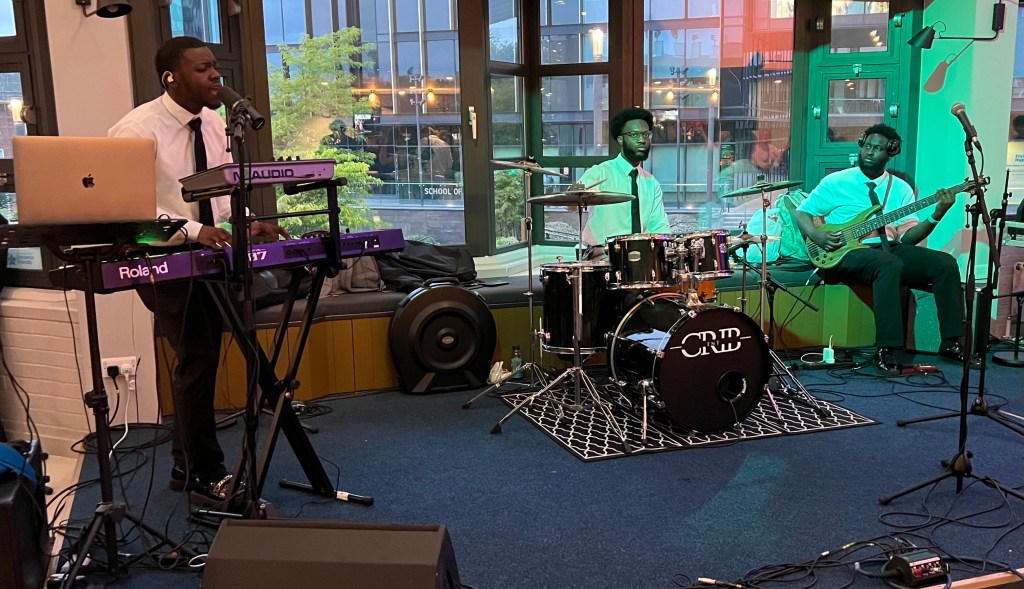
As this was a co-production in association with Belgrade Theatre, Leeds Playhouse and Liverpool Everyman, the boat was pushed out and we were treated to a performance of MOBO by a band in the bar area before the show, much to the surprise of the kids and parents attending Horrible Histories, who must have wondered what was going on and if this happens every night. It doesn’t! There were a few Nina Simone and Stevie Wonder songs as well as others from the sixties and seventies conveying a message.
After all that build up I don’t propose to write a great deal about the play itself as it is the construction and execution which sets it apart from the rest of the dramas I have ever seen.
I have always been fascinated by US history, possibly because of the films and tv I was exposed to in the 1950s when it seemed like a magical place where everyone had money, large houses, flash cars and great clothes. This was in sharp contrast to our two-up, one-down and cockroach-infested cellar with no hot running water and a shared toilet in a block at the end of the street. Obviously, as I grew older I discovered that even our slum was better than some of the accommodation which was utilised across the pond.
The racial aspect was also a mystery to me. I was always brought up to judge everyone as I found them, something which I still strive to do, and to see the films of black people hanging from trees or being beaten by whites and police, came as a great shock. The other thing which struck a chord was that I attended Central High School in Leeds between 1961 and 1966, which was the namesake of one in Little Rock, Arkansas, where, just a few years previously, black students had been prevented from entering a white school, even though enrolled, and violence ensued. They eventually were given a military escort in order to go to lessons.
In this country, people of colour were fairly rare outside London and the ports , in fact, the only two people not of British origin in my primary school were an Indian teacher and a Hungarian refugee who came over after the uprising in 1956. I went back to the school, now an academy, a few years ago and spoke to the head teacher who told me that the following Monday, they were going to welcome a new pupil who would bring the number of languages spoken to 47! What struck me was that the kids were getting on great.

There is no need to explain the ‘plot’ here as it is complicated and, as has been said, the presentation was the thing.
The play is in three acts. The first took the form of a Minstrel Show, a form of variety theatre which began in the early 19th century and comprised sketches, songs and skits. They were performed by whites who blacked up their faces and depicted the negro population as being stupid, lazy and generally naïve. One of the recurring exaggerated characters was a chap named Jim Crow after whom a set of laws were named in the late 19th and early 20th century which allowed a form of apartheid, but said that the facilities specifically for use by blacks should be ‘separate but equal’ to those for the whites. Something which was widely ignored outside publicly owned places, or the black ones simply closed.
The two actors involved here are both black; Clifford Samuel as Tambo and Daniel Ward as Bones. They were based on a real double act. Tambo played tambourine and Bones, bone castanets. Originally they were accompanied on stage by a posh, blacked-up ‘interlocutor’ who accentuated their intellectual shortcomings by asking questions which they misunderstood to much hilarity from the audience. From the examples I found on line the answers they gave appeared daft but, in fact, were logical in their own way. Q. ‘How do you get to China?’ A. ‘Go up in a balloon and wait for the earth to turn below.’ It reminded me of the Irish jokes which were told at the end of the last century ostensibly to show how stupid they were, but invariably backfired. An Englishman is driving through the Irish countryside in his Ferrari when he sees a farmer leaning against a gate. ‘Excuse me my good man.’ he says, ‘What is the best way to get to Dublin from here?’ ‘Will you be walking, using public transport or driving that nice car?’ replies the farmer. The Englishman rolls his eyes and says, ‘Driving of course!’ ‘Yes, that’s the best way to get from here to Dublin.’ says the farmer and walks away.
The play opens with Tambo working out how to find some shade in which to take a nap, the atmosphere enhanced by the sound of a banjo playing Turkey In The Straw. The set is obviously fake, with a false sun on a back sheet made to look like a summer sky. The vegetation of bushes and small trees, again fabricated. He tries several ways in which to concoct a solution, finally cracking the problem. I won’t spoil it by spilling the beans. .
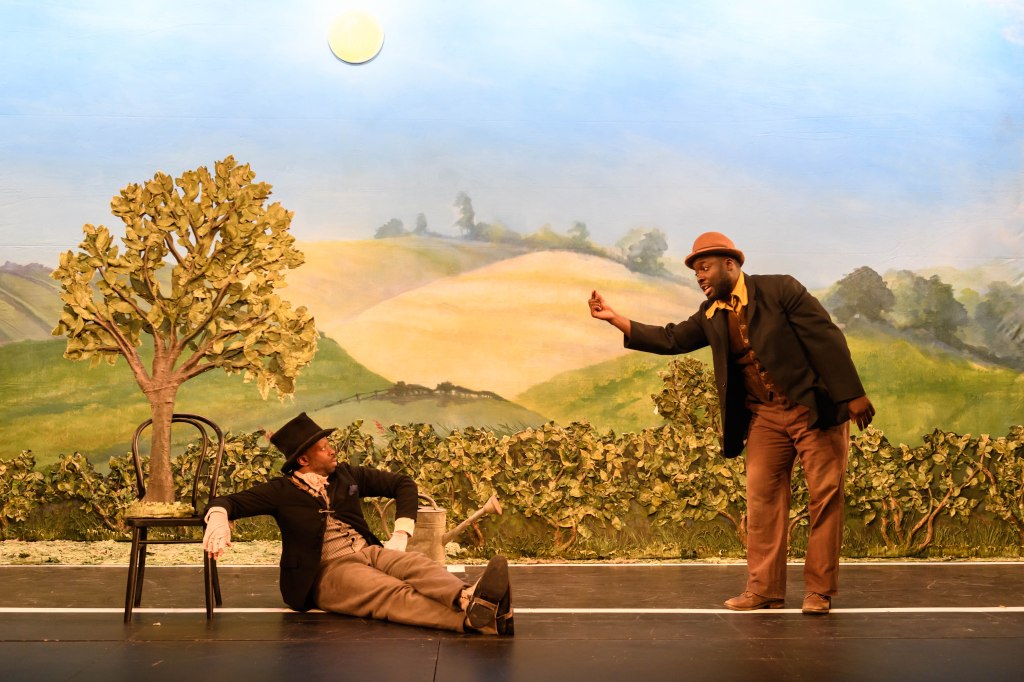
Just when Tambo has nodded off, Bones enters and looks at the audience. The whole evening breaks the fourth wall and we become involved in the action. He removes his hat and asks us if anyone can spare him a quarter, no one replies so he gives us a sob story, which is obviously as dubious as the set. This wakes Tambo and the conversation between them, and us begins. The two men display their attitudes to life, Tambo being philosophical, and wanting to change the world, whilst Bones is always on the lookout for ways to make money. His catchphrase is ‘Quarters to dollars and dollars to dreams.’
During this segment the history of black America is hilariously recounted from the early 1800s to the end of the 20th century and the demise of minstrel shows. The curtain dropped and there was a flurry of activity behind it as the stage was transformed from the one at Courtyard to a festival rig, complete with DJ in a hockey mask, scratching on a couple of decks.

Act Two began with the curtain being raised with a flurry of blinding spotlights flashing on both the stage and the auditorium. The two stars had transformed into rappers and the rest of this segment is performed as a concert. Once again the characters display their inner selves with Tambo wanting to put the world right and thus be able to sleep, whilst Bones is intent on earning even more money than he already has, having become the richest man in the world.

The lyrics to the raps is the way in which the story brings the situation up to the present day, and further, opening up the door to the third act which happens after the interval.
Act Three takes place 400 years into the future. You have to admire the optimism. Actually it is not very optimistic, as the mood becomes darker with America now being run by black people. The duo have instigated a revolution by creating some white robots to do their fighting and committing total genocide against the white population. That is as far as I am going to go, but two of the automatons are huge features in this segment and played incredibly realistically by Jason Lammens and Dru Cripps, one of whom was the DJ in Act 2. (I think that AI has taken control of my computer as the spell check just altered Dru to Dre! – Straight Outta Harrogate) Sadly there are no production images for the third act, which I am sure is intentional so as not to provide a reveal. I have included a link to the trailer in which they appear at the end.
The ending was nothing like I have ever seen before on stage, screen or television. It was devastatingly effective and I am still feeling the aftershock.
The acting by all four participants was supreme. The metamorphosis from minstrel show to dystopia handled incredibly well, with the empathy between the characters both touching and worrying, the transformation between laugh out loud humour to intensity, seamless.
I can’t recommend this show highly enough, it can be taken on any level, although a few warnings. The F word is sprinkled around like confetti, something which I found incongruous in the minstrel show as I am sure it wouldn’t have been used on stage at that time, although neither would reference to ‘big ass 50p pieces,’ when Bones was told we don’t use quarters in England. If cussin’ was rife, then there was a carpet-bombing campaign of the N word. Not complaining, just saying.
Tambo & Bones was written by Dave Harris, a poet from West Philly, and directed by Matthew Xia, Artistic Director of Actors Touring Company. Thank you, gentlemen, your work was greatly appreciated.
Tambo & Bones trailer https://www.youtube.com/watch?v=6ybZurjs664
For a look at one of the raps see https://www.youtube.com/watch?v=59fxh7Z9JA0
Sadly, this is the last stop on tour so you only have until Saturday, 24th May to go see this. You will thank me for it. For more details and to book, please go to https://www.leedsplayhouse.org.uk/event/tambo-bones/ NOW!
For information on the Actors Touring Company see https://www.atctheatre.com/
To see what else is coming up at Leeds Playhouse it is https://www.leedsplayhouse.org.uk/whats-on/
Thankfully the music in the bar was restarted after the show. The Horrible Histories crowd had left, so I decided to miss my bus home, listen to the singers, have a beer to calm down and reflect further on what I had just witnessed. It tasted great.

The gospel choir – with at least one interloper – after the show
Production images from Jane Hobson and Bar photographs by Stan Graham
 Tyke It To The Limit