
If you doubt the power of music then let me tell you that the medium has done something that even God has failed to do – get me to go to church on a Sunday!
I have become quite the fan of Leeds Baroque Choir and Orchestra since being introduced to them by a friend who lives, where else, but Marlow in Buckinghamshire. Her sister-in-law, although residing in Wales, is part of the ensemble and so I was invited, via this convoluted route, to the event which I reviewed in March.
I was so impressed that I decided to become something of a groupie, so asked if I could attend the second concert in the company’s 25th Anniversary season at Fulneck Moravian Church in Pudsey. My request was granted, so off I went. This recital was a lot more intimate than the first one, where the whole Orchestra and Choir was regaling us with their amazing talent, but then, I suppose that is more appealing to a groupie, then again…..
For readers not familiar with the environs of Leeds and Bradford, Pudsey is a town situated between those two cities, meaning it has become one huge conurbation, with no break in between. And, yes, it is the place after which the bear mascot for BBC’s Children in Need charity is named.
Fulneck is a small section of Pudsey, actually, hardly more than a street, which is a Moravian settlement, and the enclave is manly taken up by the church and a school, which, sadly, will be closing at the end of this academic year. Former pupils include, Herbert Asquith, UK Prime Minister from 1908-1916 and Dame Diana Rigg, the stage and screen actress. My American readers might also be interested to learn that another (very) old boy was Benjamin Henry Boneval Latrobe, an architect who emigrated to the USA in 1796, where he designed, amongst other things, the Capitol Building in Washington, as well as the White House porticos.

The home of Mr Latrobe.
Someone who didn’t attend the school, but was born and brought up here, is a true Yorkshire legend, Sir Leonard Hutton, the county’s opening batsman from 1934 to 1955 and playing 79 times for England, in the days when they only played test matches. He still holds the record for the highest score by an England test batsman, of 364, which was set in 1938, satisfyingly enough, against Australia.
In the current vernacular, that was then – this is now, so it is the concert I was most concerned about, mainly because it appeared that Leeds Baroque were giving two Fingers to the audience! Don’t worry, it wasn’t the age-old gesture, but a couple of pieces by the Moravian composer, Gottfried Finger (1655-1730); Sonata in C major RI 170 and Sonata in C major, RI 171, both for trumpet, violin and continuo (chamber organ) to which they had added a violoncello part to turn them into quartets. The other works were, Divisions in D minor on La Folia, by Nicola Matteis senior (c. 1670-1690), Sonata in C major, op. 1, no. 12, for trumpet, violin and continuo, by William Corbett (1680-1749) both of which were augmented by violoncello, and, Passacaglia in G minor, from the Mystery of Rosary Sonatas, for unaccompanied violin, by Heinrich Biber (1744-1704). To paraphrase Eric Morecambe, they were the right pieces, Sunshine, but not necessarily in the right order!
Apart from the music, we were given a history of the trumpet by Crispian Steele Perkins, who made, what could have been a very dry lecture into an entertaining presentation. His range of instruments spanned the centuries, beginning with a hunting horn and ending up with a trumpet he bought for sixteen quid on Ebay a few weeks ago, as a piece of Second World War memorabilia, but was probably from the beginning of the last century. If Mr Perkins says it is from the beginning of the last century, then it is. What he doesn’t know about trumpets is – well – nothing.

The collection of trumpetabelia brought by Mr Perkins. The instrument on the stand is a natural trumpet which can be modified by using the curly bits on the seat. The horn on the left of the seat was extended to change the pitch by adding the straight pipes next to it, like a snooker player extending his cue or, for we older ones, a chimney sweep improving the reach of his brush.
I did take notes and plan to try for a doctorate in the subject, but don’t worry, I will not bore you with my full dissertation here, merely pick out a few highlights.
The trumpet began life as just being a mouthpiece with no other purpose than to make an irritating noise to attract attention, something which we still have today, except we have dropped the ‘et’ from the end. Because there was no body to the apparatus, the sound dissipated so someone came up with the idea to add a horn on the end. This is where Mr Perkins produced his grandfather’s hunting horn. Again, not a musical instrument, more a basic means of communication.

Size isn’t everything – right.
Time went by and someone discovered that by extending the length of the tube, the note could be refined and, by using the lips, a tune could be played. A tube the length of the distance between the hand and the elbow was found to change the pitch by an octave. Both the Greeks and the Romans worked this out but developed their own versions, the former was 2 lengths and the latter, 3. When a fourth length is added it produces the same sound as a bugle, but is very long! These were used by the Household Cavalry from 1667.
Once some bright spark had realised that bending the tube had no effect on the pitch, things became somewhat more practical, and the natural trumpet was born, whose pitch could be altered by adding or detaching small curly tubes – sorry to get technical there.

The curly bits in action
To make it even more versatile, a small slide could be used to vary the tone without needing to modify the body, and holes drilled in the underside of the tube. This is where the story ended insofar as the trumpet’s use in Baroque music was concerned, but it was pretty obvious that valves were added to come up with today’s version, and a larger slide, to create the trombone.
It was all to do with the laws of physics, but let’s face it, it wasn’t Baroque-et science.

Asuka Sumi, violin, Crispian Steele Perkins, trumpet, Peter Holman, chamber organ and Catherine Strachan, violoncello.
Oh, yes! The music. As you will see, only three out of the five pieces involved, called upon the musicianship of the trumpet maestro, but they illustrated the use of the instrument in this genre of music superbly.
Catherine Strachan, violoncello, Peter Holman, chamber organ and Asuka Sumi, violin, were enchanting on the Finger, Matteis and Corbett pieces, with Ms Sumi giving us a sublime solo on the piece by Biber.
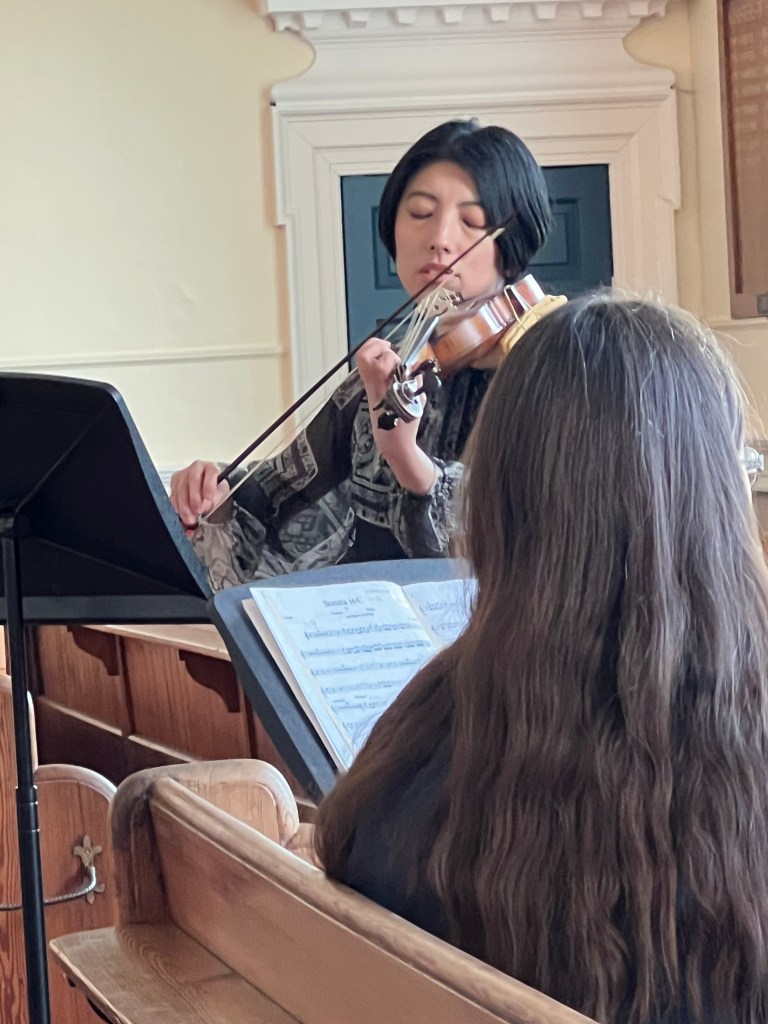
Asuka Sumi during her solo
I am now looking forward to my next trip to see Leeds Baroque at the end of June, with their Venetian Concertos at Sunny Bank Mills, Farsley on 22nd June. Should you be within striking distance of the Craven area of Yorkshire, they are staging a concert of Monteverdi Madrigals at St Andrew’s Church, Kildwick in Craven on 18th May.
For more about Leeds Baroque and to book for their concerts, please go to https://leedsbaroque.co.uk/
 Tyke It To The Limit