
To mark Bradford’s tenure as UK City of Culture, Opera North decided to spread the love and stage the first two performances of the 2025 Tour of Verdi’s Simon Boccanegra at St Georges Hall, handily situated across the road from the Interchange. I say ‘staged’ advisedly, as that is the term used to describe the way in which the opera was performed.
Rather than having the orchestra hidden in a pit, staged versions have them situated behind the vocal performers in full view of the audience. This obviously means that the elaborate sets normally associated with the genre need to be pared down so as not to transfer the musicians from one hidey-hole to another. If you think that this would have a detrimental effect on the production, think again, in my humble opinion, it was enhanced.
As you can see from the feature image, the stage was split into three compartments, all accessible from their neighbour, which meant that the singers could flow from one setting to another. The minimalist props more than adequate to convey the environment of the action.
Another plus was that the screens displaying the translation of the text from Italian into English, were by the side of the stage and so could be read whilst not distracting your gaze from the action, especially when said action was taking place in one of the end rooms.
Not only was the wonderful Orchestra of Opera North in full view, so was the Choir, although rather than being onstage, they were in the auditorium. The male voices, as can be seen, again from the feature image, occupied the portions of the Dress Circle each side of the hall, whilst the females were somewhere at the rear. I tried craning my neck but to no avail, although I believe they were at the back of the Stalls. The effect was amazing, the ultimate surround sound system.
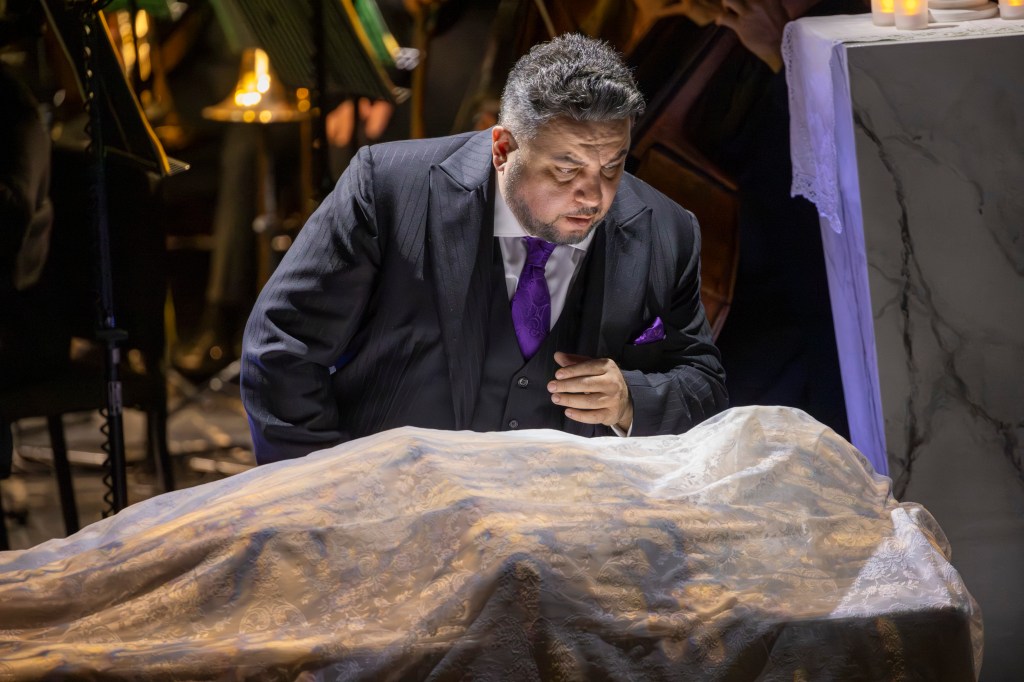
Vazgen Gazaryan as Jacopo Fiesco – later Andrea Grimaldi, mourns his daughter, Maria.
The opera itself is a mixture of personal and political relationships and, as you would expect, all are a bit far fetched, although the work is based on a play inspired by the real-life Simon Boccanegra, the first elected Doge (Duke) of Genoa. If the opera is anything to go by, the term ‘elected’ was pushing it a bit as the result was a foregone conclusion with the electorate – a chosen few – being more or less told who to vote for.
The population of Italy was split into two factions; the Plebeians (commoners) and the Patricians (aristocracy). The story begins in 1339 with the eponymous hero, a Plebeian, about to take power, but there is a slight snag in that he has had a love affair, resulting in a baby girl, with Maria, the daughter of Jacopo Fiesco, a Patrician. Maria dies and the baby disappears.
Skipping on twenty-five years and Fiesco is in hiding, having changed his name to Andrea Grimaldi, and plotting against Boccanegro. This is where the opera plot goes mad, as is the norm, and Grimaldi has somehow become guardian to a young girl named Amelia, who, would you believe it, turns out to be his missing granddaughter. I realise that the population of Europe was much smaller in the 14th Century, but, come on, what are the odds?
Any road up, Amelia, who is obviously half Plebeian and half Patrician, is in love with Gabriele Adorno, a pure Patrician, ipso facto, an enemy of Boccanegra.

Mandla Mndebele as the turncoat Paolo Albiani.
Our hero is elated when he finds out that his daughter is still alive and agrees to her marrying Gabriele as long as he switches allegiance to him. This upsets The Doge’s long-time advisor and the chap who got him elected, Paolo Albiani, who also fancies Amelia so plots to kidnap her. Rather than do it himself, he gets his fixer, Lorenzo, to organise the deed, which he does.
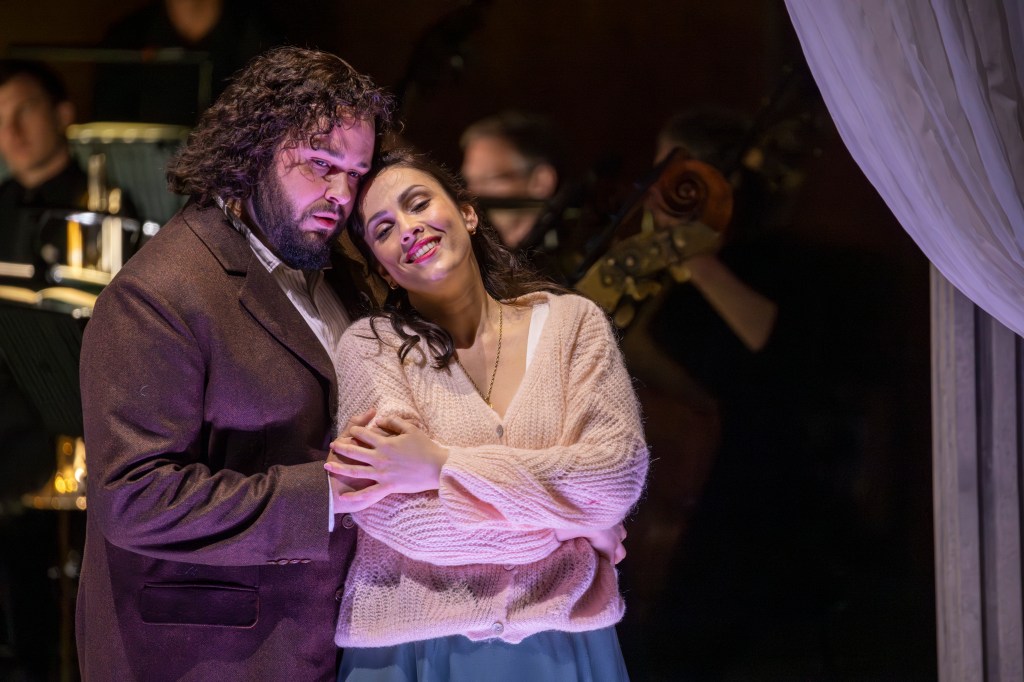
Andrés Presno as Gabriele Adorno and his love, Maria Boccanegra, later Amelia Grimaldi, sung beautifully by Sara Cortolezzis
Boccanegra’s political career is suffering as he is trying to make peace with Genoa’s long-time enemy Venice, which results in a protest by the people who demand The Doge’s death. He orders the doors to the Chamber be opened and the mob enters, along with Fiesco aka Grimaldi, and Gabriele, who admits to killing Lorenzo to free Amelia, under the orders of ‘a powerful man.’ He suspects the chap in question to be The Doge and attacks him, but the fracas is stopped by Amelia, who says that the true culprit is is present in the Chamber, which causes accusations to fly between the factions. This set-to is ended by Boccanegra, who orders Paolo to curse whomever is responsible, not realising that he is the culprit, although it seems as though he has an inkling.
After the interval, and a much needed nerve steadier, we find Fiesco and Gabriele imprisoned for their insurgency. Paolo, who is not going down alone, poisons Boccanegra’s drinking water to inflict a slow, painful death. He also tries to get Fiesco and Gabriele to assassinate him, and, after the former refuses, he stirs up the latter’s jealousy by persuading him that Amelia is The Doge’s mistress.
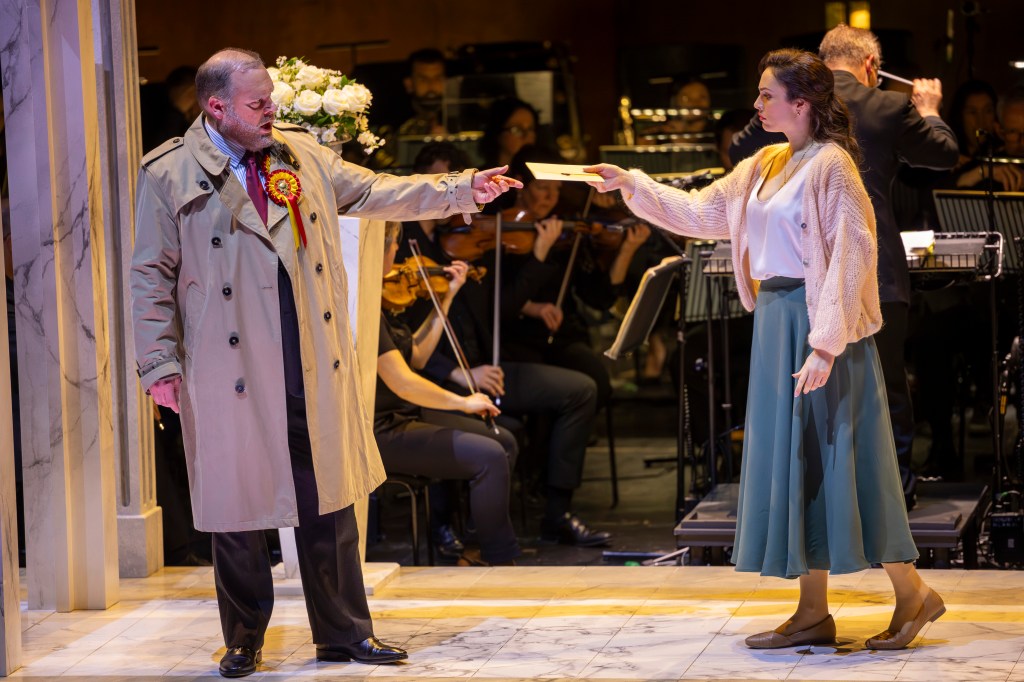
Roland Wood as Simon Boccanerga with his new-found daughter, Maria – Sara Cortolezzis
Gabriele confronts Amelia, who obviously denies the accusation made by Paolo but doesn’t reveal her true relationship with Boccanegra, and hides him as The Doge enters, holding a list of conspirators, including Gabriele. Amelia pleads for him to be pardoned and he agrees, dismisses her and sits at his desk, where he drinks the spiked water and falls asleep. Gabriele shows up to kill The Doge, but is stopped by Amelia. Boccanegra wakes and reveals his true relationship, causing Gabriele to beg for forgiveness.
A crowd gathers outside in revolt and The Doge pardons Gabriele and sends him to meet the mob with an offer of clemency, prompting him to offer to fight alongside him if it is rejected.
The revolt is defeated, Fiesco/Grimaldi granted his freedom and Paolo condemned to death, at which point he admits to arranging Amelia’s abduction and to poisoning The Doge. He is led away to his execution as Amelia and Gabriele’s wedding is taking place nearby.
The poison has taken effect and Boccanegra is able to tell Fiesco that the child he lost has been found. The two enemies are reconciled, and, with his dying breath Simon Boccanegra blesses the couple and appoints Gabriele as his successor, a move endorsed by Fiesco.

The poison takes its toll on Simon as Maria and Gabriele look on. Antony Hermus is too busy conducting the phenomenal orchestra, led by Katie Stillman, violin, to take much notice. It is great to be able to show photographs of the musicians for a change.
However implausible the plot, I thoroughly enjoyed the work, the music was superb and the interpretation, likewise. There only being eight characters, six main and two minor – in involvement rather than talent – it was easier to follow than the ones with a cast of thousands. As already stated, the staging made the experience so much more intimate than normal, and also more relaxed.
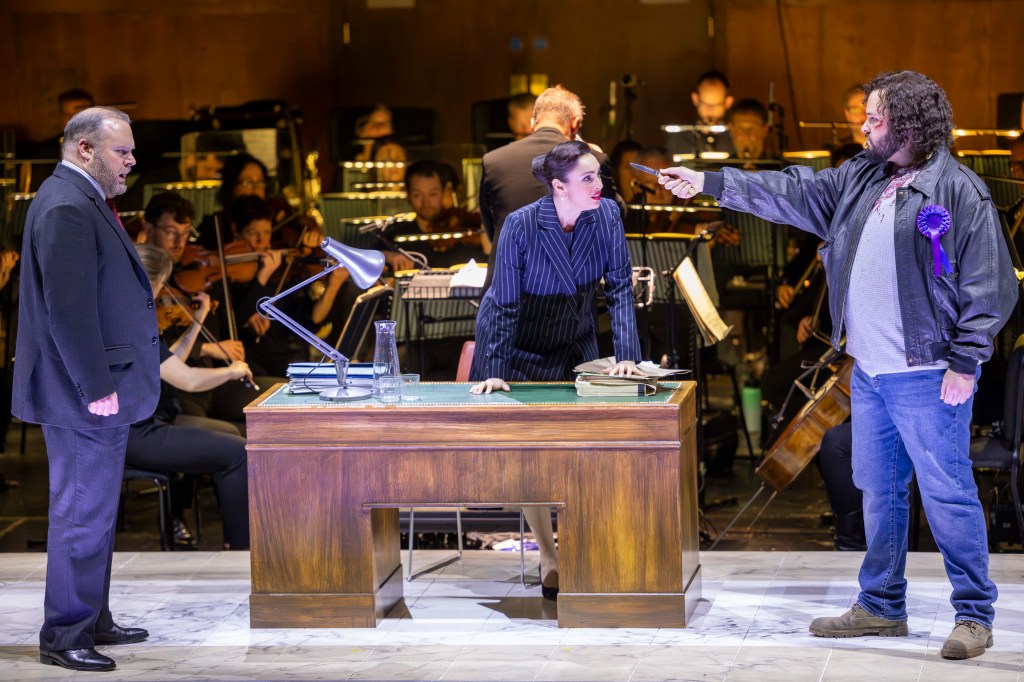
Come on boys, calm down! Maria brings an element of sense to the proceedings.
I obviously have to have one gripe, but this time it is very minor, and could be a compliment, in that the sound was a bit muted at the beginning, an element accentuated by the orchestra being louder than normal, outside its usual subterranean home. This was soon imperceptibly rectified and the balance was spot on for the rest of the night.
Having commented on singers being in the Dress Circle, it worked very well when it was the choir, but at one point Ivan Sharpe, who played a Captain, was also deployed to that spot to sing a solo, which was great except for those in the Upper Circle on his side of the auditorium, whose view of him was non-existent, him being directly below. This was only a short interlude and I suspect that it didn’t spoil things very much. The other smaller part, Amelia’s maid was sung by Laura Kelly.
The six main protagonists provided a wonderful mix of voices, Sara Cortolezzis, a genuine Italian soprano, who played Maria Boccanegra/Amelia Grimaldi, not only had a heavenly voice, but her acting was superb being very expressive whilst not overstated.
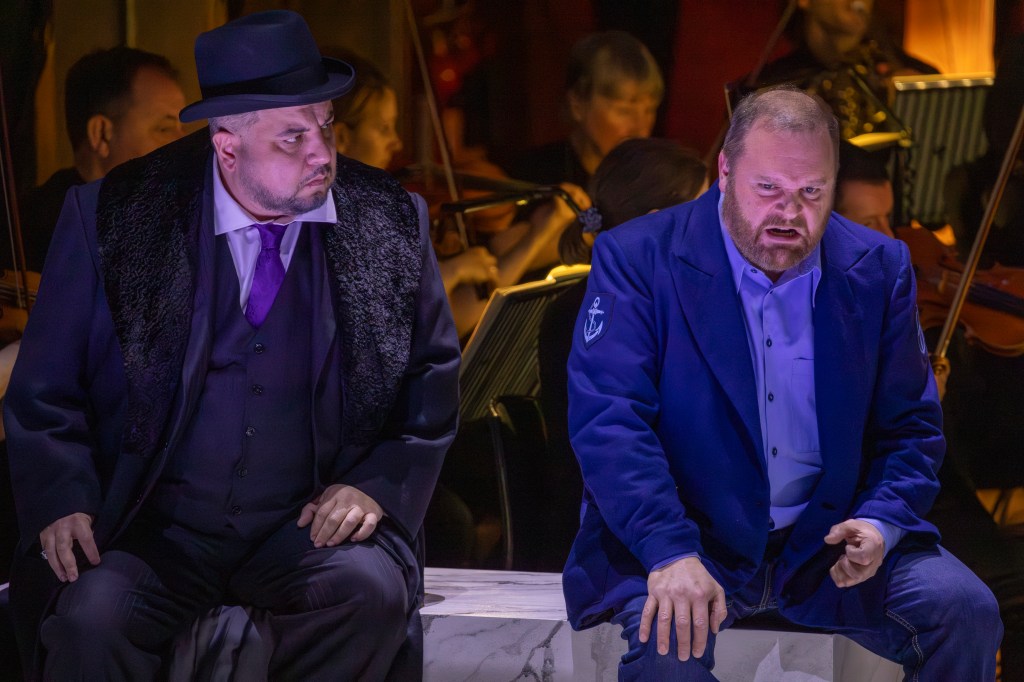
Jacopo Fiesco/Andrea Grimaldi and Simon Boccanegra in reconciliatory mood.
At the opposite end of the scale – literally, there was the rich bass of Vazgen Gazaryan, an Armenian-German, as Jacopo Fiesco; baritones; South African, Mandla Mndebele – Paolo, Welshman, Richard Mosley-Evans – Pietro and Englishman, Roland Wood as Simon Boccanegra. The only tenor in the line-up was Uruguayan, Andrés Presno, who sang Gabriele Adorno. I thought that the tenor as the love interest worked well, adding a touch of sensitivity, even though he had just murdered someone! The nature of the political in-fighting, and out-fighting for that matter, suited the singers in the lower register, although they too, needed to convey a little compassion, but only as authority figures. All were immense. Besides, I do love a good bass.
I might as well save myself some time here by copying and pasting my previous Opera North reviews – but I won’t. The Orchestra of Opera North under the baton of Antony Hermus and leader, Katie Stillman, were as impressive as ever, all the more so for being in plain sight. The Choir of Opera North – Chorus Master, Anthony Kraus – excelled, again the innovative positioning of the singers, adding an extra dimension to their superb voices. Aside from singing in the Dress Circle, they also serenaded us from a room adjoining the auditorium, the door of which had been left open, to give the impression that they were quite some distance away. That didn’t apply to me, however, as it occurred in the second half and during the interval I decided to move seats as I was flanked by two rather large chaps – I should talk – and parked myself in a row which was more or less empty. There was a reason for that – it was on a level with the open door from which the choir was giving it full bore, so I missed a few lines of singing by the main performers. It didn’t matter though as the words were on the screen. Stupid Boy!

Another look at the minimalist set, with Sara Cortolezzis and Anthony Hermus and the Orchestra of Opera North
The Director was PJ Harris, who, alongside Designer, Anna Reid, executed the piece in a format wholly suitable to the venue, the minimalism meaning that we had to exercise our imaginations rather than marvel at a mega set where everything was spelled out. Don’t get me wrong, I do love a big production, and, because of the revolts and insurrections, this could have been given the full monty, but it also lent itself to being pared back. Another nice touch was that the protagonists wore electoral rosettes to indicate whether they were Plebeians or Patricians, so you didn’t need to be told.
If you are thinking of trying opera for the first time, I strongly recommend this one. Actually I also strongly recommend it if you are a regular.
Simon Boccanegra continues on tour on 29th April at Royal Concert Hall, Nottingham, followed by The Glasshouse, Gateshead on 2nd May, Liverpool Philharmonic Hall on 11th May, Hull City Hall on 17th May and ending at Southbank Centre, London on 24th May.
Full details, teasers and booking can be found at https://www.operanorth.co.uk/whats-on/simon-boccanegra/
For all Opera North events please see https://www.operanorth.co.uk/
Photographs by James Glossop
 Tyke It To The Limit
This is a ‘do not miss’ opera, The Times gave it five stars, superb singing and production.
LikeLike