
Now here’s a novel idea. To celebrate 40 years of this iconic musical, Music Theatre International and Cameron Mackintosh Limited decided to allow amateur organisations to perform the show for the first time. Rather than just release the score, directions and other elements of the West End production to all and sundry, they chose eleven groups to interpret it in their own way, with no two being the same. They also provided assistance from those who had made the original such a success. Leeds Amateur Operatic Society was one of those selected and, being from Leeds, they decided it should be done right and threw everything at it, making the show probably one of the most expensive amateur production ever staged.
To spread the love, and the glory and workload, they approached three other local companies to ask if they would be willing to join them – silly question – so Bradford’s Buttershaw St Paul’s, Leeds Insurance Dramatic and Operatic Society and Wakefield West Riding Theatre Company became part of this historic event. The result was laid before us this evening.
I saw the touring production in December 2022 and enjoyed it a lot so had high hopes. As this version was put on by amateur organisations I was curious as to how it would come across. The answer is at the end.
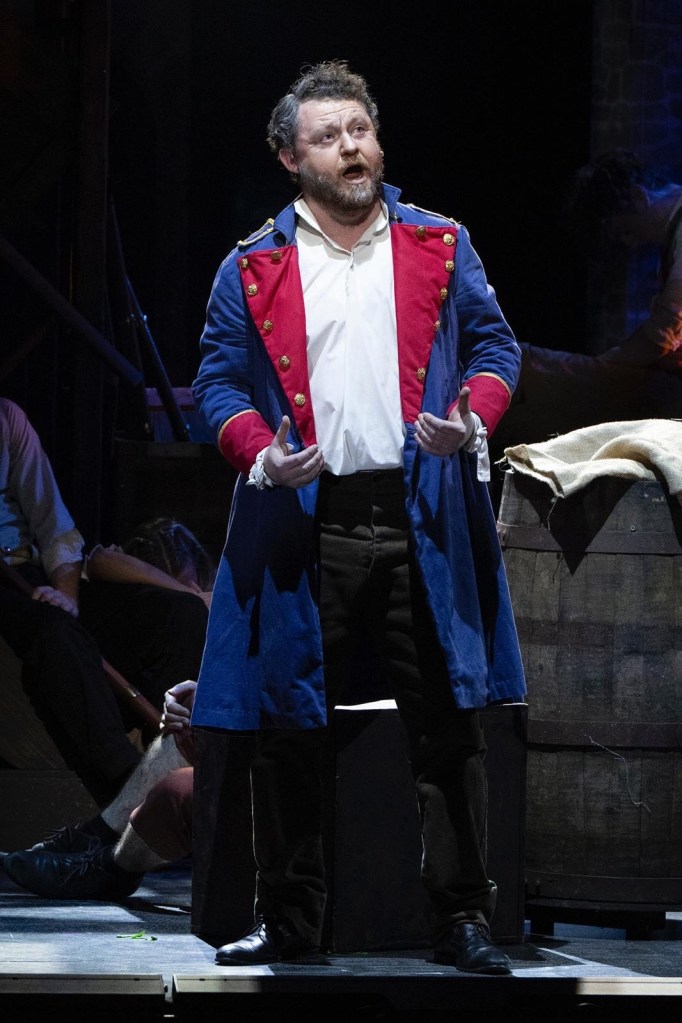
Robert Durbin as Jean Valjean
The story is about Jean Valjean, a man who has been sentenced to 19 years in prison for stealing a loaf of bread to feed his starving nephew. On his release in 1815 he is issued with a yellow parole ticket which makes it impossible for him to find work or shelter.
He is given food and a bed for the night by Bishop Myriel. During the night he steals the bishop’s silver and is caught by the police. The bishop takes pity on Valjean, and not only tells the officers that he gave the items to him as a gift, but adds a pair of candlesticks to the bundle. Jean vows to change his ways and assumes a new identity.
Now known as Monsieur Madeleine, Valjean has become a successful businessman as well as Mayor of Montreuil-sur-Mer. He is told about a young girl, Fantine, who has been unfairly sacked from one of his factories and descended into poverty with an illegitimate daughter, Cosette, to support. She has given her child to the unscrupulous M and Mme Thénardiers who own an inn, and has taken up prostitution in order to survive. She is arrested by Inspector Javert for attacking a man who harassed her. Viljean intervenes, orders her to be released and takes her to hospital.
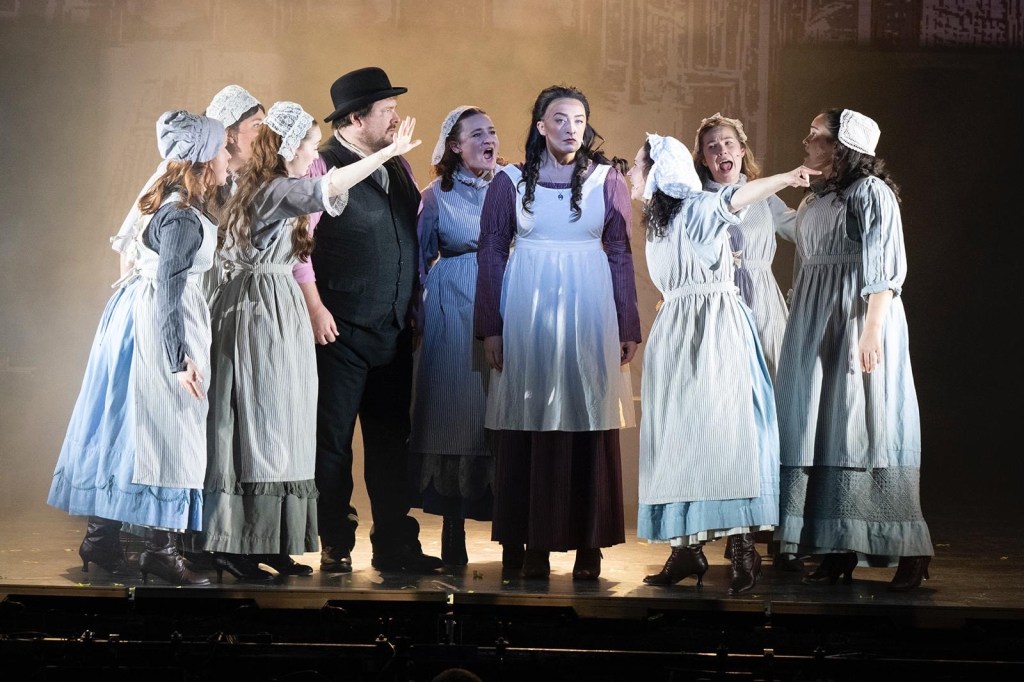
Kirsty Townend as Fantine with the cast
Valjean hears that a man has been mistakenly arrested and is due to be executed as the police believe him to be the fugitive. He is unable to allow that to happen so goes to court and admits his identity, but flees before he can be arrested. He returns to the hospital and and promises Fantine that he will care for Cosette, just before she dies. Javert arrives to arrest Valjean but, once again, he escapes. He finds Cosette at the inn of the Thénadiers, where she has been mistreated so he pays them for her release and raises her as his own daughter.
The action moves on to 1832 in Paris which is on the verge of a revolution against the oppressive monarchy. A group of students, led by Enjorlas, plan the insurrection after the only sympathetic official, General Lamarque, dies. One of the other group members, an aristocrat named Marius Pontmercy, meets Cosette and the two fall in love. This is seen by Éponine, the Thénardiers’ daughter, who, herself is madly in love with Marius although knowing that he will never feel the same.

Caitlin Magee as Éponine
Javert is still on the trail of Valjean who senses that change is coming as the students build barricades. He also realises that there is something going on between Marius and Cosette but doesn’t stand in their way. Éponine shows Valjean a letter sent to Cosette by Marius and, realising that the two are in love, he vows to protect the young man.
When the uprising begins, the students are not backed by the citizens and left to fight on their own, even though they are vastly outnumbered. Javert infiltrates the ranks in disguise but is discovered and captured, whilst Éponine returns to the fray, dressed as a boy, but is shot dead by the soldiers.
When Valjean arrives back at the barricades he is given the chance to execute Javert, but he remains true to his morals and sets him free. Once the battle is over, only Valjean and Marius, who has been severely wounded, are left alive. Valjean carries Marius through the sewers of Paris hoping to find safety, but he only encounters Javert, who, like Valjean, has seen the light of mercy and lets them pass. Traumatised by his actions, which go against his duty, Javert commits suicide by throwing himself in the Seine.
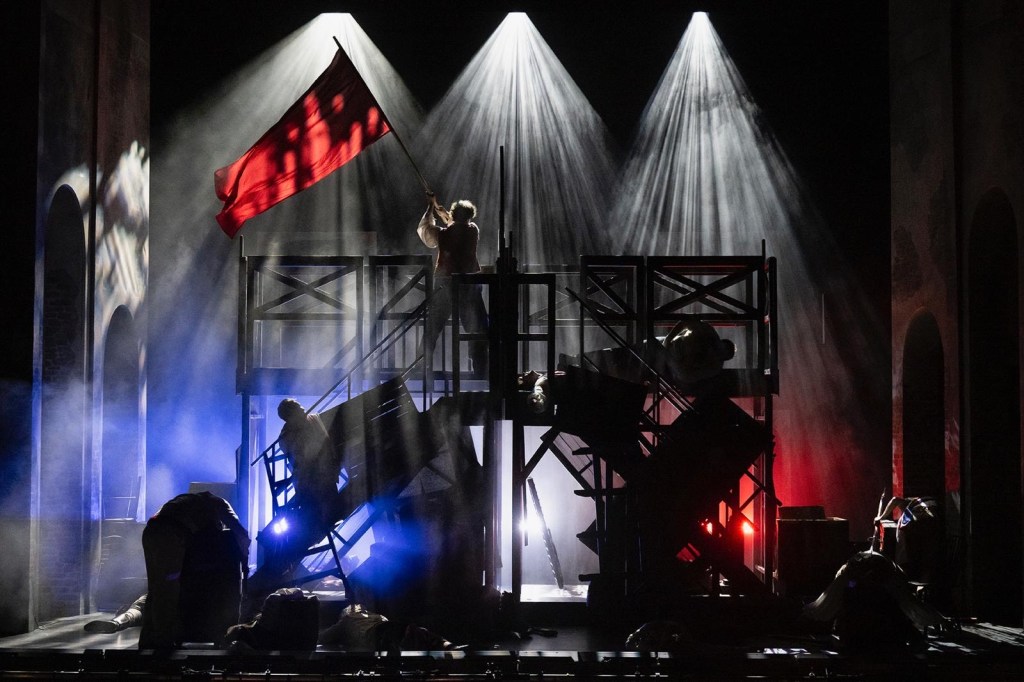
James Pegg as Enjorlas on the Barricade
Marius recovers and marries Cosette whilst Valjean prepares to fade out of her life. On his wedding day, Marius learns of Valjean’s bravery in saving him, from Thénardier, who, ever looking for the main chance, tries to blackmail Marius, who, horrified, rushes to find Valjean, but finds him weak and dying. Cosette arrives in time to to say goodbye and Valjean gives her his blessing before passing into the afterlife, guided by Fantine and the spirits of the fallen.
Not exactly a bundle of laughs but there are one or two light moments, chiefly concerning the Thénardiers, who are depicted as a couple of pantomime-type villains, despite their heinous behaviour. Their garish costumes, comic songs and eccentric dances getting the message across.

Helen Spencer as Madame Thénardier, Jason Weightman as Monsieur Thénardier and Renee Revell as Young Cosette
The way in which the production is structured makes it impossible to review without returning to see it again, as there are two totally separate casts, the Blue Team and the Red Team, so, as I saw the Red Team, I cannot pass comment on the Blues. That would be like saying what a great team Everton are after watching Liverpool play!
The structure of the musical is that it is sung, with no spoken dialogue. This made it even more difficult to review, as the actors all seemed to have great voices, but the production values were somewhat lacking in parts. The balance of the sound seemed out of kilter, even though the actors wore microphones, with the softer passages being crystal clear, whereas the big, full-throttle numbers, of which there were many, seemed to have been reined back, detracting somewhat from their clarity. I found this so strange, that I conferred with a couple of sets of paying customers who concurred with my analysis. I suppose that it could have been the other way round, with the belters being at the desired volume and the softer sections boosted, but, whatever, the effect was the same. I found the one exception, insofar as the male singers were concerned, to be Harvey Dewhurst, who played Marius, whose voice was able to transcend this effect.
There were also a few wig slips, which were easily corrected and a problem with a portico-like structure with a double gate and two lamps atop. The bulb had gone in one lamp and a gate came adrift and fell off. I also couldn’t work out why the cast spoke with broad Cockney accents, it was possibly to indicate they were an underclass but I couldn’t shake off the Oliver! comparison, especially when the young lead child actor came over all Artful Dodger. There was also a fist bump which I doubt would have been practised in 1832.
I hate to draw attention to these points – although it is my job – when the production is performed by amateurs, but I wouldn’t wish to be patronising by ignoring them. I also checked with the Grand Theatre website and the ticket prices are on a par with those charged to see the professional touring versions of forthcoming musicals. I would have really let rip had it been one of those.
Having got the cons out of the way, I will get to the pros. The 17-piece orchestra, conducted by Jim Lunt, was superb through the whole range of songs, as was the choir, some of whom performed from various parts of the auditorium at on one occasion.
Gate house aside, the set was terrific, with a digital back wall providing a range of effects. The main physical features were a stone tower to the left of the stage and a bridge which was lowered from the flies when needed. It was this which provided the ‘wow’ moment of the whole piece when Javert threw himself from it into the Seine. The effect really was insane – come on – I’m not going to miss an open goal like that!

Les Misérables is three hours of intense singing, dancing and physical exertion, so I commend the cast for their wonderful efforts, I hope that the first night glitches have been overcome and the rest of the run goes smoothly, for both the Red and Blue Teams, hang on, isn’t that Bargain Hunt?
You have until 12th March to catch this iconic show at Leeds Grand Theatre, and you should, it has great music and, insofar as the Reds are concerned, brilliant acting and singing.
To find out more and to book, please go to https://leedsheritagetheatres.com/whats-on/laos-les-miserables-2025/
To see what else is on at Leeds Heritage Theatres it is https://leedsheritagetheatres.com/whats-on/
Photographs supplied by Leeds Heritage Theatres
 Tyke It To The Limit