
Jane Eyre was not a novel on the reading list of a slum kid from East Leeds in the 1950s even though it was written by a Yorkshirewoman about an orphan girl who grew up in hardship. My first encounter with Ms Eyre was a television adaptation in 1963 on a small black and white set – that was the only kind – and was preceeded by an announcement, common in those days, telling us that, ‘The following programme is not suitable for those of a nervous disposition.’ I still remember the fire scene to this day. Obviously, because I am writing about it! As it happens the ballet, too, had its moments but the way in which they were handled, although striking, were beautifully done.
The work began with a Prologue – figures – in which a woman is running, obstructed by, possibly imaginary, male figures (D-Men). She collapses only to be found by a stranger who carries her home and, along with his sisters, aids in her recovery, whilst listening to her story.
Act One is divided into three scenes:-
- An Orphan
Jane’s parents die while she is still a child and she is raised by her Aunt, Mrs Reed, who has no love for her and neither do her own children, Eliza, Georgina and John, who bully her, until one day she retaliates and hits John. Having witnessed this, Mrs Reed arranges for her to be sent to Rev. Brocklehurst to confine her in Lowood Institution for Orphaned Girls.

Young Jane, Rachael Gillespie, surrounded by D-Men
2. Lowood Institution
Rev. Brocklehurst turns out to be a cruel headmaster but Jane befriends another girl pupil, Helen Burns, who dies of consumption causing Jane to question her own destiny.
After graduating, Jane becomes a teacher at the Institution, but she wants to spread her wings so takes a position as governess at Thornfield Hall.
3. Thornfield

Young Jane, Rachael Gillespie; Adele, Julie Nunès and Mrs Fairfax, Heather Lehan
Jane arrives at Thornfield to be met by the housekeeper, Mrs Fairfax, who introduces her to her pupil, Adele. The master of the house, Mr Rochester, is travelling abroad, but on his return he is surprised at Jane’s intellect and treats her with the kindness and respect so far denied her.
The house is holding some secrets, which Jane becomes aware of when she hears voices in the walls, and one night, she is awoken by the smell of smoke. On investigating she finds Mr Rochester’s bed and curtains ablaze. She rescues him and the pair form an intimate bond which both scares and excites Jane.
Act Two comprises five scenes.
- Jealousy
Mr Rochester is hosting a party which makes Jane feel overwhelmed by being in such grand company, including the wealthy and beautiful Blanche Ingram. Although wishing to leave, Jane is persuaded by Mr Rochester to stay.
Grace Poole, a servant, enters in a distressed state, having been injured. The party is disbanded and Jane takes care of Grace, while Mr Rochester leaves to attend to the matter.

Jane, Dominique Larose and Mr Rochester, Joseph Taylor, enjoying the party. Photograph by Emily Nuttall
2 A Proposal
On returning to the ballroom, Mr Rochester finds Jane alone and tries to restore the feelings they had after the fire, but Jane rebuffs him, convinced that he is engaged to Blanche Ingram, with whom he appeared to have been close at the party. He gently mocks her and bids her unleash her jealousy and passion. He then stuns Jane by asking her to marry him. All of this is witnessed by a mysterious woman in the shadows.
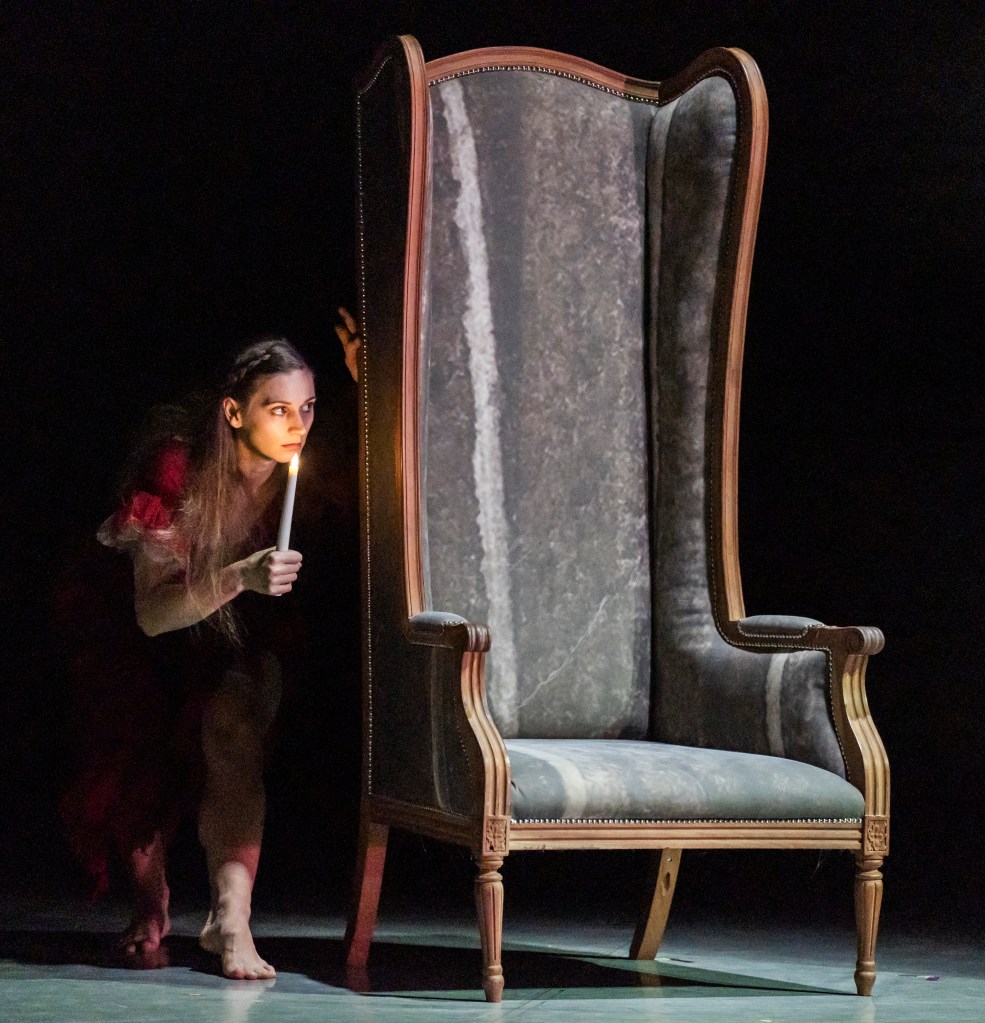
Amber Lewis as Bertha eavesdropping on Jane and Mr Rochester.
3 A Wedding
The household prepares for the ceremony, which is interrupted by a raging woman bursting into the room. She is Bertha Mason, who claims to be the wife of Mr Rochester! He admits this and says that he cannot legally marry Jane.
Jane is distraught and flees onto the moors where she collapses.
4. Taken In
Jane is discovered in the snow by St. John Rivers, who takes her to his home which he shares with his sisters. She is ill and hallucinating about her past. Eventually the women nurse her back to full health.
Rivers is set on becoming a missionary and proposes to Jane, asking her to accompany him on his travels. Jane realises that there is no love between them so refuses, craving the passion she found with Mr Rochester.

Amber Lewis as Bertha, with Joseph Taylor rescuing her from the fire.
5. Burnt
Jane returns to Thornfield to discover that Bertha has set fire to the house again, but this time has reduced it to a pile of ashes. Although he has reason to see her dead, Rochester fights through the flames and rescues her, but she dies and he is left blind from injuries sustained.
Jane finds him broken, but, as he recognises her presence, they fall into each other’s arms, vowing never to part again.
That is obviously the basis for the ballet, the novel is far more involved and intricate, being one of the first to feature an independent woman, it was even written under a pen name of Currer Bell, to hide the gender of the author – not being thought appropriate for ladies to be writers. It does, however, seem made for the genre, having various spectacular elements along with intimate ones to provide a wide spectrum of emotions. I also appreciate that Northern Ballet has shown respect to Charlotte Brontë by saying that it is based on her novel, rather than being written by her, she wasn’t that versatile.
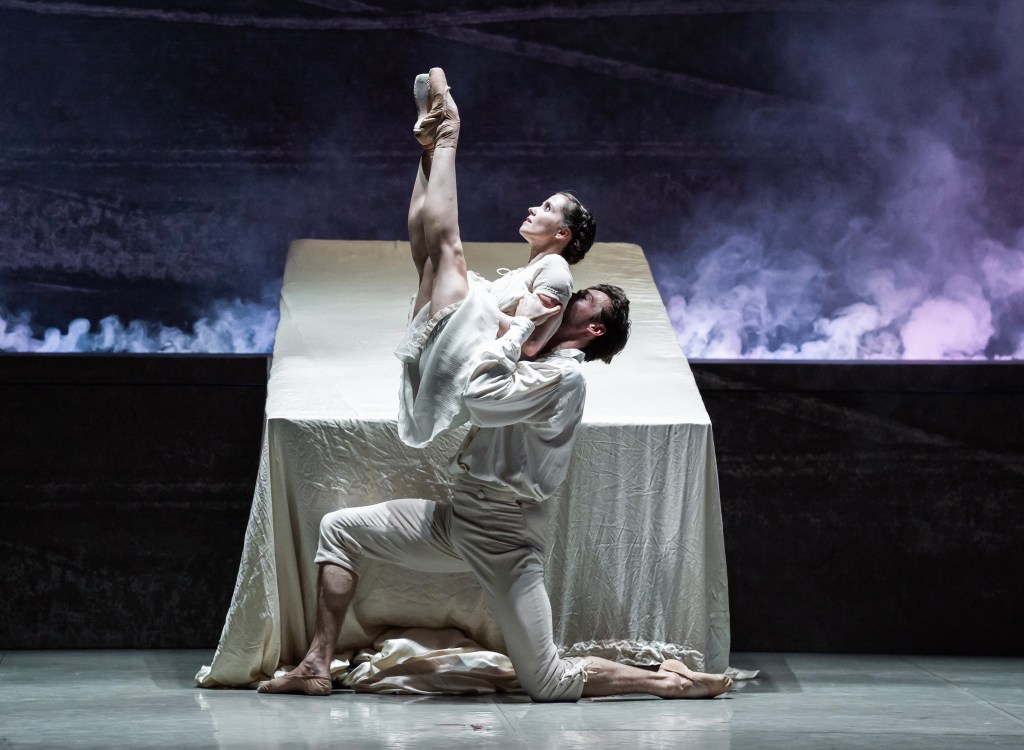
Jane, Dominique Larose and Mr Rochester, Joseph Taylor.
The three featured dancers, Dominique Larose as Jane, Rachael Gillespie as Young Jane and Joseph Taylor, Mr Rochester, were superb, as was the rest of the company. I didn’t read the programme notes, as precised above, until after the event, but I was surprised as to how easy it was to follow the story. The symbolic figures of a group of men dressed in white, introduced to us in the Prelude, were obviously the men in Jane’s life who were to place obstacles in her way with the man who picked her up, St John Rivers, the conduit for the story. The Choreographer, Director and Scenario, Cathy Marston, names the gang, the D-Men, and they reappear at various points throughout the piece. She doesn’t, however, explain what the D-Men stands for, could it be a homophone of demon? Answers on a postcard.
Although quite a sombre tale – well, it was written on top of the Yorkshire Moors – there is a bit of light relief provided by the housekeeper at Thornfield, Mrs Fairfax, whose dancing was eccentric, to say the least. She seemed to be making errors and tottering but it was obvious that it was very well rehearsed. She even did a kind of sideways Moonwalk.
Speaking of ballet moves that I have never seen before – although, being a comparative newbie, there must be thousands of those – there was a lot of sliding going on. Some were freestyle after a run up and in others, the dancers, usually female, were gracefully pulled along by their partners. Very effective and more than a little cool.
The manic portrayal of Bertha, by Amber Lewis clad in red for danger, was more than a little scary, inspiring the foreboding of some dastardly act.
It goes without saying that the dancing was the main element, but the creatives turned it into something really outstanding.
The music, Compiled and Composed by Philip Feeney, was obviously the foundation on which the ballet was built, allowing the choreographer to interpret the novel. I found it to be a wonderful collection of melodies and effects in its own right, the contrasting moods providing plenty of scope for variations in tempo and volume. We also had the pleasure, sadly one becoming more infrequent due to cuts, of a wonderful live orchestra, conducted by Daniel Parkinson.
Finally we have the Set and Costumes, which were the work of Patrick Kinmonth. I do love a display of fine men’s tailoring, and here we had a cracker. The period must have been the most elegant, with frock coats and quite narrow trousers. To create something this good looking while still being practical enough to dance in, must have been a real challenge, but he was well up to it. The women’s attire, likewise. From austere school uniforms to ball gowns and the aforementioned red Bertha, he had them all nailed.
The Lighting Design, from Alastair West, also needed to be special, and so it was. The confines of the Institution being subtly lit, whilst the grandeur of the ballroom where the party was held, more brilliantly so. The fire scenes were spectacular and worked a treat with the backcloth, see below.

Amber Lewis as Bertha in the fire. Photograph by Emily Nuttall
It was the Set Design which had me impressed, though with the majority of it comprising huge curtains as a backdrop, with others closing in front of them when the action moved somewhere a little more intimate. There was one instance, when Jane and Mr Rochester were planning their wedding, when Bertha crouched behind a chair to eavesdrop, moving to a spot behind a white translucent section, where a back light had her dancing in silhouette. On a couple of occasions, I was amazed when a character disappeared by opening a door in one of the curtains and walking through. Drapes with doors? Please! The main backcloth had random horizontal grey wavy lines which seemed to suggest the undulating dry stone walls of the moors around Haworth.
As my ballet experience widens, I am beginning to appreciate the range of stories covered and the way in which they are executed. I am also surprised as to how much I am enjoying the genre and would urge anyone who has not thought of going to the ballet to give it a try. This is the perfect starting point, a good story, familiar to many, danced to live music by one of the foremost companies in the country.
Jane Eyre is at Leeds Grand Theatre until 22nd March, after which it is on tour at Nottingham Theatre Royal from 8th – 12th April; Sheffield Lyceum Theatre, 22nd – 26th April; London Sadler’s Wells 13th – 17th May and ending at Norwich Theatre Royal from 20th – 24th May.
Feature image from Northern Ballet. Unless otherwise stated, photographs by Tristram Kenton
 Tyke It To The Limit