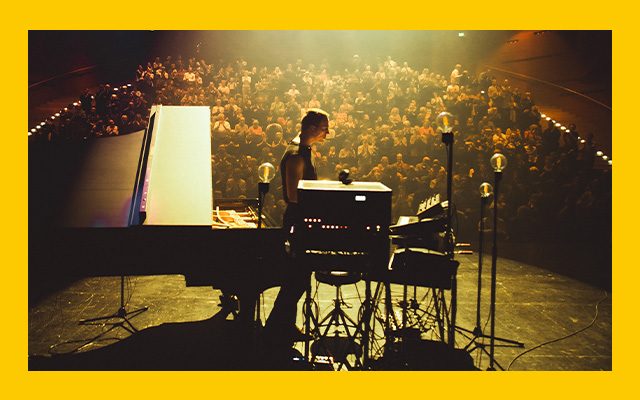
Somebody, somewhere, must be taking notice of the stuff I write because, after complaining about the inability to catch the names of a lot of the pieces played in concerts due to their being in a foreign language or the lack of a programme/set list – neither being the fault of Howard Assembly Room – along comes Herr Kohlstedt and presents an evening of improvised tunes none of which has a name at all!
I am sure that some of you, as did I, will regard the phrase ‘improvised tunes’ as being an oxymoron. Improvisation, whether in classical, jazz, electronica or any other genre, normally comprises a series of seemingly random notes or bars, almost undecipherable to the untrained ear. Tonight’s performance, however, put paid to that notion by being a wonderful evening of piano-based melodies enhanced by synthesisers. It wasn’t so much of the ‘look how clever I am’ school, but more a journey, taken by both the musician and audience with the artist being our guide. Not an easy job as he didn’t know where we were going either.

Martin Kohlstedt is a brilliant pianist, a charming person and a total enigma. Seeing him surrounded by an array of electronic gizmos, you would have thought his roots would have been a million miles away from where they actually were. Rather than being a city boy at the heart of cutting edge technology, he was born and raised in Breitenworbis, smack in the centre of Germany – and the middle of nowhere – where his father was a forester. His home, an old-fashioned building deep in the woods, had walls festooned with hunting trophies. He told us that he learned to play the piano when he was twelve, and quickly set out on the path of improvisation when one day, at home on his own, he heard the loud ticking of the old clock in the room and began to weave notes around the sound. He said he continued this for hours and would carry on experimenting each night after school.
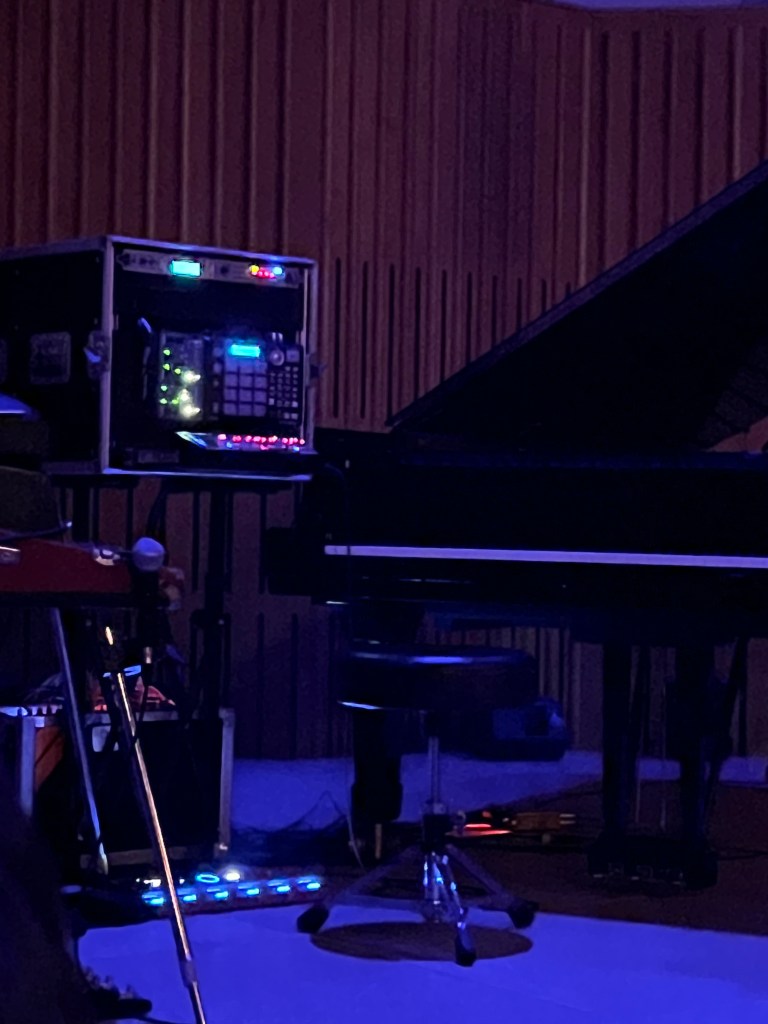
The flight deck
Tonight’s show was the second on the UK leg of his extensive European Tour, and his first ever in Leeds. It began with him taking to the piano and playing a melody, which he enhanced with the use of synthesisers, operated by his foot. The sound gradually built up, the atmosphere being reminiscent of a nightclub, with the room in almost total darkness, except for one spotlight casting a conical ray from above, while the smoke machine began to do its thing. The crescendo peaked, subsided and the tempo slowed down to a stop, at which time the spotlight was cut and the only source of illumination was from the computer control panel.
I would have loved to have taken photographs but, in concert settings, I restrict myself to shots before and after the show, so as not to be too much of a distraction to my fellow audience members. As the evening progressed I was even more sorry that I couldn’t provide pictorial evidence as there was a lighting rig which shone rays of various shapes into the audience. Sometimes they were just larger than pinholes and rotated creating amazing effects when hitting the smoke, on other occasions, tall, narrow beams, which, when vertical, gave the effect of being smoky walls tapering off creating the illusion that I was in a passage, especially when they stopped for a couple of minutes with one either side of me.
The music varied, from classical through jazz and sometimes into rock, as did the method of presentation. There were those, like the first piece, which began with a piano part and then introduced pre-programmed sounds, and others, where the artist set up the sounds to provide the accompaniment before retiring to play the main instrument. Not only was a range of electronic effects utilised, but he added some human elements as well: one was created by grunting into the microphone, which caused a great deal of amusement, and another by slamming his hand down onto a metal sheet, taking us rather by surprise.
It is difficult describing music at the best of times, but, when it is as personalised as this, it is nigh on impossible. The best I can do is to say that it was very accessible, with melodies and chords mainly in harmony rather than jarring. It put me in mind of Tubular Bells by Mike Oldfield, when each of the instruments was introduced to the basic riff to create the masterpiece which it turned out to be. Mr Oldfield had obviously meticulously planned his magnum opus, having to play the traditional instruments himself and layer them, whereas Martin Kohlstedt was making it up as he went along. The one exception was his final offering which he introduced as a ‘concert piece’. This was a little more restrained, but still mesmerising.

I very much enjoyed the evenings performance, both the music element and the narrative in-between. The anecdotes, stories and feelings were related in a gentle way using his best shot at English, which was excellent, with only the odd slip up. He has not forgotten his origins, as in 2019 he bought 1.2 hectares of land in the Thuringian Forest with the view to reforesting it. Over a hundred volunteers help him do this and the plan is that the first phase will see 10,000 trees planted, all paid for from the sale of his concert tickets. The aim is to integrate actions on climate change into the music industry. Definitely walking the walk!
For more details about Martin Kohlstedt and to see details of his tour, please go to https://martinkohlstedt.com/ I am sure that he won’t be offended if you decide to make a contribution to his conservation scheme either.
To see the man in action, go to https://www.youtube.com/watch?v=lq2uP7D6S58
For details of future events at Howard Assembly Room it is https://www.operanorth.co.uk/event-tag/har/
Feature image from Opera North. Photographs by Stan Graham
 Tyke It To The Limit