
I was a bit confused by the title of this play as I have always associated the term Shellshock or Shell shock, with the First World War, and the setting here is the period following the second global conflict. I thought it could have been because my grandfather and men of his age who had fought in the trenches of France from 1914-1918, were the only ones I had come across who were affected by it. For once in my life I was correct, it is a term which was banned from medical use in 1917 as being inaccurate because it also affected those traumatised by other elements of warfare in addition to shelling. In the Second World War it was renamed Combat Stress Reaction (CSR) and is now commonly known as PTSD, Post Traumatic Stress Disorder, and applies to psychological conditions brought on by any number of causes rather than solely military ones. I have been studying the word in case I could find a double-meaning relating to the content of the drama, but, if there is one, it has passed me by.
The play, written and directed by Philip Stokes, is a two-hander concerning a professional artist, Mr Lupine, who is in need of an assistant to help him create his magnum opus, and the newly demobbed Wesley, who has attended his studio for an interview regarding the position.
The following hour and ten minutes consists of verbal sparring between the two, with Lupine determined to rile Wesley in order to test his breaking point. As the interview progresses it becomes apparent that the artist knows much more about his assistant and his family, than he first lets on. He also seems more interested in finding Wesley’s capacity for cognac and pornographic photographs.
Lupine did not serve in the war due to having polio, thus spending the time making chairs in his father’s workshop, now the studio. Wesley returned a hero, so we had the element of jealousy added to the tension, which was ramped up further by the elder of the two insisting that the younger call him Sir or Mr Lupine, changing his preference for no apparent reason.
It transpired that the artwork to be created was to take the genre of action art to its extreme, rather than just paint a picture. Contrary to the impression conveyed by the feature image, the canvass remained blank throughout the whole time.
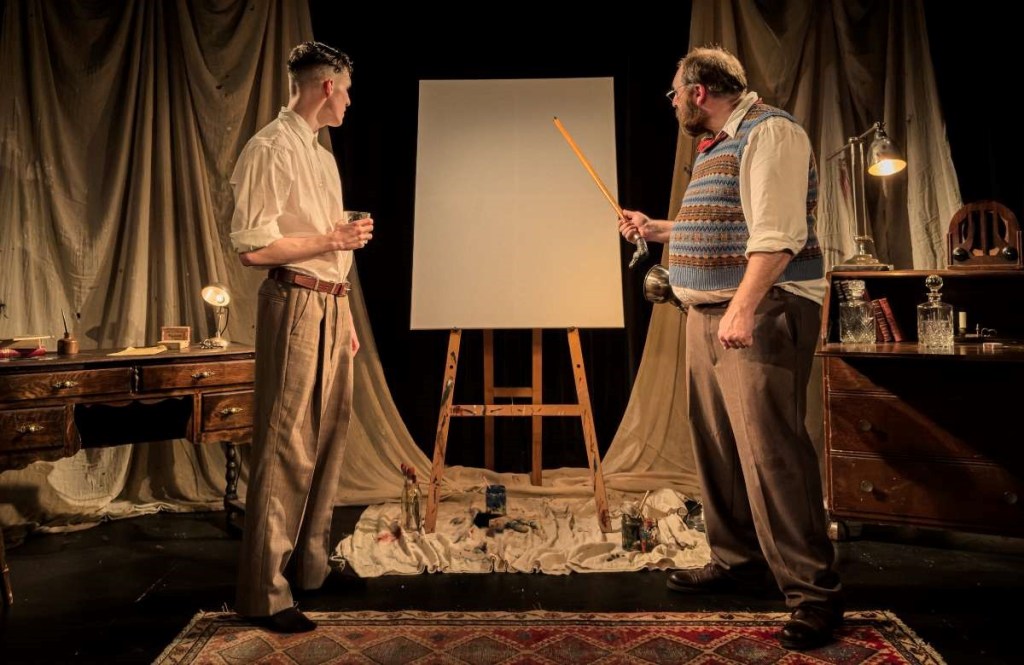
Jack Stokes as Wesley and Lee Bainbridge, Mr Lupine
There were several twists and turns regarding the behaviour of each man towards the other, which became more extreme with the consumption of alcohol and the goading by Lupine, gradually met in kind by Wesley, as he dropped the air of someone trying to make a good impression to get a job and stood his corner. The denouement was somewhat unexpected with the two possible scenarios which had been set up, being topped by a third, which hadn’t occurred to me.
Whilst the situation and its development was absorbing I felt that it was trying to be too intellectual for its own good. Every line aimed at being as deeply significant as possible. This led to the character of Lupine being pretty much unbelievable. His insistence on total accuracy in Wesley’s speech being in contrast to the temperament of any artist with whom I have ever come into contact, or seen being interviewed. Lee Bainbridge’s stilted, slightly wooden performance of him made me unsure as to whether this was to indicate that he was more suited to the ‘sturdy’ furniture-making than painting. The name, Lupine, meaning wolf-like, was evident in his predatory manner, but, having a post-polio limp he lacked that animal’s fluidity of movement. Wolves also hunt in packs so the they can tackle large animals, Lupine was a loner and his prey slender, a look exaggerated by his wearing his late father’s suit which was much too large for him. Jack Stokes was more convincing as the callow young man, whose adolescence had been stolen from him by the horrors he had witnessed.
I thought that there was also too much acting to the audience rather than each other, if you are going to ramp up interpersonal conflict, at least do it face to face. It was a shame really, as I thought that the premise was a good one, but the execution let it down. Returning to the title of the play, another jarring moment came when Lupine referred to something as ‘not fit for purpose’, a term which leapt out at me as being from another time. On checking with the BBC English website, it was a phrase not popularised until the beginning of the 21st century, rather than one which would have been used half way through the 20th.
Shellshocked is at Leeds Playhouse until Saturday, 8th February, with matinees on Thursday and Saturday. For more details and booking please go to https://www.leedsplayhouse.org.uk/event/shellshocked/ after which it transfers to Lawrence Batley Theatre, Huddersfield on 11th and 12th February. https://www.thelbt.org/what-s-on/drama/shellshocked/
To see what else is on at Leeds Playhouse, please go to https://www.leedsplayhouse.org.uk/whats-on/
Images supplied by Leeds Playhouse
 Tyke It To The Limit