
After an extremely quiet January, the new month has started with an absolute treat. Three hours of Wagner, sung in German with English translation on display screens, might not sound like a way to tempt you away from your fireside on a cold Saturday evening, but, believe me, it was worth it. The evening began with a bad news/good news announcement when we were informed that, because of an illness suffered by Layla Claire, she would be unable to sing the lead female role of Senta. The ailment did not preclude her from acting, which she did, whilst miming the part, sung by Mari Wyn Evans, from the side of the stage. It seemed a bit odd at first, but the action, lighting and skill of both performers, was such that it seemed unnoticeable after a while.
The legend of the Flying Dutchman is pretty straightforward. The eponymous sailor has been cursed to sail the seas forever on a ghost ship, only being allowed to make landfall once every seven years at which time he must find a woman who will be faithful to him in order to break the spell and save his soul. When he meets the powerful, Daland, on his seven year cycle, he offers him money to marry his daughter, Senta, who knows about the legend and is intrigued by its subject so she agrees to the plan, much to the chagrin of Erik, who thinks she is in love with him. When the Dutchman and Senta meet, she falls in love with him and the bond is formed.
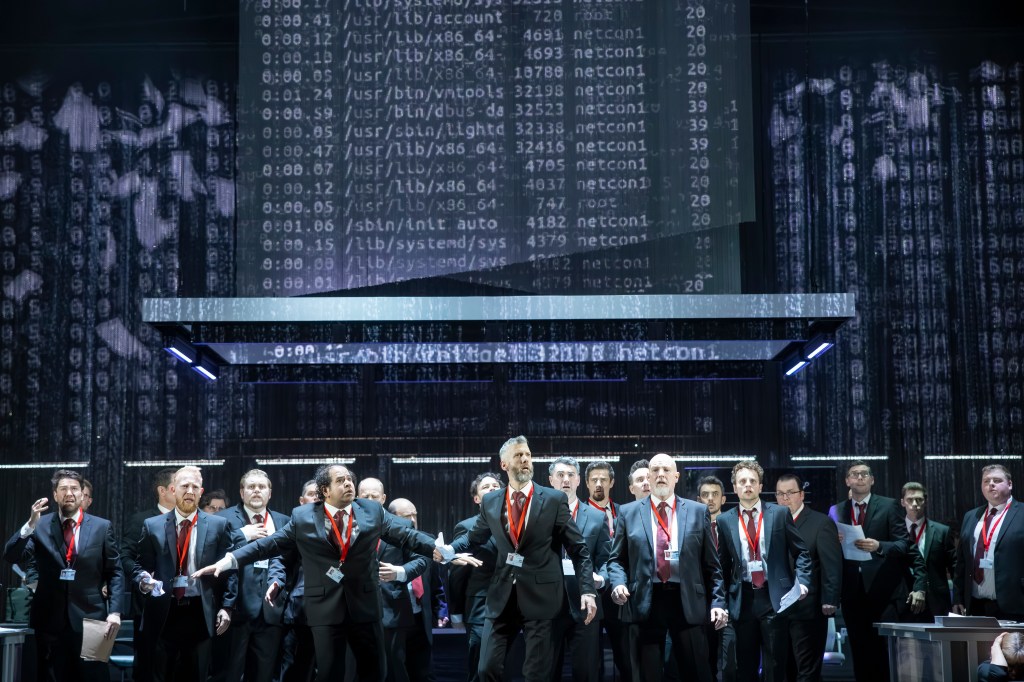
The men of the Chorus of Opera North hard at work at the Home Office. Not a cup of tea in sight.
The story is handled in a symbolic manner, rather than being a straightforward story of a sailing ship and, as well as being informed of the situation regarding the leading lady, we were reminded that Opera North is the only opera company of sanctuary, which means that it gives opportunities for those seeking refuge as well as providing them with a safe space. Before each act a female figure walked in front of a screen displaying a shifting seascape with voices eerily telling the story of their journey from their homeland to Leeds. This was not as gratuitous as it sounds, I was brought up to do what I could for people, because it needed doing rather than for the bragging rights, but Richard Wagner, the composer, was himself an asylum seeker fleeing from Riga in Latvia, to London illegally in 1839 to avoid his creditors. The literal translation of the title of the work is more like The Fleeing Dutchman than The Flying Dutchman. It was not until I read the programme that I realised that the title referred to a man rather than being the name of the ship. I have always viewed it in the same way as I do The Flying Scotsman railway engine! You’re never too old to learn.
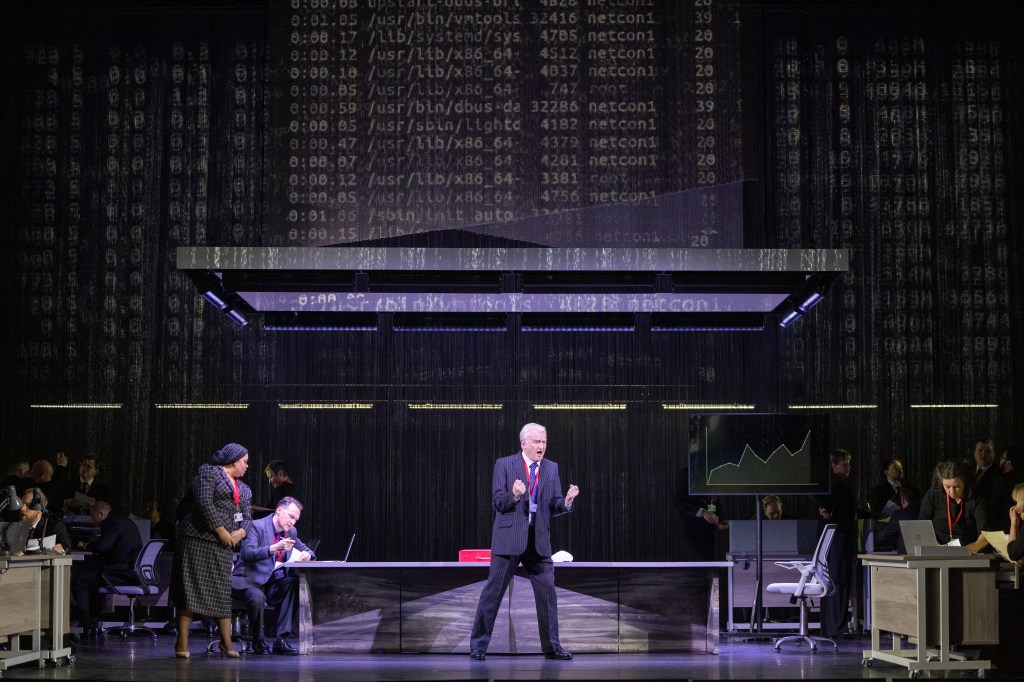
Molly Barker as Mary, Edgaras Montvidas as Erik/Steersman and Clive Bayley as Daland trying to steady their ship.
The symbolism continued with the setting of the action in the Home Office, a ship of state, where Daland is in charge although things are not going well. There are chainmail strips suspended above the stage, which act as screens onto which are projected computer code and, as, they were lowered, gave me the impression that the data was being shredded. When Daland has pacified the staff (crew) he orders them to go and get some rest, leaving his deputy, Erik/The Steersman, in charge. Erik promptly falls asleep himself and the ship of The Flying Dutchman appears with him reflecting on his lot to sail until Judgement Day with only one stop every seven years. When his boss reappears he finds Erik still napping and the mysterious figure occupying the premises. They talk and the Flying Dutchman, for that is who the figure is, asks him if he has a daughter. When he replies in the affirmative the Dutchman asks him if he can have her hand in marriage, in exchange for his valuable cargo, which has been deposited in the office, again by use of the chainmail strips. The two men disappear to Daland’s home to work out the details.

Robert Hayward as The Dutchman and Clive Bayley as Daland with the ship’s treasure as payment for his daughter’s hand.
In the second act, the stage is occupied by women workers, one of whom is Senta, who becomes the butt of their teasing over her relationship with Erik. She, however, is more interested in the picture of a pale stranger, which she has discovered and who, obviously, is the Dutchman. She becomes obsessed by the legend and decides to transfer her affections away from Erik to him. When Daland arrives at the workshop with the Dutchman in person, Senta gives Erik the elbow and commits to her new found object of desire. Daland decides to throw a party to celebrate.
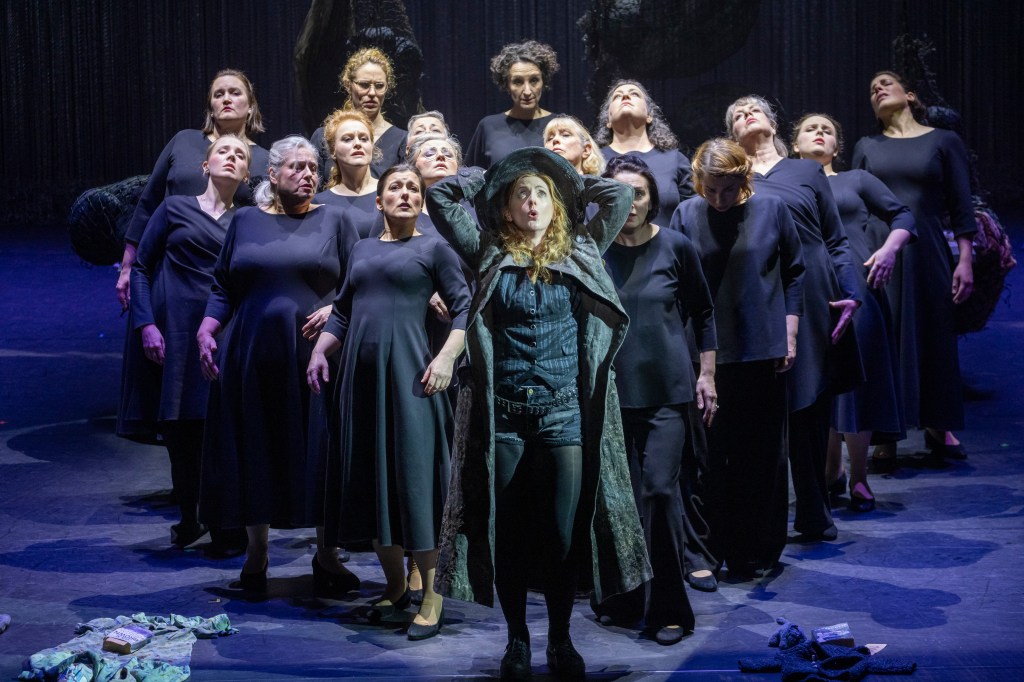
Layla Claire as Senta with the ladies of the Chorus of Opera North
Act Three opens with the wedding bash, complete with dad dancing – and mum dancing as well – being something between the twist and robotics. Erik does what spurned lovers do and berates Senta for leading him to believe she loved him and reminds her of the good times they had together. The Dutchman overhears this and concludes that Senta can’t be fully committed to him and orders his crew to prepare to set sail. He explains to Senta the fate of eternal damnation that awaits her should she not be able to be totally faithful to him. After getting the message home to Erik once and for all, she runs off with the Dutchman, setting them both free.

Edgaras Montvidas as Erik trying to appeal to Senta, Layla Claire, to give it one more try, with Robert Hayward as The Dutchman listening in.
I must say that I was utterly enthralled by the whole opera and the hour and fifty minutes until the first break seemed to fly by – pardon the pun. Fortunately I had restrained myself regarding pre-show drinks for fear of placing too much strain on the bladder, a strategy which worked a treat.
For such a grand production, the cast list was surprisingly small with Daland sung by Clive Bayley, Erik/Steersman by Edgaras Montvidas, The Dutchman Robert Hayward, Mary – Daland’s Secretary – Molly Barker, and the aforementioned Layla Claire acting Senta with Mari Wyn Williams providing the singing voice, and what a voice it was!
Daland’s staff, women workers and the dispossessed were the members of the Chorus of Opera North, Chorus Master Anthony Kraus, who were as amazing as ever, as was the Orchestra under the baton of Opera North’s Music Director, Garry Walker.
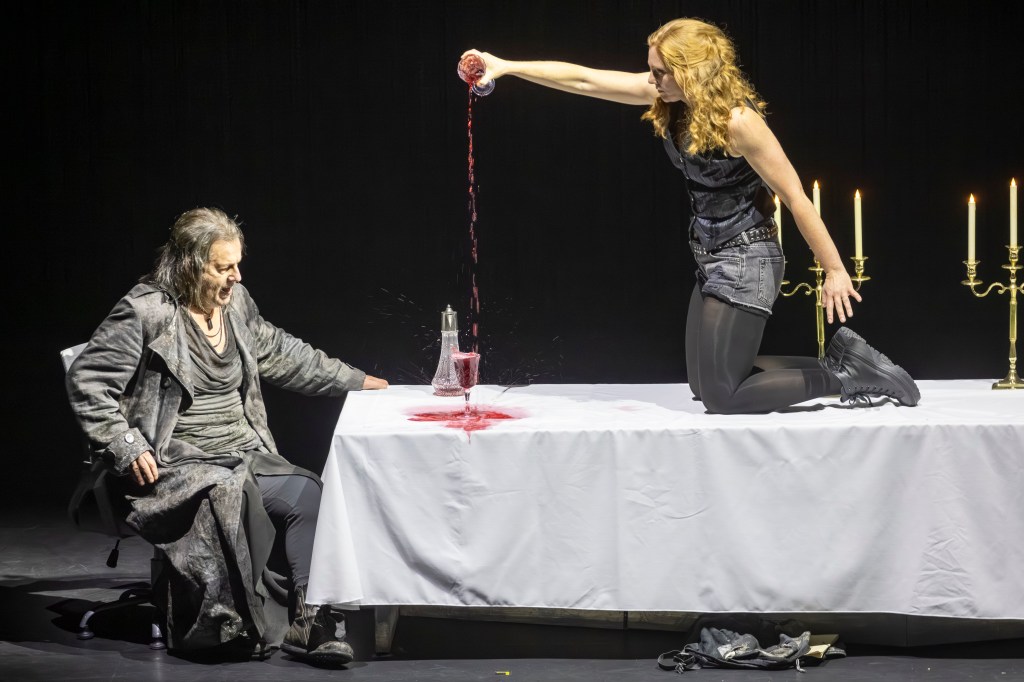
Say when! Robert Hayward as The Dutchman being given a small libation by Layla Claire as Senta
The set and costumes, designed by Joanna Parker, were dark and doom laden, with the video, which she also designed, giving a further dangerous, sombre tone.The Lighting Designer was Kevin Treacy, The Movement Director, Angelo Smimmo, Artistic Designer, Christine Jane Chibnall and the whole thing Directed by Anabel Arden.
Being a relative newcomer to opera, I sometimes wish that I had been able to see the original versions of the works, rather than modern interpretations, but, in this case, I thought that the piece worked well as it was and, taken at face value, proved to be a great night out. The 1843 version would also probably not have seen the leading soprano sport a pair of Daisy Dukes throughout the work.
Although the word ‘diva’ has come to signify a petulant or over-demanding female singer or actress, its original meaning was simply female opera singer. Nothing illustrated this as well as the curtain call at the end of the performance, when Layla Claire, who had brilliantly portrayed Senta, showed just how generous a performer can be by remaining with the other cast members to let Mari Wyn Williams step forward to accept the plaudits for the singing. She was rightly given a magnificent ovation.
This is where I normally mention the scheme for first-time opera-goers, Try It ON, whereby you can get two great seats for £20 each as well as other benefits to help you enjoy the visit to its full extent. Although I enjoyed this experience very much, and the performances were superb, the length of the first act might be a bit of an ordeal. Should you be open for the challenge of just short of two hours for the first act, then go for it, otherwise hang fire for the next production, which is The Magic Flute. It is much more accessible and sung in English, although still with titles to make it easier to follow.
For details of the Try It ON scheme please go to https://www.operanorth.co.uk/your-visit/new-to-opera/tryiton/
For more about The Flying Dutchman and to book, it is https://www.operanorth.co.uk/whats-on/the-flying-dutchman/ where you will also find cast details and snippets of the music. The next performances at Leeds Grand Theatre are Saturday 8th February at 2.30pm, by which time I hope that Layla Claire will have made a full recovery, Tuesday 11th February at 6.00pm, Friday 14th February at 7.00pm and Friday 21st February at the same time. It then moves on to Newcastle, Theatre Royal on Saturday 8th March, Lowry, Salford Quays on Saturday 15th March, Theatre Royal, Nottingham Saturday 22nd March and Hull New Theatre on Friday 28th March. All begin at 7.00pm.
Feature Image from Opera North. Photographs by James Glossop.
 Tyke It To The Limit