
What a way to return from a lengthy break. After the dearth of new shows since Christmas I was looking forward to getting back in the saddle and this production, which appeared to be more like a musical than a full-blown opera, seemed just the thing. It was written in 1948 by Kurt Weill and Alan Jay Lerner, so that confirmed my opinion. The thing I hadn’t banked on was that it would be full of references to other musicals – years before they were written!
I would normally begin with a synopsis of the story, but in this case there wasn’t one, the construction being done in the style of a vaudeville show with episodes depicting various stages in the history of the USA. It features a time-defying couple, Sam and Susan Cooper, played by Quirijn de Lang and Stephanie Corley, whose lives, along with their two children Johnny and Elizabeth – Louie Stow and Tilly Baker – are picked up in the years 1791, 1821, 1857, 1894, the 1920s and 1948, never having aged a day. Unsurprisingly during 157 years of marriage, they have their ups and downs!
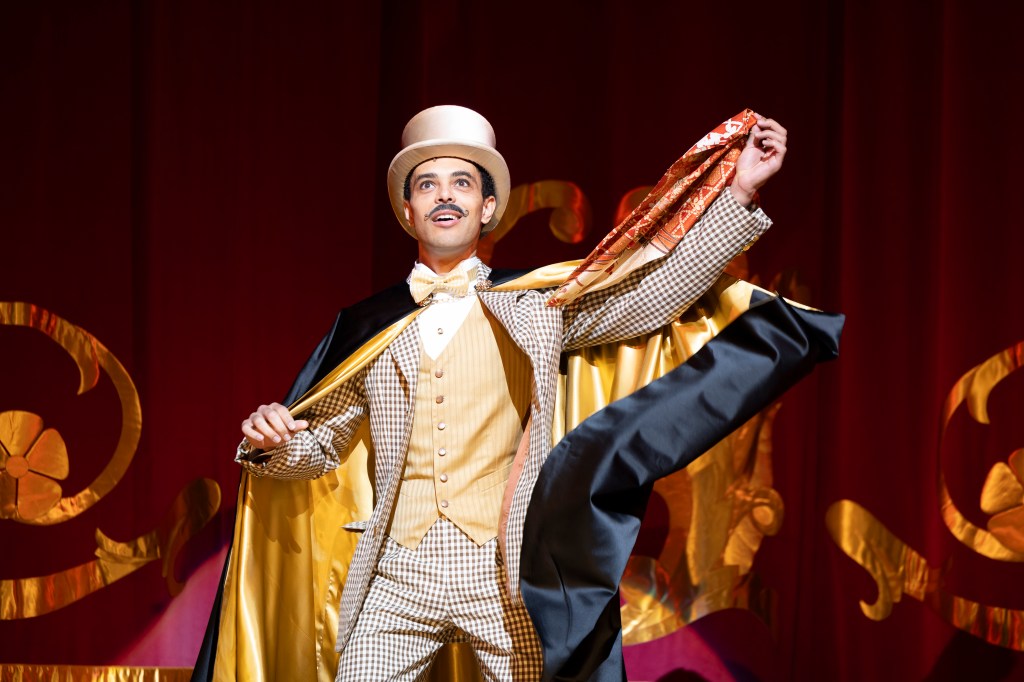
Magician, Themba Mvula
The show opens in the present day (1948) with the orchestra, situated at the back of the stage, playing the overture before the curtains close again and a Magician, possibly the inspiration for Emcee in Cabaret, Themba Mvula, appears to perform tricks – some more successful than others. The curtains reopen for him to feature two volunteers, the Coopers, in his finale. He places Susan in a horizontal cabinet, not dissimilar to a coffin, and Sam on a chair atop a table. He proceeds to saw Susan in half, separating the cabinet and rotating both sections so she is looking at the soles of her feet, before removing the chair and leaving Sam sitting apparently in midair. He then walks away leaving the pair to discuss their marriage in their new postures. They decide that they were happiest when newlyweds, so the action moves back to 1791, after they have been restored to their original conditions.
The USA was only 15 years-old at the time and full of optimism and opportunity (by the way, brace yourself for 365 days of non-stop self congratulation and over-the-top celebratory events next year when it turns 250! But that’s youngsters for you.) so Sam and Susan move to the small town of Mayville and open a furniture shop, for no other reason than it doesn’t already have one. They introduce themselves to the townsfolk with the songs ‘Who is Sam Cooper?’ and ‘Here I’ll Stay’, as they are planning to remain there forever.
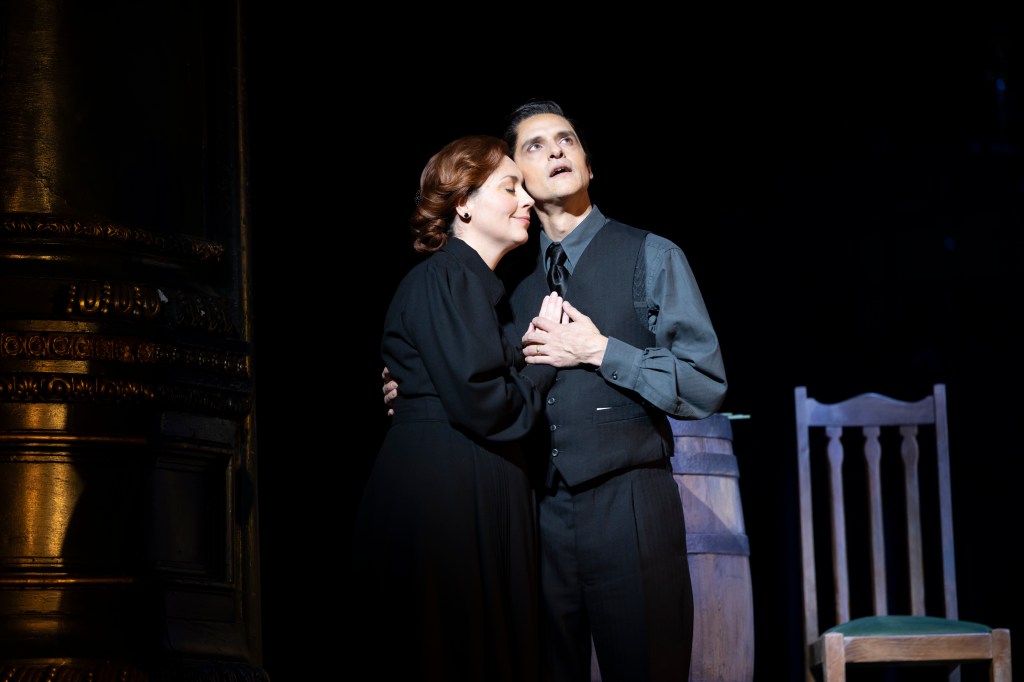
Susan, Stephanie Corley and Sam, Quirijn de Lang, Remembering it well
Moving on to 1821, marked by the number, ‘Progress’, Sam decides to close the shop and go work in one of the new factories. The couple reminisce about their arrival in the town with ‘I Remember It Well’, before moving on.. This is the song which will feature in Alan Jay Lerner’s musical film, Gigi, in slightly amended form ten years later. They decide to delay their departure until after the town’s celebration of the arrival of spring, ‘Green-Up Time’.

Barbershop Quartet: Joshua da Costa, Andrew Randall, Masimba Ushe and Will Hopkins
Fast forward to 1857 with the singing of ‘Economics’ by a barbershop quartet straight out of Guys and Dolls (1950). Sam has left the factory and is working away on railroad construction. Susan tells Sam she would like another baby, which is a moment of comedy gold as Sam consults his business diary to see when he is available to be home to look after her, then deducting nine months to see if he is free to engage in the process of conception.

The Three Tots: Lottie Gray, Felicity Moore and Amber Midgley, with Joshua da Costa
1894 begins with the song ‘Mother’s Getting Nervous’, performed superbly by three tots, and has a ring of ‘Brush Up Your Shakespeare’ from Kiss Me Kate (also 1948). Sam is enjoying some time off work whilst Susan has joined the local women’s group who are campaigning to be allowed the vote. This leaves the children bored and depriving Sam of his ‘me’ time, celebrated by his singing of ‘My Kind of Night’. Meanwhile, at the meeting the women give a rendition of ‘Women’s Club Blues’. The musical style evolving with the rest of the history.

Hobo, Justin Hopkins
The scene shifts to the 1920s with ‘Love Song’, sung by Hobo, Justin Hopkins. The action moves to an ocean liner where Sam is hustling for business, schmoozing from one table to another, trying to get clients for his investment company by promising each one that he is the perfect chap to handle their money as he holds the same values as they do – no matter what they are. ‘I’m Your Man’. This causes him to neglect Susan who is getting bored and is seduced by a smooth talker.
There is a big finale to the first half which includes the whole cast singing and dancing.
Following the break we have an Entr’acte, a second overture, and we are in New York, 1948, which is when the rest of the show takes place.
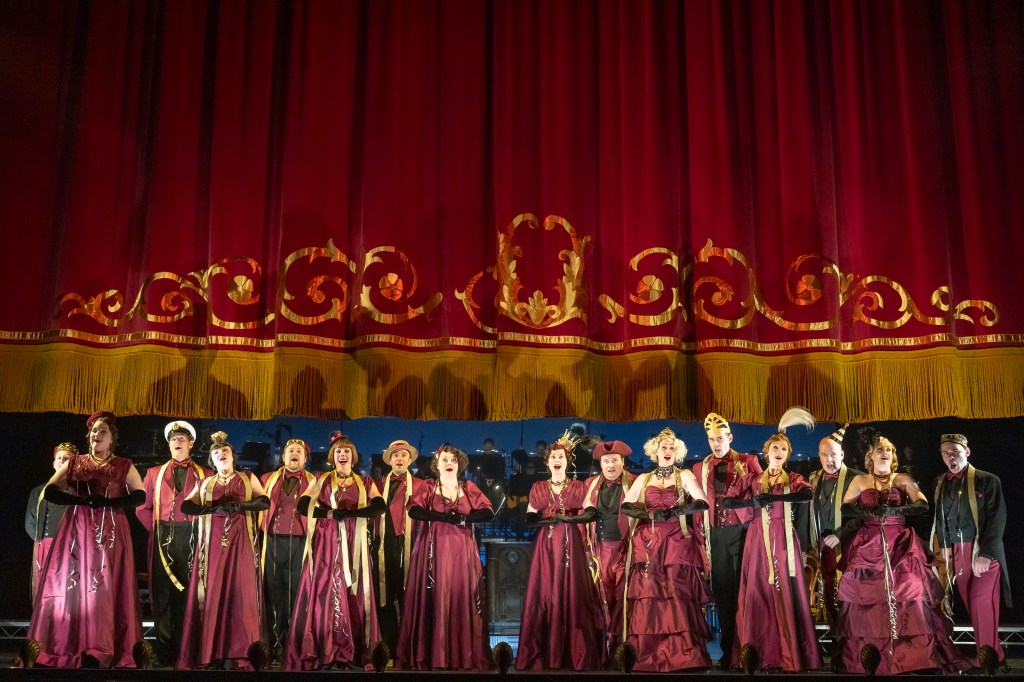
Madrigal: Oh Johnny O!. The Chorus of Opera North
The first song is a madrigal performed by 16 singers, and is an absolute hoot. It is called ‘Ho. Billy O!’ and tells the story of the eponymous chap taking a walk to the bar, being joined by a succession of people he meets along the way, all suffering from some form of neurosis.
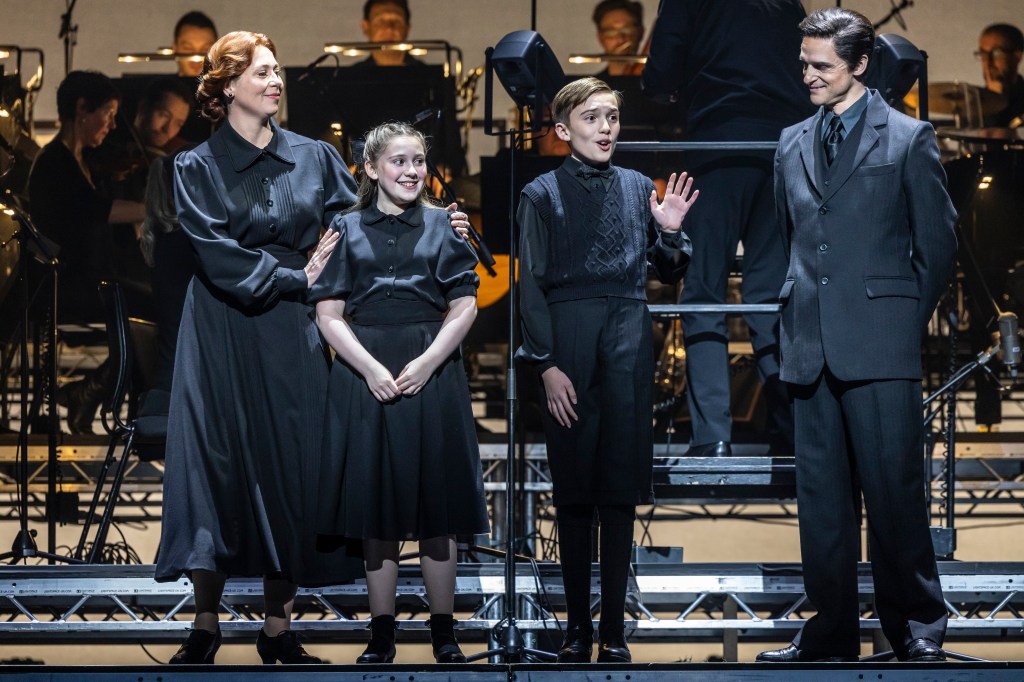
Susan, Stephanie Corley; Elizabeth, Tilly Baker; Johnny, Louie Stow and Sam, Quirijn de Lang
Sam is working in a bank and Susan in a store. Friction increases among the family, crystallised in the argument between all four members about which radio show they should listen to. The children go to their friends, Sam gets his way with the radio station and his wife goes to her room where she sings ‘Susan’s Dream’.

Susan’s Dream with Stephanie Corley and the quartet, who have scrubbed up: Will Hopkins, Joshua da Costa, Andrew Randall and Masimba Ushe.
Some days later the pair have decided to divorce with a reprise of ‘I Remember It Well’ and another song asking ‘Is It Him Or Is It Me?’
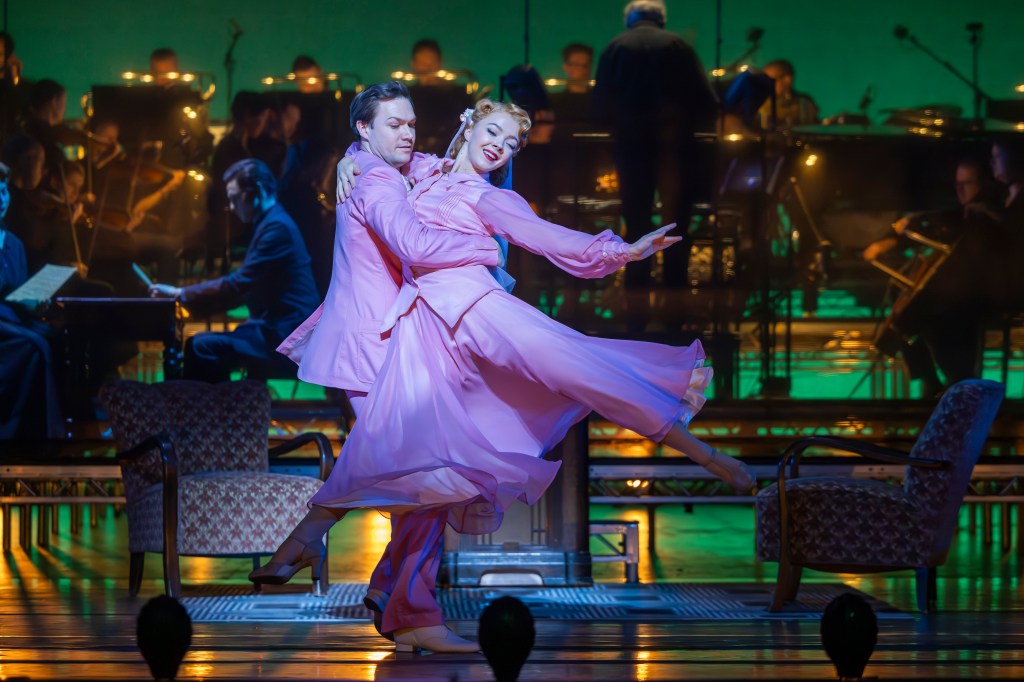
Holly Saw and Max Westerwell perform the Divorce Ballet
There follows two dancers performing ‘Divorce Ballet’ after which we join Sam in a hotel room revelling in his freedom, though not very convincingly, by singing ‘This Is The Life’.

The Illusion Minstrel Show with Sam and Susan watching Charlie Drummond as Miss Horoscope and Helen Évora as Miss Mysticism
It is clear that the couple are no happier alone than they were together and go to The Illusion Minstrel Show, introduced by the song ‘The Minstrel Show’, presented by a conman and some accomplices Miss Horoscope, Miss Mysticism, Mr Cynic and Miss Ideal Man who sings ‘Mr Right’, all of whom offer solutions to the Coopers’ woes, but it transpires that they are also deeply troubled. This leads Sam and Susan to come to the conclusion that they should give their marriage another chance.
The show ends, not surprisingly, with an amazing finale involving all of the cast and is twice as spectacular as the one ending the first half. Incredible.
I think it is easier to review a show with a story!
I found every element of the show to be superb. The singing from Mr de Lang, an Opera North regular, and Ms Cooper, was just the right blend of operatic purity and a more informal style befitting the situations in which they found themselves. The other characters, whether singing, dancing, acting or performing magic, were also flawless in their presentation. Even the three tots were proficient rather than sickly sweet. As you would imagine, the whole piece was performed using American accents, which, again, were spot-on.

Susan Cooper, centre, with the ladies from the Women’s Group, preparing for action.
Having the wonderful Orchestra of Opera North, conducted by James Holmes, situated on stage throughout reminded us that this was a show, rather than a dramatic piece, and it also gave them their moment in the spotlight rather than their being confined to invisibility in the pit.
The costumes, designed by Zara Mansuri, were the same throughout, despite the era differences, with the bulk of the characters being in black, whilst the Coopers were a shade lighter in grey. She also designed the set, which, although seeming minimalist, was incredibly intricate in parts, which facilitated its seamless changing during the show, but the most impressive feature was a series of steel scaffolding structures which were lowered from the flies as each period moved on, resulting in a substantial construction by the end. It also provided the set for The Illusion Minstrel Show, complete with lighting rig.
The Director, Matthew Eberhardt, had the whole thing, segmented as it was, running effortlessly from scene to scene.
My one huge criticism is that there were only three performances, held on consecutive dates, which has not given me chance to promote it by my review. It would be tragic if it were not resuscitated and given a more lengthy run, or even a tour, before too long. It would have been great to have been able to recommend it to those who, like the couple sitting next to me, are not opera fans, but who would enjoy something like this as much as they did.
If you would like to hear the show it was recorded and will be broadcast on BBC Radio3 on Saturday, 8th February. There were also video cameras in evidence, but no mention was made of whether or not it will be transmitted.
For details of the 2024/25 Opera North Season, please go to https://www.operanorth.co.uk/
 Tyke It To The Limit