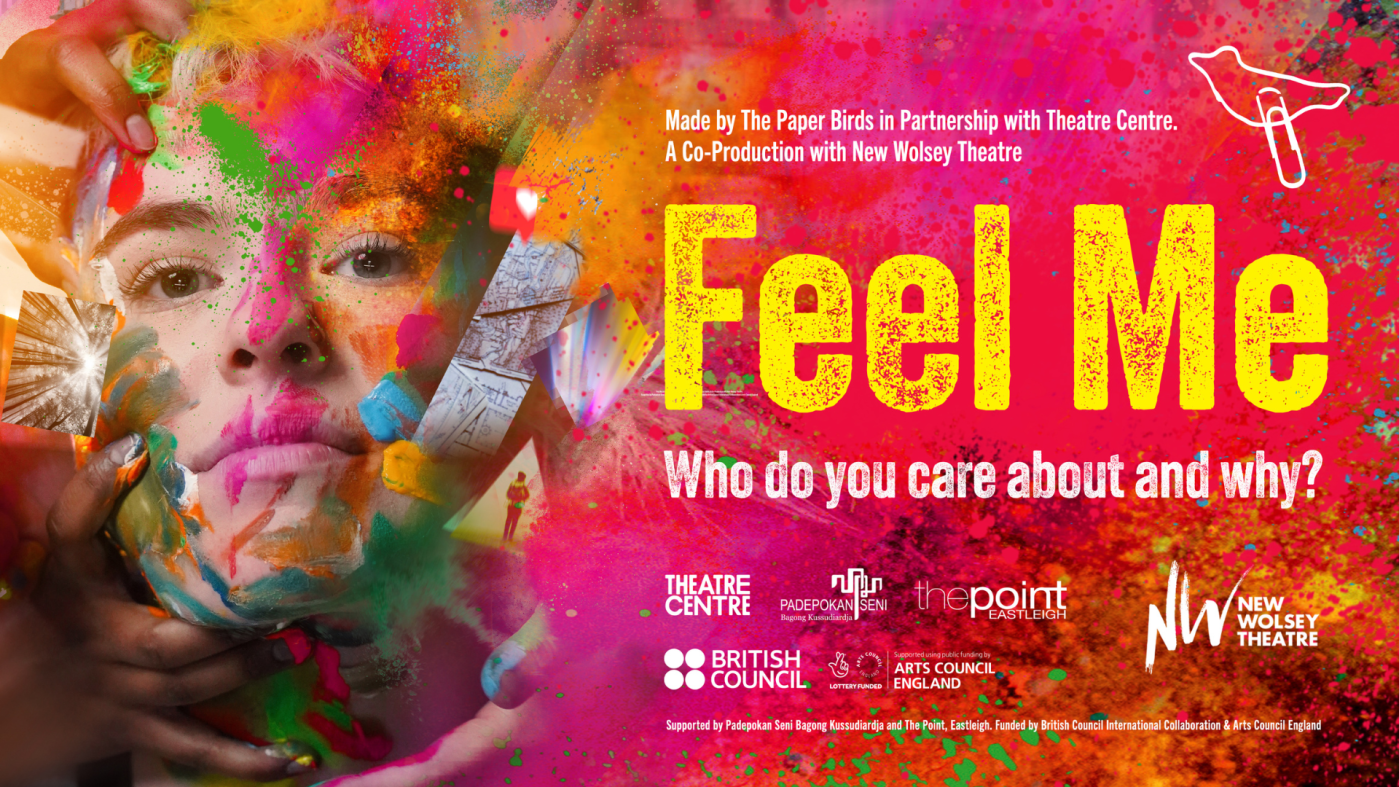
I have rewritten this piece several times as I want to do it justice, but the more I analysed it the more confused I became about its aim. The strap line on the programme is ‘Who do you care about and why?’ A bit of a profound question to be examined in just over an hour. Two concepts were introduced, those of ’empathy’ and ‘forced displacement’, which meant that two extremely serious subjects were glossed over. I have said before that writing a review of a play with an overtly political theme is difficult as I am there to comment on the artistic element rather than the political one.
The USP here was audience participation, not the get up out of your seats to dance and sing variety, but a series of breaks in the action during which we were asked to use our mobile phones to provide feedback, thus indicating how our feelings had changed during the performance.
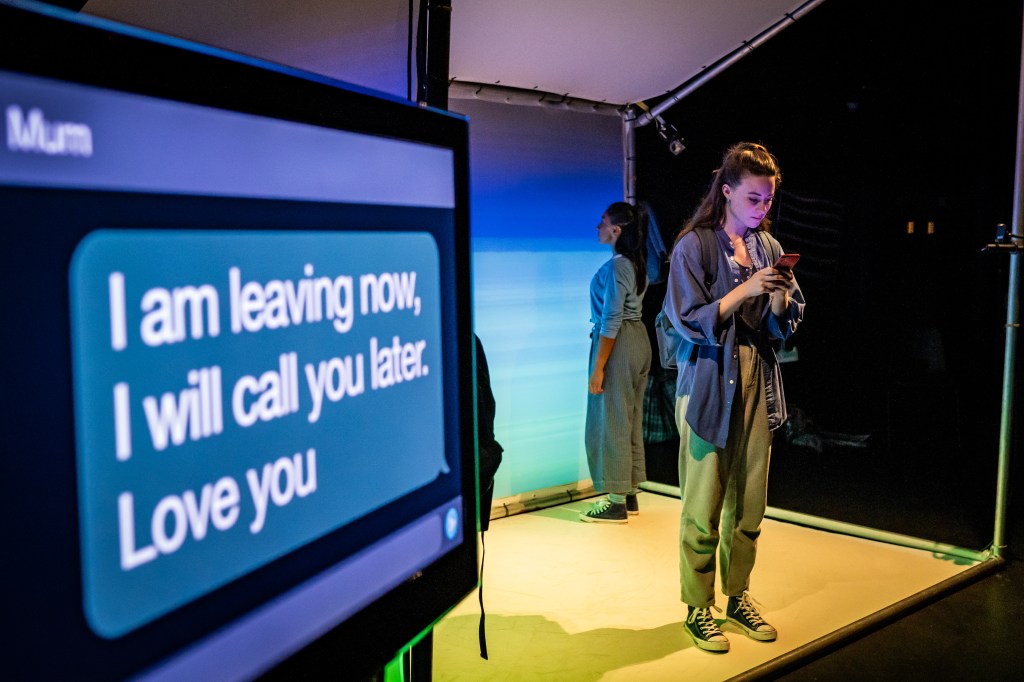
It began by asking us a few questions which we answered on our smartphones, using various methods; selecting a tick box, moving a slider or placing a dot on, or near, the outline of a human shape to indicate how much empathy we felt for the subject of the show. We connected via a QR code. Results were displayed on a large screen by the stage which also doubled as an aid to the hearing impaired.
I am not sure whether I missed something here as the performance began before I had connected, in fact I didn’t get to answer the first question at all. It was concerning my age and I thought that this was the most important piece of data needed to make sense of the rest of my responses. I didn’t see any others in the 75 bracket. Let me make it clear that I am pretty tech savvy, I was programming computers in the Seventies when they still used punch cards and have kept my hand in ever since, I also manage to maintain this website quite easily. It was not my phone either which is a newish, top of the range iPhone – that has no doubt invited a mugging in the near future! I was probably, make that definitely, a bit slower than the rest of the overwhelmingly young audience. Anyway, when I looked up to pay attention I was being asked to make comments about my feelings towards a photograph of a victim of forced displacement which had gone viral with several million hits. I am not sure whether it was shown or we were just dealing with an abstract case. Whatever the rest of my companions were commenting on, I was taking an abstract view.
The action took place mainly within the confines of a white cloth cube with an open front. The three remaining sides and the ‘roof’ being used as screens on which to display videos and images of a journey of desperation undertaken by someone who had received a frantic text from their mother urging them to ‘Run now!’.

There followed a series of vignettes showing the trek across various terrains and the dangers encountered, as well as the bureaucracy involved in moving from place to place. Further texts were displayed as the migrant progressed. Dancing and other physical actions were also used to interpret elements of the journey.
As stated, there were breaks in order to ask questions as to how we pictured the subject, how we empathised with them, how were we feeling etc. There was also a kind of lecture on how the plight of the refugee is portrayed, especially in the appeals for funds. It was summed up in the acronym VIM: Visuals, Information, Music. Each of the three elements was examined using different images of a refugee, various voiceovers and moods created by the soundtrack.
The show was written and performed by a company called The Paper Birds and consisted of three actors who were introduced by one of their number as being twenty-somethings, often referred to as Snowflakes and viewed as oversensitive. They were Beckie Callow, Klara Kaliger and El Solly, the work was devised in conjunction with the original performers; Lil McGibbon, Daz Scott and Karen Virdee. It came out of their digital, multi-platform project, The School of Hope, comprising creatives aged between 13 and 25.
I am seventy-something, often referred to as a Boomer and regarded as being extremely lucky to have been born when I was, and had life easy. I can agree with a lot of that but by no means all, so tried to contribute what I could along the way.
In the opening paragraph I said that this show made me feel very old, mainly because of the reference points I rely on. That could be said of everyone present with my, possibly outdated, views on life seeming sometimes to be at odds with those of the following generations but I am not prepared to ditch the lessons learned over the years for fear of causing offence, something which works both ways. As an aside, I am not affiliated to any political or religious idealism, so judge every situation on its merits rather than see where it fits into a doctrine devised by someone else. I too was convinced that I knew everything when I was in my twenties. By the time the audience who watched this work are my age, or, given the speed at which things are currently moving, quite a bit younger, they will hold views based on what they are experiencing today which will be unacceptable to the twenty-somethings of 2075, who may by that time be Ironfists rather than Snowflakes. Who knows.

A lot of emphasis was placed on the word ’empathy’, which my dictionary defines as ‘the ability to understand and share the feelings of another’. I can go along with this in most situations, and am surprised that it is a characteristic which needs to be fostered by a play, It was always drilled into my psyche by my parents. It was we Boomers who brought about the abolition of capital punishment, legalised homosexuality and suicide and pushed for equality of sexes and ethnicities. The one thing I have a problem empathising with, is the fleeing from your home country. I understand exactly why refugees do what they do, in fact I am proud that Leeds has been a safe destination for many displaced persons over the years, but my father and grandfathers fought in World Wars and running was not an option. It was instilled into me that you stay and fight no matter what the odds. This applied even more to the people living on mainland Europe during the wars who had nowhere to run. Fortunately, my ability to translate my feelings into action has never been tested, again, who knows.
In conclusion, I found this production to be very well acted, sung and presented as well as daring to be different. My only problem was with the questions. As with all multiple choice there is always an option you want to tick but which is not there. It was also a bit simplistic as, if you began by stating that you had total empathy with the subject in question, and remained in that mindset, you could only answer ‘no’ to a later one, which asked if you now had more empathy towards them after seeing the previous scene. This would also apply in reverse. I realise that this was an artistic work and not a scientific study so only a small gripe. Using your phone is not compulsory and won’t spoil the experience should you choose to abstain. All answers are anonymous and deleted after the show.
Oh, and for future reference, would you please give anyone in the upper age quartile a chance to get sorted before beginning. We Boomers are used to being spoiled!
Feel Me has finished its run at Leeds Playhouse but please go to https://thepaperbirds.com/feel-me/ for more details, keep checking back for further tour dates. To see what else Paper Birds are up to it’s https://thepaperbirds.com/
Productions at Leeds Playhouse can be viewed at https://www.leedsplayhouse.org.uk/whats-on/
All photographs by Will Green are of the original cast rather than the ones who appeared in this performance.
 Tyke It To The Limit