What a brilliant way to get children into opera. My first experience of live classical music was back in the Sixties at grammar school, when the second form was herded into a building in Rossington Street, just opposite where the Merrion Centre stands today, and made to shut up and listen to a string quartet play Mozart and Chopin. The only quartets we were interested in were The Beatles, The Searchers, The Kinks, The Who etc, all of whom had just kicked down the doors of British culture and taken the space over.
The audience members at the Grand Theatre, who had brought along their bodyguards, were several years younger than I was, being between 5 and 12. They were also in a far more interesting and comfortable venue than the one in which we found ourselves confined. I presume it was a part of Leeds College of Music, but it was austere and claustrophobic, still, it beat the pants off double history with Tossy. (Nicknames are not what they used to be)
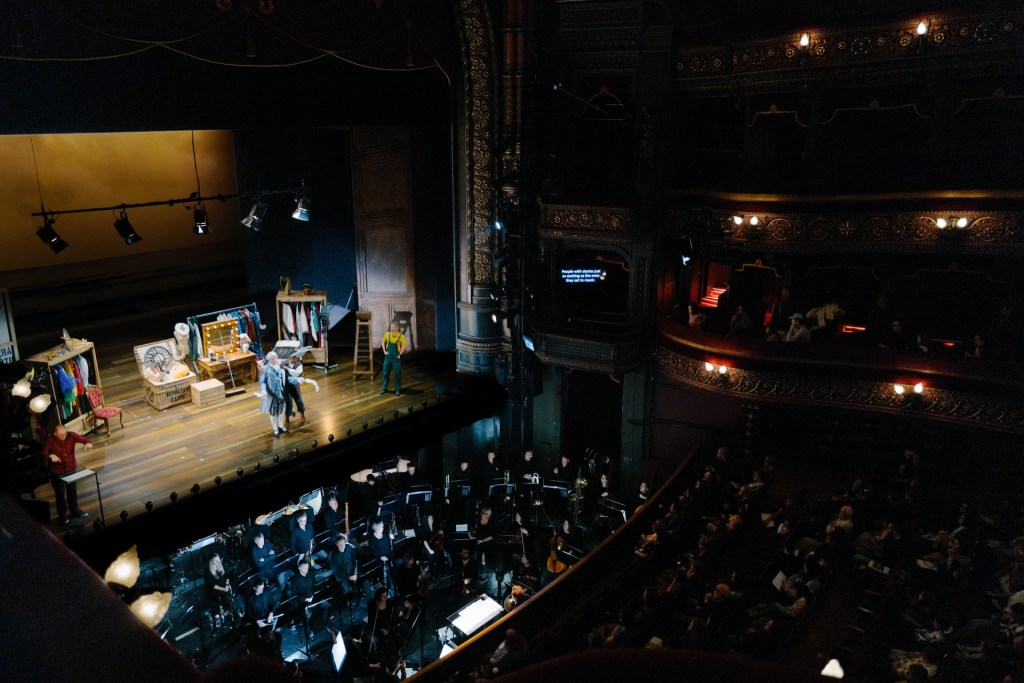
The Orchestra of Opera North with the performers. Note the titles on the screen for the hearing impaired, and the chap on the bottom left who was translating the show into BSL. There was also a dodgy old geezer in the third row!
Rather than being commanded to sit down and shut up, audience participation was almost compulsory, but handled superbly well. No one was made to feel excluded or embarrassed, including me, who ticked off one more item on my bucket list, but more of that later.
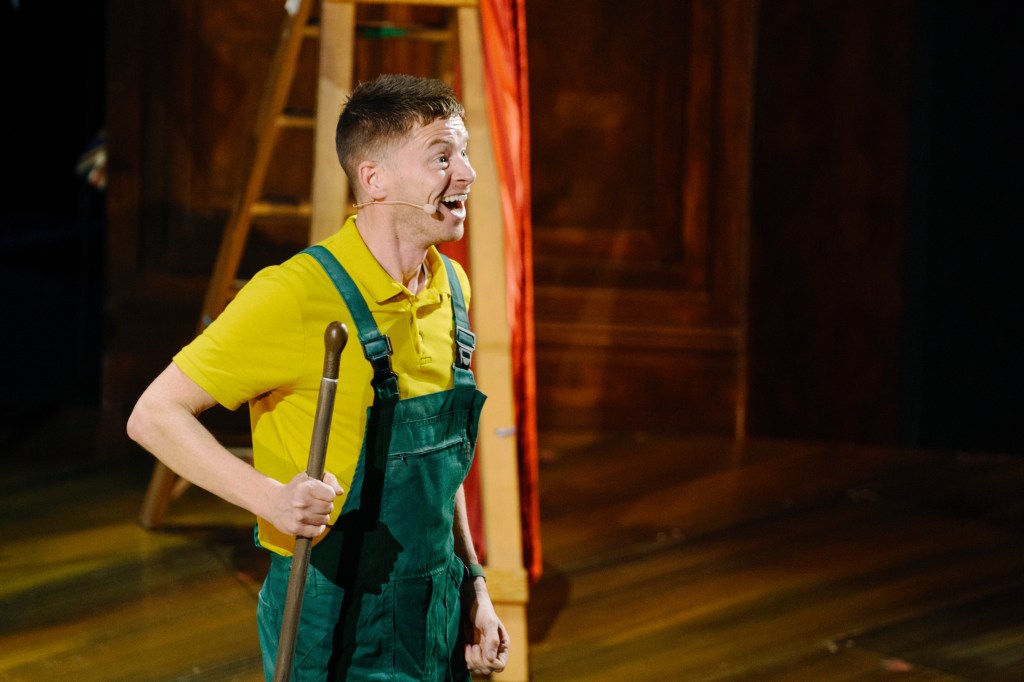
Proceedings began with a caretaker (Luke Broughton) sweeping the stage, which was bedecked with a collection of props from various operas. When he paused and noticed the audience, he said that the Opera House was closing down and we should get up and leave as he would shortly be locking the doors for good. He was then joined by a chap (Dominic Bevan) who asked what he was up to, and he received the same explanation. He added that he didn’t care about the closure as no one is interested in opera nowadays. The rest of the show was aimed at convincing him, and obviously the audience, that opera was as popular and relevant as ever.

Julia Mariko, having removed several layers of clothing to morph into Audrey Hepburn
The modus operandi was to perform excerpts from operas, embroidered into a plan to save the theatre. The singers were in the costumes appropriate to the original work. Speaking of costumes, the soprano, Julia Mariko, a rather attractive lady, first appeared in a trench coat, which she took off to reveal a queen’s gown beneath. As it was secured with velcro it was quickly removed, exposing a third example, again whipped off, transforming her into an elegant woman in evening dress, with one shoulder exposed. I am sure that if the string quartet had employed a similar tactic in 1962, a group of pubescent boys would have paid much more attention than they did. I can only imagine the words of encouragement for a continuation of the performance!

Msimelelo Mbali, Luke Broughton and Dominic Bevan
Back to reality. Tenor Dominic Bevan came on as a grandfather clock with his face being that of the timepiece, the hands affixed to his top lip like a moustache. I believe that this is the clock which strikes 13 times in Der Rosenkavalier. Sadly, the structure prevented the singer’s voice from projecting as well as it should, but, fortunately, that was the only glitch.
There were arias from Die Fledermaus, A Midsummer Night’s Dream, The Magic Flute, The Adventures of Pinocchio, The Anonymous Lover and Hansel and Gretel with singers dressed as an aviator, a grasshopper, a doll, an ass and a witch, amongst many other things.

Julia Mariko, Luke Broughton and Dominic Bevan
The magnificent Orchestra of Opera North, under Harry Sever, was in the pit, and played sublimely, whilst joining in the fun and making their presence felt at appropriate moments. The conductor’s baton also played a pivotal role in proceedings, although, thankfully, it was the real thing and Mr Sever didn’t have to wave a disguised singer aloft.
The nub of the plot was that the theatre could be saved if a magic baton could be located. It was somewhere on the stage but where? In order to find it several clues needed to be solved and, handily, these were provided on a puzzle sheet distributed to the audience members on arrival. So as not to make any of the younger, or much older, participants feel left out, the caretaker read out the questions during the execution of his duties and the kids shouted out the answers before everyone entered them on their sheet.
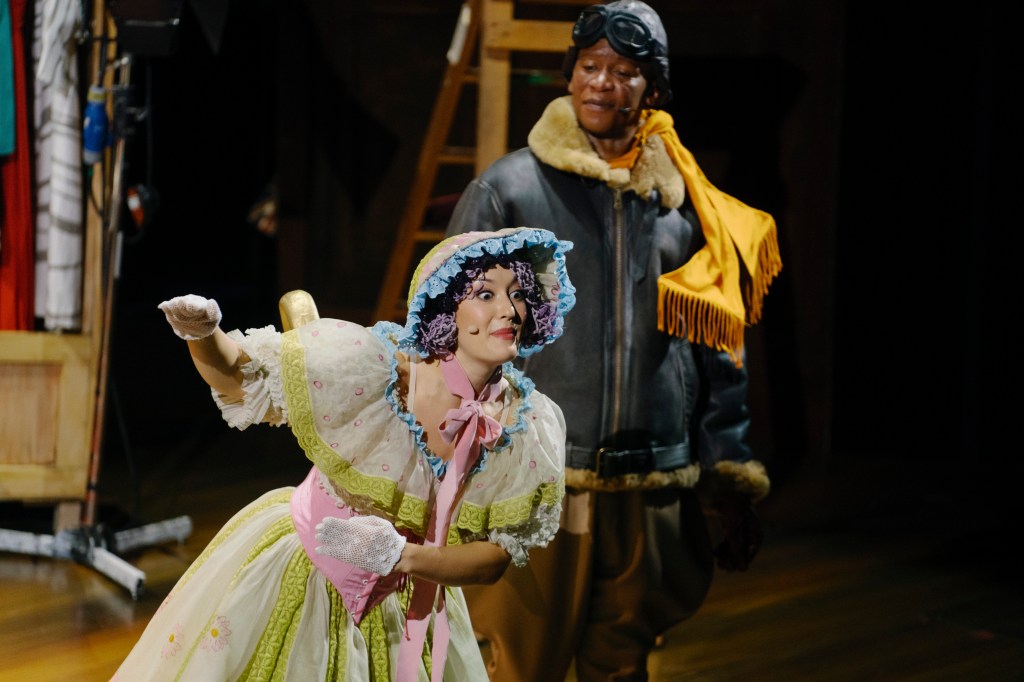
Julia Mariko and Bass, Msimelelo Mbali
Needless to say, the Grand was saved from closure, at least I hope it was as I am booked to go there on Tuesday, and the caretaker became a fan of the genre. We were all asked to spread the word amongst our friends, at least those who had any, and get the place, and others like it, filled for years to come.

The Magic Baton!
The big finish was when the caretaker said that the only bit of opera he knew was that song they sing at football, to which Dominic Bevan, responded by giving us a rendition of Nessun Dorma. After a quick lesson from Julia Mariko there was an encore and we were all encouraged to join in with the grande finale, hitting the high notes whilst singing ‘Vinceró!’
Extract from Bucket List of Stan Graham:-
Sing a bona fide aria in a real Opera House – tick! – Luciano who?
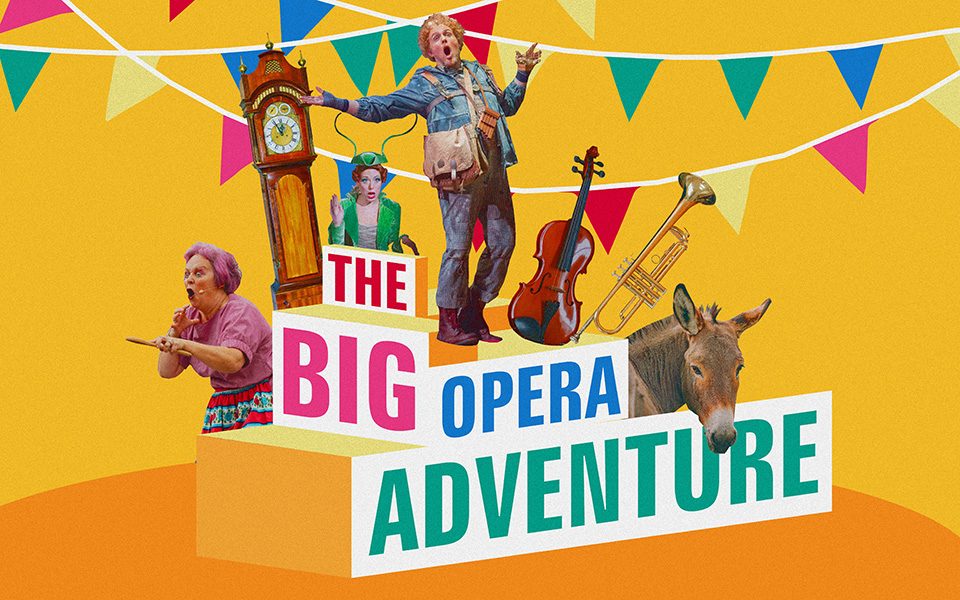
The Big Opera Adventure was Directed by Jonathan Ainscough and Designed by Bek Palmer. It plays at Lyric Theatre, Lowry, Salford Quays at 11.00am on Saturday, 16th November, so to get more information, including a trailer, and to book, please go to https://www.operanorth.co.uk/whats-on/the-big-opera-adventure/
For details of everything Opera North related see https://www.operanorth.co.uk/whats-on
Photographs by Tom Arber
 Tyke It To The Limit