
Not a very appropriate title for a production staged on a wet and chilly day in mid-October, but, as they would have been struggling to coincide with any of the three summer days we have had this year, I will overlook that. I have never seen the play by Shakespeare, on which this opera by Benjamin Britten and Peter Pears is based, as the only works by the Bard I did at school were half of Hamlet and all of Macbeth, when it was discovered that the subject of the GCE ‘O’ Level English Literature exam of 1966 was The Scottish Play, rather than the Danish one which we had begun learning.
I don’t understand why it should be specific to Midsummer Night, although my research tells me it might be because it was a feast day for a saint associated with lovers. I always thought it was the day when fairies came out to play in the woods. I could be flirting with disaster insofar as language and its modern interpretation is concerned here, just wait until I get to Bottom, the Ass! Whatever the reason, that is the date chosen so let’s just accept it. If grammar school teachers can get it wrong so can I.
If you thought that some of the previous operas I have written about had convoluted stories, you ain’t read nothing yet!
The whole thing begins with Oberon and Tytania, King and Queen of the Fairies having a row about a young changeling boy who she wants to raise as her own and he wants as a knight. It is obvious that things are not going well in the conjugal department of the relationship as, to get his own way, Oberon orders his loyal spirit, Puck, to sprinkle Tytania’s eyes with the juice of a magical flower while she is asleep. The effect of this will cause her to fall in love with the first creature she sees when she wakes.

Peter Kirk as Lysander, Siân Griffiths as Hermia, Camilla Harris as Helena and James Newby as Demetrius
In the human realm there is a bit of a thing going on between two couples; Lysander and Hermia, who have run away to the forest, and Demetrius and Helena. Demetrius also fancies Hermia so follows them, pursued by Helena, who, for some inexplicable reason, neither man has any time for, but who has the hots for Demetrius. Oberon has seen their problem and told Puck to do the magic flower thing to Demetrius so that he will fall in love with Helena.
The forest now begins to resemble Briggate on a Saturday afternoon, with the arrival of six craftsmen, who, weirdly, have formed an acting troupe and are there to devise and rehearse a play they hope to perform at the forthcoming wedding of Theseus, Duke of Athens, and Hippolyta, Queen of the Amazons, a woman obviously in her Prime. There are squabbles between the actors, as Flute doesn’t want to play the female lead and Bottom wants to play two parts. They eventually agree to play Thisbe and Pyramus respectively.
This next bit should come as a warning not to go around sprinkling magic flower juice on sleepers, as Puck mistakes Lysander for Demetrius and treats him. Who do you think he first claps eyes on when he awakes, you’ve got it, Helena. When he makes a move on her she runs off thinking he is mocking her, leaving Hermia alone. On his second mission, the spirit gets the correct mark, Oberon, but obviously things go awry.
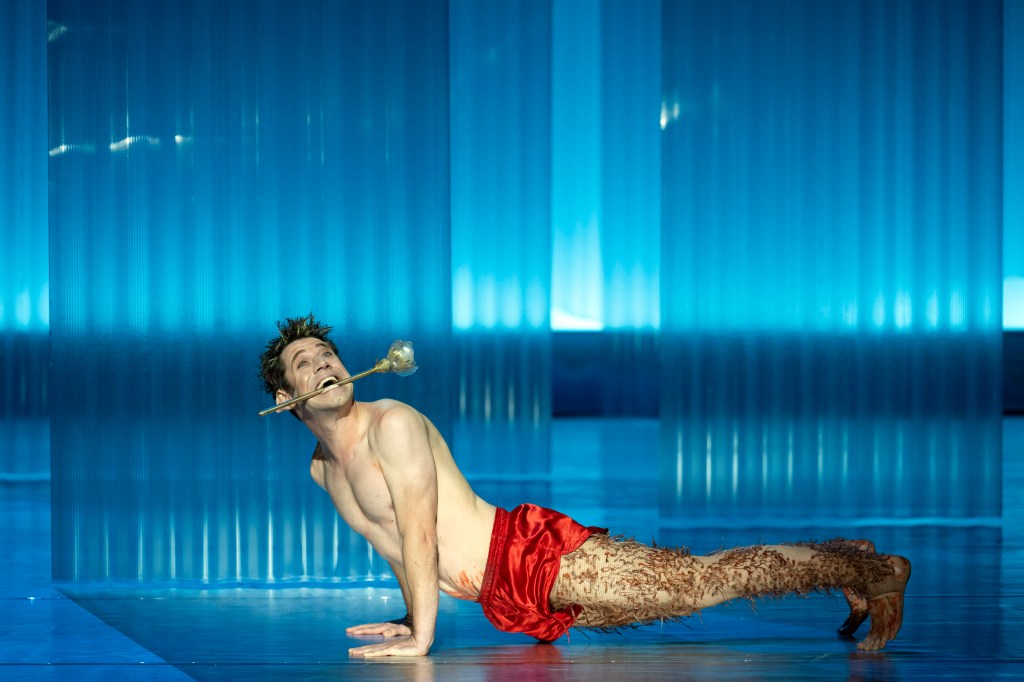
Daniel Abelson as Puck
In a period of boredom, Puck has decided to amuse himself by turning Bottom’s head into that of an ass. (Note to my American readers, in this instance ass is used to mean the donkey-like animal rather than the thing you can kiss if you don’t like my writing!) When his fellow thespians see the resultant mutant they run away, so, in order to keep up his spirits, Bottom sings, with the result that he wakes Tytania from her slumber, causing her to fall madly in love with him. If you think I am going to do the ‘feeling a little horse’ joke you are correct.
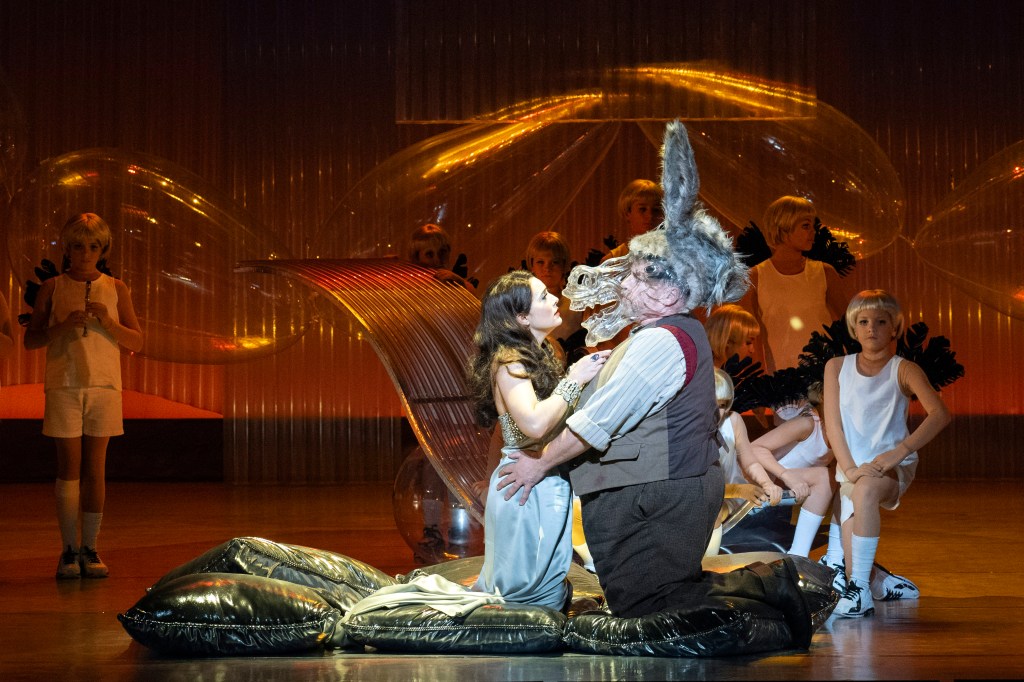
Henry Waddington as Nick Bottom and Daisy Brown as Tytania with the children of A Midsummer Night’s Dream cast as Fairies
Tytania seems pretty cool with this outcome, although oddly ticked off about Puck’s blunder with her instructions. She orders him to go back and do the job properly so he sprinkles Demetrius’s eyes. When he awakes he finds that he has two visitors, Lysander and Helena, on whom he immediately casts his eyes. This means that now both men love her, leaving the initial sex object, Hermia, manless. When Tytania realises what has happened, she gives Puck an antidote to give to Lysander.
Before sunrise, Oberon releases Tytania from the spell so the status quo is restored and the human lovers, and her equine fetish are sorted out.

Molly Barker as Hippolyta and Andri Björn Róbertsson as Theseus
At the wedding, the two couples ask for the forgiveness of Theseus, which is not only granted, but he turns the occasion into a triple wedding, incorporating them. The actors perform their play, Pyramus and Thisbe, and everyone goes to bed. Oberon, Tytania and the fairies bless the sleeping household and Puck brings the show to a close.
The opera is divided into three acts, with two intervals. The first act is a scene-setter and takes the story up to where Puck has messed up and the characters are in chaos. I found this a little hard to follow, as I didn’t have time to read the programme, and even so, I like to approach everything I see with no preconceptions, just as any person buying a ticket would. The second act unravelled the Puck ups and set the scene for the play, clarifying a few of the things which were thus far confusing me. Act three comprised the play.
I had a few gripes concerning the production, the main one being that the human action was set in the late 1960s with the cast clad accordingly. The problem here was that the language was still in Shakespearian 16th Century English, so not a ‘far out’, ‘hang loose’ or ‘you’re putting me on’ to be heard. It got more annoying as the play progressed. This time I definitely have no idea why the period was shifted. The only thing in common with the story was the magic vegetation!
The scenery echoed the Swinging Sixties vibe, sorry, fulsomely pleasurable air, with the use of translucent plastic strips to represent the forest’s trees and Jeff Koons style balloons, although he didn’t start work until the Eighties.
The costumes of Oberon and Tytania were, again of the time, apart from Oberon’s skirt, made from mirrors in the style of a glitter ball which was great in the case of Tytania, but Oberon’s were much larger and, when the spotlights caught them and reflected back towards the audience, the effect was near blinding.

James Laing as Oberon and Daisy Brown at Tytania
OK, now I have got the negatives out of the way, I was surprised how much I enjoyed this opera. As you will know by now, I don’t do silly, which this most certainly was, but it did have a message, well, several actually, and the script was acted out superbly. The play at the end, although I thought could have been a bit shorter, was hilarious, thanks to the actors, whose vocal attempts were made to sound amateurish in parts to reflect the ineptitude of the tradesmen concerned. Before they staged the play, however, they were able to demonstrate their superb singing skills. When you are really good at something it must be difficult to do it badly.

Nicholas Butterfield as Robin Starveling, Frazer Scott as Snug, Nicholas Watts as Francis Flute, Henry Waddington as Nick Bottom, Colin Judson as Tom Snout and Dean Robinson as Peter Quince
The children who played the fairies were all wearing short, blond wigs which put me in mind of the horror film, Village of the Damned. My suspicion was confirmed when I later read in the programme that the Director, Martin Duncan, had chosen them to reflect a certain creepiness inspired by that movie, which was released in 1960, the same year as the opera was written. The black wings added a further foreboding.

Daisy Brown as Tytania with the children of A Midsummer Night’s Dream cast as Fairies
The Orchestra of Opera North, conducted by Garry Walker, was in its usual impeccable form performing the score, which was moody and descriptive rather than being filled with arias. This meant that they had to cover the full range of emotions, from grief and menace to romance and humour.
The singers were all on top form with the plum role of Bottom being judged to perfection by Henry Waddington, whose bass baritone adapted very well to both the romantic and humorous sections of his part, as did his body language.
Oberon was acted and sung superbly by James Laing, a countertenor, which I thought a little high pitched for a king with such far reaching powers. This meant that soprano, Daisy Brown, as Tytania, was sometimes singing in a lower register than her husband. A sort of paranormal version of Sonny and Cher.
The real show stealer, was Daniel Abelson as Puck. He had no singing as such but his movement around the stage was so lithe as to make you feel that he was a quadruped, an impression enhanced by the way in which he cavorted round his master, Oberon, in turn like a little puppy and then a vicious dog ready to be let loose.
At this point I normally give my recommendation as to whether you should take advantage of the wonderful Opera North scheme, Try It ON, for first-timers, but, for once, I am ambivalent. Much as I enjoyed the opera, it is just over three hours long and the music is not the kind which you will be whistling on your way home, it also takes a bit of getting into. If you are prepared to be adventurous and make the effort at the beginning, the third act will make you want to come back for more. Have a look at https://www.operanorth.co.uk/your-visit/new-to-opera/tryiton/ for full details.
A Midsummer Night’s Dream is at Leeds Grand Theatre on 19th, 24th and 31st October, after which date it goes on to Newcastle Theatre Royal on 6th November, Lowry, Salford Quays on 13th ending its run at Theatre Royal, Nottingham on 20th.
For more details and to book, please go to https://www.operanorth.co.uk/whats-on/a-midsummer-nights-dream/#book
All images supplied by Opera North
 Tyke It To The Limit