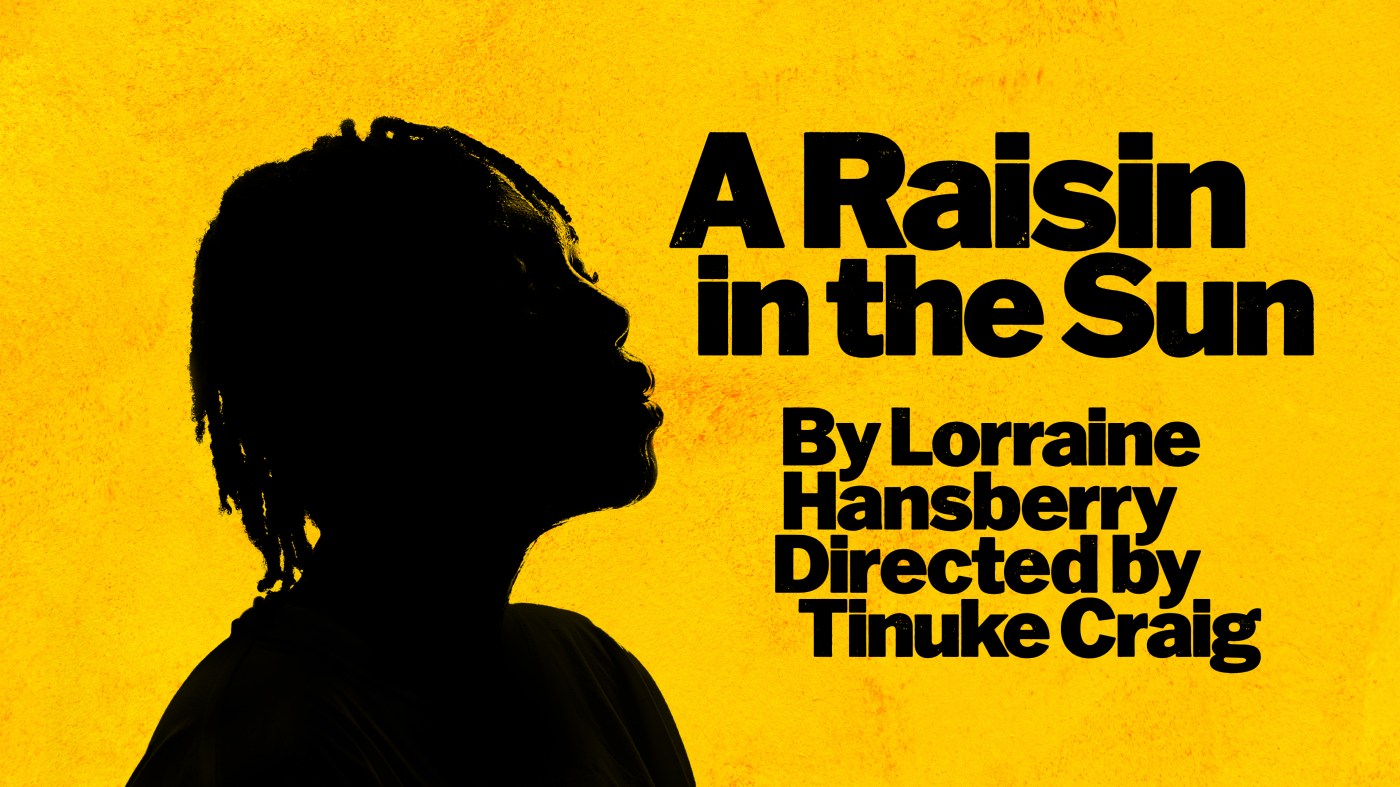
Three years ago at this venue I saw one of the best pieces of drama I have ever witnessed in Jitney, the story of unlicensed taxi drivers in Pittsburgh. It had all the elements of a great work, but most of all it was a story with multilayered messages delivered in a straightforward, adult way with no gimmicks or punches pulled. It was Directed by Tinuke Craig for Headlong and Leeds Playhouse, so, when the same team, this time with the addition of Lyric and Nottingham Playhouse, was back in town with Raisin in the Sun, the calendar was swiftly marked. I need not have worried about my balloon of optimism being deflated, this was another brilliant production.
Raisin in the Sun was written by Lorraine Hansberry, the first woman of colour ever to have a play performed on Broadway, and is set in 1959, the year in which it was written. This time the location is the South Side of Chicago, which, as Jim Croce put it, is ‘the baddest part of town’. Unusually it is not based on a novel or film, but a poem, ‘Harlem’ by Langston Hughes. I trust I have not broken any copyright laws by adding it as an appendix. The year is important as it is at the beginning of the Civil Rights Movement in the USA and so people of colour were still treated with disdain as second class citizens. Martin Luther King only became active in 1955, the year of the Montgomery bus boycott, and it would be another four years before his 1963 ‘I have a dream’ speech at the Lincoln Memorial in Washington. The first Civil Rights Act was not passed until 1964, so segregation was still rife.

Lena played by Doreen Blackstock
The action never moves out of the two bedroom apartment which houses the matriarch of the family, Lena, her daughter, Beneatha, her son, Walter, his wife, Ruth and their son, Travis. As space is obviously at a premium, Travis has to sleep on the couch in the living room, which is where the action begins with him being woken one morning by his mother who is making breakfast.
Although the home is in an overcrowded tenement block in a working class area, it is kept spotless by Lena and Ruth, who also work as cleaners and housekeepers for the rich folk. Walter is a chauffeur to a businessman so they are all subjected to the signs of white affluence every working day of their lives. The effect this has varies, with Lena being resigned to knowing her place in the grand scheme of things, Ruth just wanting to provide for the family and pay the bills, whereas Walter is determined to join the ranks of the super rich by setting up a business, even though he obviously has no feasible plan, only dubious local role models.
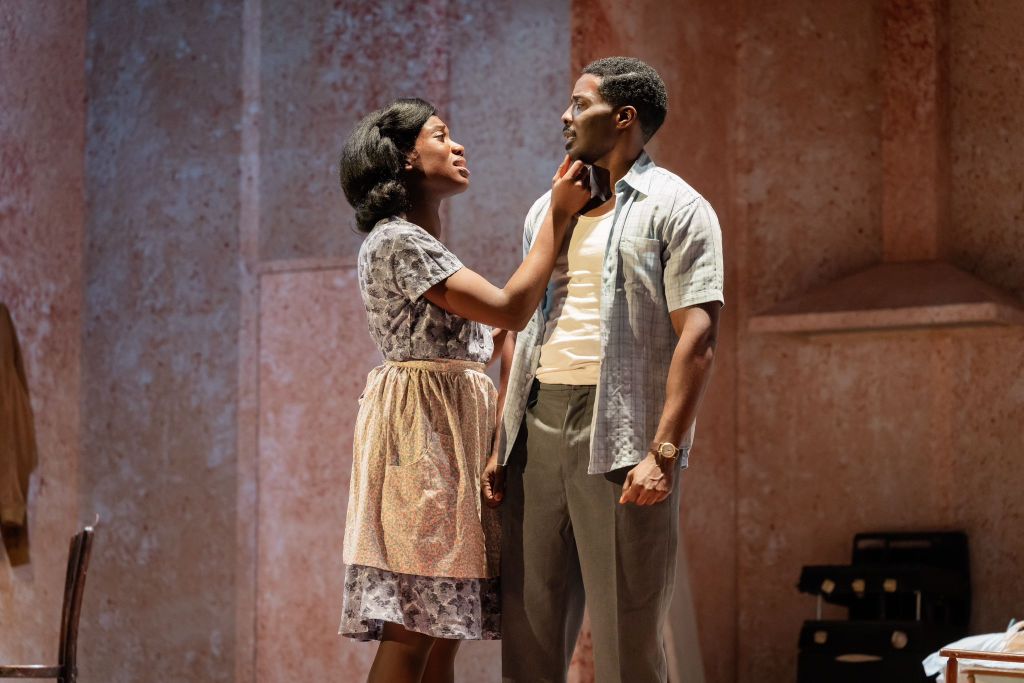
Cash Holland and Solomon Israel as Ruth and Walter
The catalyst for the play is the death of Lena’s husband, whose life insurance is due to be received the day after the action begins. This gives an opportunity for the characters to reveal their – well – characters, and put forward the way in which they would like to see the new found wealth put to good use.
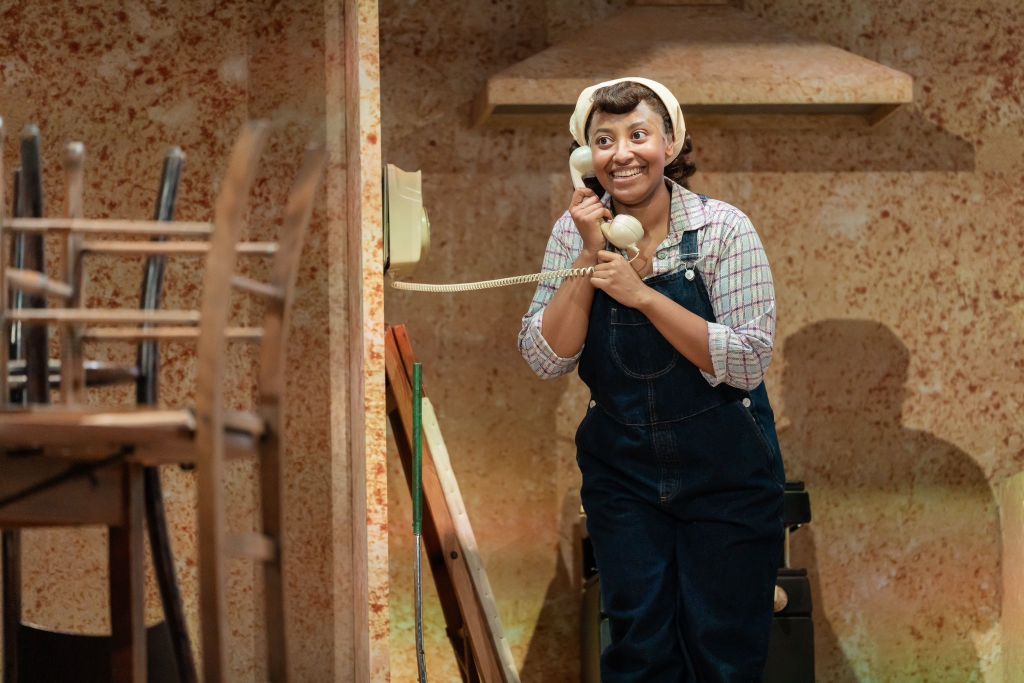
Joséphine-Fransilja Brookman as Beneatha
Ostensibly the money belongs to Lena, played by Doreene Blackstock, as she is the next of kin and beneficiary, who, although having had time to assimilate the news, is still contemplating what to do, preferring to hold judgement until the cheque is in her possession. She is determined that enough is put aside to pay Beneatha’s college fees, so she can become a doctor, but otherwise she is open to suggestions. Beneatha played by Joséphine-Fransilja Brookman, is herself happy to remain a student but is more interested in being courted by two rich men, George, played by Gilbert Keys Jnr, her fellow student, who is from a well-to-do family and snobbish and Joseph (Kenneth Omole), a Nigerian who wants her to marry him and move to Africa. Both have their appeal but seemingly only on a platonic level.
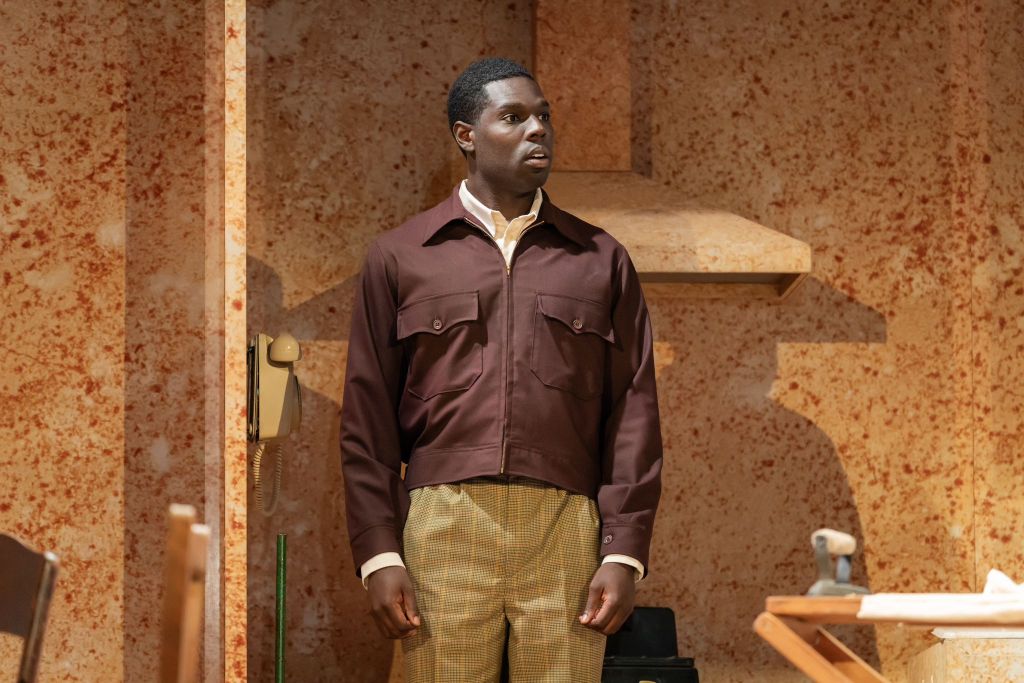
George played by Gilbert Kyem Jnr
Walter, played brilliantly by Solomon Israel, has already put his plan for the money into action by teaming up with his friend Bobo, again played by Keneth Omole, and arranging to go into business with an associate, Willy, to buy a liquor store. You know from the outset the this is not going to end well when it is suggested by Willy, whose part is confined to phone calls, that they need to grease some palms in order to expidite the issue of their licence. Ruth, who has discovered that she is pregnant again, is resigned to going along with whatever her husband has decided as he is a man and so the dominant partner in the relationship.
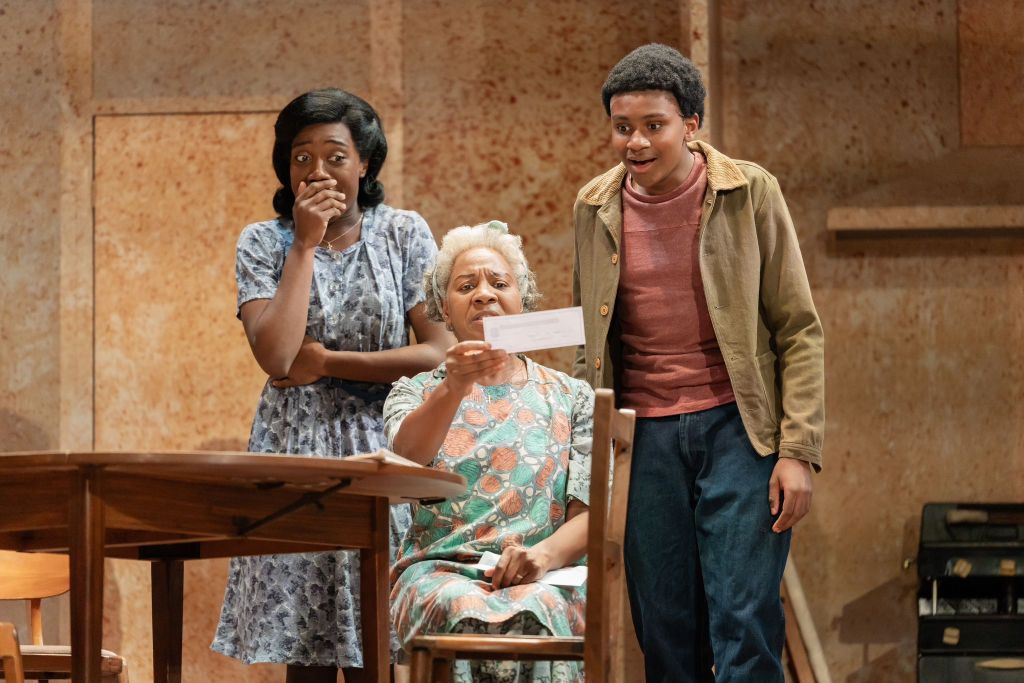
Ruth, Lena and Travis inspect the cheque. This is a different actor playing Travis from the one I write about.
When the big day arrives and the cheque for $10,000 is received, there is general merriment along with more heated debate about what should be done. Long-standing family attitudes to each other and the world in general surface with stuff being said to sour the euphoria. That evening, Lena returns home after being out all day and announces that she has been to the bank to cash the cheque. Not only that but she has made a down payment of $3,500 on a house to accommodate them all, along with the expected new addition. The premises in question are situated in the suburb of Clybourn Park, which Walter points out is an all white neighbourhood.
Later, when Lena and Walter are alone, she gives him an envelope containing the $6,500 cash balance of the cheque, telling him to go to the bank on Monday and open an account for Beneatha’s college fees and deposit $3,000 to secure her future, the remainder he can use for his venture. Walter is overcome with emotion because he didn’t think she trusted him with money.
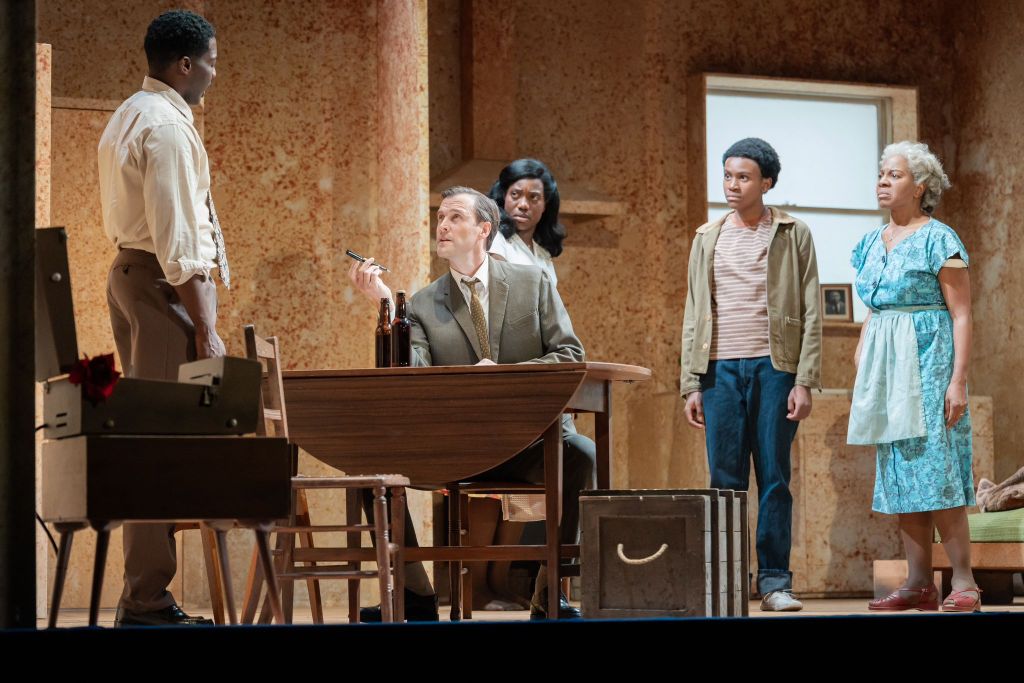
Karl, Jonah Russell, explaining why it might not be a good idea for the family to move to Clyborn Park
The family gets a visit from Karl, the Chairman of the Clybourn Park Residents’ Association, played by Jonah Russell, who, although purporting to be sympathetic to the family’s ambitions, points out that they would probably not fit in with the existing residents and says he has the authority to offer them a price for the house which exceeds their outlay. They send him away after refusing and his attitude changes to one more threatening.
It goes without saying that Walter goes nowhere near the bank, handing the whole amount over to Willy, who promptly does a runner leaving Bobo and Walter penniless.

Keneth Omole who plays both Joseph and Bobo.
I will not reveal the ending, as the discussion which follows this event, whilst not being a mystery, is the nub of the play’s main message. I say main message because there are several things which can be gleaned from this play, not all to do with colour, although that is at the root of the piece.
There is one actor I have not mentioned so far, and that is Josh Ndlovu who played Travis.
There are two reasons for this; the first is that he is one of three young actors who rotate in this role as he is only 14 years-old, and his portrayal of the pubescent youth was superb. He had the air of a moody, picked upon teenager and an immaculate range of facial and bodily expressions as well as spot-on comedy timing. His acting skills were accentuated when the play had finished and the cast were taking their curtain call. He reverted from being in character to his adolescent self, beaming and waving at the people he recognised in the audience. I thought he was going to explode with joy, in fact I nearly did so on his behalf.
The second is that he is the character with which I most identified. I am a white male of 75 years so, when the play was written I was 9 years old and all of that time had been spent living in an East Leeds back-to-back slum with no hot water, a cellar riddled with damp and cockroaches, two bedrooms and a ground floor room which would now be called open plan but was a small space with a sink in one corner and a coal fire. The toilet was in a block at the end of the street which we shared with the people next door. Washing was done in the sink and bathing in a zinc tub dragged up from the cellar on a Sunday night. My dad, like Walter, was always looking for the main chance in order to be accepted by his wealthier associates, but his exploits invariably came to naught, mainly because, again like the anti-hero, he wanted the trappings of success immediately rather than working up to them, hence, at one stage, when one of his ventures paid off, there was a Bentley parked outside the hovel! He put a deposit down on a four bedroom detached new build in Sandal, Wakefield and we moved in with everything brand new. Needless to say, about a year on when he went bankrupt, we were back in East Leeds in the same dump where we stayed for another three years until we got a council house. As I said, the attributes of the characters in the play are not exclusive to people of colour.

The set, designed by Cécile Trémolières, comprised a sitting room which was used as such throughout the whole play. There were semi-transparent panels at each side so that some characters could be seen even though not on the main stage, adding an extra dimension to the work. The costumes were designed by Maybelle Laye and wigs, hair and make-up by Dominique Hamilton, both adding an authentic feel to the play.
I really cannot recommend this play highly enough. It has everything, drama, humour, pathos and, most of all, makes you think.
Raisin in the Sun runs at Leeds Playhouse until 28th September. For more information, and to book, please go to https://www.leedsplayhouse.org.uk/event/a-raisin-in-the-sun/
To see what else Leeds Playhouse has to offer it is https://www.leedsplayhouse.org.uk/whats-on/
After its run at Leeds Playhouse it goes on tour to Oxford Playhouse from 2nd – 5th October, Lyric Hammersmith Theatre 8th October – 2nd November and Nottingham Playhouse 5th – 16th November.
Images provided by Leeds Playhouse, photographs by Ikin Yum
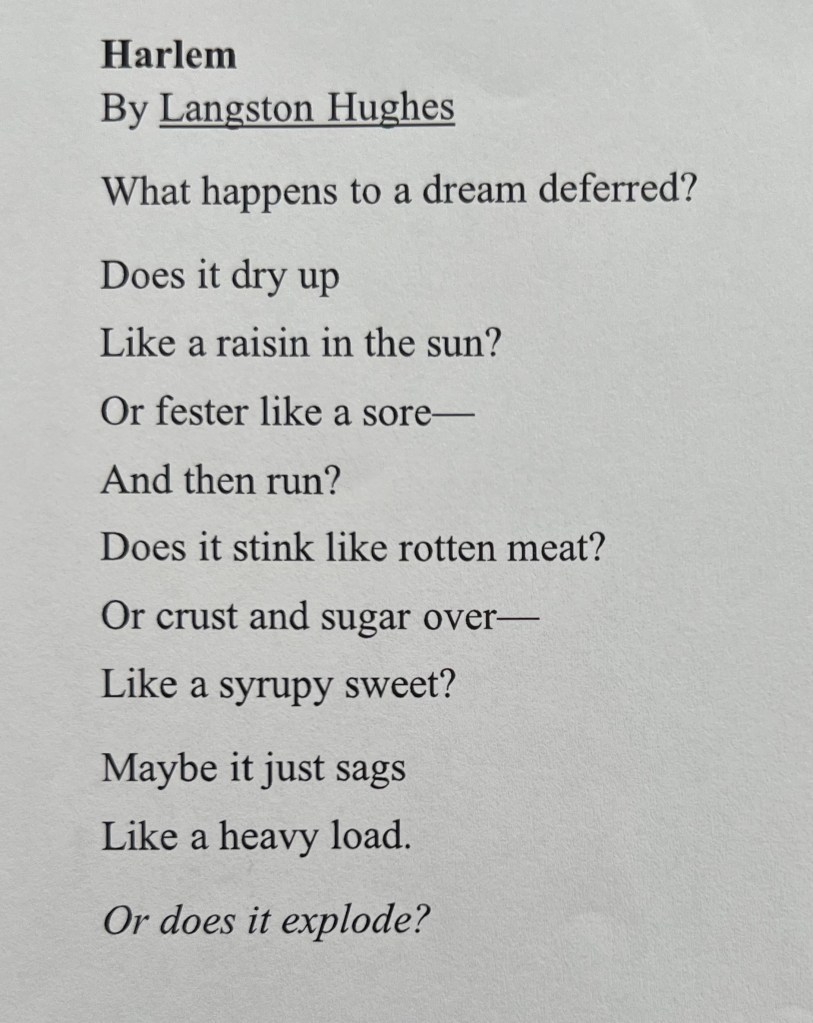
Included in the programme from Leeds Playhouse. Photographed by Stan Graham
 Tyke It To The Limit