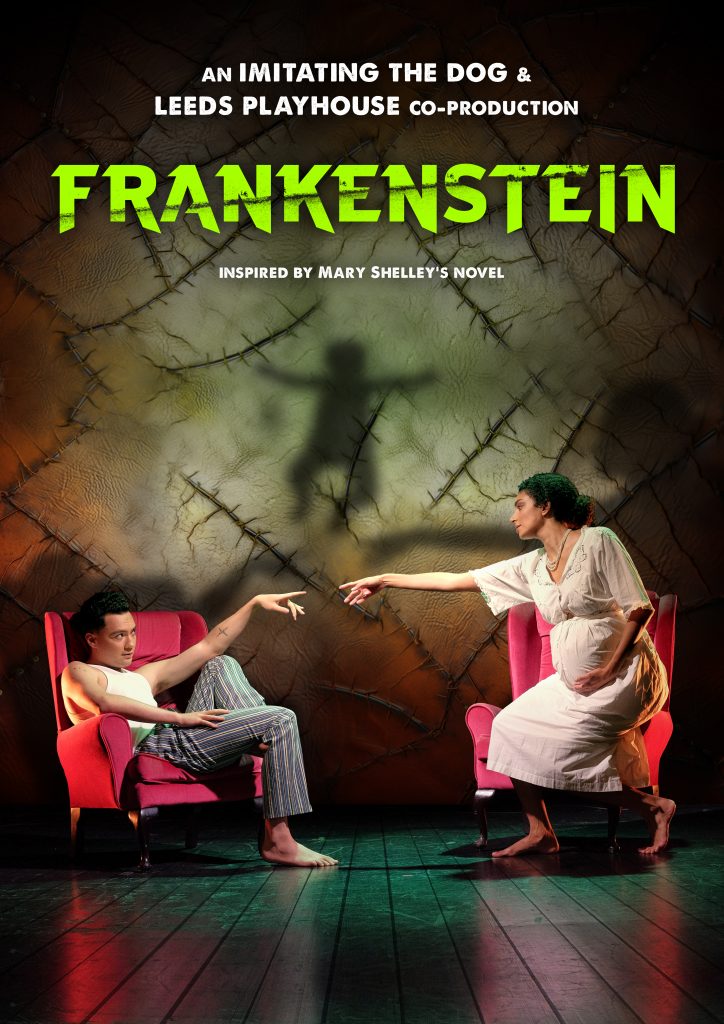
imitating the dog have made their name by staging productions which do not conform to the norm, even their name has no upper case letters. I find that last fact extremely irritating but the first one usually compensates by stretching the audience’s intellectual boundaries. This piece was no different in that the telling of the story of Frankenstein was imaginatively done, referring back to the format of the novel rather than drawing on the images from the various film adaptations.
The novel, by Mary Shelley, was first published anonymously in 1818 and is widely regarded as the first science fiction story. Her name was added to the second edition in 1821. It was written in Geneva when, during 1816, known as The Year Without A Summer, due to the cold weather caused by the eruption of the volcano, Mount Tanbora, the previous year, Mary, her future husband Percy Bysshe Shelley, John Polidori and Lord Byron, who also found themselves in the Swiss city, had a competition to see who could come up with the best horror story.

Georgia-Mae Myers shows Nedum Okonyia the result of the pregnancy test.
Just to clarify matters, Frankenstein is the name of the scientist who created the creature, not the that of the monster. The being he made was not manufactured from whole body parts grafted together, nor was it animated by exposing it to electricity generated by lightning. Victor Frankenstein discovers an unknown principle of life which allows him to bring alive scraps of inanimate matter which he collects from disecting rooms and slaughterhouses. The creature had to be of huge stature because some of the components of the human body were too small to work with in their ‘natural’ state. The result was an 8ft tall, grotesque being resembling a human but with yellow eyes and skin, transparent enough to display the muscles and blood vessels beneath. Frankenstein is so repulsed that he leaves the creature in the laboratory. The following day he meets an old friend, Henry Clerval, whom he takes to the lab to show him the monster. When they get there they find it has escaped. Victor moves away to study until he gets a letter from his father saying that his brother William has been murdered. On his return to Geneva he sees his creature near the crime scene and is convinced it is responsible.

A series of adventures, sees Frankenstein pursue the being across Europe and eventually to the North Pole He is discovered on the brink of death from hypothermia by Captain Walton whose ship had been ice bound. Both men had seen a dog sled being driven by an enormous being and had pursued it. This is where the novel actually begins, the aforementioned narrative, and other incidents too numerous to relate here, being told in what amounts to a series of flashbacks from the point of view of the different participants: Captain Walton, Victor Frankenstein and The Creature, as documented by fictional correspondence between Captain Walton and his sister, Margaret.
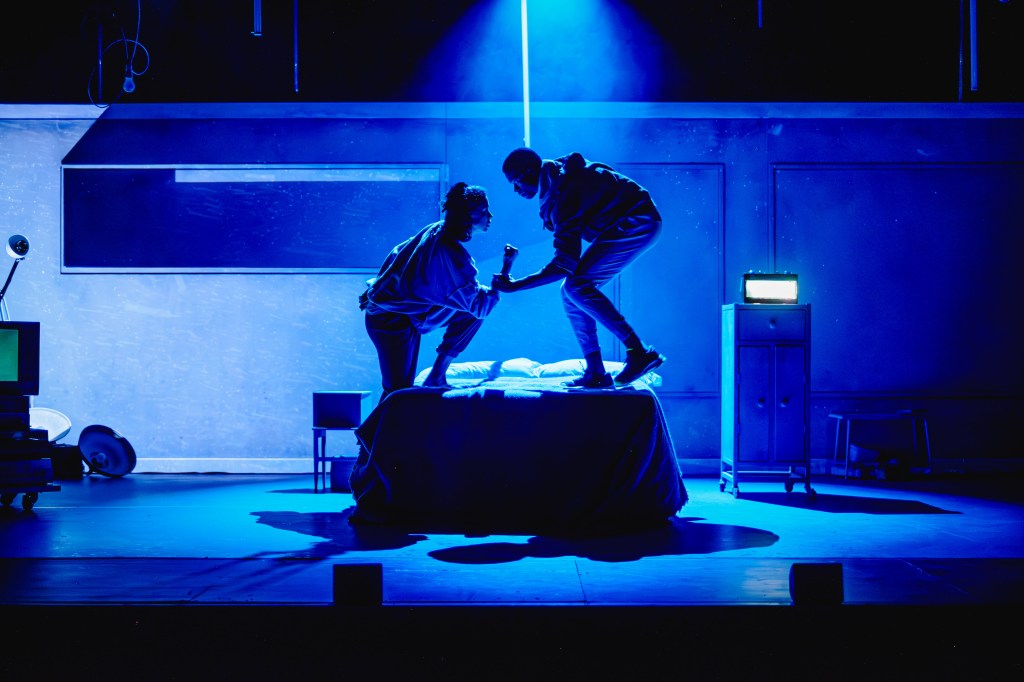
This dramatisation employs the use of only two actors; Georgia-Mae Myers and Nedum Okonyia who convey the story by the use of spoken word and dance, although, as there is no music, it is more of a physical interpretation. The employment of projections onto the rear of the set and special effects are also utilised in a most imaginative way.
Frankenstein’s journey to, and discovery at, the North Pole are represented by the radio which seems to be permanently tuned to Radio 4 as it plays the Shipping Forecast and news items pertinent to the voyage.

The actors portray a young, unnamed couple in their home, which they seem loathe to leave being in a kind of perpetual dread of the outside world. When the woman discovers she is pregnant, there follows a series of diatribes between the pair on the responsibility and ethics of creating a living being in a time of so much uncertainty. During these debates the number of days in the gestation period which have passed is shown by means of a projection onto the back or side of the set. The deadline for deciding on a termination adding tension to the discussion. The pregnancy is also followed by use of a large iPad-like screen which the woman periodically holds in front of her abdomen with an image of the foetus displayed. The activities of a strange neighbour added more than a little menace.

The special effect showing the progression of the foetus, whilst the blizzard rages outside.
The action at the North Pole is represented by a blizzard, once again projected to the rear of the stage. A third strand to the story, the relationship between Victor Frankenstein and his fiancee, Elizabeth is interspersed between the other two by means of a voiceover.
The creature is not all bad and another facet of the novel, appropriately enough, is that you can’t judge a book by its cover. He, for it is male, takes pity on a poor couple and moves next door to them in the forest, making and leaving meals outside their cottage under cover of the night. He also cleared snow from their path and performed other tasks. He tried to befriend them but the only person in the house was the blind father with whom he conversed freely. When the sighted son came home he was frightened and attacked him. The next day the family moved away. The creature saw himself in a reflection in a pool and was as horrified as everyone else. He sought out Frankenstein and demanded that he create a female version of himself so he could live happily with her in seclusion, Victor agreed as he was so worried about the consequences of refusing, but had no intention of doing so as he thought the second monster would be more evil than the first.
In the play, the woman assumes that the child will be a girl and begins calling the unborn infant ‘she’. I assumed that this was to echo the creation of a female by Frankenstein, thus explaining why there was the thought of terminating the pregnancy.
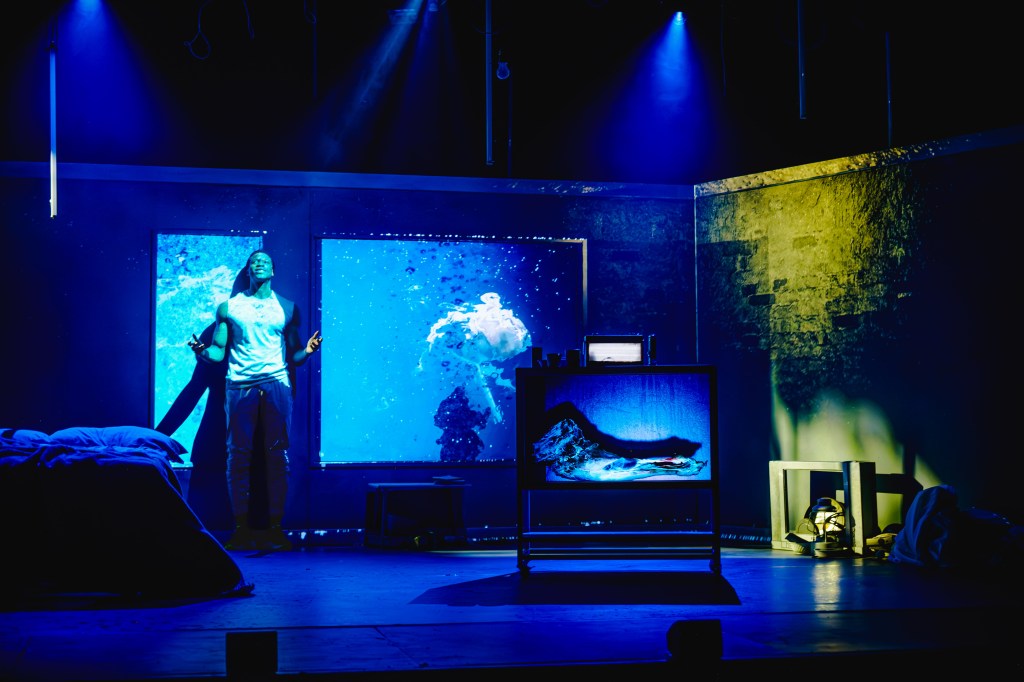
More special effects adding to the tension
Not having read the book, the synopsis above being gleaned from research whilst writing this article, I found the way in which the story was conveyed to be a little confusing to begin with, but I soon worked out what was going on and from that point I was engrossed.
The physicality of the actors, not to mention their stamina, was very impressive. I was at the Saturday matinee which meant that the two-hour performance had to be repeated with only a three-hour recovery period. The special effects were stunning and the sparse set added to the claustrophobic sense of impending disaster. I won’t reveal the ending as I would hope that you would go and see it for yourself.

What I was also impressed by was the honesty. The play is billed as Frankenstein, Inspired by Mary Shelley’s Novel. I have seen so many productions which have been ‘reimagined’ for the stage whilst purporting to have been written by the original playwright.
Frankenstein, a Leeds Playhouse and imitating the dog production, Directed by Julie Brown, runs at Leeds Playhouse until Saturday, 24th February. Details and tickets can be obtained at https://www.leedsplayhouse.org.uk/event/frankenstein/ after which the production goes on tour to Oxford, Watford, Salford Quays, Switzerland, Doncaster, Colchester, Liverpool, Lancaster and Newcastle. Dates and venues can be found at https://www.imitatingthedog.co.uk/project/frankenstein/
All photographs by Ed Waring
 Tyke It To The Limit