
Of all the types of events I write about, I find art exhibitions to be the most challenging. When I look at a painting, sculpture or any other item in a gallery I resist the temptation to read the explanatory notice next to it until I have made my own interpretation. Invariably my take on the piece is wildly different from the message that the artist intended to convey, but I believe that the whole point of the exercise is to run your ideas up the flagpole and see who salutes them. Contested Bodies narrowed down my field of perception as the exhibition was to present the artists’ gender, or view on gender, as the basis of the work, so focussed my mind in that direction.
I find the whole gender debate quite confusing with something so basic as the means of procreation, being subdivided into so many categories. Before anyone writes me off as a typical white, middle class, elderly man who is out of touch, I would inform you that, in the early 1990s I was in a relationship with a woman whose sister began life as her brother. After going through the many medical procedures in order to facilitate transition, she just wanted to live life as the woman she had become, quietly and peacefully in her cottage in the country. I often wonder how she feels about the histrionics surrounding the subject today. Anyway, on to the event itself.

The exhibition was introduced by University Librarian and Keeper of the Brotherton Collection at the University of Leeds, Masud Khokhar. Unfortunately he is a very soft-spoken man and I found it difficult to grasp most of what he was saying.
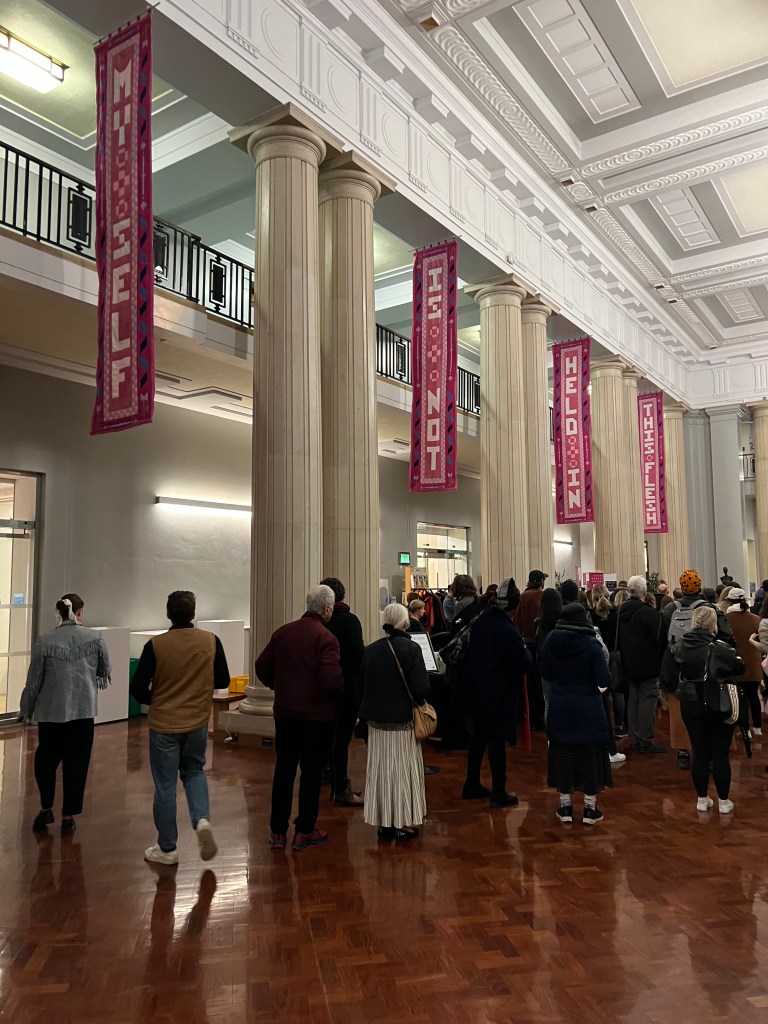
The Brotherton Building, where the exhibition was held, is a spectacular edifice being visible from all over the city. Inside, the first floor is a huge atrium with a series of rooms off one side. The event was in one of these and was large enough to easily accommodate the crowd at the opening.
Rather than begin with a photograph of an exhibit, I thought that I should include an image of the introduction displayed so as not to misrepresent the situation.
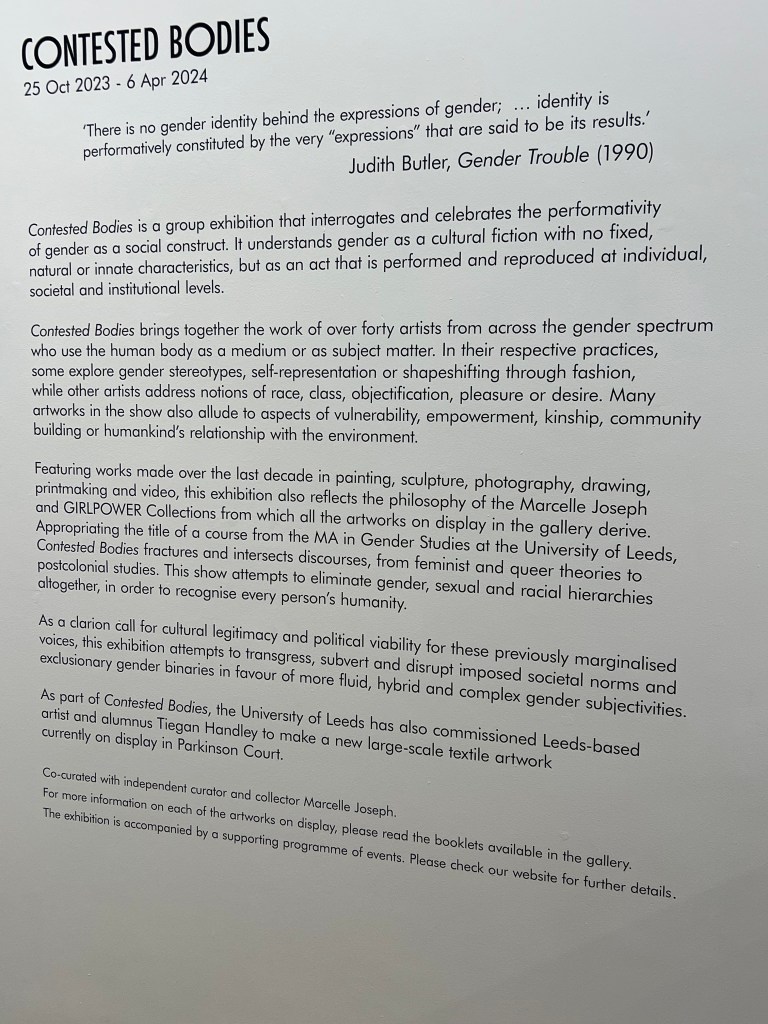
With that out of the way I had a stroll around the rooms to see what was on offer.
The pieces comprised a wide variety of visual techniques, some which I found very moving and others which, surprisingly, I found to be quite amusing. There were so many that I have only been able to include a small sample.
The first is called Looking Ready For It by Lisa-Marie Harris and is in Calabash, lacquer, leather and reclaimed intercom.

I could see no explanation of the work so we need to make of it what we will.

This is called Rhinestone Cowboy and is a self-portrait of the artist, Sam Keelan, who hails from the Wild West Yorkshire town of Huddersfield. The glittery container in his hand is an inhaler to self-administer poppers, or amyl nitrate, a sexual enhancer used by gay couples. The blood on his nose is a side effect of the drug, a reminder that he is still human even in his finest drag.
I placed this in the sad category, as I find a lot of the more flamboyant gay people I encounter to be trying to convince themselves that they are living the dream, but their eyes tell a different story. Here the artist’s eyes are hidden behind his hat brim, perhaps so as not to give the game away even more.

Sadly, I didn’t make a note of the details of this photograph, but I had to include it as it fell into the category, whether intentionally or not, of hilarious. I don’t know how universal this is, but when I was an adolescent, I was given the dire warning, from some who I regarded as elderly people, that I refrain from whatever word they used for masturbation, as, should I be so tempted, hair would grow on the palms of my hands. If the old-wives’ tale is true, then this chap is obviously ambidextrous and an avid practitioner.
I end with the poster for the exhibition, a facsimile of one of the exhibits, C.R.E.A.M. by Alberta Whittle. It is ‘an Afro-futuristic photo collage hinting at the daily posturing and pressures that Black people endure to survive in the face of white supremacy.’ The various elements expose the hidden history of violence and captivity in the Caribbean.
The reason I have chosen to use the version on the poster is that I found the stated aim of the artist and the collection of images to be totally undermined by the small flash in the top right-hand corner, especially given the pose of the model.

As you can see, Contested Bodies is open from 25th October until 6th April, 2024 and admission is free. For more details please go to https://library.leeds.ac.uk/events/event/658/contested-bodies
Photographs by Stan Graham
 Tyke It To The Limit
Looks… interesting! And good to see my old, much-missed haunt again. Thanks for an enjoyable review!
LikeLike
Thank you very much. I am writing this reply from your old haunt, another exhibition Treasures of the Brotherton. Watch this space!
LikeLike