
I can’t remember ever being so irritated and annoyed by a piece of work, partly because of the upsetting subject matter but also by the way in which it was written and produced, negating all of the valid points by reducing them to cliches.
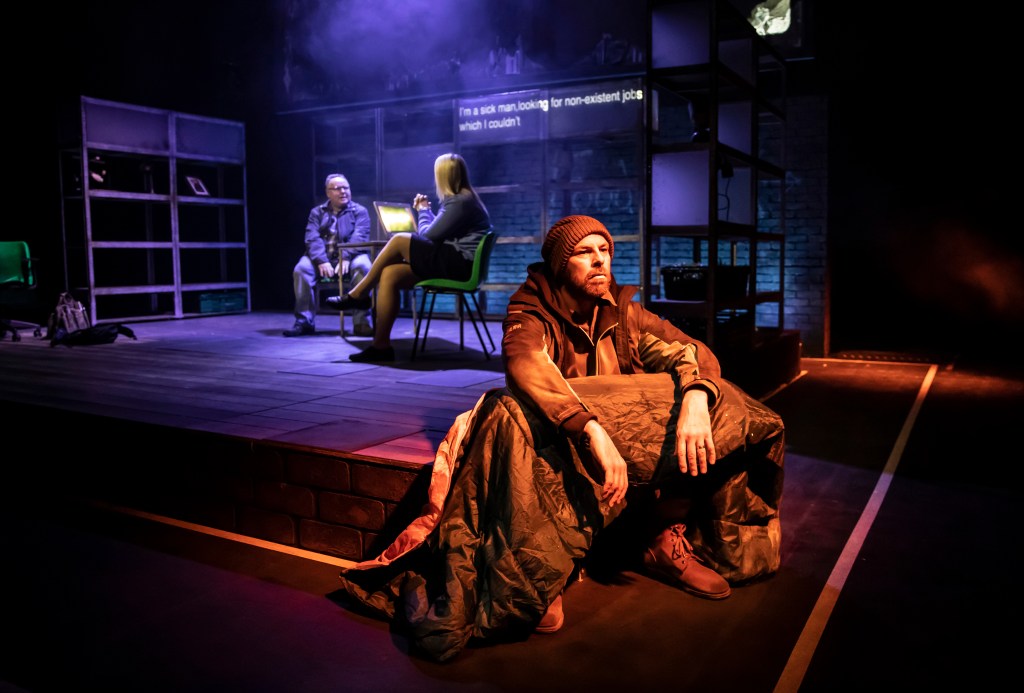
The play, adapted by Dave Johns from the film by Ken Loach, tells the story of the eponymous hero who is recovering from a heart attack. His doctor has certified that he is not yet fit to return to work, but the Department for Work and Pensions have their own standards and insist that he looks for work or lose his benefit.
When he is attending the DWP office for an assessment he meets a single woman and her daughter who are from London and being asked to leave the premises as they arrived late for their appointment. Being strangers in Newcastle they were put off the bus by the driver at the wrong stop, thus causing their tardiness. The officers in the department refuse to see them and say they must arrange another date, even though they have no money to see them through. Daniel Blake takes pity on them and helps them locate the flat which they have been allocated and, as he has no work, he assists them in fixing it up. They become good friends and help each other out.

Left to Right; Bryony Corrigan as Katie, Jodie Wild as Daisy and David Nellist as Daniel Blake
The vagaries of the benefits system decree that Mr Blake has to spend thirty-five hours per week looking for work and he must compile a cv to give to prospective employers. As he can’t work due to his medical condition, the process becomes a sham. He eventually has to sell all of his possessions and the woman, Katie, who is still without funds, firstly uses food banks to keep the two of them going, before resorting to shoplifting for hygiene products when her daughter, Daisy, is mocked at her new school for being smelly. She then moves on to prostitution to make ends meet. Because she feels such shame about this decision she tells Daniel that she doesn’t wish to see him again, a move which causes him deep pain and he withdraws to his flat. It is only when Daisy takes him a meal Katie has prepared that they reconcile. The two get together the night before Daniel’s appeal is due to be heard, but after she leaves, the inevitable happens and he suffers another heart attack, this time fatal.
The end of the play is taken up by, what should have been a touching moment, when Katie reads out a letter Daniel has given her, outlining what he was going to say at the appeal, so that she could peruse it and suggest any amendments. The letter ends with the following paragraph.
‘My name is Daniel Blake. I am a man, not a dog. As such, I demand my rights. I demand you treat me with respect. I, Daniel Blake, am a citizen, nothing more and nothing less. Thank you.’
I have not sen the film but I have the greatest respect for Ken Loach who, over the years, has led crusades for social justice. His most famous work was Cathy Come Home, broadcast by the BBC in 1966 as part of their Wednesday Play series. It had such an impact that it changed the way in which single parents were regarded when it came to housing and child care.
Having done my usual research I find that the stage version of I, Daniel Blake, differs from the film in a couple of ways; firstly, the original was set in 2016 when David Cameron was Prime Minister and Katie had two children, rather than one. The play was prefaced by some soundbites of the prime ministers since that date; Cameron, May, Johnson, Truss and Sunak, to show that things have moved on somewhat. Not necessarily for the better due to the impact of COVID, Brexit, the Cost of Living Crisis, not to mention the broken promises and failed reforms.
Micky Cochrane as Harry Edwards/Floor Manager/Ensemble
Having the highest regard for Mr Loach I hope that there were other deviations from the film version, because I found the characters in the play to be bordering on the caricature. Daniel is an avuncular Geordie, cashing in on the images of a nice middle-aged man, with what is regularly voted the most trustworthy accent in the UK, a region also with an historically high level of unemployment, indicating lack of opportunity. Katie was a Cockney and, as such, was stereotyped as not trusting anyone, being suspicious of their motives in offering help. The staff at the DWP were portrayed as being deliberately obstructive and unhelpful, almost to the point of revelling in their roles. When one female officer was reading out a list of questions she was directed to ask the less relevant ones in a sneering, sarcastic manner, a little childish I thought. I realise that the whole point of the piece is to illustrate the totally unacceptable way claimants are treated, but, come on, she had probably had a constant string people over a period of years to whom she had had to ask the same questions, which, although seemingly irrelevant to the particular claimant, were designed to progress the matter to the appropriate caseworker. Similarly, the chap in the call centre hadn’t been sitting there listening to the phone ringing for an hour before answering it, it will have been directed to him from the queue, his volume of calls monitored so that he had to constantly keep working.
Similarly, the DWP caseworkers will have a full diary so that, should they see someone who has arrived late for their appointment, there would be no wiggle room meaning that the person who arrived on time, or even early, for the last slot of the day could not be seen.
This simplistic look at the way the system operates I find to be demeaning to those who are trying to use it and those who are trying to operate it, both under great strain.

Kema Sikazwe as China
There was emphasis put on the need to complete certain procedures on-line which can be a major obstacle to someone like Daniel who is a middle aged manual worker, therefore deemed by the writer to be computer illiterate. Some are, but there are many in that demographic who manage to order stuff from Amazon, and WhatsApp friends and relatives with consummate ease. Here Daniel asks China, a neighbour with a side line in importing fake designer trainers and selling them from a suitcase on the street, for help, which he receives. Later he tries to do it himself at the public library but with no success. At no time was it even hinted that the obvious plan of action, seeking assistance from the brilliant Citizens’ Advice Bureau, be explored. That would have defeated the object and got the matter sorted out, so no play.
The thing I found which undermined the impact of the piece most was the sheer hypocrisy of Daniel. I referred to his final message as, what should have been a touching moment, but I couldn’t help but recall the abuse he had meted out to the DWP staff, both male and female, in person and on the phone, scattering F-bombs like confetti and telling them they must change the system to accommodate his circumstances. He then demands to be treated with respect! Respect is a two-way street, and should you come across a thoroughfare where it is one-way, it should be flowing from you to the recipient.
I am so upset about this play because it is highlighting a valid problem which needs addressing. In another part of his final note he says that he is a person with a name rather than a number or National Insurance number. We all know that we are numbers as, although depersonalising people, it speeds up identification and helps eliminate mistaken identity. No one seems to whinge about having to accept an email address such as JohnSmith3456@whatever.com to differentiate them from all the others of the same name, so why a NINO.
The acting by all concerned was as good as it could be, given the direction to overplay the authority figures. I also found it difficult to believe that Daisy was young enough to be Katie’s daughter, but I suppose that as it is a stage show, a child actor would present problems with the restrictions on the hours worked. David Nellist as Daniel seamlessly morphed from Mr Nice Guy to Mr Angry, whilst Bryony Corrigan as Katie nailed her part to perfection.
To sum up, I thought this was a wasted opportunity to make a valid point seriously. To revert to a cliche myself, sometimes less is more!
Feature image provided by Leeds Playhouse, photographs by Pamela Raith
I, Daniel Blake is at Leeds Playhouse until Saturday, 7th October and then touring. For more details and to book please go to https://leedsplayhouse.org.uk/event/i-daniel-blake/
 Tyke It To The Limit
Don’t let the play put you off the far superior film.
LikeLike
Thank you for that, I won’t.
LikeLike