
It’s that time of year again when the Opera North Winter Season begins. The various environmental groups will be pleased to read that it has been renamed The Green Season as all of the productions conform to the Theatre Green Book standards which sets out new benchmarks for sustainability. What might upset them though is that the first offering is Falstaff by Giuseppe Verdi and is full of fun and laughter so not compliant with their mission to make our lives a bloody misery.
The essence of The Green Season is that as much as possible of the scenery, props, costumes and other theatrical necessities have either been used in previous productions or acquired second-hand. I do believe that even some of the singers, and certainly the conductor, Garry Walker, have appeared in past operas and concerts, now that’s what I call recycling. The final green link is the work in question, Falstaff by Giuseppe Verdi – verdi being the Italian for ‘green’.
As I said before, this is an opera full of fun and silliness, although there is a lot of wit in the libretto so not a complete farce. Based on The Merry Wives of Windsor by Shakespeare, first published in 1602, Verdi’s opera was premiered in 1893 at La Scala in Milan and, as is seemingly compulsory nowadays, it was performed in modern dress. I am sure this more easily facilitated the acquisition of some of the costumes but it made something daft, dafter still.

Left to right: Colin Judson as Bardolph, Henry Waddington as Falstaff and Dean Robinson, Pistol
The synopsis is that Falstaff has been out on the lash with his mates Bardolph and Pistol, who have got him drunk and robbed him. When Dr Caius tells him what has happened, the two miscreants mock him and he leaves. The landlord appears with the bill for the night’s session which Falstaff can’t pay. This is where the modern ‘dress’ jars as not only is he brassic, but he is clad like a cross between a character from that tv series, Shameless and Jim Royle, in trousers, braces and vest. That last sentence will have totally confused my American readers to whom a vest is a waistcoat – note, here it is an undershirt. He decides that, as he is a Member of the Order of the Garter, and fat, he will be irresistible to women so plans to hit on a couple who are married to rich husbands. The criteria might have worked in 1602 when being fat was a status symbol, being OG still is, but nowadays being a drunken, overweight, lazy scruff does nothing for the sex appeal, if it did I would have women queuing round the block – hey ho.
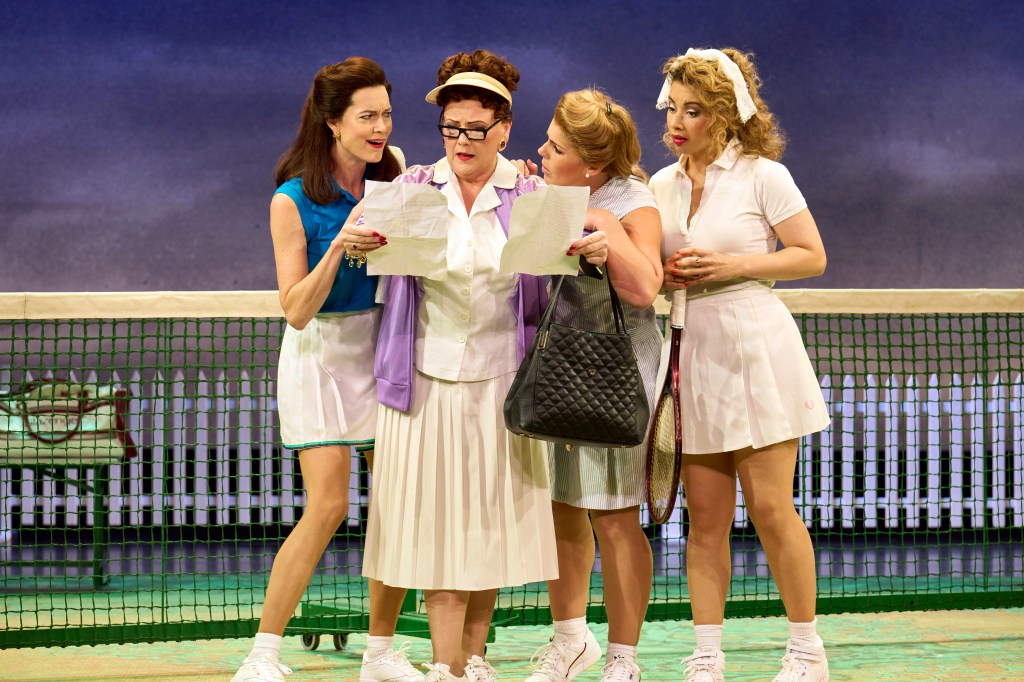
The ladies: Kate Royal as Alice Ford, Louise Winter as Mistress Quickly, Helen Évora as Meg Page and Isabelle Peters as Nannetta
Falstaff writes two identical letters, one to each of the targets and gets Robin to deliver them. Meg and Alice, for they are the ladies in question, realise that they are being played and, with the help of their friend, Mistress Quickly, set a trap to disgrace the perp, not that he needs much help in that department. Alice’s husband, Ford, becomes jealous when he suspects his wife has a secret lover so he goes to see Falstaff, in disguise, seemingly as a Texas oil baron, and pays him to seduce his wife to test her fidelity.

The ‘gentlemen’: Colin Judson as Bardolph, Paul Nixon as Dr Caius, Dean Robinson as Pistol, Richard Burkhard as Ford and Egor Zhuravskii as Fenton
Ford becomes more jealous and, having learned of Falstaff’s appointment with his wife, he turns up at her boudoir, forcing the Lothario to hide in a laundry basket, which the ladies arrange to have thrown into the Thames by four proper hunks. In a sub-plot, Ford has promised the hand of his daughter, Nannetta, in marriage to Dr Caius, who is much older than she, but her heart belongs to a young man called Fenton.

Washed up and washed out, Falstaff with bottle
When Falstaff is dragged from the river he hits the bottle again and is told by Mistress Quickly that his other mark, Meg, will be under the great oak in Windsor Park at midnight. She says that there will be many people there, all in fancy dress. He decides to go as Herne the Hunter – as you would – and dons a set of antlers. To cut a long story not very short, there is to be a wedding in the park and Mistress Quickly arranges for Nannetta and Fenton to be in similar fancy dress to that worn by the legitimate couple and to make it a double wedding, Ford only realising the consequences when Fenton’s hood is removed. He has performed the ceremony and, not only has he married his daughter to Fenton but also married Dr Caius to Bardolph, again, something which would have been shocking in 1602, or even 1893, but is very ho-hum nowadays.
Any road up, they all see the funny side and more alcohol is consumed, naturally.
It took me little while to get into silly mode but there were several audience members guffawing from the first note so, not being one to argue with the verdict of the paying punters I unleashed my inner Chuckle Brother and went with the flow. I don’t think people realise how weird it is to keep a part of your brain analytical in order to take note of the sound, no pun intended for once, the lighting, props, scenery and general production whilst, at the same time hitting the daft switch to enjoy the piece. So…
The sound I found to be a bit patchy to begin with, the singers not very loud when at the rear of the stage, but it seemed to improve fairly quickly. To be fair to those involved, I was recovering from a bad cold and my lugholes were a bit bunged up. The lighting, under the direction of Paule Constable and Ben Pickersgill, was excellent, as was a very inventive projection to the back of the stage. The sets by Leslie Travers ranged from a derelict caravan which Falstaff called home, a tennis court, a boudoir, the banks of the Thames and finally an oak tree which self-assembled before our eyes. The costumes were designed by Gabrielle Dalton, who must have spent some time in less than salubrious surroundings to get Falstaff’s look right. She does a very convincing fat suit as well. Lauren Poulton was the Movement Director without whose skills a lot of the farce scenes of people chasing one another round various locations, would not have worked half as well as they did.
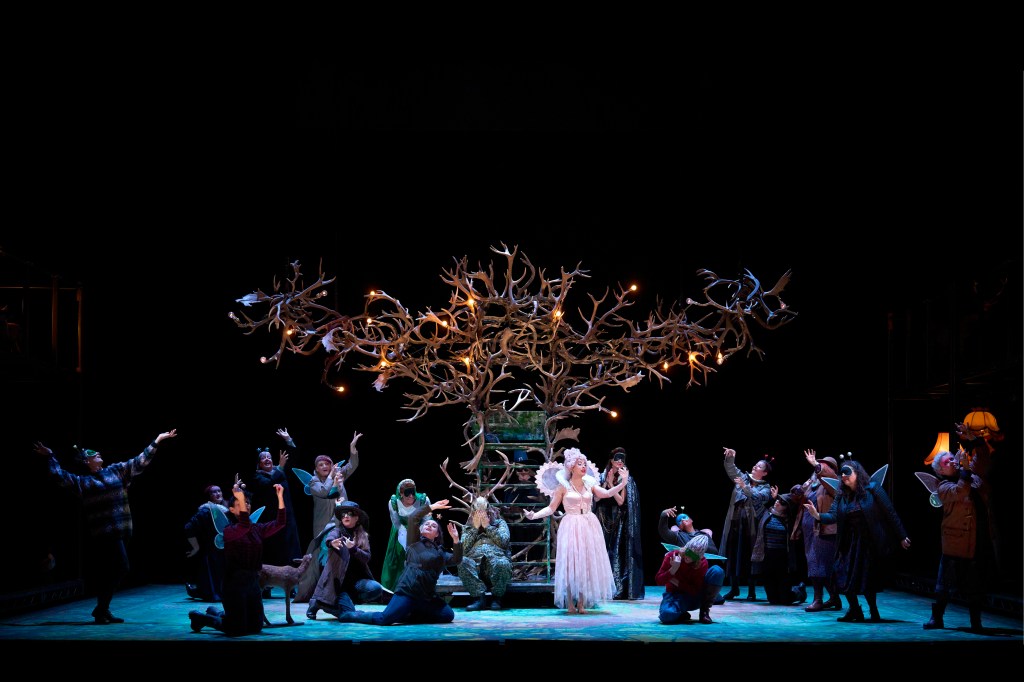
The cast under the old oak tree for the finale.
Falstaff was Directed by Olivia Fuchs and I believe was a great success. if a farce can make me laugh then it is a triumph.
The Orchestra of Opera North was in its usual fine form under the baton of Garry Walker, as was the Chorus, Mastered by Anthony Kraus!
Henry Waddington was superb as Falstaff, his bass/baritone suitably rich but with the hint of world-weariness reflecting his situation. He is one of those characters who doesn’t seem ever to be worried about impending doom as long as he can blag a drink from a landlord, an eternal optimist. He can also pull off wearing a fat suit convincingly, his large white beard filling out his face.
The two ladies, Meg Page, sung by mezzo soprano Helen Évora and Alice Ford, soprano Kate Royal, added the required touch of glamour associated with posh Windsor yummy mummies, highlighting even more, the chasm between their sophistication and Falstaff’s self neglect. Louise Winter as Mistress Quickly lived up to her name, darting about like a mother hen protecting her chicks, Meg, Alice and Nannetta.
All in all, this is an opera to enjoy just for the sheer amusement of it and so, should you be contemplating a first time visit to sample the medium then I would heartily recommend it as your option for the Try it ON scheme https://www.operanorth.co.uk/your-visit/new-to-opera/tryiton/
If you are an opera regular in need of cheering up, and who isn’t, then I still recommend it. It runs on various dates in Leeds until 25th October when it decamps to Theatre Royal, Newcastle, Theatre Royal, Nottingham and The Lowry, Salford Quays. For full details and to book please see https://www.operanorth.co.uk/whats-on/falstaff/
To see details of the other productions in The Green Season it is https://www.operanorth.co.uk/whats-on
Photographs provided by Opera North credit Richard H Smith.
 Tyke It To The Limit