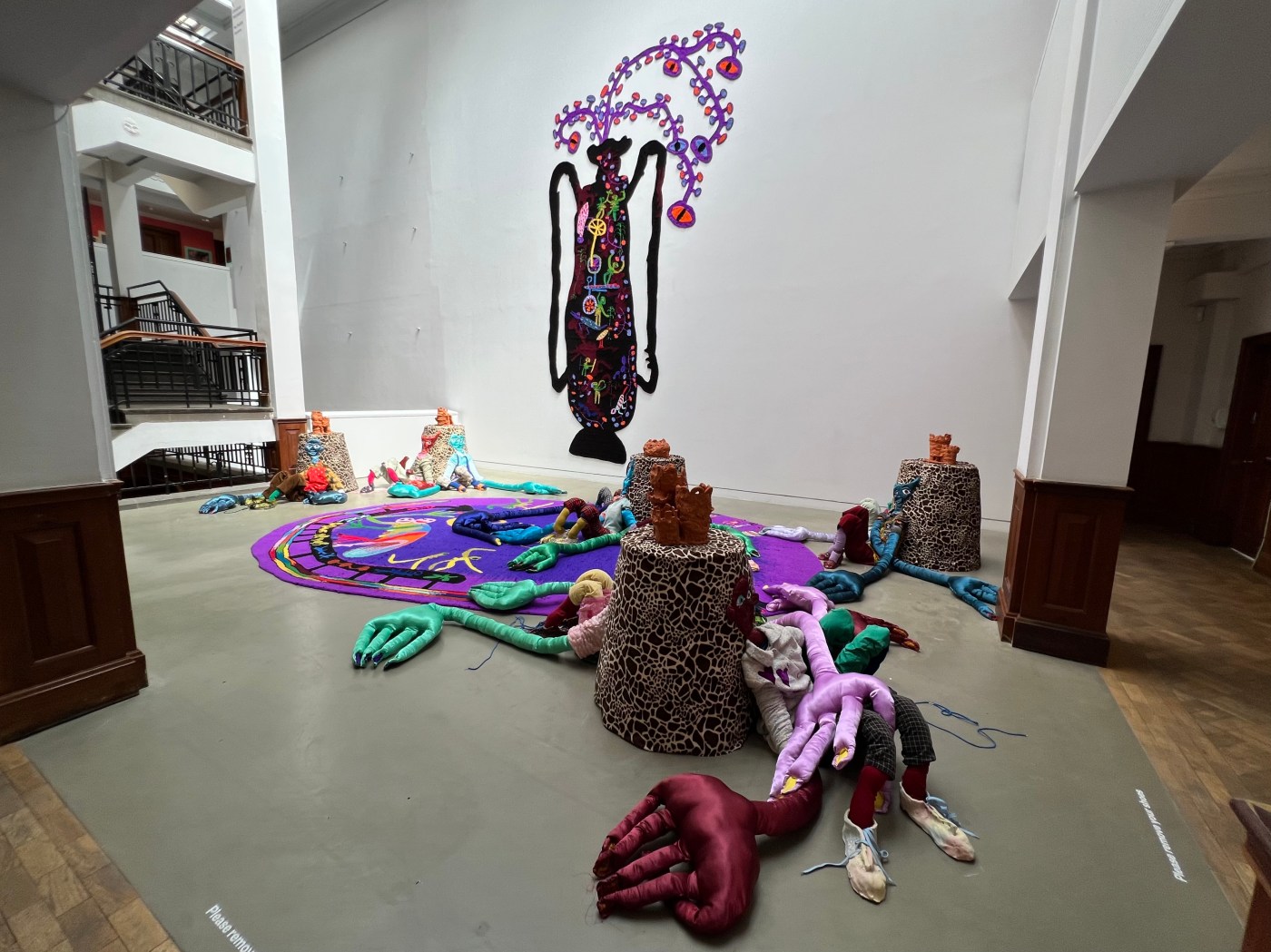
It is always a pleasure to visit The Tetley, not only for the art installations and menu launches, but because it is a piece of Leeds’ history in its own right and brings back memories of the fun visits I paid when it was a brewery. Fortunately, when I go there these days I feel much better the following morning than I used to.
Speaking of fun, that was the emotion which Dutch artist, Afra Eisma, is trying to convey in her soft sculptures, paintings, sound works and ceramics. After hearing her give a guided tour of the various rooms, it is also a description which could be applied to her persona. The get up is also a bit of a giveaway.
After an introduction by Bryony Bond, the Director of Tetley, we were given an overview of the exhibition by its Curator, Georgia Taylor Aguilar, who also accompanied we viewers to add her expertise to the mix. I am so glad that we had the artist and curator with us as I was seeing the exhibits in a totally different way to that which was intended, but that is the point of art; you do what you do and then let the viewer interpret the results for themselves.
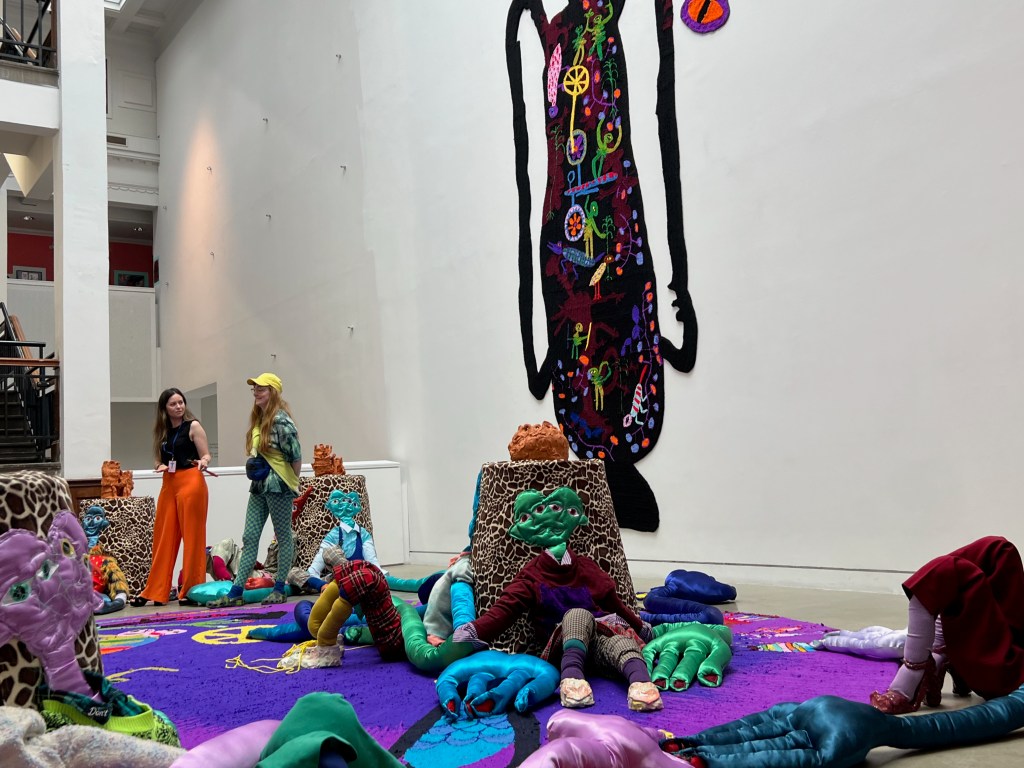
Georgia Taylor Aguilar, left, and Afra Eisman
The great thing about this exhibition is that it has been tailored to some extent to fit the space, so possibly could not be shown in full at other galleries. The most glaring example of this is the giant tapestry, celestial dreams, suspended in the Atrium, which was created when Ms Eisman saw the huge amount of wall space so felt that she had to make something to fill it.
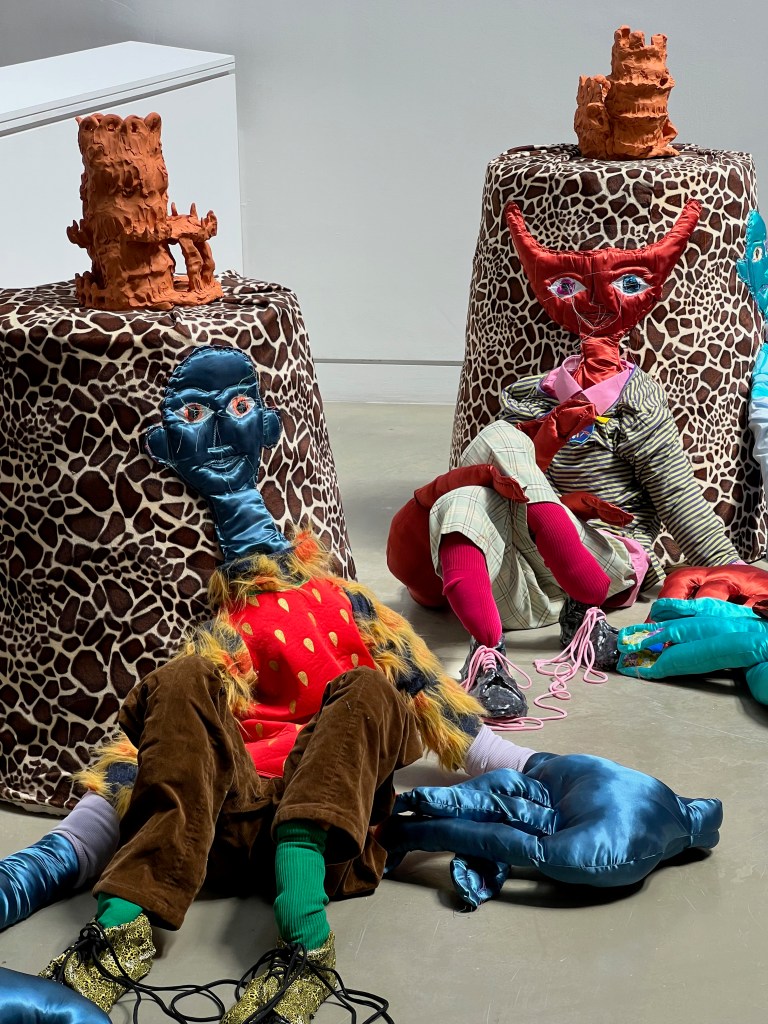
On the floor in front of the tapestry is a collection of soft sculptures to be enjoyed in a tactile way with visitors encouraged to sit amongst them and be comforted by stroking or just touching. When you visit, please be sure to remove your shoes before engaging with this particular installation, and don’t take any food or drink into any part of the exhibition. Shouldn’t need saying but I am just making sure.
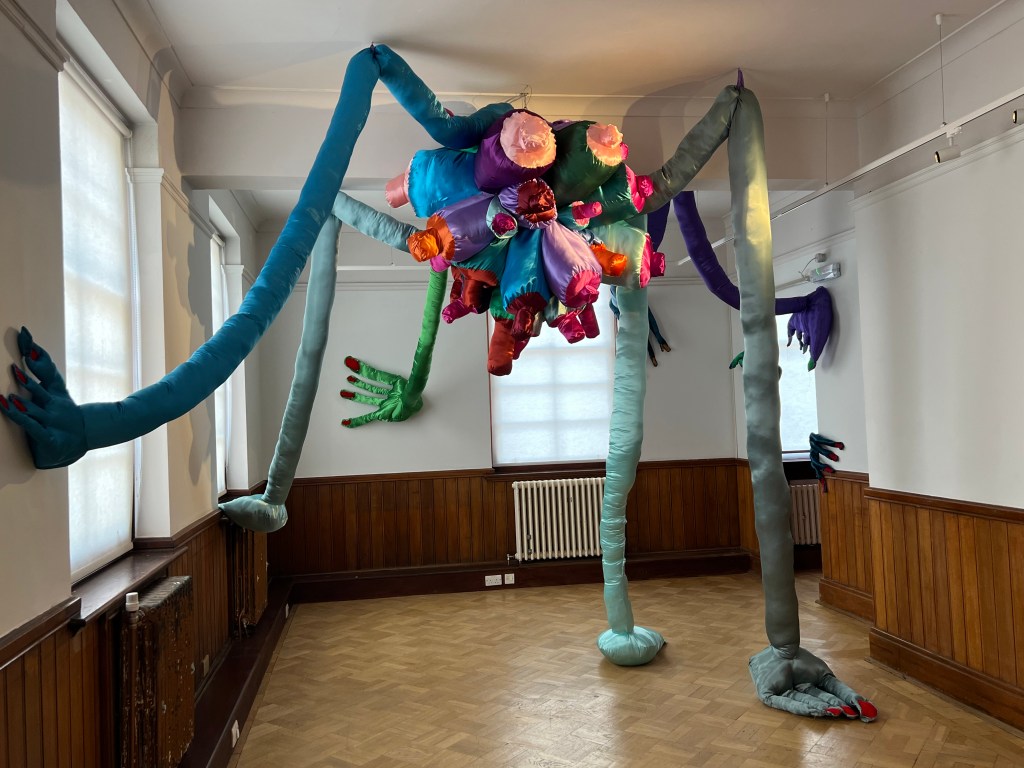
Rather than being fun and comforting, I found the figures, some of which had two heads, and hands to be quite disturbing, but more of that later.
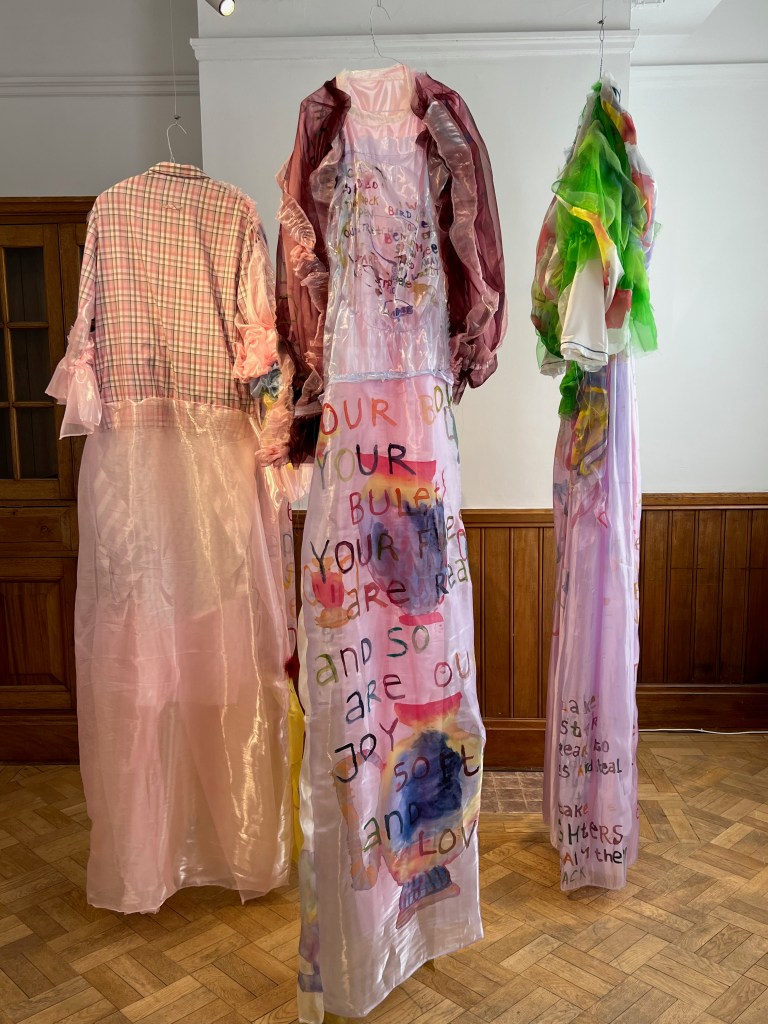
The first side room contained a display of three multi-layered dresses which had slogans painted on them. Ms Eisma said that these were what she calls her Warrior Garments which she wears when attending protests, as they invoke her alter ego. The frocks are suspended from a carousel which takes a minute to rotate them.
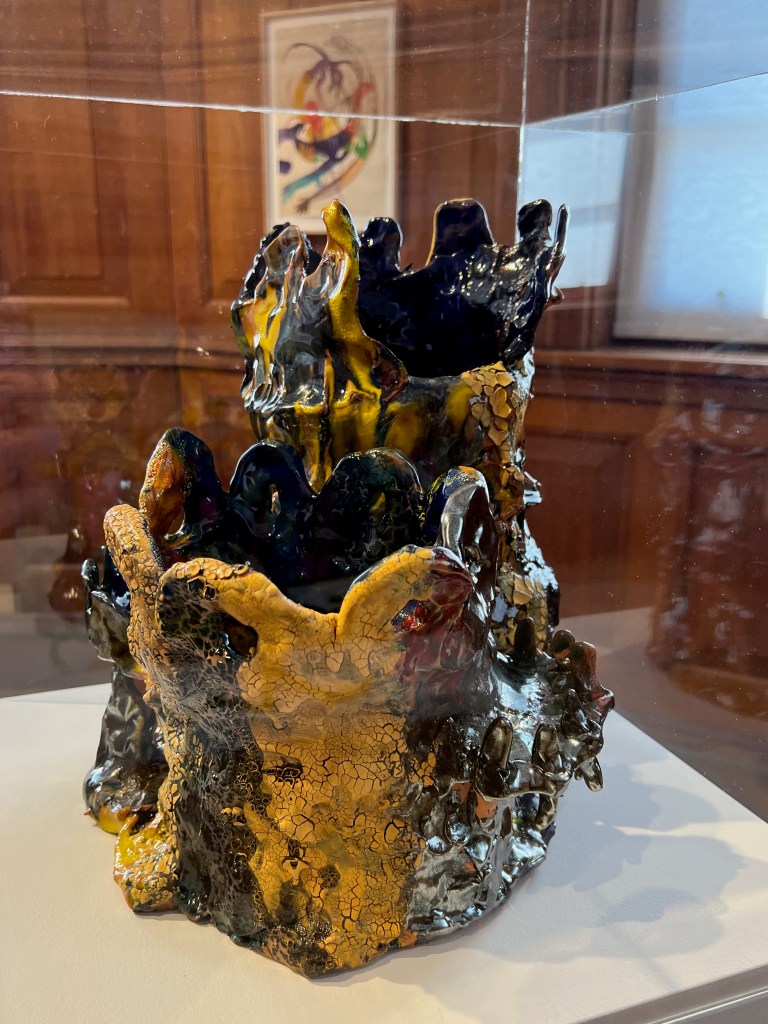
The next room is the home to drawings, and a model, which are miniature templates for the rest of her work. There is also a ceramic piece which is a multiple container.
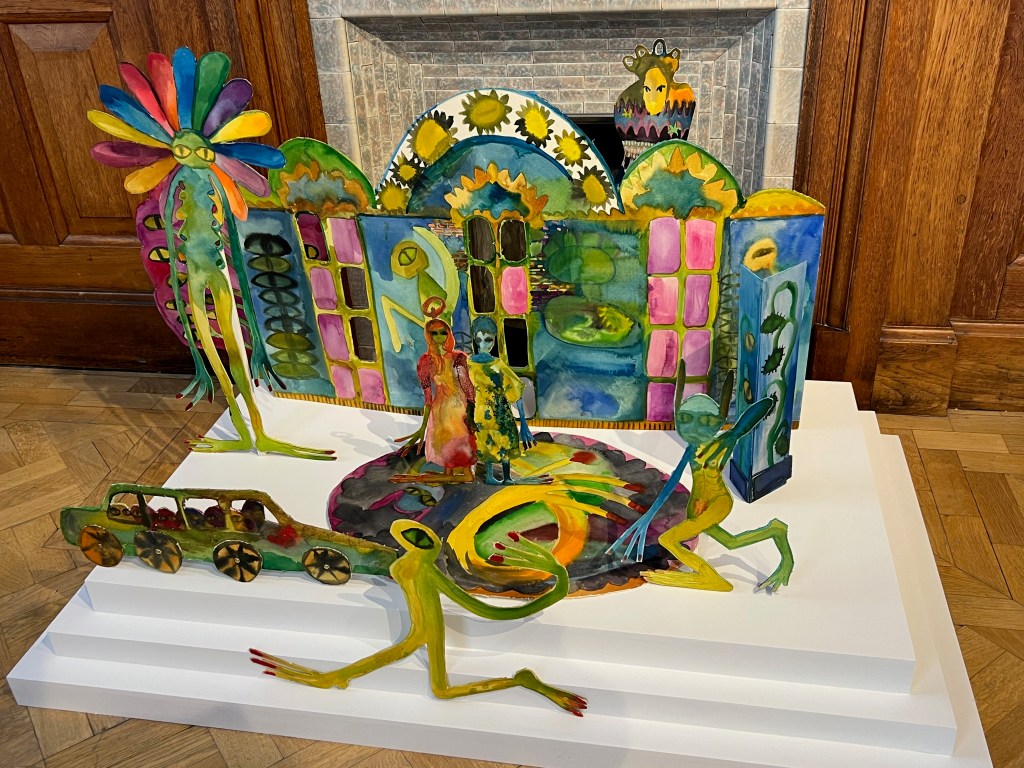
The composite model of ideas used in later rooms. The significance of the containers, below, is explained in the next exhibit.
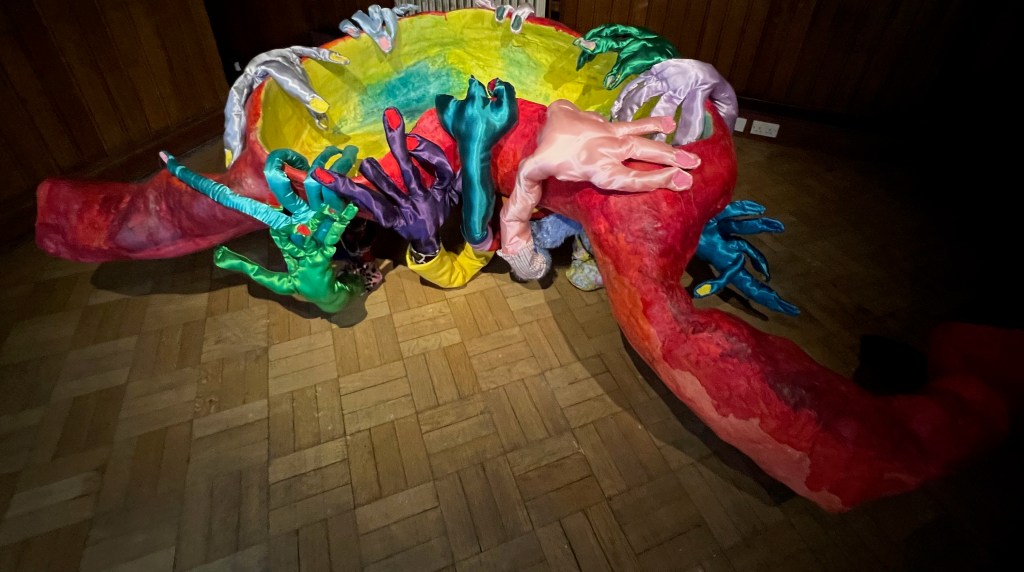
If I thought that the figures in the Atrium were disturbing, that was nothing compared to what I felt in Gallery 3 which consists of a stomach, complete with rumbling and gurgling sounds. It symbolises a primitive type of container holding butterflies, knots, food and gut feelings. The artist gave an amusing explanation for the noises and asked why we are embarrassed when our stomachs rumble in public. It is a totally involuntary action but we still feel guilty. Yet more hands are holding the top open so as to facilitate the addition of more contents.
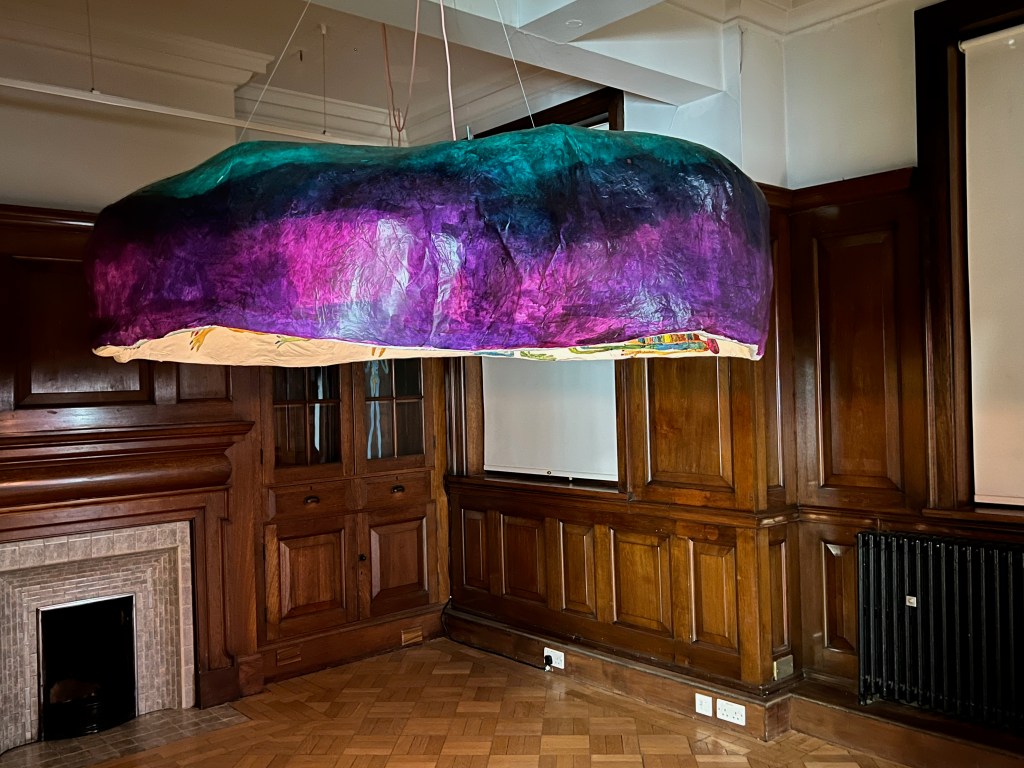
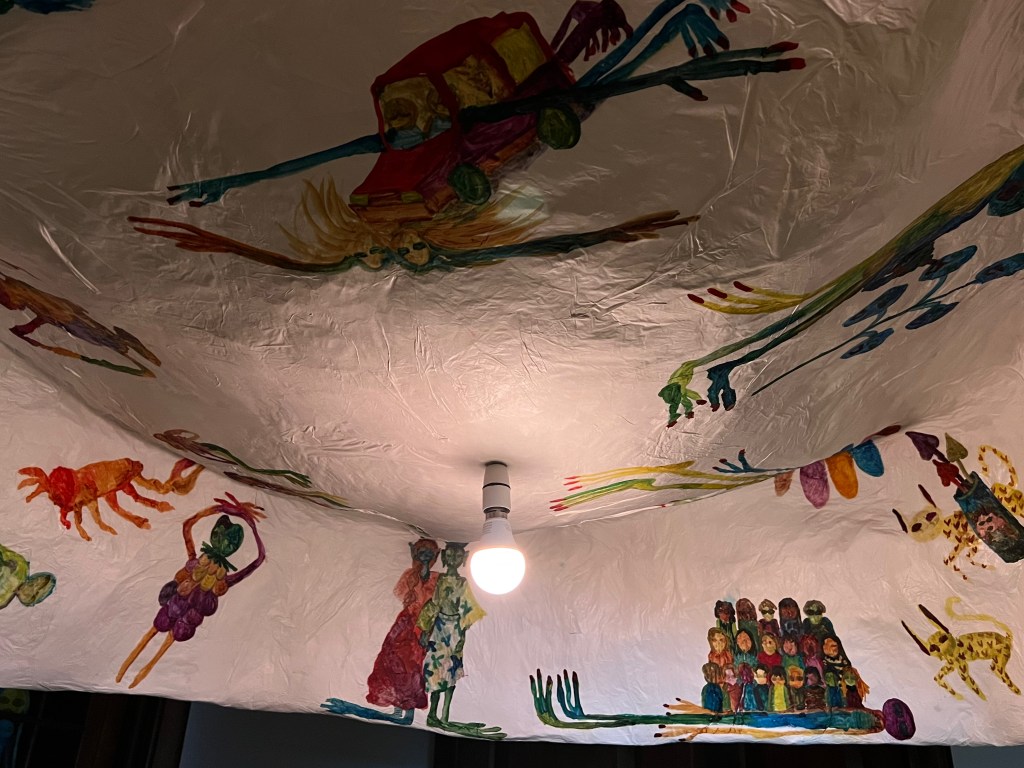
Gallery 4 contains a giant lampshade suspended from the ceiling which encourages the viewer to walk beneath it in order to see the underside of the shade. The images revealed are a universe with details of her life and best friends in various settings.
On leaving this room we are ‘invited’ to the next along a corridor, the access to which is kept open by yet more hands. I thought, once again, that they were a force of danger rather than help and could let go of the doorway at any time to capture us in the walkway. There was also an ominous dripping noise.
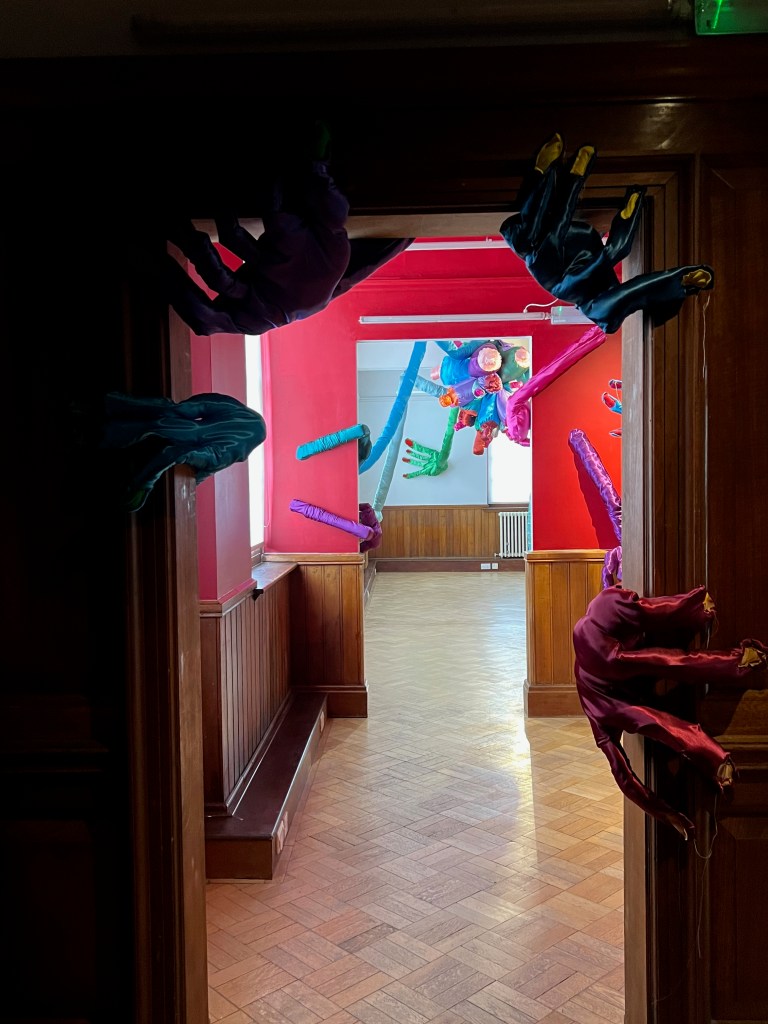
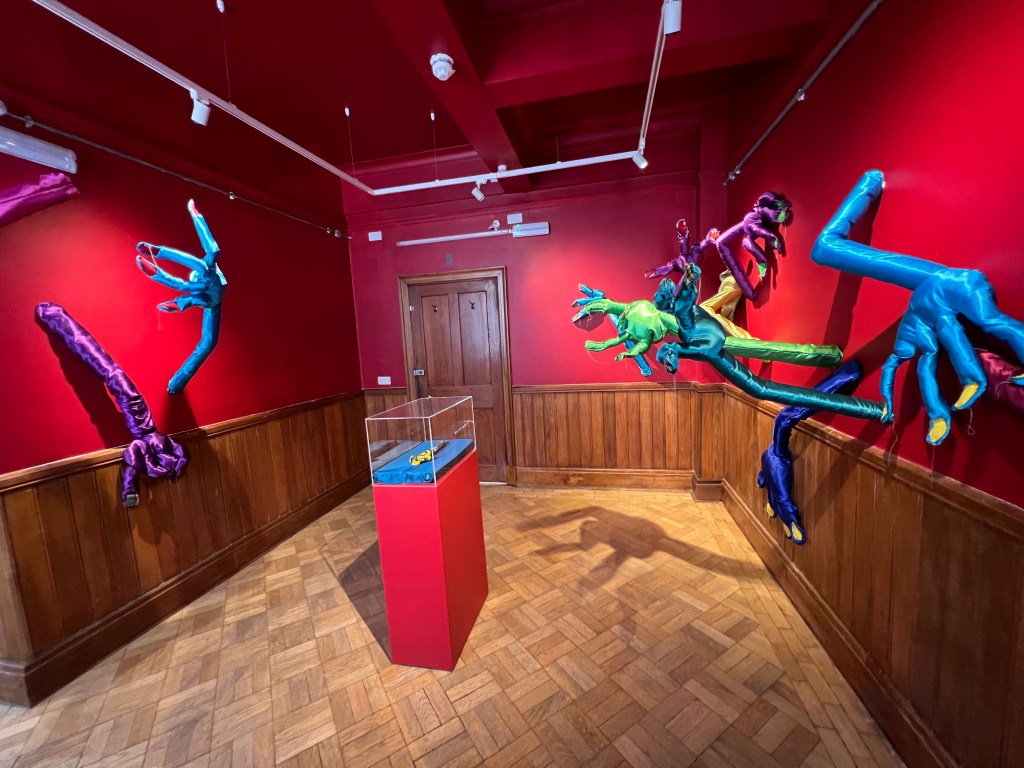
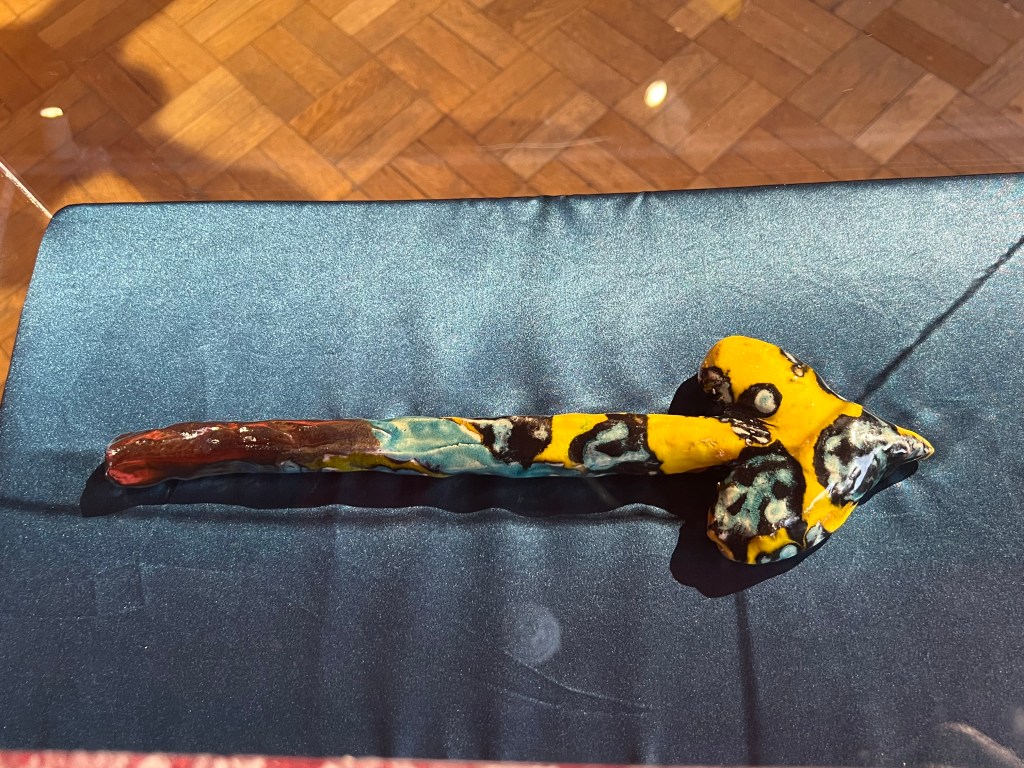
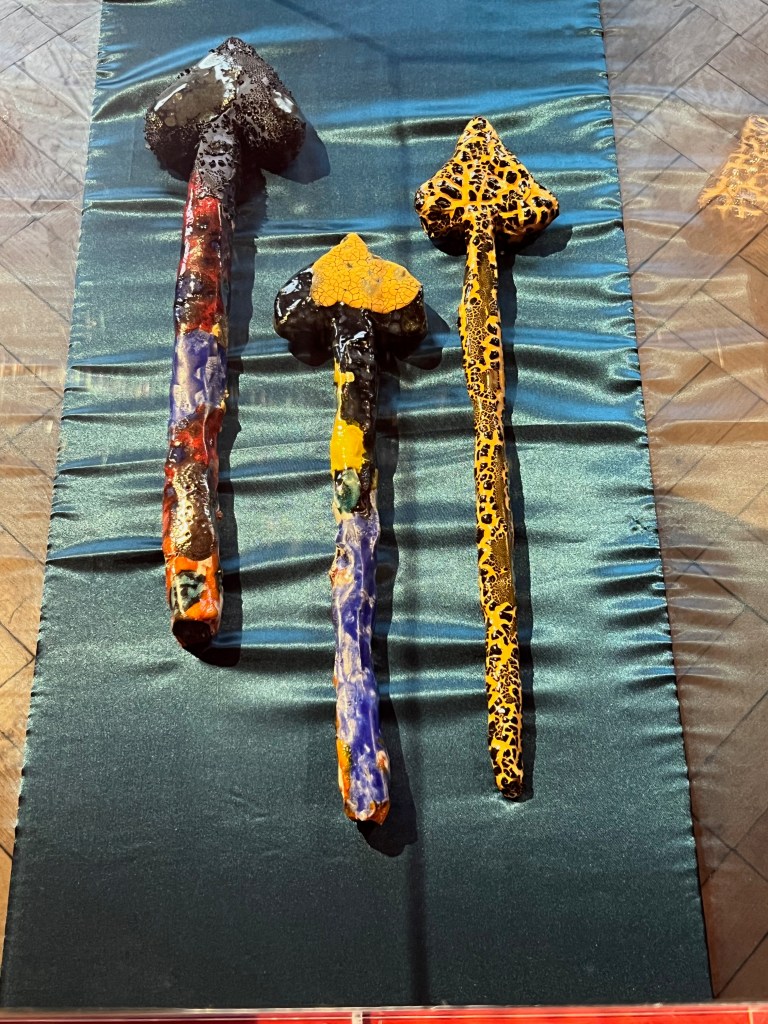
The corridor was coloured in bright red to make the viewer feel as though it was a passage within the body, and that theme was continued in the next gallery where yet more hands and arms were keeping guard over a display cabinet housing a javelin with heart-shaped tip. This, we were told, is a metaphor for emotion and anger, a symbol of love on a weapon. The hands were meant to be a comfort and welcoming. The javelin is a representation of anger, the heart reflected her attitude that, far from being a negative, anger can be a force used to facilitate change.
On emerging from this gallery into the corridor we were confronted by the ‘Booby Spider’ which was created as a friendly monster. I thought it was fun but I can see that it will have its knockers.
The next gallery was more or less a repeat of the last one except with three javelins in the case.

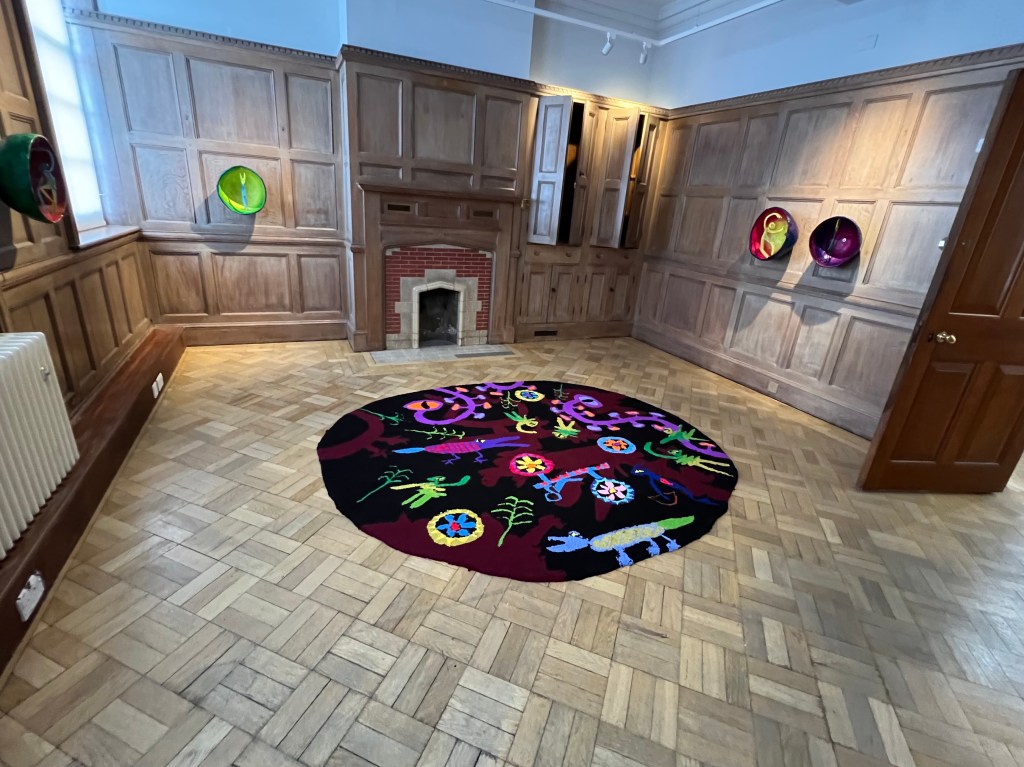
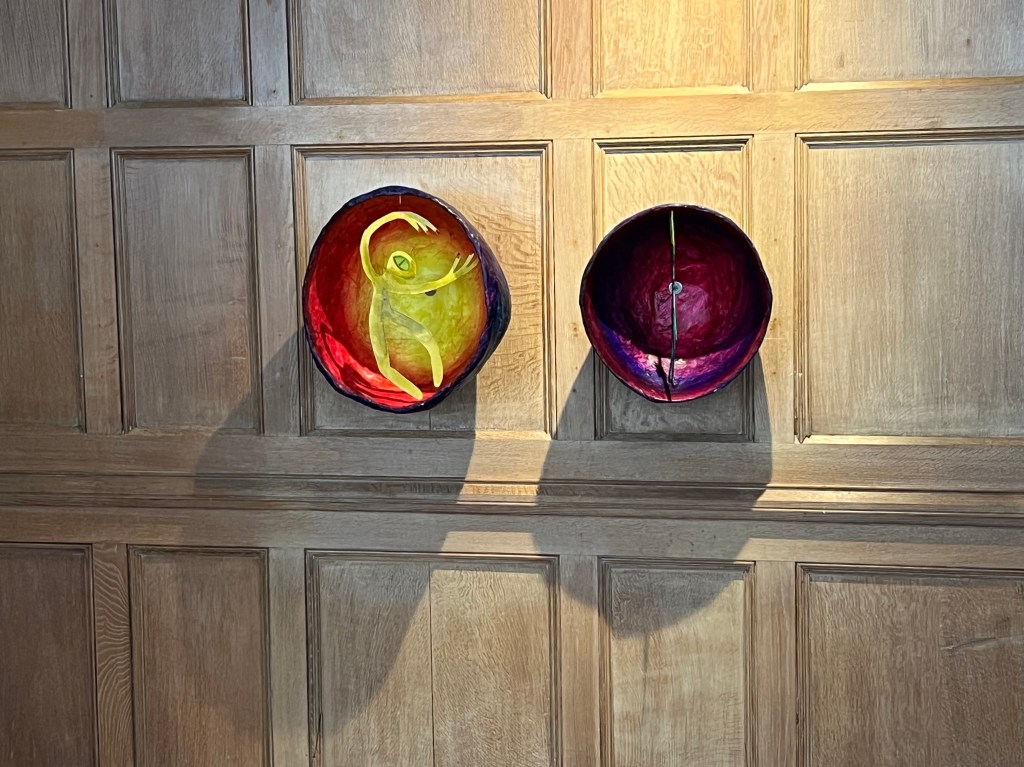
We ended in a room which brought all of the other elements together. The rug contained the previously referenced figures on a vividly coloured background. The figures on the wall are placed in shells to signify safety. The cupboards contain representations of the artist and her best friend and collaborator.
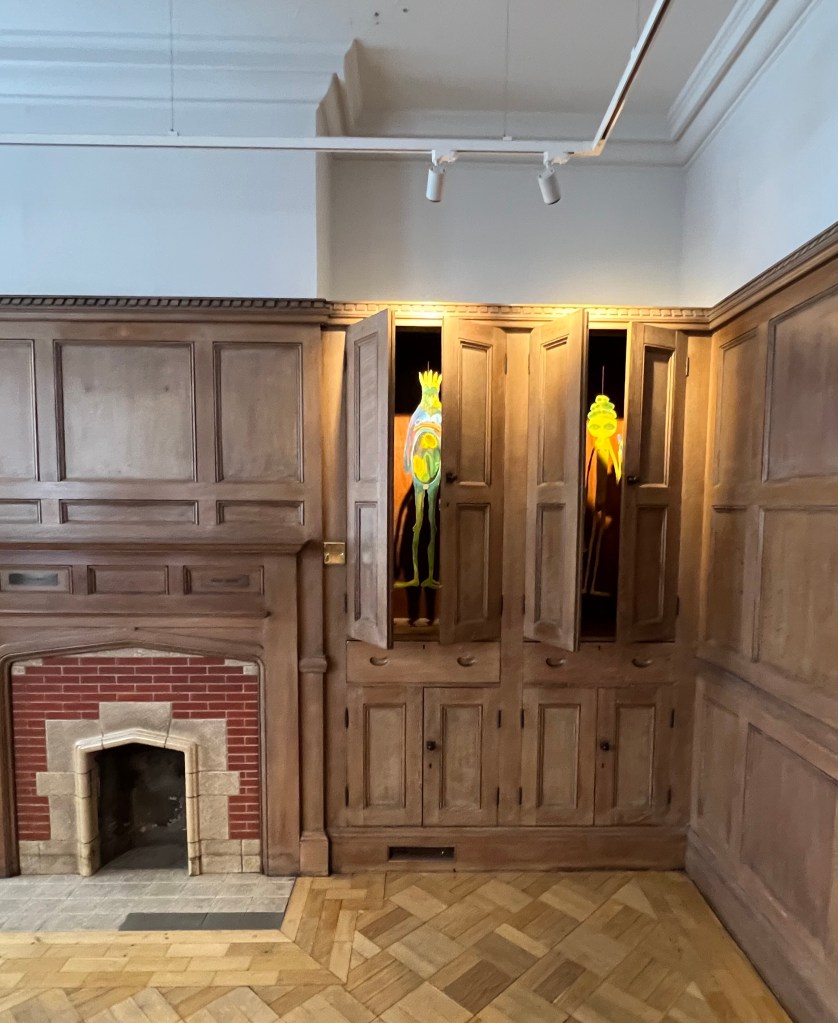
As I stated at the beginning, my interpretation of the exhibits, which must have taken an age to create, were at odds with the commentary so, should you be a psychologist, or psychiatrist, with any ideas as to why I see a threat where there is supposed to be fun, please let me know. Mind you I have the same feelings about roller coasters and bungee jumps!
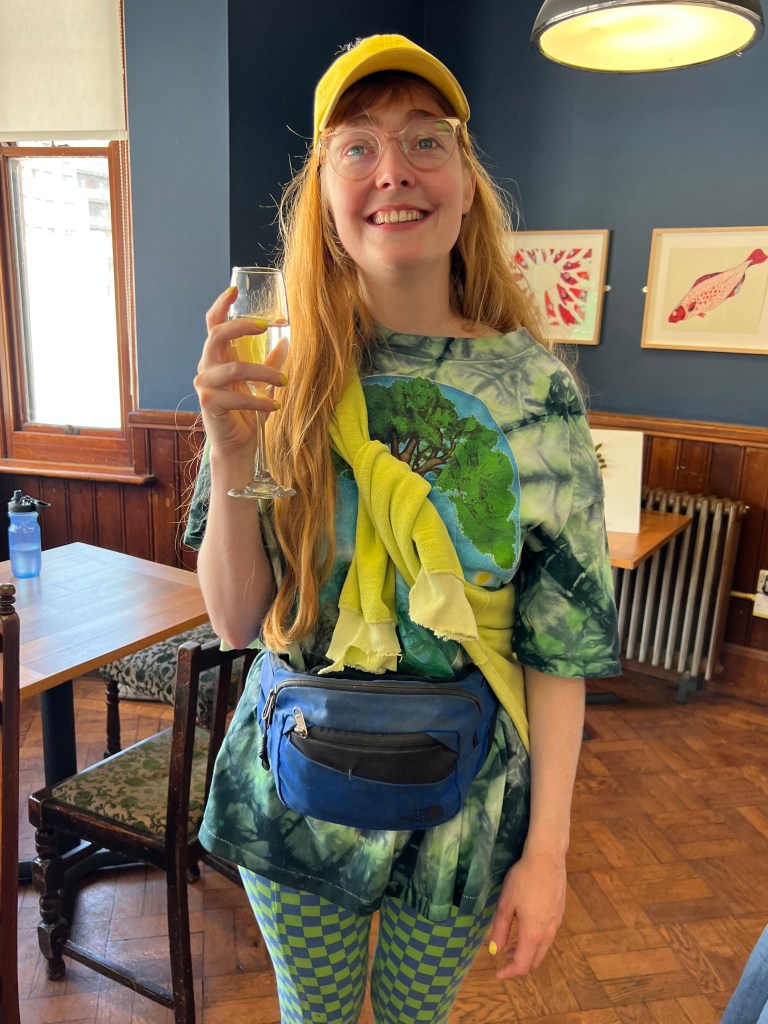
Afra Eisma, personifying fun and exhibiting hands doing what they are meant to do!
The exhibition is supported by the Mondriaan Fund, The Embassy of the Kingdom of the Netherlands in the United Kingdom of Great Britain and Northern Ireland, LEEDS 2023 and No Man’s Art Gallery, Amsterdam.
Being a gentleman of a certain age and having a lengthy bus journey home, I decided to pay a visit to the ‘facilities’ before leaving. As I was approaching the loo I heard a loud, rather disturbing noise so I paused to consider whether my entry was really a good idea, until I realised that the churning sound was being generated by the stomach in Gallery 3!
All photographs by Stan Graham
 Tyke It To The Limit