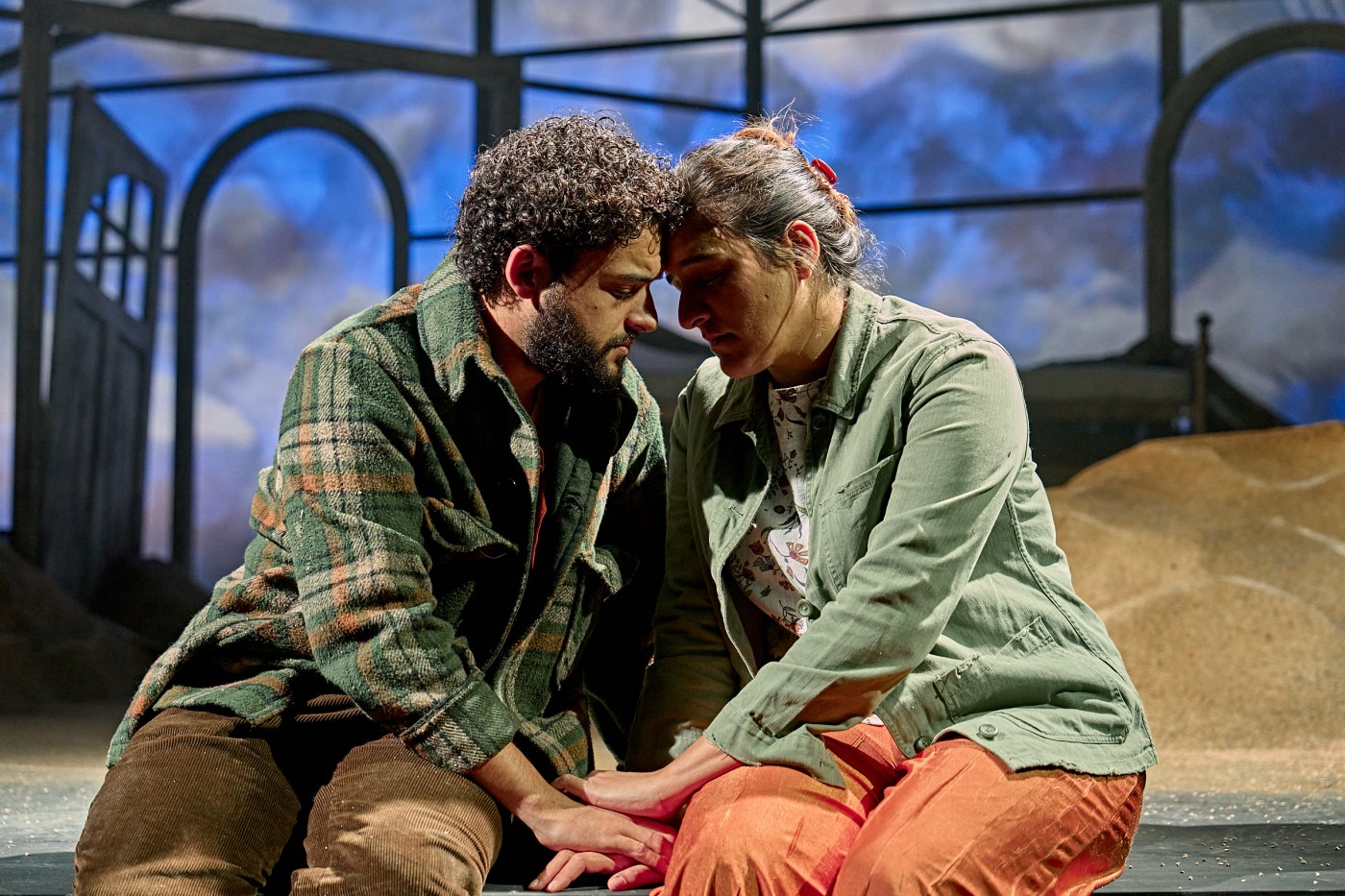
Another example of the impact a playwright can have when connecting with their audience. This time it wasn’t me and the effect was even greater.
The play, adapted for stage by Nesrin Alrefaai and Matthew Spangler, from a book by Christy Lefteri who, my research tells me, spent two summers working in a refugee camp in Athens, which is on one of the routes taken by those fleeing Syria for Northern Europe. It tells the stories of Nuri, played by Alfred Clay, his wife Afra, Roxi Faridany and Nuri’s cousin Mustafa, Joseph Long.
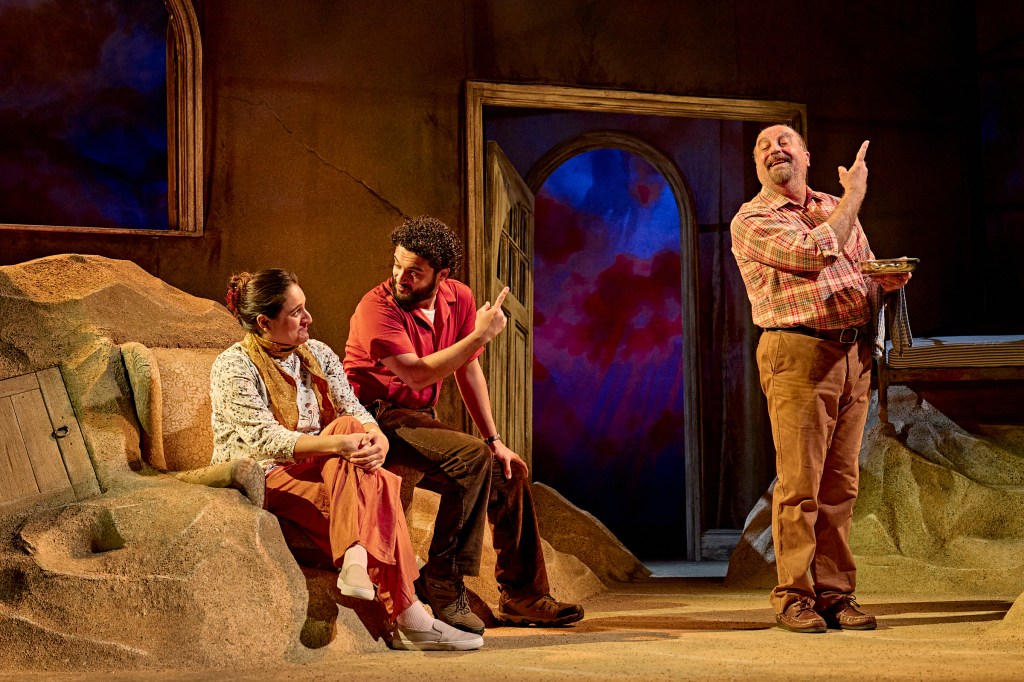
Afra played by Roxy Faridany, Nuri, Alfred Clay and Mustafa, Joseph Long testing honey
Mustafa is a beekeeper who introduces Nuri to the joys of apiary and he becomes smitten. They start a business together selling the honey they produce and everything is well until civil unrest breaks out in various towns and cities in their country so they decide to flee to the UK for sanctuary. Mustafa takes the route through Turkey, Bulgaria, Romania, Hungary etc whereas Nuri and Afra go via Turkey and Greece. This is where things get confusing as the Director, Miranda Cromwell, has the action darting backwards and forwards all over the place. One minute we are in England, the next in Athens, back to Syria and back to England with no apparent information as to how they get to the boat to take them across the English Channel. Needless to say, whichever way they went, the story was a harrowing one with Afra not only loosing her eyesight en route, but also being raped by the trafficker while Nuri is at work delivering dubious parcels for the people-smuggler in order to pay their fare.
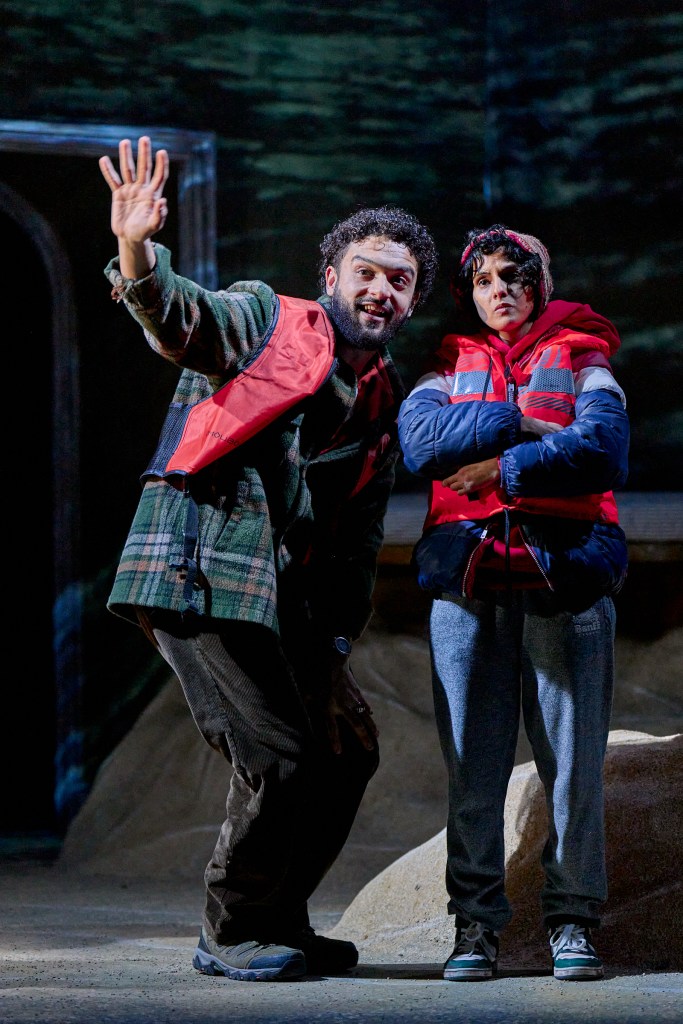
Nuri, Alfred Clay and Mohammed, Elham Mahyoub
Nuri has his own problems, being unable to come to terms with the loss of their son and only child. This is manifested by his ‘adopting’ a stray young boy, Mohammed, Elham Mahyoub, who accompanies the couple to England – or does he?
It appears that Mustafa made the better decision as, by the time Nuri and Afra make it to the UK, he is already teaching the inhabitants of Yorkshire the niceties of beekeeping.
I found the play to be one of two halves, to use a footie cliche. The first was overly simplistic and almost farcical which I thought odd for a piece dealing with such a serious subject. The flash forwards to the English reception centre kept featuring a Moroccan refugee, also played by Joseph Long, who, resplendent in track suit top and Union Flag t-shirt, kept calling everyone ‘geeza’ in a Cockney accent as he said the secret to being granted asylum was to blend in, despite topping off the outfit with his kufi.

UK Reception Centre
Something common to both halves was the way in which the UK Officials were treated with ridicule. As an ex-civil servant, I can endorse that there are a few numpties in post, but these caricatures were beyond the pale. Border Guard, played by Daphne Kouma, to Nuri, ‘What is your occupation?’ Nuri to Border Guard, ‘Beekeeper.’ Border Guard ‘What does a beekeeper do?’ Nuri ‘Keeps bees.’ The first example of official mocking concerned NGO Worker played by Lily Demir but, unfortunately I couldn’t get the verbatim exchange, just the gist, as her voice projection was somewhat lacking. This was also a failing of Elham Mahyoub whose quest to be too cute as Mohammed overrode his enunciation.
Alfred Clay, Roxy Faridany and Joseph Long, were superb and kept the piece on track. The set by Designer Ruby Pugh consisted of a bed which doubled as a small boat atop a sand dune, an armchair looking as though it had been crafted out of a second dune, which also housed a trap door. there was a third sand dune which was just that.
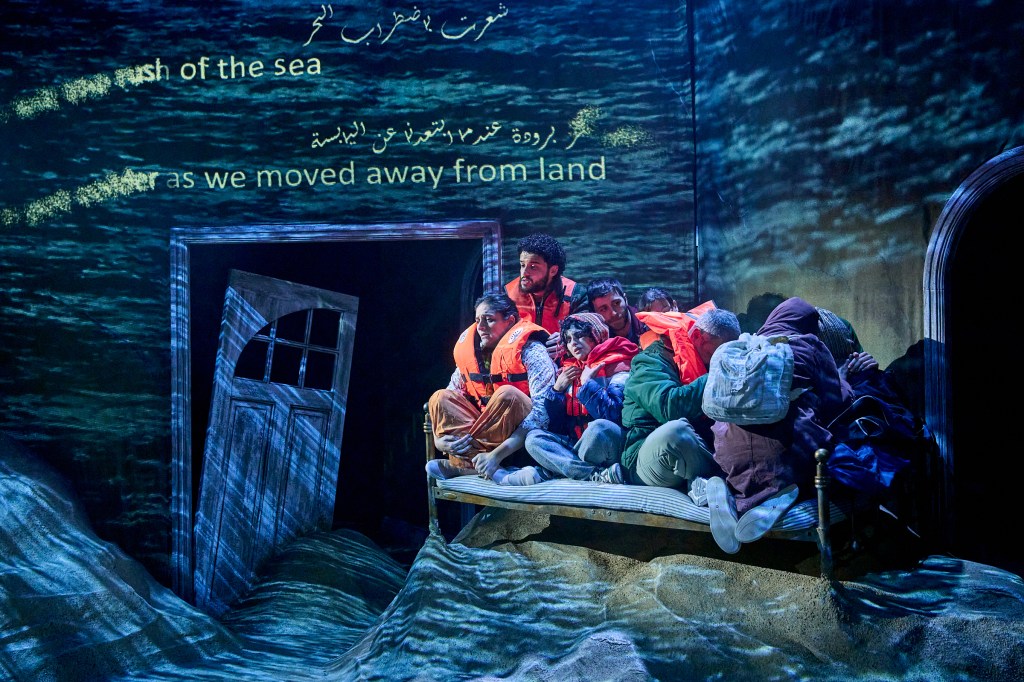
The Channel Crossing
When the bed was a boat, a video projection changed the sand to water. Video was also used spectacularly to show the ruins of Aleppo after its destruction during the fighting. This was the only really shocking part of the production, even Afra’s rape was kept low key.
As I intimated in the opening paragraph, there were parallels between this play and A Passionate Woman, which I reviewed last week. A touching story was treated in an incongruously farcical way in parts, there was a spectre of a deceased person and an examination of marital relationships. The other common denominator concerned the audience, or at least one member of each of them. My eyes were a little more than misty last week when it felt that the story had really hit home, and during this play, a young woman a few seats away was in floods of tears during most of the evening and still emotional when she left the theatre. One of the ladies sitting in the seats between me and the woman, who had been chatting to her before curtain up and during the interval, told me that she was from Syria and the play had hit her hard.
I have written this before, and I will probably do so again, but it doesn’t really matter what we reviewers think of anything, it is the impact it has on the paying customers that counts as we all come at it from different perspectives.
The Beekeeper of Aleppo is at Leeds Playhouse until Saturday, 3rd June. For more details and to book, please go to https://leedsplayhouse.org.uk/event/the-beekeeper-of-aleppo/
All photographs by Manuel Harlan.
 Tyke It To The Limit
Great review. You’re so prolific these days I can hardly keep up! Sounds like it was a very interesting play, if not quite pitch perfect.
LikeLike