
I don’t think that I have ever had such a difficult time watching a play, especially one with a comic element. I had to take a moment or two to gather myself before I could leave my seat at the interval. Causing me to be late for a free glass of red wine at half time shows the effect it had. Art is a form of communication and, as with all other types, there needs to be a certain amount of recognition of what is being conveyed. In A Passionate Woman it was not just a certain amount, it was as though the play was written about me and my mum. The wonderful Madge.
I would be two years older than Kay Mellor, the playwright who died almost exactly a year ago on 15th May, 2022, so there were the common reference points, especially as the late Ms Mellor was born and brought up in Leeds like myself, and the play is the story of her mother, the lost love of her life and the way in which it affected her in her marriage.
Please forgive my indulgence here if you are unfortunate enough not to come from this great city, but the references were not ones which I casually knew, they had a special significance. When the dialogue refers to the Mecca Locarno Ballroom, not only had I heard of it, but my father was the manager there for a short time after his demob following the last unpleasantness with the Germans. Not only that, but it is where he met my mother, so without that particular dance hall I would not be writing this.
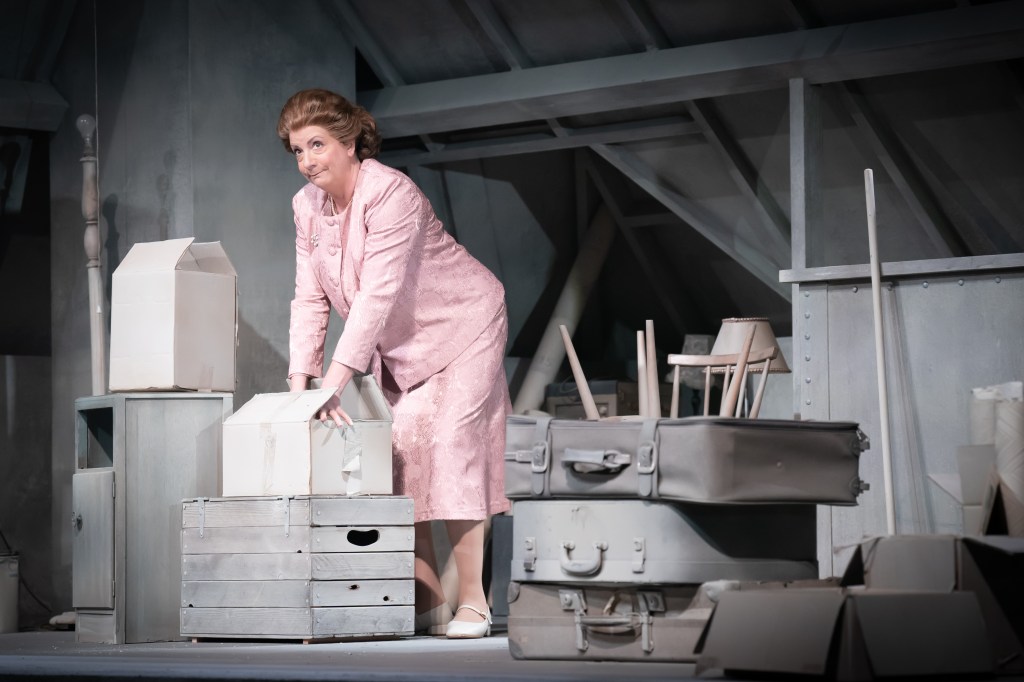
Katherine Dow Blyton as Betty in her sanctuary – the loft
She then mentions a woman who had run off with the Rington’s Tea man, a position which was my first paid employment after having had to abandon my law degree course due to lack of money. Sadly I was not the prey of the 1970 version of a cougar. For those not in the know, Rington’s is a Newcastle-based company with a huge depot in Leeds, and delivers tea to customers’ houses in the same way as a milkman sells his wares.
The bit which really hit home, though was a scene in where Betty, played by Katherine Dow Blyton, insists that her son Mark, Tom Lorcan, who is 36 and just about to get married, dance with her to her favourite Johnny Mathis record, Chances Are. On Millennium Eve my mum was staying at mine and we had been to a bash at the local, where black tie was the dress code. When we arrived home at about 1.00am, adrenalin still racing, we went into the kitchen for a cuppa and ended up with her teaching me to jive, not the English jive, but the authentic American version which the GIs had taught the local girls when stationed here during the war. Needless to say, it was Glenn Miller’s In The Mood on the cd player.
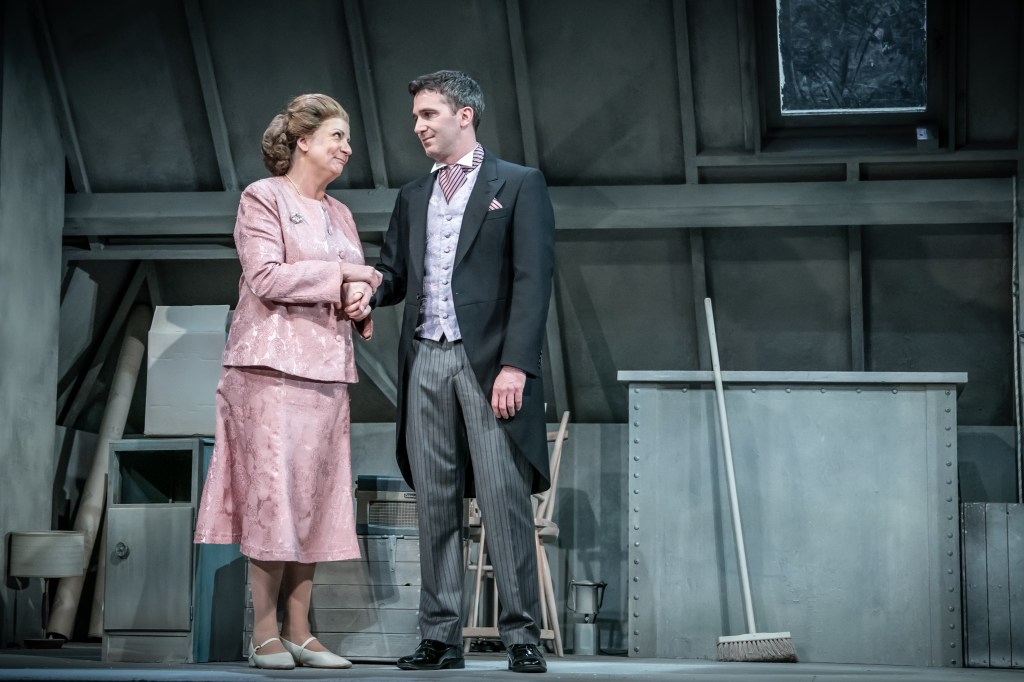
Betty, played by Katherine Dow Blyton and Mark, Tom Lorcan
Finally, Betty reveals to Mark that before he was born she had been deeply in love with a Polish boy named Craze, Michael Bijok, who was a fairground worker but was shot dead by his wife. When I was young, Madge told me about a boy to whom she was engaged, named Tommy, who was killed in the Normandy Landings. It was pretty obvious that he had always been ‘the one’. The difference was that there was no doubt about my parentage as the timeline didn’t fit and she had remained celibate until marriage, as you did in those days, and I am the double of my late dad.
Thank you for allowing me to share that with you, I feel much better now, even if you don’t.
There were other references but they were of the more ‘I remember that place’ type, rather than, the ‘that could have been me’ sort.
To the play. It is Mark’s wedding day and Betty has sought refuge in the loft, closing the hatch, to gather her thoughts after making sure that the house was spotless for the guests. After a bit of tidying up and reminiscing about the family, a brilliant tool to get the audience up to speed with the various relationships, she hears Mark shout up to se if she is there. She keeps quiet and carries on with her contemplation. Eventually she lets him up and he appears through the hatch resplendent in morning suit ready for the big day. Mark tries to talk her into coming down as it is only an hour before the ceremony is due to begin, but she prevaricates in order to stave off the moment. This is where she says that if he dances with her she will relent and return to the lounge. He does, and she doesn’t! It is at this point that the ghost of Craze appears, to Betty at least, and details of the affair are revealed. Betty can see him whereas Mark can’t, which leads to some very funny dialogue.
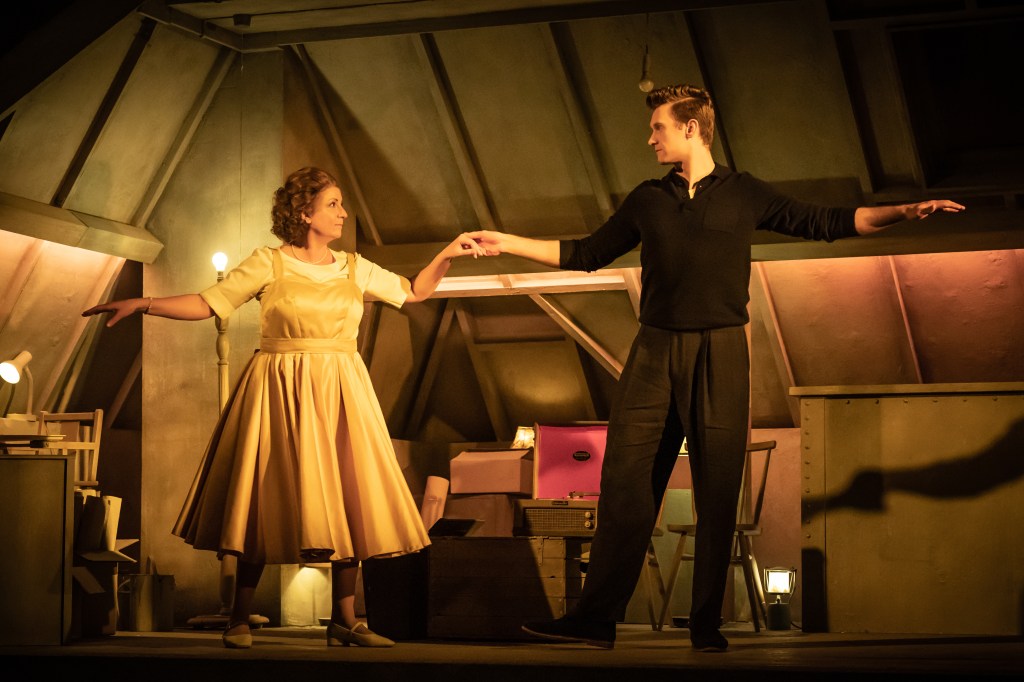
Betty, Katherine Dow Blyton, in he old dancing dress and Craze, Michael Bijok
It transpires that Betty is going through a crisis as, with Mark leaving home to live in Milton Keynes, where his new wife has got a job, she will have lost the only two men she has ever loved and so feels a void. Donald, her husband, played by David Crellin, has never been the kind of man to inflame Betty’s passions in the way that Craze did, and they had just stayed together for the sake of Mark. It is now Donald’s turn to shout up to the loft to see what is going on and he appears, also in formal attire.
The play is concerned with relationships, rather than being a linear story, so the cast members are rotated in order that each combination can reveal their feelings, both personal and in relation to the others. This is done brilliantly well, with the perfect amount of comedy and pathos.
After the interval, the scene changes from the inside of the loft to the outside of the roof, where Betty is now perched precariously, dressed in her old yellow dancing dress over her mother of the groom suit. The conversation and revelations continue until the big finish. I will not spoil it for you except to say that I found this to be the weak spot in the otherwise superlative play, as it transcended into farce, albeit symbolic rather than literal. I thought it deserved a bit better.
The problem with going to see this revival of Kay Mellor’s first play, which premiered at the Playhouse in 1992, since then she has written so many wonderful things for tv and film so I couldn’t help but use the more rounded later pieces as a yardstick and that is not really fair. Had this been 1992 and I had not been familiar with her canon I would have raved about the whole thing, possibly even the ending. I am really looking forward to seeing the other plays in her back catalogue, which I would love to think would be in chronological order, to see how she developed over the years.
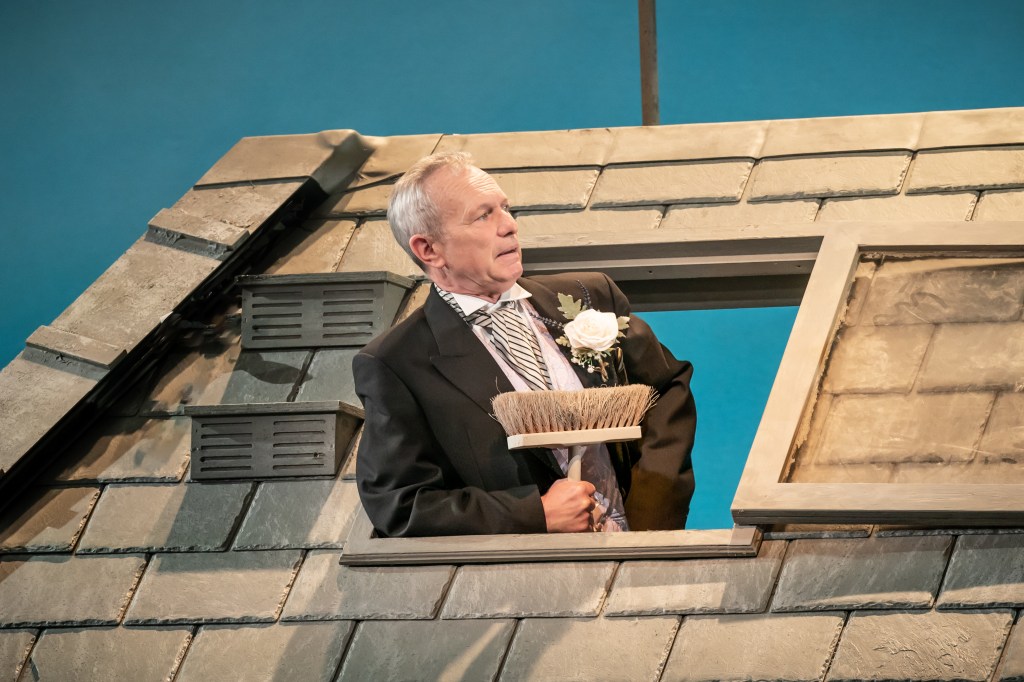
David Crellin as Donald
The acting by all concerned was brilliant, with the three family members nailing the Leeds accent down to perfection, which is no mean feat as it is a difficult one to pull off, and only Tom Lorcan is a Loiner. David Crellin is from Sheffield and Katherine Dow Blyton, Jarrow in Newcastle. Craze is from the Czech Republic so also had some dialect work to do to morph into Polish.
Director, Tess Seddon, handled the whole thing superbly, and hit the family dynamic nail squarely on the head. Although first performed in 1992, the action is set in the early 1980s and Rose Revitt, the Set and Costume Designer, had Craze’s outfit smack on, the other men were in morning suits which, like Betty’s MOTG two-piece are basically timeless. It was her set though which was the triumph, with the stage being revolved to show the interior of the loft which was filled with her memories – all coloured grey, except for the ones relating to her affair which were bright and vibrant, like her yellow dancing dress, and exterior being the roof – whilst still finding room for a hot-air balloon and a fire engine cherry picker platform.
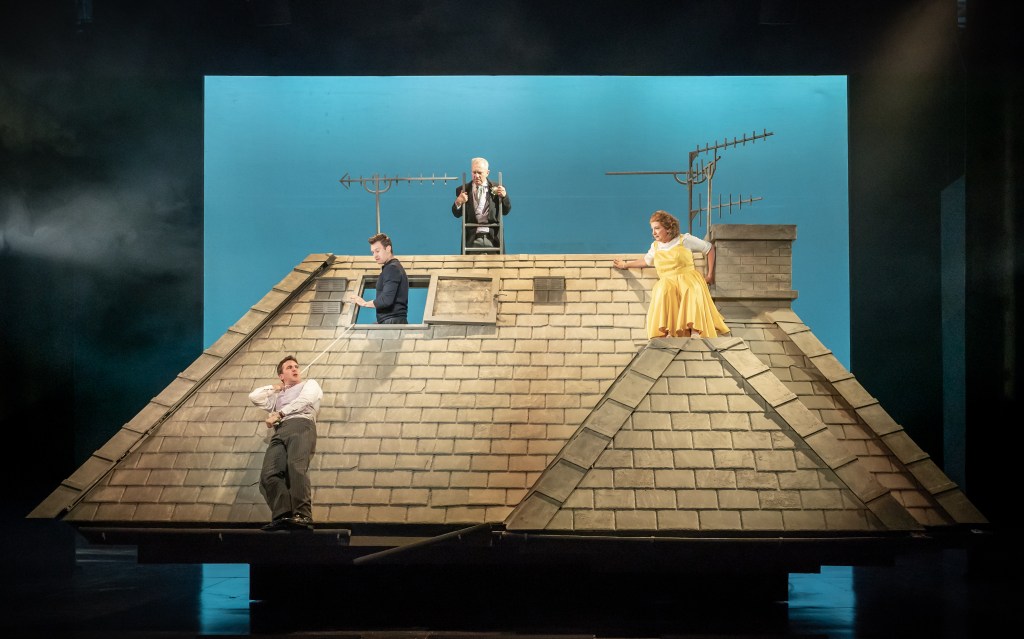
This is where it got silly. Tom Lorcan, Mark; Michael Bijok, Craze; David Crellin, Donald and Katherine Dow Blyton, Betty.
There are obvious morals to be drawn from this fabulous play, but, as I found out, they will obviously mean different things to each member of the audience, whether from Leeds or not.
A Passionate Woman runs until 10th June at Leeds Playhouse. You really should make the effort to go see it as it is, not only a great play, but a classic of the genre. For more information and to get your ticket, lease go to https://leedsplayhouse.org.uk/event/a-passionate-woman/
Feature image provided by Leeds Playhouse, all photographs by Marc Brenner.
To see what is coming to Leeds Playhouse please go to https://leedsplayhouse.org.uk/whats-on/
 Tyke It To The Limit